AI Agents in Nepal: What They Are, How They Work, and How to Learn Them (2026 Guide)
Search "AI agent" on Google today and you will find two very different crowds: developers arguing about LangChain versus CrewAI, and Nepali business owners asking a WhatsApp bot to answer customer questions while they sleep. Both are talking about the same thing.
An AI agent is software that can look at a goal, decide the steps needed to reach it, and carry out those steps on its own, using real tools like a browser, a spreadsheet, or an API. It is not a chatbot that waits for your next message. It is closer to a junior employee who takes an instruction, plans the work, and reports back once it is done.
Nepal is catching up fast. Nepal's IT export sector crossed USD 1 billion in 2026, up from USD 515 million in 2023, and now employs roughly 100,000 professionals, according to NAS-IT data reported by The British College. The government's fiscal year 2026/27 budget even set aside plans for a "Sovereign AI Compute Centre" in Syuchatar, Kathmandu, the country's first national AI computing facility.
This guide covers what an AI agent actually is, how the underlying AI agent model works, where tools like n8n and MCP fit in, and how to start learning if you want a career built around building them.
Key takeaways
- An AI agent plans and executes multi-step tasks on its own; a chatbot only replies to what you type.
- Gartner projects that 40% of enterprise applications will include task-specific AI agents by the end of 2026, up from under 5% in 2025.
- n8n and MCP (Model Context Protocol) are the two tools most beginners in Nepal use to build their first working agent, and both have free tiers.
- AI-related roles in Nepal pay between NPR 50,000 and 200,000 a month, according to necojobs.com.np salary data, well above typical entry-level IT pay.
- You do not need a computer science degree to start. A structured AI agent course in Nepal, plus consistent practice, can get a beginner building working agents within a few weeks.
What Is an AI Agent? (Definition and Core Concept)
An AI agent is a program built on a large language model (LLM) that can perceive information, reason about a goal, choose an action, and execute that action, then repeat the cycle until the goal is met. The word "agent" is doing real work here: it means the system acts on behalf of someone, with a degree of independence.
Compare that to a normal script. A script that sends an email just sends the email, exactly as written, every time. Ask an agent to "follow up with every client who has not paid this month," and it has to figure out who qualifies, draft a message for each one, check tone, and send it, adjusting as it goes.
What Is an "Agent" in Artificial Intelligence, Exactly?
If you have typed what is agent in artificial intelligence into a search bar, here is the short version. In classic AI theory, an agent is anything that perceives its environment through sensors and acts on that environment through actuators. A thermostat is a very simple agent. A self-driving car is a far more capable one.
Modern AI agents add a large language model as the reasoning core. The LLM reads the situation, decides what to do next in plain language, and hands that decision off to a tool that actually performs it, whether that is calling an API, running code, or updating a spreadsheet.
AI Agent vs Chatbot vs RPA: The Real Difference
People confuse these three constantly, so here is the plain distinction:
- Chatbot: Answers questions inside a single conversation. It does not take action outside the chat window.
- RPA (Robotic Process Automation): Follows a fixed, pre-programmed sequence of clicks and rules. It breaks the moment the process changes.
- AI agent: Understands a goal in natural language, decides its own steps, calls tools to complete them, and can adjust when something unexpected happens.
The shift from RPA to AI agents is the same shift factories made from fixed machinery to programmable robotics: less rigid, more capable of handling variation.
How AI Agents Work: The AI Agent Model Explained
Every AI agent, from a simple email sorter to a multi-agent research team, runs on the same underlying loop. Understanding this loop is the fastest way to actually understand agentic AI instead of just repeating the buzzword.
The Four-Step Agent Loop
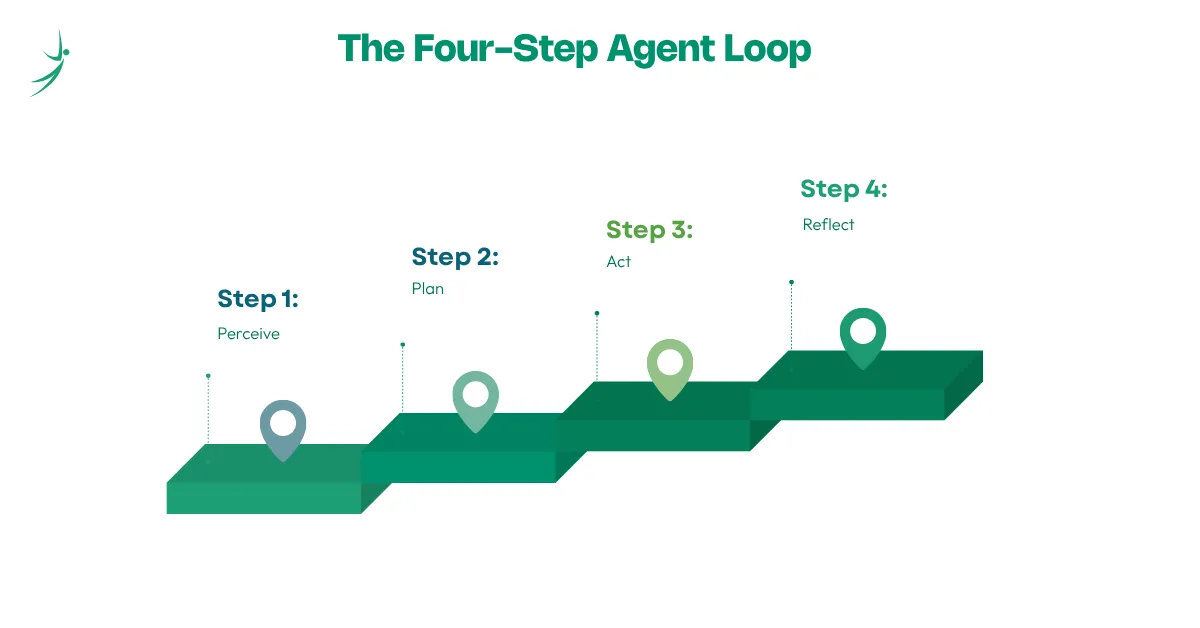
- Perceive: The agent gathers information: an incoming message, a database record, a webhook trigger, or a scheduled event.
- Plan: The LLM reasons about the goal and breaks it into smaller steps, deciding what needs to happen first.
- Act: The agent calls a tool, an API, a script, or another agent, to carry out that step.
- Reflect: The agent checks the result, updates its memory of what has happened so far, and decides whether the goal is complete or another loop is needed.
This loop is the core AI agent model behind almost every agent builder on the market, whether it is LangChain, CrewAI, AutoGen, or a no-code tool like n8n. The tools differ; the loop does not.
Where MCP Fits: Giving Agents Access to Real Tools
An LLM on its own cannot check your calendar, read a Google Sheet, or pull today's exchange rate. It needs a standard way to connect to those outside systems. That standard is the Model Context Protocol (MCP).
Anthropic introduced MCP in November 2024 as an open specification so that any AI model could talk to any tool through one shared connector, instead of engineers building a custom integration for every model-and-tool pairing. Growth since then has been fast: monthly SDK downloads went from around 100,000 at launch to roughly 97 million by March 2026, and Anthropic donated the protocol to the Linux Foundation's Agentic AI Foundation in December 2025, with OpenAI, Google, Microsoft, and AWS now supporting it too.
For a beginner, the practical takeaway is simple: ai agent mcp setups are what let your agent actually read your files, query your database, or post to Slack, rather than just generating text about doing those things.
Why AI Agents Matter in Nepal Right Now
Three forces are converging at the same time, and this is why AI agent adoption is accelerating rather than staying a niche developer topic.
First, the technology got genuinely usable. Earlier chatbots followed rigid rules and broke the moment a conversation went off-script. Current systems interpret intent, hold context across steps, and recover from unexpected inputs.
Second, the business case is measurable. Gartner's 2026 CIO and Technology Executive Survey found that only 17% of organizations have deployed AI agents so far, but more than 60% expect to do so within two years, the steepest adoption curve of any technology category the survey tracked.
Third, Nepal's own market conditions line up. PwC's 2026 Global AI Jobs Barometer, based on more than a billion job postings across 27 countries, found that AI skills carry a 62% wage premium over comparable non-AI roles. That premium applies just as much to a Kathmandu-based freelancer bidding on Upwork as it does to a Silicon Valley engineer.
What AI Agents Can Do: Real AI Agent Examples
Theory is useful, but real AI agent examples make the idea concrete. Here is what AI agent can do in practice, task by task, already running in production.
For Businesses in Nepal
- Customer support agents that read incoming WhatsApp or Messenger queries, check order status in a database, and reply without a human touching the conversation.
- Lead qualification agents that scan form submissions, score them against set criteria, and push only the warm leads into a CRM.
- Reporting agents that pull sales numbers every morning and post a summary to a manager's Slack or email before the workday starts.
- Fraud detection agents that flag suspicious transactions in real time, similar to how eSewa already uses AI models to catch fraudulent activity before transactions clear.
For Freelancers and Students
- A research agent that reads through ten competitor websites and returns a structured comparison table.
- A content agent that drafts, formats, and schedules social posts across platforms from a single brief.
- A coding agent that writes, tests, and fixes small scripts inside a developer's existing codebase.
- A personal finance agent, a project type Nepali training programs now teach, that reviews daily gold, stock, and fuel prices and sends a summary through Discord or WhatsApp.
Key Benefits of Using AI Agents
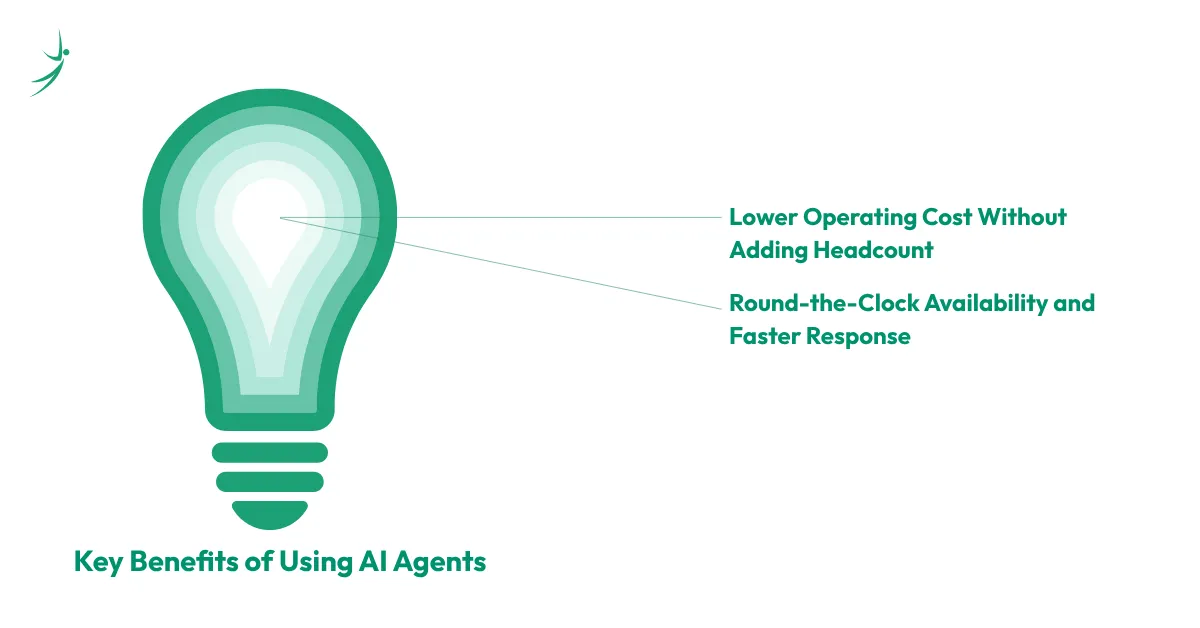
Lower Operating Cost Without Adding Headcount
A single agent can handle a volume of repetitive customer queries or data entry work that would otherwise need several hires. That does not mean people become unnecessary; it means the same team can take on more clients or projects without a proportional rise in payroll.
Round-the-Clock Availability and Faster Response
Nepal-based businesses serving international clients face a real time zone gap. An agent does not sleep. A customer in New York asking a question at 3 AM Kathmandu time still gets an instant, useful reply, with a human stepping in only for edge cases.
Other measurable gains include:
- Fewer manual errors, since agents follow consistent logic rather than getting tired or distracted.
- Faster reporting cycles, turning a task that took a person half a day into one that finishes in minutes. The Kathmandu Post reported in April 2026 that a business proposal at IMS Software that used to take half a day now takes about ten minutes with AI tools involved.
- Better use of skilled staff, since routine work moves to the agent and people focus on judgment calls the agent cannot make.
AI Agent Builder Tools: n8n, MCP, and Where to Start for Free
You do not need a computer science degree to build your first working agent. Most beginners in Nepal start with one of two paths: a visual builder or a code-first approach.
n8n AI Agent: The No-Code Starting Point
n8n is a workflow automation platform that now ships native agent nodes built on LLMs, letting you connect to Gmail, Google Sheets, WhatsApp, or a database by dragging connections on a canvas instead of writing a backend from scratch. The platform has grown past 200,000 active users and more than 3,000 enterprise customers globally, and several Kathmandu training providers now build their agentic AI curriculum around it.
A typical first n8n AI agent project looks like this: a webhook receives a form submission, an LLM node reads and categorizes it, and a final node sends a personalized reply by email, all without touching a line of Python. That short build is close to a working ai agent tutorial in itself, and most beginners can finish it in an afternoon.
AI Agent for Free: What You Can Build Without Spending a Rupee
You can get real, working experience before spending a single rupee:
- n8n's free self-hosted tier lets you build unlimited workflows on your own machine.
- Free-tier API credits from providers like OpenAI, Google Gemini, and Anthropic's Claude cover small personal projects during the learning phase.
- Open-source agent projects such as AutoGPT, CrewAI, and Hugging Face's agent tools cost nothing beyond your own compute.
- Public MCP servers, of which more than 10,000 now exist, give you ready-made connectors instead of building integrations from zero.
An ai agent for beginners does not need a paid subscription to start. It needs one small, real problem, a spreadsheet you update by hand every week, an inbox you sort manually, and a willingness to automate that single task first.
Which AI Agent Is Best, and Which Is Best for Coding?
There is no single best AI agent tool; the right one depends on what you are building and how comfortable you are with code.
| Tool | Best For | Coding Required |
|---|---|---|
| n8n | Business workflow automation, customer support, reporting | No |
| LangChain / LangGraph | Custom multi-step reasoning agents | Yes (Python) |
| CrewAI | Multi-agent teams (researcher, writer, reviewer roles) | Yes (Python) |
| GitHub Copilot Agent Mode | Autonomous coding, refactoring, test writing | Yes (any language) |
| Claude Code / Cursor | End-to-end software development tasks | Yes |
| Vertex AI Agent Builder | Enterprise agents grounded in company data (RAG) | Low-code |
If the question is specifically which AI agent is best for coding, GitHub Copilot's Agent Mode and Claude Code currently lead for autonomous software development, since both can plan a change, edit multiple files, run tests, and fix their own errors inside a real repository. For business automation without a developer background, n8n remains the most practical starting point.
AI Agent Creation and Development: What Actually Works
Building an agent that survives contact with real users takes more than a clever prompt. Based on what separates working deployments from abandoned pilots, a few principles hold up consistently:
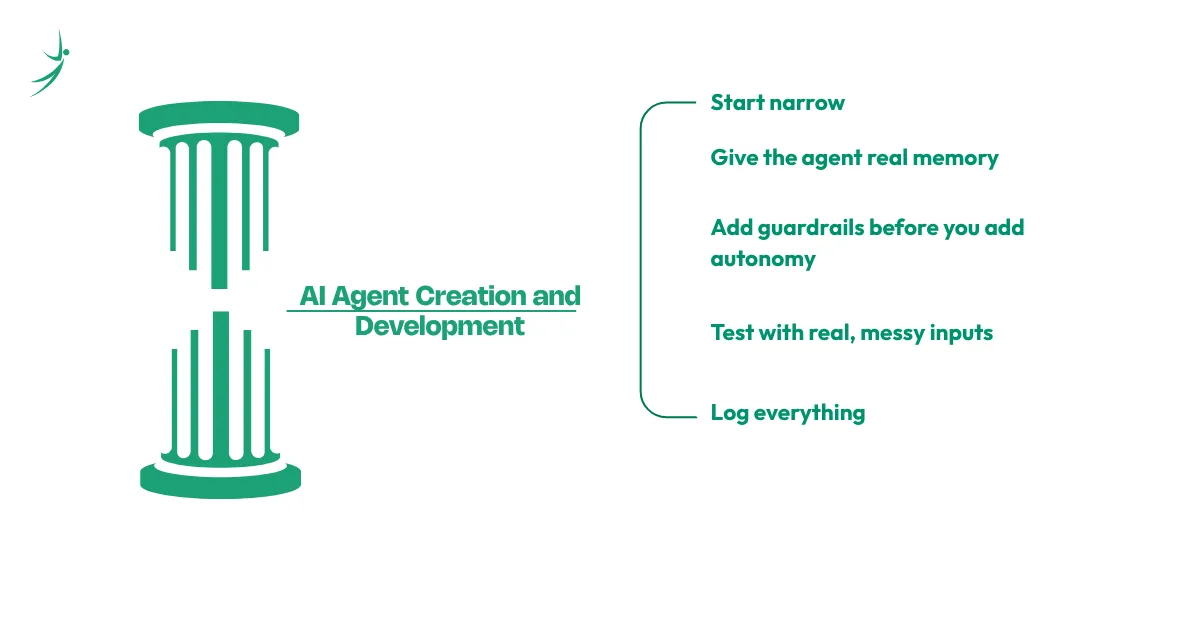
- Start narrow. Automate one task completely before trying to automate an entire department. A lead-qualification agent that works perfectly beats a "do everything" agent that works half the time.
- Give the agent real memory. Short-term context for the current conversation, plus a longer-term record of past interactions, is what separates a genuinely useful agent from one that repeats the same mistakes.
- Add guardrails before you add autonomy. Set spending limits, approval steps for anything irreversible (like sending payment or deleting data), and clear fallback rules for when the agent is uncertain.
- Test with real, messy inputs. Clean demo data hides the failures that show up the first week in production.
- Log everything. When an agent makes a wrong call, you need to see exactly which step in its reasoning went off track.
This is the practical side of AI agent development that most tutorials skip: the plumbing around the agent (logging, limits, fallback rules) matters as much as the reasoning logic inside it.
Challenges in AI Agent Development (And How to Get Past Them)
Agentic AI is not without real friction, and pretending otherwise sets beginners up to fail.
- Project abandonment is common. Gartner predicts that more than 40% of agentic AI projects will be cancelled by the end of 2027, usually because the business value was never clearly defined before the build started. The fix: define the exact metric an agent needs to move before writing a single workflow.
- The "black box" problem. Complex agents can be hard to explain when they make a mistake. Logging every decision step, rather than just the final output, keeps you able to trace what happened.
- Data privacy risk. Agents that touch customer data need the same access controls as any other system handling personal information, not looser ones just because "it's just an AI."
- Cost creep. Every LLM call has a price. An agent that loops unnecessarily can burn through API credits fast; setting a maximum number of steps per task avoids runaway costs.
- Skill gaps. Many Nepali developers know Python but have never worked with prompt design, tool-calling, or MCP servers. This is exactly the gap a structured career path built around AI and automation skills is designed to close.
AI Agents Already Working in Nepal: Case Studies
The clearest evidence that this is not theoretical comes from what is already running in Nepali companies.
- eSewa, one of Nepal's largest digital payment platforms, uses AI models to flag fraudulent transactions before they clear, protecting both the company and its users in real time.
- Ncell runs AI-powered chatbots that handle customer queries around the clock, reducing the load on human support agents during peak hours.
- IMS Software, as reported by the Kathmandu Post in April 2026, cut the time needed to draft a business proposal from roughly half a day down to about ten minutes by building AI into that workflow.
A startup based in Biratnagar built an application that analyzes drone imagery to warn farmers about crop pests early enough to act, showing that agentic AI use cases in Nepal extend well past Kathmandu's tech scene and into agriculture.
On the training side, local providers such as AI Automation Nepal and Kathmandu-based institutes now build custom n8n workflows and AI-powered chatbots for small and medium businesses, a sign that demand for AI agent development talent is real, not speculative.
The Future of the AI Agent Ecosystem
Three trends will shape where the AI agent ecosystem goes over the next two to three years.
- Multi-agent teams will replace single agents for complex work. Instead of one agent trying to do everything, a "supervisor" agent will delegate to specialist agents, a researcher, a writer, an editor, the same pattern already taught in agentic AI courses at institutes like Broadway Infosys.
- MCP will become the default connector standard. With Anthropic, OpenAI, Google, Microsoft, and AWS all shipping support for it and a joint specification update released in July 2026, MCP is heading toward being as ordinary as an API key, not a niche technical choice.
- Voice and multimodal agents will move from novelty to normal. Agents that can listen, speak, and interpret images or video are moving out of demo videos and into scheduling assistants, customer support lines, and accessibility tools.
Gartner's own projection puts a number on this: agentic AI could drive close to 30% of enterprise application software revenue by 2035, up from about 2% in 2025, in its most optimistic scenario. Even the conservative estimates point to a large, permanent shift rather than a passing trend.
How to Choose the Right AI Agent Course in Nepal
Not every AI agent course in Nepal covers the same ground, and comparing AI agents courses side by side before enrolling saves months of wasted effort later. Check these four things first.
- Does it include hands-on tool-building, not just theory? A course that only explains concepts without having you build a working agent leaves you unable to do the job.
- Does it cover both no-code and code-based paths? You want exposure to n8n-style building alongside enough Python and API fundamentals to grow into custom development later.
- Is MCP and API integration actually taught? An agent that cannot connect to real tools is a demo, not a deployable system.
- Does the curriculum get updated regularly? This field moves fast enough that a syllabus from two years ago is already outdated.
Skill Shikshya's hands-on agent-building program in Kathmandu is built around exactly this structure: prompt design, tool integration, n8n-based workflow building, and MCP fundamentals, taught by mentors with real automation project experience. If you want the underlying machine learning foundations that power these systems, that pairs naturally with the agent-building coursework. For a wider look at how Nepal's tech training options compare before you commit, it is worth reading that comparison first.
How Much Does an AI Agent Cost? (And How to Measure ROI)
Cost depends entirely on scale, and this is where most beginners either overspend or underestimate.
- Learning and prototyping: Close to free. Self-hosted n8n, free-tier LLM credits, and open-source tools cover a beginner's first several projects.
- A small business automation: Typically a few thousand to a few tens of thousands of rupees a month in API and hosting costs, depending on message volume, plus the one-time cost of building the workflow.
- Enterprise-grade multi-agent systems: Costs scale with usage, the number of LLM calls, the number of tool integrations, and the monitoring infrastructure around them. This is where in-house AI agent development skills pay for themselves fastest, since ongoing consultant fees usually cost more than training an internal team.
To measure whether an agent is actually worth what it costs, track:
- Time saved per task, compared with the manual process it replaced.
- Error rate, before and after the agent takes over.
- Response time, especially for customer-facing agents.
- Cost per resolved task, factoring in API usage against staff time saved.
A simple rule of thumb answers how much AI agent cost is worth paying: if the agent's monthly running cost is lower than the salary of the person-hours it replaces, and the error rate has not gone up, it is paying for itself.
Conclusion and Your Next Step
An AI agent is not a chatbot with a new name. It is software that perceives a situation, plans a response, acts through real tools, and checks its own work, and that shift from "answering" to "doing" is why businesses in Nepal and worldwide are moving budget toward it fast.
You do not need to wait for a computer science degree or a job at a multinational to start. The tools are largely free at the learning stage, the platforms are well documented, and the local demand for AI agent Nepal talent, reflected in real deployments at companies like eSewa and Ncell, is already here, not five years away.
Start with one task you do by hand every week. Automate that single task with a free n8n workflow. Then decide whether you want to go deeper through structured, mentor-led training. Skill Shikshya's AI agent course in Kathmandu is built for exactly that next step, whether you are a complete beginner or a developer looking to add agentic AI to an existing skill set.
Frequently Asked Questions
What is an AI agent in simple terms?
Do I need to know how to code to build an AI agent?
Is n8n free to use for building AI agents?
What is MCP and why does it matter for AI agents?
How much can someone earn building AI agents in Nepal?
Which AI agent course in Nepal is worth taking?
About Author: