How to Start an IT Career Without a Degree in Nepal | Skill Shikshya
Yes, you can start an IT career without a degree in Nepal. Many IT companies in Nepal today hire based on practical skills, real projects, and certifications - not college certificates. Whether you passed SEE, completed +2, or are simply someone looking to switch careers, IT is one of the few fields where what you can do matters far more than where you studied. If you are still exploring your options, start with this complete guide on how to start a career in IT — it covers every path available to you. To understand the full scope of IT career in Nepal and what an IT career is before diving into this guide, these two reads will give you strong context. When you are ready to take the first real step, Skill Shikshya - best IT training institute in Nepal, offers practical, job-focused training designed specifically to get you employed, with or without a formal degree.
Can You Really Get an IT Job Without a Degree in Nepal?
The short answer is yes - and it is happening every day across Kathmandu, Lalitpur, and even remotely from cities.
Nepal's IT industry has shifted significantly over the last five years. Startups, outsourcing companies, and digital agencies are no longer screening candidates by their degrees first. They are looking at GitHub profiles, live projects, internship experience, and problem-solving ability. A candidate who walks in with three real projects and a certificate from a structured training program often beats a fresh graduate with a degree but no practical output.
Here is what makes this shift real in Nepal's context:
Startups hire for output, not credentials: Kathmandu's growing startup ecosystem - companies like F1Soft, Leapfrog, and CloudFactory - actively hire junior developers, QA trainees, and UI/UX designers based on skill demonstrations. Many of their current employees never completed a four-year IT degree.
Outsourcing companies care about delivery: Nepal exports over USD 500 million worth of IT services annually. The companies driving those exports need people who can deliver, not people who can show a certificate.
Freelancing removes the degree filter entirely: Platforms like Upwork and Fiverr do not ask for your educational background. Nepali freelancers are earning internationally competitive rates in web development, QA, and UI/UX, purely on the strength of their portfolios.
The Nepal job market data confirms it: Over 65% of IT companies in Nepal now say they prefer candidates with demonstrated technical skills and hands-on experience over formal degrees alone. Entry-level roles in QA, web development, Flutter, and UI/UX are regularly filled by candidates who came through structured short-term training programs. For a detailed breakdown of which institutes are leading this shift, read our guide on the best IT training institute in Nepal.
So the question is can you get an IT job without a degree in Nepal? The real question is which skill should you learn first, and how do you become job-ready as fast as possible?
Best IT Fields You Can Enter Without a Degree in Nepal
Not every IT field has the same entry barrier. Some require deep theoretical foundations. Others are completely learnable through focused, practical training in three to six months. Here are the best IT fields you can realistically enter without a degree in Nepal — and what each one demands from you. For a deeper look at each field, their curriculum, and career outcomes, read our detailed guide on the best IT training courses in Nepal.
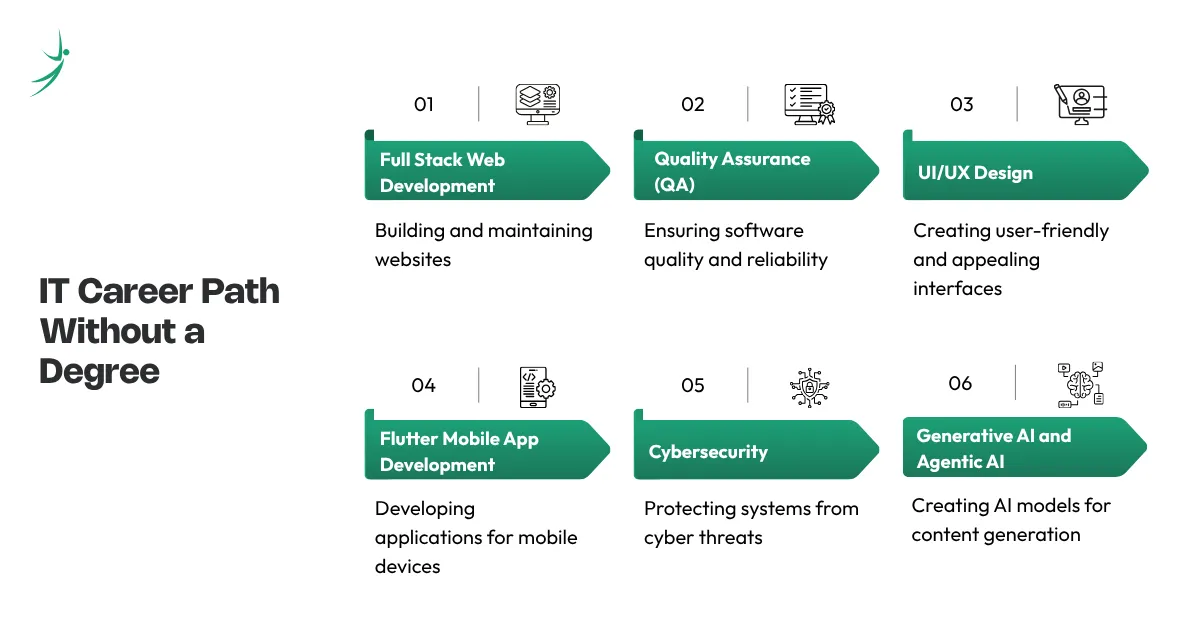
Full Stack Web Development: Web development is one of the most accessible entry points into IT. You learn HTML, CSS, JavaScript, and a backend framework like Node.js or PHP and within a few months, you can build real, functional websites. Nepal's outsourcing companies and startups have a constant demand for junior web developers. Your portfolio of two or three live projects is often enough to land your first interview.
Quality Assurance (QA): QA is one of the most overlooked but fastest paths into IT without a degree. You do not need to write complex code to start. QA professionals test software, find bugs, write test cases, and ensure products work before they reach users. Many Nepal-based IT companies actively prefer QA trainees who have done structured training over candidates with degrees and no testing knowledge.
UI/UX Design: If you have a creative eye and enjoy thinking about how people interact with technology, UI/UX design is an excellent choice. Tools like Figma are learnable in weeks, and a strong design portfolio on Behance or Dribbble can open doors faster than any degree certificate in Nepal's growing product design market.
Flutter Mobile App Development: Mobile apps are everywhere in Nepal from eSewa to Hamrobazar. Flutter, Google's cross-platform mobile development framework, lets you build apps for both Android and iOS from a single codebase. It is in high demand across Nepal's fintech and e-commerce sectors, and structured training programs can make you job-ready within four to six months.
Cybersecurity: Nepal's digital economy is growing fast, and so are cyber threats. Entry-level cybersecurity roles like IT support, network monitoring, and ethical hacking assistance are increasingly available to candidates who hold practical certifications like CompTIA Security+ rather than a degree. This field rewards curiosity, logical thinking, and a willingness to keep learning.
Generative AI and Agentic AI: This is the newest and fastest-growing field in global IT right now and Nepal is not far behind. AI literacy is becoming a baseline requirement across industries. Starting with practical AI tools, prompt engineering, and AI-integrated workflows puts you years ahead of most degree holders who have never touched an AI tool in a classroom setting.
The common thread across all these fields is the same — practical skills + real projects + structured training. A degree is optional. A portfolio is not.
Skills That Matter More Than a Degree in IT
Before you pick a course, you need to understand what Nepal's IT employers are actually evaluating when they look at a candidate without a degree. The skills required for an IT career go beyond just technical knowledge. Here is what truly moves the needle.
A Portfolio of Real Projects: Your portfolio is your degree replacement. It shows employers exactly what you can build. A junior web developer with three live websites on GitHub will always be considered over someone with a degree and no projects. Start building from day one of your training do not wait until you feel "ready."
Certifications from Recognized Programs: Certifications alone will not get you hired. But a certification from a structured, industry-aligned training program combined with real projects gives employers the confidence to take a chance on someone without a degree. Make sure your training institute issues certificates that are recognized within Nepal's IT hiring community.
Problem-Solving Ability: Most IT interviews in Nepal, especially for junior roles include a practical test. You might be asked to find a bug in a piece of code, design a simple user flow, or test a basic web form. Candidates who can think through problems clearly and explain their reasoning always stand out, regardless of their educational background.
Communication Skills: Nepal's IT outsourcing sector works with international clients. English communication both written and verbal is valued highly. Companies like CloudFactory and Deerwalk regularly hire entry-level candidates who can communicate clearly with overseas teams. This is a skill you can build alongside your technical training.
Consistency and Learning Habit: IT is not a field you learn once and stop. Employers can tell, even at the interview stage, whether a candidate is someone who keeps learning or someone who stopped the moment their course ended. Maintain a GitHub profile, follow tech blogs, and work on personal projects even after your training is complete.
How to Start an IT Career Without a Degree: Step by Step
This is the core of everything. If you follow these steps in order and stay consistent, you can go from zero IT knowledge to your first job in Nepal within six to twelve months without a degree.
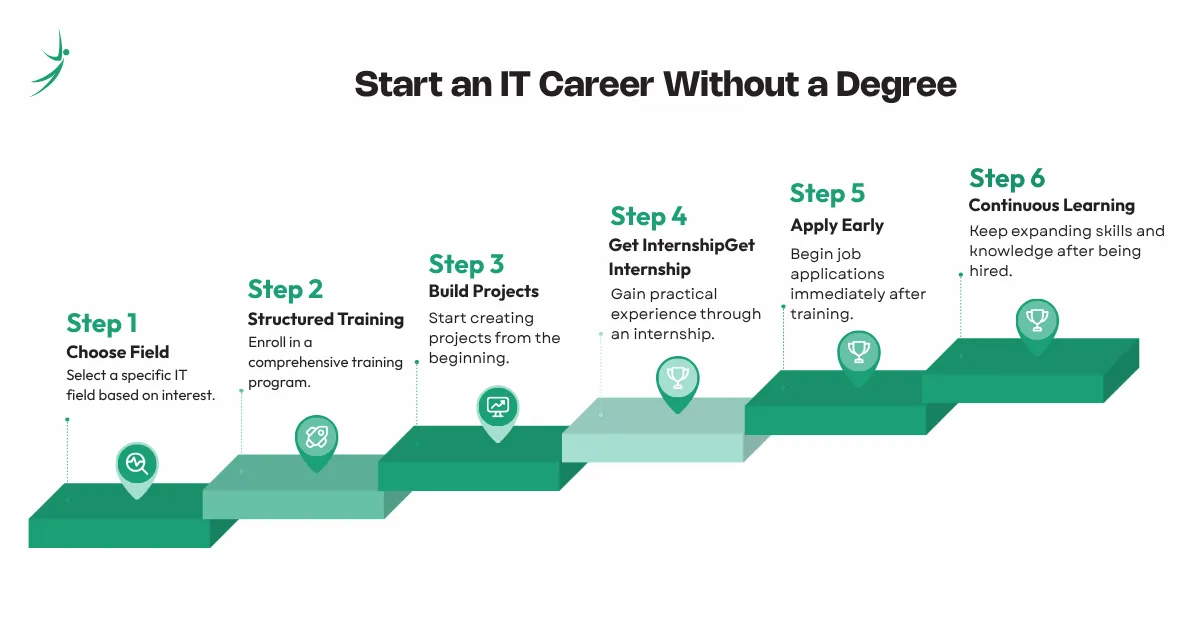
Step 1: Choose One Field and Commit to It: The biggest mistake beginners make is trying to learn everything at once. Web development, cybersecurity, AI, data science all at the same time leads to confusion and zero progress. Pick one field based on your interest and stick with it completely until you are job-ready. Refer back to the fields section above if you are unsure where to start.
Step 2: Enroll in Structured, Practical Training: Self-learning from YouTube is possible but slow and unstructured. A proper training program gives you a curriculum, a mentor, real project work, and accountability. Look for programs that include internship support and placement assistance - this is often where the difference between a six-month journey and a two-year struggle is decided.
Step 3: Build Projects From Week One: Do not wait until you "finish" your course to start building. Start your first project in the first week of training even if it is small and imperfect. By the time you complete your training, you should have at least three projects on GitHub or your portfolio site that you can show an employer.
Step 4: Get an Internship: An internship is the bridge between training and employment. Even an unpaid or stipend-based internship in a real Nepal IT company gives you something no degree can professional experience, a reference, and proof that you can work in a team environment. Many training institutes in Nepal offer internship placement as part of their program. Prioritize institutes that do.
Step 5: Apply Early and Apply Often: Most beginners wait too long before applying for their first job. Apply as soon as your training is complete even if you do not feel fully ready. Junior roles in Nepal expect you to be a learner. They are not hiring experts. They are hiring people with the right foundation and the right attitude. Job portals like LinkedIn, Merojob, and Kumari Job regularly list entry-level IT roles in Kathmandu.
Step 6: Keep Learning After You Are Hired: Your first job is not the finish line, it is the starting point. The IT professionals in Nepal who grow fastest in the first two years are those who treat every project at work as a learning opportunity, take on new tools, and build on their foundational skills consistently.
Many students at Skill shikshya have followed exactly this six-step path — from zero IT background to their first job or internship within three months of completing training. The Job Ready Program at Skill Shikshya — best IT training institute in Nepal is built around this exact progression, with guaranteed job or internship placement for every qualifying student.
How Long Does It Take to Become Job Ready in IT Without a Degree?
This is one of the most common questions from beginners and the honest answer depends on three things: the field you choose, the quality of your training, and how consistently you practice.
Here is a realistic timeline for Nepal's market:
Months 1–2: Foundation You are learning the basics of your chosen field. Concepts, tools, and your first small projects. This phase is often the hardest because progress feels slow. Push through it.
Months 3–4: Skill Building You are now building real projects, applying what you have learned to actual problems, and starting to develop your portfolio. Your confidence grows significantly in this phase.
Months 5–6: Job Ready With a structured training program, most students reach job-ready status by the end of month five or six. You have two to three portfolio projects, a certificate, and enough foundational skill to perform in an entry-level role.
Months 6–12: First Job or Internship With active applications, networking, and internship placement support from your training institute, most candidates land their first IT role within this window.
Common Mistakes Beginners Make When Starting IT Without a Degree
Knowing what not to do saves you months of wasted time. These are the most common mistakes that beginners in Nepal make when trying to enter IT without a degree:
Learning too many tools at once. Jumping between Python, JavaScript, Figma, SQL, and cybersecurity simultaneously leads nowhere. Master one skill stack first.
Watching tutorials without building anything. Tutorial videos feel productive but they are not the same as real learning. You must build, break, fix, and build again.
Waiting for the "perfect moment" to apply. There is no perfect moment. Apply while you are still learning. The feedback from real interviews is irreplaceable.
Ignoring soft skills. Technical knowledge alone will not get you hired in Nepal's IT market. Communication, punctuality, and team collaboration matter especially in companies that work with international clients.
Skipping the internship step. Many beginners try to jump straight from training to a full-time job. Internships bridge the gap and dramatically increase your chances of getting hired.
Choosing a training institute based on price alone. The cheapest option is rarely the best investment. Look for institutes that offer practical curriculum, real project work, mentorship, and placement support.
Is Certification Enough to Get an IT Job Without a Degree in Nepal?
No, not on its own.
A certificate tells an employer you completed a course. It does not tell them what you can actually do. Employers at companies like Leapfrog, Deerwalk, and Cotiviti evaluate candidates through practical tests, portfolio reviews, and problem-solving exercises - not certificate paper.
What actually works is the combination:
Certificate + Real Projects + Internship Experience = Hireable Without a Degree
Your certificate opens the door to the interview. Your portfolio proves you can do the work. Your internship proves you can function in a professional team. Together, these three replace what a degree would otherwise signal to an employer.
Nepal-Specific Advantage: Why Skill Beats Degree Here More Than Anywhere
Nepal has a unique job market condition that works in your favor if you are entering IT without a degree.
Most large IT companies in Nepal, especially those working with international clients, evaluate candidates through GitHub activity, take-home assignments, and technical interviews. The degree is often just a checkbox on the initial application form, and many companies explicitly state "or equivalent experience" next to their education requirements.
Nepal's freelancing economy adds another layer of opportunity. You do not need anyone's permission to start freelancing. Build your portfolio, create a profile on Upwork or Fiverr, and start pitching for small projects. Many of Nepal's most successful IT freelancers started this way before they ever had a full-time job.
The government's Digital Nepal Framework is also accelerating IT adoption across banking, healthcare, education, and government services, creating thousands of new IT roles annually that did not exist five years ago. Many of these roles are being filled by skilled candidates from training backgrounds, not just degree holders.
Start Your IT Career the Right Way
Starting an IT career without a degree in Nepal is not a compromise; it is increasingly the smarter, faster path for people who want to be employed and earning within six months rather than waiting four years for a degree that may still not guarantee a job.
The path is clear: choose one field, get practical training, build real projects, complete an internship, and apply consistently. Every step of that path is designed around skill and output, not credentials.
If you are ready to take that first step with structured guidance, real project work, internship placement, and a job guarantee, explore your options at Skill Shikshya: The best IT training institute in Nepal, where the curriculum is built around one goal: getting you employed.
Frequently Asked Questions
Can I get an IT job in Nepal without a degree?
Which IT field is easiest to enter without a degree in Nepal?
Can I start an IT career after SEE without a degree?
Is a certificate enough for an IT job in Nepal?
How long does it take to become job-ready in IT without a degree?
Do Nepali IT companies require degrees for entry-level roles?
What skills do I need for an IT job without a degree in Nepal?
How do I build an IT portfolio with no experience?
About Author: