Will AI Replace Jobs? What the Data Actually Shows for Nepal in 2026
If you've typed "ai replace jobs" into Google recently, you're not alone. Software developers in Lalitpur, finance graduates in Kathmandu, and marketing professionals across Nepal are all asking some version of the same question: is my job next?
The data-backed answer isn't a simple yes or no. Global research from the World Economic Forum, PwC, the ILO, and the World Bank, plus real accounts from Nepali companies, points to something more specific: AI is changing which parts of a job get done by a person, far more than it is erasing entire occupations. This guide walks through the actual numbers behind ai replace jobs, what's happening inside Nepal's job market right now, and what you can do about it.
Why Everyone in Nepal Is Asking "Will AI Replace Jobs"
Nepal's software companies have moved fast, and the evidence is showing up in daily work, not just headlines:
- At Lalitpur-based Cedar Gate Technologies, developer Mamata Chaudhary now writes code alongside Amazon Q, an AI coding assistant the company licensed and rolled out across its engineering team. She told The Kathmandu Post that her first instinct now, whenever she hits a problem, is to ask the AI first rather than think it through herself, a shift that has made her deliberately practice solving problems solo before turning to the tool (Kathmandu Post, April 2026).
- Hiring has slowed in several entry-level categories. Shailendra Raj Giri, managing director of the job portal Mero Job and chair of the AI Association Nepal, says demand for software developers, transcribers, translators, and content writers has dropped sharply since early 2024, while demand for AI-skilled workers keeps climbing.
- That gap between "jobs disappearing" and "jobs changing" is exactly why the question feels urgent right now, in interview processes, salary negotiations, and classroom debates across the country.
What the Global Data Says About AI Replacing Jobs
The WEF and PwC Numbers on Entry-Level Work
The clearest global dataset on ai will replace humans comes from a joint 2026 report by the World Economic Forum and PwC, built on insights from more than 9,000 entry-level workers across 48 countries. It found that more than one in three young workers worldwide, 37%, are in occupations with medium to high exposure to AI-driven task change. Exposure varies sharply by region: 75% of young workers in Eastern Asia, 69% in Northern America, and 63% in Europe hold jobs where AI is expected to change daily tasks. Financial services, information and communication, professional services, and education carry the highest exposure, while agriculture, construction, and food service are comparatively untouched.
PwC's companion 2026 Global AI Jobs Barometer, which analysed more than a billion job postings across dozens of countries, found something specific rather than alarmist: entry-level roles most exposed to AI are now seven times more likely to require senior-level skills like leadership, creativity, and face-to-face judgment. Job openings for these "seniorised" entry-level roles have grown 35% since 2019, while other entry-level postings shrank 10% . Separately, PwC's workforce survey found 45% of entry-level workers say they now spend more time working because of AI, and 28% believe half or less of their current skills will still be relevant within three years.
What the ILO and World Bank Found
A joint working paper from the International Labour Organization and the World Bank, prepared for the World Bank's 2026 World Development Report, examined AI exposure across 135 countries covering roughly two-thirds of global employment. Its core finding matters directly for Nepal: developing economies risk experiencing disruption from generative AI before they see the productivity gains, because of gaps in digital infrastructure and how work is currently organised.
The World Bank's South Asia Development Update adds regional numbers directly relevant to ai replace job questions in Nepal. Monthly job postings for white-collar roles across South Asia fell 20% following the rise of generative AI, and workers without a college degree, along with those just entering the workforce, face the highest exposure. At the same time, the report found real upside: about 15% of South Asian jobs have strong complementarity with AI, meaning productivity gains rather than displacement, and jobs requiring AI skills already command close to a 30% wage premium. Job postings requiring AI skills in South Asia more than doubled between January 2023 and March 2025, from 2.9% to 6.5% of all listings, with demand for AI skills growing 75% faster than non-AI listings.
What's Actually Happening Inside Nepal's Job Market
Real Cases From Nepali Companies
- Santosh Tamrakar, managing director of IMS Software, told The Kathmandu Post that drafting a business proposal, which used to take half a day, now takes about ten minutes with AI. His team uses Claude for coding and Beautiful.ai for presentations, and system architecture that once required two to three days of focused work can now be roughed out in minutes.
- Abhay Poudel, co-founder of Gokyo Labs and treasurer of the Nepal Association for Software and IT Services Companies, says his company hired 10 to 12 graduates from a pool of 20 to 25 interviewed candidates over the past year, a reasonable rate, but every one of them needed four to six months of extra training before becoming genuinely useful on the job.
What Hiring Managers Are Seeing
- Tamrakar put the shift plainly: the market is no longer just looking for people who can write code, it wants people who can verify AI output and feed it the right data.
- Mid-level developers who only know how to write code, without the ability to review or direct AI output, face a genuinely harder market than they did two years ago.
- New roles are emerging that most fresh graduates aren't trained for yet: AI application developer, data engineer, prompt engineer, and AI consultant.
- Ankur Sharma, Innovation Director at Leapfrog Technology, notes that in many cases you no longer need to write code at all; companies need people who can operate AI tools on top of a solid engineering foundation. That mismatch, new roles opening while old ones tighten, is the real story behind ai will replace which jobs searches.
Will AI Replace All Jobs, or Just Change Them?
Here's the more useful framing: will AI replace all jobs, or reshape what jobs look like day to day?
The data points clearly toward the second answer. The WEF and PwC report frames AI's impact as changing how work is performed far more often than eliminating the role itself. The ILO's exposure research reaches a similar conclusion: generative AI shows the highest exposure in routine clerical and administrative tasks, but is more likely to reshape tasks within a job than wipe out entire occupations. Judgment, verification, and decision-making remain squarely human territory in nearly every data source available.
So if you're wondering whether ai will replace humans entirely, the evidence so far says no. What it replaces is the routine, repeatable slice of almost every job, while raising the skill bar on the judgment-heavy parts that remain, which is exactly what PwC's "seniorised entry-level roles" finding shows in practice.
Which Jobs Are Most at Risk in Nepal?
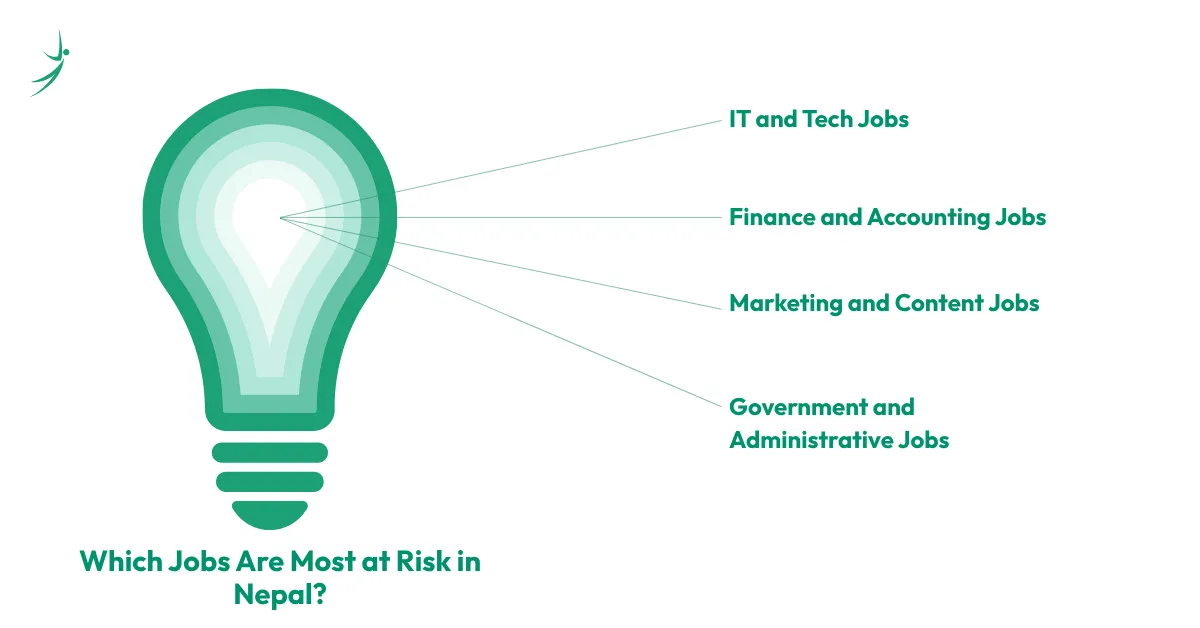
IT and Tech Jobs
Will AI replace IT jobs entirely? No, but the entry-level version of many IT roles is shrinking.
- This is where the pressure is most visible. Giri at Mero Job has watched Nepal's IT hiring decline steadily since early 2024, with demand drying up fastest for basic coding, manual testing, and routine data entry work.
- If you're weighing will ai replace tech jobs across the board, the honest picture is that senior, AI-literate roles are growing even as purely code-writing junior roles tighten.
- Building AI-integrated technical skills, through a structured Frontend Software Engineering course or a broader IT career guide, is the practical response fresh graduates in Nepal are turning to right now.
Finance and Accounting Jobs
Can AI replace finance jobs? Partially.
- Routine bookkeeping, basic reconciliation, and repetitive reporting are prime automation targets.
- But will AI replace finance jobs that require judgment, tax strategy, audit reasoning, client advisory, is a different question, and the answer there is much closer to "not soon."
- Nepal's accounting sector still runs heavily on tools like Tally, and professionals who pair that software fluency with real compliance judgment (VAT, TDS, audit prep) remain in steady demand, matching the World Bank's broader finding that South Asian jobs with strong human-AI complementarity see productivity gains rather than displacement.
Marketing and Content Jobs
Will AI replace marketing as a field? Not the strategic side of it.
- AI has made content drafting, basic graphic design, and video editing faster, routine work that used to take hours now takes minutes.
- But campaign strategy, brand judgment, and reading what actually makes a Nepali customer buy still require a human interpreting the audience.
- Marketers who want to stay ahead of this shift can build on a structured Digital Marketing course or review common digital marketing interview questions shaped by what employers are hiring for today.
Government and Administrative Jobs
Will AI replace government jobs in Nepal? Slowly, and unevenly.
- Nepal's public sector has been slower to adopt AI tools than private IT firms, but repetitive administrative processes such as form processing and basic data entry are the most exposed over time.
- Nepal's "National Commitment" document, synthesising pledges from six major political parties, includes mandatory AI literacy through Grade 12 and plans for a sovereign large language model, alongside a five-year target for Nepal to become a computational power exporter.
- That signals government awareness of this shift, even if implementation is still catching up to intent.
Which Jobs Are Holding Steady (For Now)
Cybersecurity, DevOps, and Network Engineering
Search "will ai replace cyber security jobs quora" and you'll find plenty of anxious threads, but the current data points the other way.
- Giri notes that roles in cybersecurity, along with UI/UX, QA/QC, cloud engineering, and network administration, have held comparatively steady in Nepal's hiring data, precisely because threat judgment and incident response still need a human decision-maker.
- The same logic applies to will ai replace devops and will ai replace network engineers: these are hands-on, systems-level roles that AI tools support rather than fully perform.
- Learners building toward these paths can start with a structured Cyber Security course, which also covers the most common types of cyber attacks targeting Nepali businesses today.
Product Management, UI/UX, and Data Science
Will AI replace product managers? Not likely soon; the role is fundamentally about prioritising what to build based on business and user context, which AI can inform but not decide.
- A related question, will ai replace data science, gets a similar answer: AI speeds up data cleaning and querying, but interpreting what a dataset actually means for a Nepali business, and deciding what to act on, remains a distinctly human skill.
- UI/UX design has shifted too, with AI accelerating wireframing and prototyping, while the underlying skill of understanding what a real user needs stays a human strength.
- Structured programs like Skill Shikshya's UI/UX Design course, Business Data Analytics with AI course, and Data Science and Machine Learning program are built specifically around this AI-plus-judgment combination, including a practical primer on Power BI for anyone starting from zero.
Interior Design and Other Hands-On Creative Work
Will AI replace interior designers?
- AI tools can now generate mood boards and rough layouts, but translating a client's actual space, budget, and lifestyle into a workable design, and managing the vendors and contractors who execute it, stays firmly in human hands.
- The visualization software has gotten faster; the judgment behind it hasn't been replaced.
Nepal's Biggest Challenge: Classrooms vs Workplaces
Here's the uncomfortable part. Nepal's IT companies have moved fast on AI adoption. Its universities have not moved at the same pace.
- Kathmandu University has built a dedicated AI department within its Computer Science and Engineering division and passed a formal policy fully embracing AI use across all schools.
- Purbanchal University now teaches AI as a standalone subject.
- Tribhuvan University, the country's largest, has banned AI in exams since 2024 and has no full AI degree program, though it has folded AI basics into several undergraduate courses.
- Pulchowk Engineering Campus has taught AI-related content through its Data Science and Analytics program since 2019.
- King's College offers a BSc in Computer Science with an AI specialisation.
The result is a country where two students graduating the same year can leave with completely different levels of AI fluency, depending on which institution they attended, a gap that shows up immediately once they enter a job market that has already moved on. This is precisely why has AI replaced jobs yet is the wrong question to sit with for too long. The more useful one is: is your own skill set keeping pace with what employers already expect? A practical starting point is Skill Shikshya's guide on how to start an IT career in Nepal without a degree, which maps entry points that don't depend on which university you attended.
How to Future-Proof Your Career Starting Now
The pattern across every data source, Nepali and global, points to the same short list:
- Learn to direct AI, not just use it. Knowing how to prompt, verify, and correct AI output is now a baseline hiring expectation across Nepal's IT firms, not a bonus skill.
- Double down on judgment-heavy skills. Communication, critical thinking, and decision-making are the parts of any job the data consistently shows AI still can't do well.
- Get practical experience, not just theory. Real projects and portfolio work matter more to Nepali hiring managers than certificates alone.
- Pick a specialisation AI struggles with. Cybersecurity, DevOps, product management, data science, and hands-on creative work are all comparatively steadier right now, based on Nepal's own hiring data.
- Treat learning as ongoing. PwC's data shows the skill bar in AI-exposed jobs is changing more than twice as fast as in less-exposed roles.
Skill Shikshya's Generative AI and Agentic Systems course and the no-code AI for Everyone course are both built around this exact gap between using AI casually and directing it professionally, a distinction explained further in " Why Skill Shikshya's Trainings Are AI-Integrated.
What Happens by 2030
- Fintech analyst Sanjib Subba cautions against short-term thinking here: the AI advances expected by 2030 to 2032 will make much of today's technology look basic, and Nepal needs to plan its skills pipeline accordingly rather than reacting year to year.
- Multiple analysts tracking Nepal's tech sector expect AI to replace jobs by 2030 in a narrower, more specific sense than headlines suggest: not mass unemployment, but a steady narrowing of purely routine roles alongside continued growth in AI-adjacent positions, prompt engineering, AI implementation, data infrastructure, and AI-assisted operations across finance, marketing, and beyond.
- Regional data backs this direction. The World Bank's South Asia Development Update found monthly white-collar job postings across the region fell 20% following the rise of generative AI, with workers who lack a degree and those just entering the workforce facing the highest exposure. Nepal isn't isolated from that trend, but it also isn't further along it than its South Asian neighbours.
- The honest long-view answer to will AI replace human intelligence: no. Human intelligence and machine output are different things. What's changing is which slice of work each one handles, and how quickly Nepali workers adapt to that division.
How to Choose the Right Skill Path for You
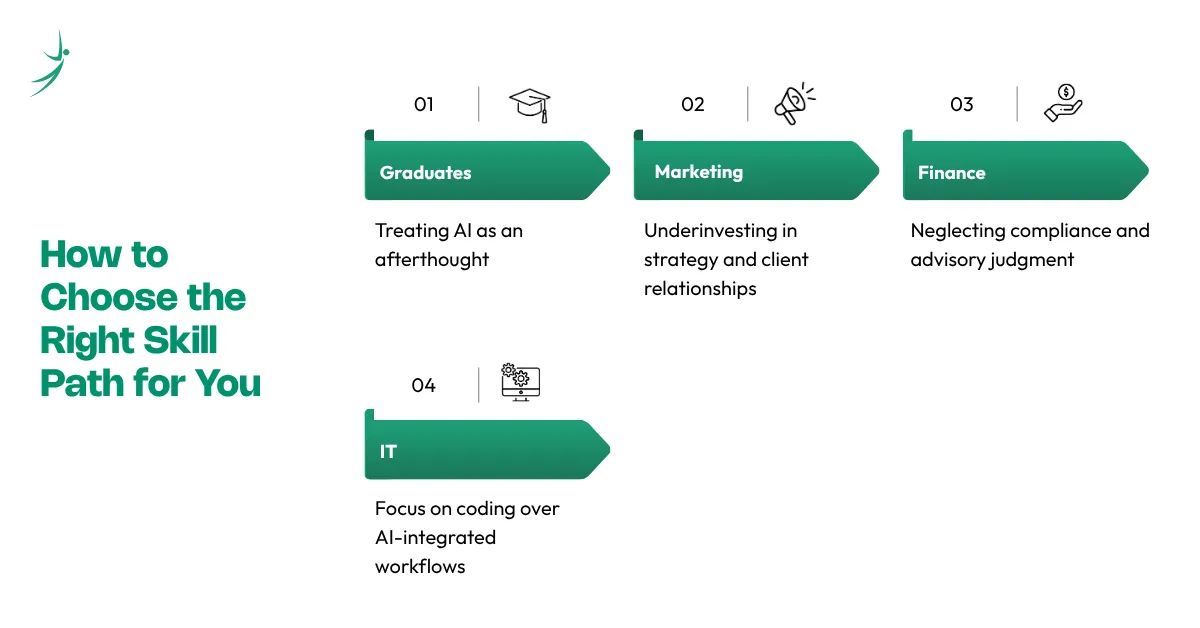
If you're deciding what to learn next, work backward from where the pressure actually is:
- If you're in IT: move beyond "I can code" toward "I can build, verify, and ship with AI tools." Cloud, DevOps, and cybersecurity specialisations are holding up best in Nepal's current hiring data.
- If you're in finance or accounting: pair software fluency (Tally, Excel) with the compliance and advisory judgment AI can't replicate.
- If you're in marketing or design: get fast at using AI for production work, but invest harder in strategy, audience insight, and client relationships. Skill Shikshya's Advanced SEO course folds AI-powered SEO directly into this kind of strategic skill-building.
- If you're a fresh graduate unsure where to start: prioritise a program that teaches AI-integrated workflows directly, rather than treating AI as an afterthought bolted onto an old curriculum. Skill Shikshya's overview of what an IT career actually looks like is a reasonable place to map your options first.
Conclusion and Action Steps
The real question was never a clean yes-or-no on "ai replace jobs." The data from the WEF, PwC, ILO, and World Bank, combined with real accounts from Nepali companies like IMS Software and Gokyo Labs, points to the same conclusion: it's about which slice of your job is routine enough to automate, and how quickly you move toward the judgment-heavy, AI-directed version of your field.
Nepal's job market has already made its decision, even while its classrooms are still debating. Companies are hiring for AI fluency today, not waiting for curricula to catch up.
Next steps if you're figuring out where you stand:
- Audit your own role or course honestly: how much of it is repeatable, and how much requires judgment?
- Pick one AI tool relevant to your field and get genuinely fluent in it this month.
- Choose a specialisation from the steadier list, cybersecurity, DevOps, product management, data science, or compliance-heavy finance, if you're still choosing a path.
- Look for training that teaches AI-integrated workflows directly, such as Skill Shikshya's cybersecurity, data analytics, UI/UX, or generative AI programs, instead of an old syllabus with AI bolted on as an afterthought.
Frequently Asked Questions
Will AI replace all jobs?
Will AI replace me specifically, or will AI replace you if you're in a similar role?
Will AI replace us as a workforce, or just some of us?
Will AI replace my job, specifically if I work in IT support or basic coding?
Has AI replaced jobs yet in Nepal?
Will AI replace tech jobs across the board?
About Author: