Generative AI & AI Agents (Agentic AI) Course In Nepal
Build a future ready career at the frontier of technology with Skill Shikshya's best generative AI course in Nepal. Learn how the world's leading tech companies and AI startups are building intelligent systems using large language models, autonomous AI agents, RAG pipelines and the AI automation stacks reshaping every industry in 2026. Whether you want to become an AI engineer, build your own LLM powered products, automate business workflows with AI, or simply understand generative AI technology well enough to apply it at work, this course gives you the technical depth, real projects and career support to lead in one of the most in demand fields of the decade.
Course Key Highlights

Hybrid Classes
Attend class physically or online from anywhere and learn practical, real-world skills with guidance from industry professionals.

Industry Practices
Learn essential strategies used by agencies, brands, and global marketing teams.

Flexible Schedule
Morning and evening batches designed for students and working professionals.

Beginner Friendly
No prior experience required to start learning and building your skills.
Learn Generative AI & AI Agents with SkillShikshya
Skill Shikshya's generative AI course is one of the most comprehensive and forward thinking AI training programs in Kathmandu, built for students, working professionals, entrepreneurs and tech enthusiasts who want a serious generative AI learning path, not a surface level overview.
So what is generative AI, in plain terms? Generative AI meaning, at its core, is a category of artificial intelligence that creates new content, text, images, code or audio, by learning patterns from massive amounts of existing data. It is one of the fastest growing areas of generative ai technology in the world, and companies across every industry in Nepal and internationally are urgently hiring people who can build, deploy and manage AI powered systems.
This course covers the complete generative ai fundamentals and the full generative AI with large language models workflow: prompt engineering, working with LLMs from OpenAI, Claude and Gemini, building AI agents with LangChain and CrewAI, Retrieval Augmented Generation (RAG), AI automation with n8n and Make, vector databases, LLM fine tuning and deploying real AI powered applications, using the same generative ai platforms and generative ai software that top companies rely on.
What You Will Achieve:
- Build a Complete AI Specialist Portfolio: Real generative AI and agentic AI projects, not isolated exercises.
- Design Autonomous AI Agents: Systems that reason, plan and execute complex tasks independently.
- Master Generative AI Tools: ChatGPT API, Claude API, LangChain, CrewAI and other modern generative ai tools used in production.
- Understand Generative AI for Business: Apply prompt engineering, RAG systems and AI automation to real business workflows.
- Get Career Ready: Job placement support for AI engineering roles across Nepal and remote international opportunities.
Why Skill Shikshya's Generative AI Course?
Plenty of short generative ai tutorial videos and generative ai tools free lists exist online, but stitching those together rarely builds the depth employers expect. Here is what makes this the best generative AI course in Nepal rather than a scattered set of tutorials:
- A Structured Generative AI Learning Path: Thirteen modules take you from Python essentials for LLM engineering through to a full capstone project, covering complete generative ai essentials in order, not random topics.
- Real Generative AI Chatbots and Agent Projects: You build working chatbots, RAG pipelines and multi agent systems, not just prompt a model in a browser.
- AI Automation Covered in Depth: Learn to connect generative ai platforms like n8n and Make to real business processes, a core generative ai for business skill employers are paying for.
- 2.5 Months of Structured, Mentor Led Training: Enough depth to understand how generative AI software actually works under the hood, not just how to use it.
- Career Support Included: Portfolio review, CV support, LinkedIn positioning, mock interviews and career roadmap guidance.
- Hybrid Campus and Online Access: Attend in person at our Kathmandu campus or join live online from anywhere in Nepal.
Generative AI Course vs Other Ways to Learn AI
If you are comparing your options before choosing where to invest your time, here is how a structured generative AI developer program compares to other common paths in Nepal:
| Learning Path | Core Focus | Primary Strengths | Learning Curve | Ideal For |
|---|---|---|---|---|
| Generative AI Course (Skill Shikshya Path) | Structured generative ai fundamentals plus agent and automation engineering | Covers LLMs, RAG, agents and deployment in one guided path, mentor feedback, real projects | Beginner friendly, with genuine depth by the end | Career switchers, developers and business professionals who want job ready AI skills |
| Free YouTube Tutorials | Scattered generative ai tutorial videos | Free, flexible, good for isolated concepts | Steep without structure, easy to stop halfway | Highly self motivated learners exploring a single topic at a time |
| Generative AI Tools Free Trials | Hands on use of ChatGPT, Gemini or similar generative ai tools free tiers | Immediate, no cost, good for basic familiarity | Very shallow, teaches usage not engineering | Casual users who just want to try generative ai chatbots |
| University AI or Data Science Degree | Theory heavy academic curriculum | Strong theoretical foundation, recognised degree | Steep, several years | Students seeking a formal academic credential alongside AI knowledge |
Who Is This Course For
Students and Graduates
Start your career with practical training and build job-ready, indusrty-relevant skills.
Entrepreneurs and Business Owners
Apply modern strategies to grow your business and reach more customers.
Aspiring Professionals
Build a strong foundation and transition into a professional career path.

Freelancers and Side Hustlers
Work independently, offer services globally, and build income-generating skills.
Skills You Will Learn
Generative AI Fundamentals
Understand generative AI, LLMs, and how businesses use AI to transform products and workflows.
Prompt Engineering for AI Models
Learn to craft effective prompts and instructions for accurate AI-generated outputs.
Building AI Agents with LangChain
Build AI agents that can reason, use tools, and perform multi-step tasks autonomously.
Retrieval-Augmented Generation (RAG)
Connect AI models with custom data to generate accurate, context-aware responses.
Agentic AI & Multi-Agent Systems
Develop multi-agent systems where AI agents collaborate to solve complex problems.
Large Language Models (LLMs) & APIs
Work with OpenAI, Claude, Gemini, and open-source LLM APIs to build AI apps.
AI Workflow Automation & Integration
Automate business processes using AI tools like Zapier, Make, and n8n.
Vector Databases & AI Memory Systems
Use vector databases to enable semantic search and long-term AI memory.
AI-Powered Application Development
Build and deploy real-world AI applications using generative AI technologies.
Fine-Tuning & Customizing AI Models
Customize AI models for specific industries and domain-focused use cases.
AI Ethics, Safety & Responsible AI
Understand AI ethics, bias, privacy, and safe AI development practices.
Generative AI Portfolio & Freelancing
Create a strong AI portfolio and start freelancing or consulting in AI.
Platforms & Tools You'll Master
You will learn industry-standard tools used by agencies and companies.


AI-Powered Engineering Course
An AI engineer in 2024 spent most of their time on plumbing: writing boilerplate LangChain code, debugging API call failures, manually chunking documents for RAG, and configuring vector database schemas from scratch. In 2026, that workflow has fundamentally changed. Modern AI development stacks, LangGraph with checkpointing, n8n with MCP integration, CrewAI with role-based crews have abstracted the plumbing so engineers can focus on what actually matters: designing agent architectures, evaluating model outputs, writing the business logic that makes an AI system genuinely useful rather than just technically functional. This course teaches you both layers: the technical foundation and the engineering judgment that AI tools cannot replace.
AI Tools Table
| Task in the AI Engineering Workflow | Tool Used | What Was Done Before (2024) | What You Do Now (2026) |
|---|---|---|---|
| Building LLM-powered applications | LangChain + OpenAI / Claude API | Write raw API calls from scratch, manage prompt templates manually, handle conversation history by hand, debug token overflow errors individually | LangChain abstracts the boilerplate — chains, memory, and tool routing handled in minutes. You focus on what the application does, not how to wire the API. What took a day now takes an afternoon. |
| Building stateful AI agents | LangGraph | Agents had no reliable state — they forgot context between steps, could not branch conditionally, and had no rollback on failure. Production agent systems required bespoke engineering for every workflow | LangGraph models agents as explicit state machines — graphs with nodes, edges, and checkpoints. Define the workflow explicitly. The agent retains state, branches conditionally, retries on failure, and supports human-in-the-loop approval before critical actions. |
| Multi-agent systems where agents collaborate | CrewAI | Building multi-agent systems from scratch meant writing custom orchestration, message passing, and failure recovery logic — weeks of work | CrewAI: assign each agent a role (researcher, writer, reviewer), give them tools and a goal. The crew coordinates, delegates, and produces outputs. Working multi-agent demos in an afternoon. Used by 1,500+ companies executing 10M+ agents per month. |
| Connecting agents to external tools & data | MCP (Model Context Protocol) | Every new tool integration required a custom connector — weeks of engineering per tool, and different LLMs needed different connector formats | MCP is the universal standard: build one MCP server per tool and every MCP-compatible agent (Claude, GPT, Gemini, n8n) can use it. Over 500 public MCP servers now exist — GitHub, Slack, Stripe, PostgreSQL, Figma, Docker. Your agent can use any of them. |
| Building RAG pipelines (AI + your own documents) | LangChain + ChromaDB / Pinecone | Manually write document loaders, chunking logic, embedding calls, and vector search from scratch — error-prone, slow, and different for every data source | LangChain RAG pipeline: load documents, chunk, embed, store in ChromaDB or Pinecone, retrieve at query time — in a structured workflow you build once and reuse. What previously required senior ML engineering knowledge is now a module-level skill. |
| Running LLMs locally without API costs | Ollama + Llama 3 / Mistral / DeepSeek R1 | Local LLM deployment required deep ML infrastructure knowledge — CUDA setup, model quantisation, serving layer engineering | Ollama: one command to pull and run Llama 3, Mistral, or DeepSeek R1 locally. No API costs, no data leaving your machine, no internet required. Switch between local and cloud models based on task and cost requirements. |
| AI workflow automation for business processes | n8n + MCP | Connecting AI reasoning to business systems (CRMs, email, databases) required custom code for every integration. n8n workflows and AI agents were separate, incompatible systems | n8n now supports MCP — your AI agent can discover and call n8n workflows as tools. An agent that researches a company can trigger an n8n workflow to send a personalised email, log the result in a CRM, and notify a Slack channel — all decided by the agent, not hardcoded by you. |
| Monitoring and debugging production AI systems | LangSmith / Langfuse | Production AI failures were invisible — you knew something was wrong when users complained. There was no equivalent to server logs for LLM applications | LangSmith and Langfuse give you full observability: trace every agent step, see every prompt and response, detect latency spikes and prompt drift, evaluate model outputs programmatically. The most common reason agent projects fail after demo is skipping this layer. |
GENERATIVE AI & AI AGENTS COURSE CURRICULUM
SkillShikshya's Generative AI & Agentic AI Course in Nepal is structured to take you from zero AI knowledge to a confident, job-ready generative AI specialist and AI agent developer. Every module includes practical AI building labs, real-world automation projects, and hands-on LLM experiments designed to build a strong, employer-ready AI specialist portfolio.
The curriculum covers the complete generative AI and agentic AI engineering workflow: prompt engineering, LangChain agent development, RAG systems, multi-agent architectures, LLM API integration, vector databases, AI automation with n8n and Make, fine-tuning, AI application deployment, AI ethics, and portfolio development, the full stack of skills that AI companies and tech employers are urgently hiring for globally.
Accordian Title

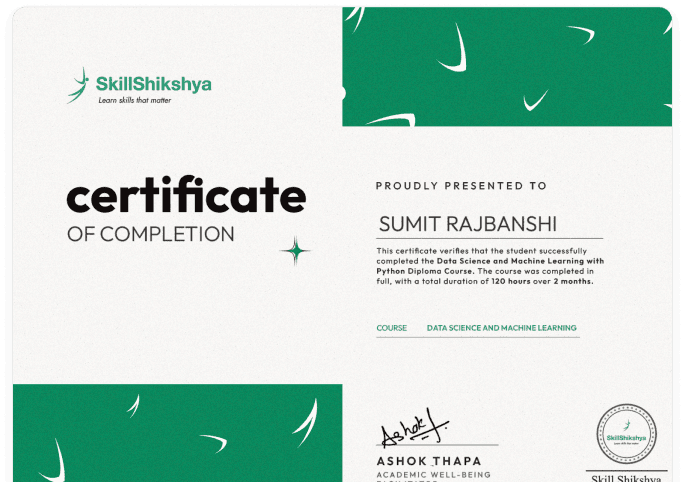
Earn a Certification & Advance Your Career
After completing the program, you will receive a certification from At Skill shikshya, the best online learning institute in Nepal. This certification helps demonstrate your professional skills when applying for jobs or freelance opportunities.
How We Make Learning Different
Thinking of enrolling? Here's what makes our courses different.

Beginner Friendly
Start from the basics and gradually progress to advanced concepts.

Expert Led Training
Learn from professionals with real-world industry experience.

Hands-On Projects
Work on practical projects and build a strong, portfolio-ready skillset.

Lifetime Learning Resources
Access learning materials, updates, and resources even after completing the program.

Career Support
Get guidance for job applications, internships, and career growth opportunities.

Industry Certification
Earn a recognized certification that validates your skills and knowledge.

Batch Repeating Options
Repeat sessions if needed to strengthen your understanding.

Free Workshops
Access additional workshops covering tools, trends, and evolving practices.
HR & CV Sessions
Resume building, interview preparation, and career counseling support.
Learn From Industry Experts

Yugan Dashaudi
Python Django Mentor
Career Support
Our structured system helps you go from learning to applying it in real-world scenarios with confidence and direction.
Build real experience, present your skills professionally, and confidently step into jobs, internships, or freelance opportunities.
Join the Generative AI & AI Agents Course Today
Build AI agents, work with LLMs, and create real-world applications using modern AI tools.
Enroll Now
Real words from real learners
What Our Students Say
Hear what our
students have to say

The AI training by SkillShikshya was extremely practical and insightful. We learned how to use different AI tools effectively for productivity, presentations, communication, and organizational growth.
Sujita Shrestha
HR & Admin of Litmus Industries
Hear what our
students have to say

This training introduced us to many AI tools beyond just ChatGPT and Gemini. It showed us how AI can improve both our professional work and daily productivity.
Sajesh KumarNiraula
Sr Executive of Litmus Industries
Frequently Asked Questions
Everything you need to know about our Professional Courses in Nepal
Do I need any AI or machine learning experience to join this course?
What is the course fee and duration?
What is MCP and why does this course teach it?
What is the difference between this course and Broadway Infosys's AI training or TechAxis's AI for Everyone?
What jobs can I apply for after completing this course?
What is the difference between LangChain, LangGraph, and CrewAI — and why does this course teach all three?
Do I need a powerful GPU or expensive computer for this course?
Is this course available online or only in Kathmandu?
What is RAG and do I need it for AI engineering?
What makes this an "Advanced Diploma" rather than a basic course?
What is generative AI?
Is this the best generative AI course in Nepal for complete beginners?