What Is an IT Career? Complete Guide (2026)
You have probably heard people say, "Get into IT, it pays well, and jobs are everywhere." But what does that actually mean? What is an IT career? What do people in IT actually do every day, and how do you even get started? If you're still unsure where to begin, this step-by-step guide to entering the IT field breaks down the exact path in a simple and practical way.
What Is an IT Career?
An IT career is a profession that involves working with computers, software, networks, and digital systems to build, manage, secure, and support technology used by businesses and individuals.
Every app on your phone, every website you visit, every online payment you make, an IT professional made that possible. IT careers exist across every industry, from healthcare and banking to education and government, making it one of the most widely available career fields in the world today.
What Do IT Professionals Actually Do?
People assume IT is just "fixing computers." The reality is much bigger than that. IT professionals generally work across four core areas:
- Build: Developers and engineers create the websites, mobile apps, and software systems that millions of people use daily. Think of every banking app, e-commerce site, or social media platform someone built that.
- Manage: System administrators and network engineers keep servers running, databases organised, and internal systems stable. When your office internet goes down, a network admin fixes it.
- Secure: Cybersecurity professionals protect sensitive data from hackers, breaches, and unauthorised access. With cyberattacks rising globally, this role has become more critical every year.
- Support: IT support specialists are the first line of help when something breaks — hardware issues, software crashes, connectivity problems. This is also one of the most beginner-friendly entry points in IT.
Types of IT Careers — Choose Your Path
One of the biggest advantages of an IT career is how many directions you can go. At Skill Shikshya, courses are built around the fields that Nepal's job market is actively hiring for right now. Here are the main paths:
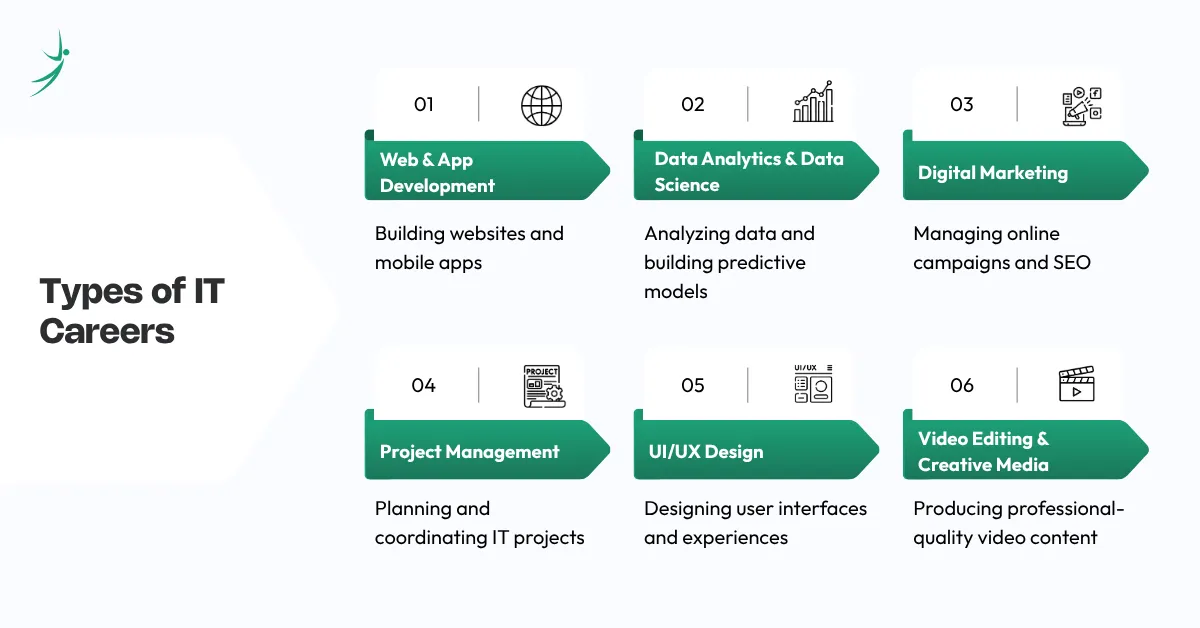
Web & App Development
If you want to build things people actually use — websites, mobile apps, platforms — this is your starting point. Developers write code to bring digital products to life, and demand for them in Nepal keeps growing.
- Flutter Developer — builds cross-platform mobile apps that work on both Android and iOS from a single codebase
- Frontend Developer — creates everything users see and interact with on a screen
Tools you will work with: Flutter, Dart, Firebase, HTML, CSS, JavaScript
Skill Shikshya offers a Complete Flutter Diploma Course where you build real apps using AI-assisted UI generation and debugging from day one.
Entry salary in Nepal: NPR 25,000–50,000/month for freshers
Data Analytics & Data Science
Data is now one of the most valuable resources a company has. Businesses across Nepal — from banks to e-commerce companies — need people who can read data, find patterns, and turn numbers into decisions.
- Business Data Analyst — works with Excel, SQL, and Power BI to report and visualise company data
- Data Scientist / ML Engineer — builds predictive models using Python and machine learning
Tools you will work with: Python, PostgreSQL, Excel, Power BI, TensorFlow, Jupyter, Pandas
Skill Shikshya offers two dedicated courses here: Business Data Analytics with AI (job-ready in 2.5 months) and the Data Science & Machine Learning Diploma for those going deeper into AI.
According to the U.S. Bureau of Labour Statistics, data science roles are projected to grow around 34–36% over the next decade, making it one of the fastest-growing careers.
Digital Marketing
Not every IT career involves code. Digital marketing is one of the fastest-growing fields in Nepal, with businesses of every size needing professionals who can run ads, grow traffic, and manage online presence.
- SEO Specialist — grows organic website traffic through search engine optimization
- Digital Marketing Manager — manages campaigns across Google, Meta, and other platforms
Tools you will work with: WordPress, Google Ads, Meta Ads Manager, analytics platforms
Skill Shikshya's Digital Marketing Diploma Course covers SEO, Google Ads, affiliate marketing, e-commerce, and AI-guided campaign management — all in two months.
Entry salary in Nepal: NPR 20,000–40,000/month for freshers, with strong freelancing potential
Project Management
Every software product, every tech company, every IT project needs someone who keeps things on track. Project managers are the link between technical teams and business goals — and this role pays well without requiring you to write a single line of code.
- Project Manager — plans, coordinates, and delivers IT projects on time and within budget
- Scrum Master / Agile Lead — runs agile development teams using frameworks like Scrum and Kanban
Tools you will work with: Jira, Asana, Slack, and other industry-standard project tools
Skill Shikshya's Project Management Diploma Course is built for people who want a strong IT career without going the coding route. It covers SDLC, STLC, and AI-augmented QA and project planning.
UI/UX Design
Behind every app and website that feels easy to use, a UI/UX designer made deliberate decisions about layout, flow, and experience. This is one of the most creative paths in IT — and one of the most in-demand in Nepal's growing startup scene.
- UI Designer — designs the visual side of apps and websites (colors, buttons, screens)
- UX Researcher — studies how users behave and improves product usability based on findings
Tools you will work with: Figma, Adobe XD, prototyping tools
Skill Shikshya trains students in UI/UX as part of its design-focused courses, with hands-on projects building real product interfaces.
Video Editing & Creative Media
Content creation is a full career now — not a hobby. Video editors work with media companies, YouTube channels, advertising agencies, and corporate brands to produce professional-quality video content.
- Video Editor — cuts, colors, and assembles footage into finished productions
- Motion Graphics Designer — adds animated text, effects, and visual elements to video
Tools you will work with: Adobe Premiere Pro, DaVinci Resolve, After Effects
Skill Shikshya's Video Editing Diploma Course covers motion graphics, color correction, transitions, and AI-assisted editing tools — giving you production-level skills in a short time.
Not sure which path is right for you? Skill Shikshya offers free online counselling to help you pick the course that matches your interests and career goals in Nepal. Book a session here.
Skills You Need for an IT Career
Technical Skills
You do not need to master everything at once. Most IT roles require a focused set of technical skills depending on the path you choose.
- Programming basics — even one language (Python or JavaScript) goes a long way
- Computer fundamentals — how hardware, operating systems, and networks work
- Databases — understanding how data is stored and retrieved (SQL is widely used)
- Version control — tools like Git are used in almost every development role today
Soft Skills
Technical knowledge gets you the interview. Soft skills get you the job — and help you keep it.
- Problem-solving — IT is about finding solutions, not just knowing facts
- Clear communication — explaining technical issues to non-technical people is a daily task
- Logical thinking — breaking complex problems into manageable steps
- Patience — debugging, troubleshooting, and learning all take time
These skills can be built through proper training and consistent practice, which is exactly what structured IT courses are designed to develop.
Why IT Is One of the Best Career Choices Today
There are many reasons people choose an IT career, but these four stand out the most in 2026:
- High global demand: According to the U.S. Bureau of Labour Statistics, computer and information technology occupations are expected to generate around 356,700 job openings each year from 2024 to 2034, highlighting strong and sustained demand in the IT sector. That demand exists globally, not just in the US.
- Solid starting salary: Even entry-level IT roles pay well compared to many other fields. In Nepal, a fresher in web development or IT support can expect NPR 20,000–50,000/month, with clear room to grow quickly.
- Remote work is real: Many IT roles, especially in software development and data analysis, can be done fully remotely. This opens international job markets to professionals sitting in Kathmandu or Pokhara.
- Fast career growth: Skills-based careers like IT reward performance over time served. A developer with two years of strong practical experience can earn more than someone with a five-year degree in an unrelated field.
Scope of IT Career in Nepal
Nepal's IT industry has been growing steadily, and 2026 is looking stronger than ever. Here is what that means practically.
The government's push toward digital governance, the rise of fintech companies, and the growth of software outsourcing firms in Kathmandu have all created real demand for IT professionals domestically.
Freelancing and outsourcing are also major opportunities. Many Nepali developers and designers work with international clients through platforms like Upwork and Toptal, earning in USD while living in Nepal.
IT jobs in Nepal for freshers are available more than ever, particularly in IT support, web development, digital marketing, and entry-level data roles. Companies increasingly hire based on practical skills rather than just academic qualifications.
The biggest challenge in Nepal's IT job market right now is the skill gap. Companies want trained professionals, but many graduates lack hands-on experience. This is exactly where focused, practical training makes the difference.
Do You Need a Degree to Start an IT Career?
Short answer — no.
This is one of the most important things to understand about IT jobs. Unlike medicine or law, you do not need a formal degree to get hired. What employers actually care about is whether you can do the job.
Many of the most successful IT professionals globally are self-taught or trained through short, focused courses. Google, Apple, and IBM have publicly stated that they hire based on skills and portfolio, not degrees.
IT jobs with no degree requirement are not a workaround; they are the standard in many companies. What matters is:
- Can you build a working project?
- Do you understand the fundamentals?
- Can you solve real problems?
In Nepal specifically, many IT companies and startups care more about what you can actually do than the certificate on your wall.
With the right guidance and practical training, anyone, regardless of background, can start a credible IT career within months.
How to Start an IT Career — Step-by-Step Guide
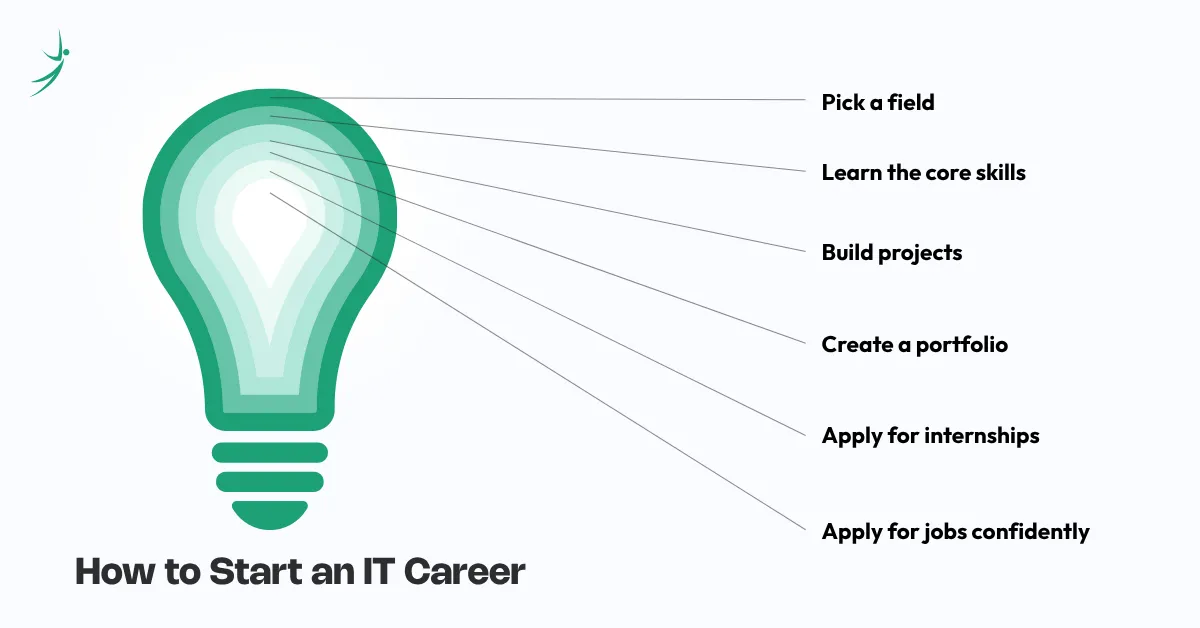
Here is a clear, realistic path for beginners:
- Step 1: Pick a field. Do not try to learn everything at once. Choose one area of web development, data analysis, cybersecurity, or IT support — and commit to it for at least 3–6 months.
- Step 2: Learn the core skills. Enrol in a structured course or training program. Look for one that focuses on practical skills and real projects, not just theory.
- Step 3: Build projects. Theory without practice means nothing to employers. Build a simple website, analyse a real dataset, or set up a small network. Do the actual work.
- Step 4: Create a portfolio. A portfolio is proof that you can deliver. Even 2–3 solid projects on GitHub or a personal website can open doors faster than a degree.
- Step 5: Apply for internships. IT internships in Nepal are available, and they are the fastest way to get real work experience on your resume. Many internships convert into full-time roles.
- Step 6: Apply for jobs confidently. Once you have skills and a portfolio, start applying. You do not need to be perfect. Employers expect freshers to learn on the job.
Why Choose Skill Shikshya to Start Your IT Career
Watching tutorials online is free, but it rarely gets you hired. What actually moves the needle is structured training, real project work, and someone guiding you through the process. That is what the best IT Training Institute in Nepal is built for.
Here is what students get:
- Practical, project-based training: Students do not just watch lessons; they build. Coursework includes real-world projects like building fully functional websites, analysing actual datasets, deploying web applications, and setting up small network environments. By the time you finish, you have a portfolio, not just a certificate.
- Instructors with industry experience: Every course is taught by professionals who have worked in the field, not just taught it. That means you learn how things actually work in a real IT job, not just how they work in a textbook.
- Internship and placement support: Skill Shikshya connects graduates with internship opportunities and actively supports job placement. Many students have gone on to work at IT companies in Kathmandu, land remote freelancing work, and secure positions abroad — all within months of completing training.
- Tools used in real workplaces: Students get hands-on experience with tools that employers actually use, including VS Code, Git and GitHub, MySQL, Figma, Python libraries, and more. You will not walk into your first job and feel lost.
- Beginner-friendly from day one: Over 1,000+ students have started their IT journey at Skill Shikshya with zero prior experience, career changers, fresh graduates, and school leavers alike. The program is built to take you from a complete beginner to a job-ready professional.
If you are asking which IT field is best in Nepal and where to start, Skill Shikshya (Best IT Training Institute in Nepal) gives you both the answer and the path to get there.
Is an IT Career Right for You?
Ask yourself these three questions honestly:
- Do you enjoy working with technology? You do not need to be a computer genius. Simple curiosity about how things work is enough to start.
- Do you like solving problems? IT is fundamentally about fixing things and building solutions. If you enjoy figuring out why something is not working, you will fit right in.
- Are you open to continuous learning? Technology changes fast. The best IT professionals are always picking up new tools and skills — not because they have to, but because they genuinely enjoy it.
If you said yes to at least two of those, an IT career is worth pursuing seriously.
Conclusion
An IT career is one of the most reliable, well-paying, and genuinely future-proof paths you can choose in 2026. The field has room for builders, analysts, problem-solvers, and support specialists, meaning there is a place for many different types of people.
In Nepal, the demand for skilled IT professionals is growing faster than it is being filled. That gap is your opportunity.
You do not need a degree. You do not need to already know how to code. You need the right skills, practical experience, and a willingness to start.
Start your IT journey with the right guidance and training and take the first step today.
Frequently Asked Questions
What is an IT career in simple terms?
Is IT a good career in Nepal?
Can I start IT without a degree?
Which IT job is best for beginners?
About Author: