Vibe Coding Explained (2026): What It Is, the Best Tools, and Whether It's Already Over
Vibe coding went from a casual tweet to Collins Dictionary's Word of the Year in under twelve months. It has also, according to a growing pile of 2026 industry writing, already started dying in its original form, replaced by something more disciplined. Both things are true at once, and this guide walks through exactly what that means, tool by tool, term by term, so you are not left guessing whether the thing you are learning is already outdated.
1. Vibe Coding Definition: What It Actually Means
If you are searching vibe coding is what, or vibe coding what is it, the short answer is this: vibe coding means describing the software you want in plain, everyday language and letting an AI model write the actual code, while you steer, test, and approve the result rather than typing every line yourself.
The term was coined by Andrej Karpathy, a former Tesla AI lead and OpenAI co-founder, in a February 2025 post describing a workflow where a developer accepts AI-generated code based on instinct rather than reading every line. That original, low-oversight version of the vibe coding definition is exactly the part of the practice now facing the most criticism, which is covered further down.
2. Vibe Coding vs. Traditional Coding vs. AI-Assisted Coding
These three get confused constantly, so here is the actual distinction:
- Traditional coding: You write every line yourself, using AI at most for autocomplete.
- AI-assisted coding: Tools like GitHub Copilot suggest code inline as you write, but you remain the primary author. This is a different category from full vibe coding, since Copilot completes code rather than generating whole applications from a description.
- Vibe coding: You describe a feature or an entire app in natural language, and the AI generates the working code, files, and often the deployment, with you reviewing and directing rather than authoring line by line.
Understanding this distinction matters because most vibe coding software and most AI-assisted coding tools now sit on a spectrum between these two points rather than a clean either/or. It is also the same reasoning behind why training providers are rebuilding their curricula around AI from the ground up instead of treating these tools as an optional add-on module.
3. Vibe Coding News: What Actually Changed Between 2025 and 2026
A quick timeline, since the landscape moved fast enough that content from even six months ago is already dated:
- February 2025: Karpathy coins "vibe coding."
- Late 2025: Collins Dictionary names it Word of the Year.
- Early 2026 (Y Combinator Winter batch): roughly a quarter of startups reported codebases that were 95% or more AI-generated.
- 2026, ongoing: GitHub has reported that close to half of all newly committed code across its platform is now AI-generated.
- February 2026: Karpathy himself posted a follow-up distancing the term from its original meaning, describing his own current workflow as far more structured, with heavier review, and suggesting "agentic engineering" as a more accurate label for how professionals actually work now.
That last point is the single most important piece of vibe coding news for 2026: the person who coined the term has already moved past its original definition.
4. Best Vibe Coding AI Tools in 2026
Based on how these vibe coding software options perform on real, multi-week projects rather than one-off demos, here is where each one actually fits:
- Lovable: Best for non-technical founders. Generates a full-stack app (commonly React plus Supabase) from a single prompt, with hosting included.
- Bolt (bolt.new): Fast, in-browser scaffolding with more code access than Lovable. Strong for demos and hackathons, weaker for production-grade code without a rebuild.
- Cursor: An AI-native code editor built for developers who want AI assistance inside a real IDE with full file context.
- Claude Code: A terminal-based, agentic coding tool aimed at experienced developers who want an AI agent working across an entire codebase, including running tests and fixing its own errors.
- v0 (by Vercel): Focused on generating React-based user interfaces quickly, strongest for frontend work headed to Vercel.
- Replit / Replit Agent: An all-in-one cloud IDE that builds, runs, and deploys in one place, popular for learning while shipping.
- Windsurf (rebranded Devin Desktop in June 2026): Built for large, complex codebases and long-term context retention.
- Base44: A fast full-stack app builder aimed at predictable pricing for small teams.
- Google Antigravity: Free during public preview, built around running multiple AI agents in parallel.
No single tool wins across every use case. The honest split is: app-generation platforms (Lovable, Bolt, Replit) for people who want a working product without owning the codebase, versus agentic IDEs (Cursor, Claude Code, Windsurf) for developers who need to maintain and scale what gets built. If you are mapping out the full learning sequence behind these tools rather than just picking one, our step-by-step path to becoming a production-ready full-stack developer covers where AI tooling fits alongside the core fundamentals.
5. Vibe Coding With Claude: What Makes It Different
Vibe coding with Claude, specifically through Claude Code, leans toward the agentic end of the spectrum rather than the one-shot app-generator end. Instead of producing a single prompt-to-app result, it operates as a terminal-based agent that can read an existing codebase, plan a multi-step change, write code across several files, run the test suite, interpret failures, and fix its own mistakes before handing the result back for review. That workflow lines up closely with what Karpathy has since called agentic engineering: you define the objective and review the output, rather than writing or even reading every generated line yourself.
6. Best Free Vibe Coding Tools in 2026
If you are looking for vibe coding for free, vibe coding AI free, or general vibe coding tools free options, here is what genuinely has a usable free tier as opposed to a token-limited trial:
- Google Antigravity: Free during its public preview, with parallel agent execution.
- Bolt: Roughly 1 million free tokens per month for in-browser scaffolding.
- Lovable: A small number of free daily credits, enough for light experimentation.
- Google AI Studio: Free for prototyping directly with Gemini models.
- Cursor, v0, and Replit: Each offers a genuine, if limited, free tier suitable for small projects.
- Claude Code: Notably does not have a standalone free tier; it requires an active Claude plan.
If your goal is a vibe coding website free option, whether that means a free vibe coding website builder for a simple landing page or a small MVP, Bolt and Lovable's free tiers are the most practical starting points before you hit a paywall.
7. Vibe Coding as a Website Builder
Used as a vibe coding website builder, tools like Lovable, Bolt, and v0 can take a plain-language description (for example, "a landing page with a pricing table and an email signup form") and produce a deployed, working site in minutes rather than days. This is genuinely useful for MVPs, portfolio sites, and internal tools. The tradeoff is code quality: several 2026 comparisons note that output from these vibe coding sites is often "quick and dirty" by design, meant to validate an idea fast, with the expectation that anything going into serious production gets rebuilt or hardened in a tool like Cursor or Claude Code afterward.
8. Vibe Coding for Game Development
Vibe coding for game development is a smaller but fast-growing use case. Tools like Cursor and Claude Code are increasingly used to scaffold game logic, generate level layouts, and prototype mechanics in engines like Godot or in JavaScript-based frameworks, while chat-based assistants (Claude, ChatGPT) are commonly used for one-off scripts such as enemy AI behavior or procedural generation logic. The pattern holds even here: prompting works well for prototyping mechanics quickly, but performance-sensitive game code (physics, rendering loops) still benefits heavily from a developer who understands what the AI generated well enough to optimize it.
9. Vibe Coding Agents: The Real Shift in 2026
Vibe coding agents are the biggest structural change since the term was coined. The original 2025 version of vibe coding was single-shot: one prompt, one output, minimal review. The 2026 version is agentic: you define a goal, and multiple AI agents plan the implementation, write code across many files, run tests, interpret errors, and iterate on their own, with a human acting as architect and reviewer rather than typist.
This is precisely the distinction Karpathy drew when he moved from "vibe coding" to "agentic engineering" as his preferred term. It is not a rebrand for its own sake. Agent-driven tools like Replit Agent, Claude Code, and Devin Desktop are built to work through an entire feature end to end, including debugging their own failures, which a single vibe-coding prompt was never designed to do. This agentic shift is also why entry paths into Nepal's IT job market that don't require a university degree increasingly list AI-agent fluency as a baseline skill rather than a bonus.
10. Is Vibe Coding Open Source?
Vibe coding open source is a two-sided question. The tools themselves range widely: some vibe coding platforms are proprietary SaaS products (Lovable, Bolt, Replit), while others are built on open standards or offer open-source components (certain Antigravity and Devin Desktop tooling, plus open-source alternatives built by independent developers on top of open models). Separately, there is a real concern raised in a January 2026 academic paper arguing that heavy vibe coding usage is quietly reducing developer engagement with the open-source maintainers who keep critical infrastructure running, since AI-generated pull requests and dependency usage often bypass the community interaction that traditionally sustained those projects.
11. Vibe Coding Projects Worth Practicing On
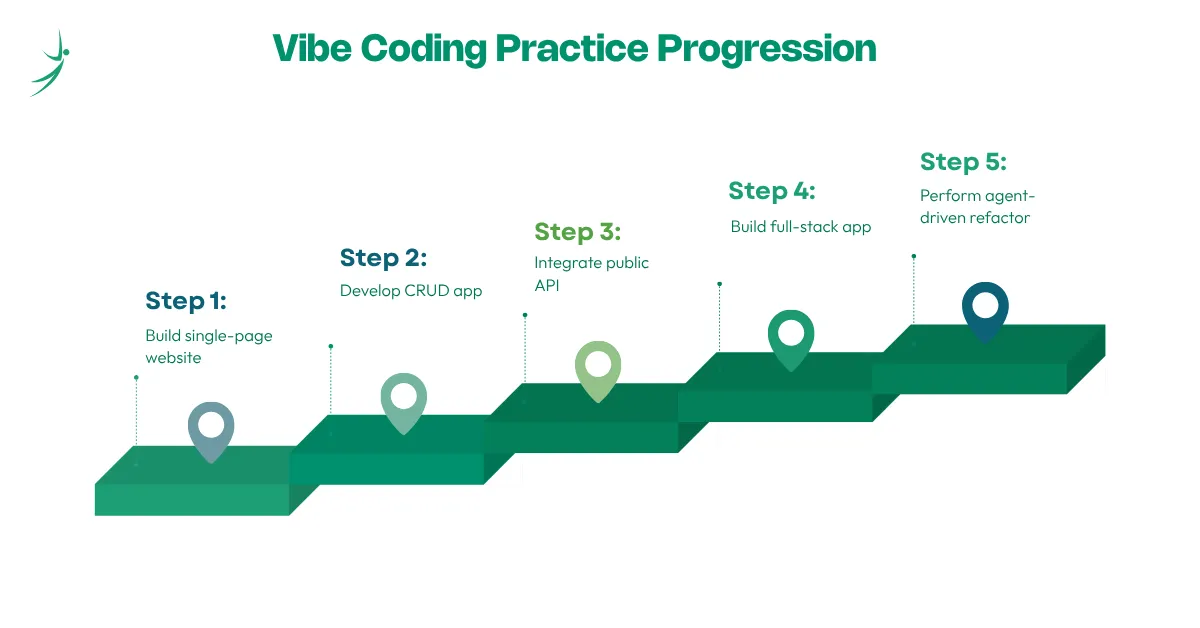
If you are looking for concrete vibe coding projects to build a portfolio or simply learn the workflow, a practical progression looks like this:
- A single-page website with a contact form (good first project in Lovable or Bolt)
- A CRUD app (create, read, update, delete) such as a simple task tracker, to practice database and backend logic. If the terminology here is new, this beginner breakdown of how full-stack web development actually fits together is a useful primer before starting.
- An API-integrated tool, such as a weather dashboard pulling from a public API
- A full-stack app with authentication, such as a mini job board or booking tool
- An agent-driven refactor, taking an existing small codebase and using Claude Code or Cursor to add a feature end to end, including tests
Each step forces engagement with a different fundamental (frontend, database, third-party integration, auth, testing) rather than just generating disconnected demos.
12. Vibe Coding Prompts That Actually Work
Generic prompts produce generic, often broken output. Prompts that hold up across a real project tend to share three traits:
- Specific constraints, not vague goals. "Build a login form" performs worse than "Build a login form using email and password, with client-side validation for a valid email format and a minimum 8-character password, and show an inline error message on failure."
- Explicit tech stack, so the AI is not guessing. Naming the framework, database, and styling approach up front avoids inconsistent output across a session.
- Incremental scope, one feature per prompt rather than an entire app in one instruction. This is the direct fix for what practitioners now call context collapse, where a single AI agent session gradually loses track of earlier decisions the longer and broader a prompt runs, and the resulting code starts contradicting itself.
13. Is Vibe Coding Over? The Honest Answer
This is one of the most-searched questions right now, and it deserves a direct answer rather than a hedge.
- Vibe coding in its original, February 2025 sense, accept the AI's code without reading it and move on, is genuinely fading as a professional practice. The data behind this is fairly stark: a Georgetown CSET study found that close to half of AI-generated code contained security vulnerabilities, and multiple 2026 industry write-ups point to the same root causes: no architecture behind the generated code, no specification for the AI to work from, and long AI sessions accumulating what practitioners now call cognitive debt, meaning the accumulated cost of unreviewed AI decisions and lost context piling up until the codebase becomes unmanageable.
- What is not over is AI-assisted development itself. It has simply moved toward the agentic, review-heavy model described in the vibe coding agents section above. So the honest framing is not "vibe coding is over," full stop, it is that the unsupervised, mega-prompt version of vibe coding is over, while a more disciplined, agent-driven version of the same underlying idea is now the default way serious developers work.
14. Vibe Coding Course, Bootcamp, Class, and Training Options
If you are evaluating a vibe coding course, vibe coding bootcamp, vibe coding class, or any structured vibe coding training, whether as a standalone vibe coding online program, a vibe coding tutorial series, or a full vibe coding full course, the material above should tell you exactly what to check for before enrolling:
- Does it teach prompting alone, or does it also cover reviewing generated code for security and correctness?
- Does it include at least one project built with an agentic tool (Claude Code, Cursor, Replit Agent), not just a one-shot app generator?
- Does it address context management and incremental prompting, or does it encourage single mega-prompts that lead to context collapse?
- Is it recent? Given how fast this space moved between 2025 and 2026, a vibe coding free course or vibe coding tutorial built even a year ago may already be teaching a workflow the field has moved past.
A genuinely useful vibe coding course, free or paid, should leave you able to explain why generated code works, not just how to ask for it. If you want that combination already built into one program rather than assembling it yourself from scattered tutorials, Skill Shikshya's structured full-stack program built around this exact workflow covers fundamentals, agentic tools, and reviewable, production-ready output together.
Frequently Asked Questions
What is vibe coding in simple terms?
What are the benefits of vibe coding?
What are the risks of vibe coding?
How do I get started with vibe coding?
Is vibe coding free?
Is vibe coding over?
What are vibe coding agents?
Can vibe coding replace junior developers?
Can I use vibe coding for game development?
About Author: