The Ultimate IT Career Roadmap 2026: Step-by-Step Guide for Beginners to Get Hired Fast
You've been thinking about it for a while, "Should I get into IT?" Maybe a friend landed a job at a software company right after training. Maybe the salary numbers caught your attention. Whatever brought you here, you're in the right place, and if you're ready to take your first concrete step, this roadmap will show you exactly how.
This IT career roadmap is built for anyone starting from scratch in 2026, whether you're a fresh graduate, a career switcher, or someone without a degree who wants a real shot at a tech job. You'll find a clear path that tells you exactly what to learn, which direction to choose, and how to get hired fast.
Before anything else, what is a career, really? Career, meaning, at its core, is the direction your professional life takes over time. It's not just a job. A career is a sequence of roles, skills, and growth that builds toward something bigger. In IT, that direction can start with a single course and lead to international companies, remote work, freelance income, or a leadership role faster than in almost any other field.
An IT career means working in roles that use technology to solve real business problems, from writing code and managing servers to protecting systems from cyber threats and analyzing data. IT professionals work in banks, hospitals, government offices, startups, and multinational companies. For a full picture of what day-to-day IT work looks like: What Is an IT Career? A Complete Overview for Beginners.
Nepal's IT sector is growing faster than most people realize. Companies in Kathmandu, Lalitpur, and Pokhara are actively hiring, and they are not always waiting for four-year degrees. What they want are skills, certifications, and proof that you can do the work.
Scope of IT in 2026: Why This Year Matters
What is the scope of IT in 2026? Wider than it's ever been and still growing. A few numbers worth knowing:
- Global IT services spending is projected to reach nearly $1.9 trillion by 2026 (Gartner).
- The U.S. Bureau of Labor Statistics projects IT employment to grow 15% through 2031, far above the average for all industries.
- Nepal’s IT ecosystem includes hundreds of registered companies and a rapidly growing freelancer base.
- Nepal’s IT exports have grown rapidly, surpassing NPR 67 billion in 2022 and exceeding $1 billion annually in recent years.
The IT scope in Nepal is particularly strong right now. The government's push toward digital infrastructure, e-governance projects, smart city planning, and Nepal's growing startup culture are all creating real demand for trained IT professionals across the country.
The IT scope is not limited to one type of role. What is the scope of IT that stretches across software companies, banks, hospitals, telecom providers, e-commerce businesses, government agencies, NGOs, and international organizations — all of which run on technology and need people to build and maintain it.
The scope of IT in future will grow even further as more Nepali businesses go digital and as remote work opens doors to global clients. For the full breakdown: Scope of IT Career in Nepal.
Will AI Replace IT Jobs? What Beginners Need to Know
This is the question every beginner in 2026 is asking. It deserves a straight answer.
AI is already changing IT work. Tools like GitHub Copilot write code suggestions in real time. ChatGPT can draft scripts and explain errors. AI-powered security tools can detect threats faster than manual review. So — should you be worried?
No. And here's why.
AI is replacing tasks, not careers. It is automating repetitive, predictable work — things like writing boilerplate code, generating test cases, or basic data entry. What it cannot replace is judgment, problem-solving, and the ability to understand what a business actually needs.
In fact, AI is creating entirely new IT roles:
- AI/ML Engineer: building and training machine learning models
- Prompt Engineer: writing effective inputs for large language models
- AI Data Annotator: preparing and labeling training datasets
- MLOps Engineer: deploying and maintaining AI systems in production
- AI Cybersecurity Analyst: detecting AI-based threats and attacks
The IT professionals who will thrive are the ones who use AI tools as assistants — not the ones who ignore them or fear them. A developer who uses GitHub Copilot well produces more in a day than one who doesn't. That's a skill, and it's learnable.
What this means for beginners starting in 2026:
- Learning to work with AI tools is now part of being a competitive IT professional
- Core technical fundamentals (logic, networking, data structures, security principles) matter more than ever AI tools don't remove the need to understand what you're doing
- Fields like cybersecurity, cloud infrastructure, and software architecture are growing faster partly because of AI, not despite it
- IT-related jobs in Nepal and globally are multiplying — the World Economic Forum estimates AI will create 97 million new roles by 2025, with technology jobs making up a significant share
The bottom line: AI doesn't make IT careers less viable. It makes the wrong approach to IT less viable. Stay curious. Keep learning. Use the tools available. That's the difference between someone AI replaces and someone AI makes more productive.
IT Career Path Options: Which Field Is Best for You in Nepal?
One of the most common questions beginners ask is: Which IT career is best for the future? Or more specifically, what career path is right for me?
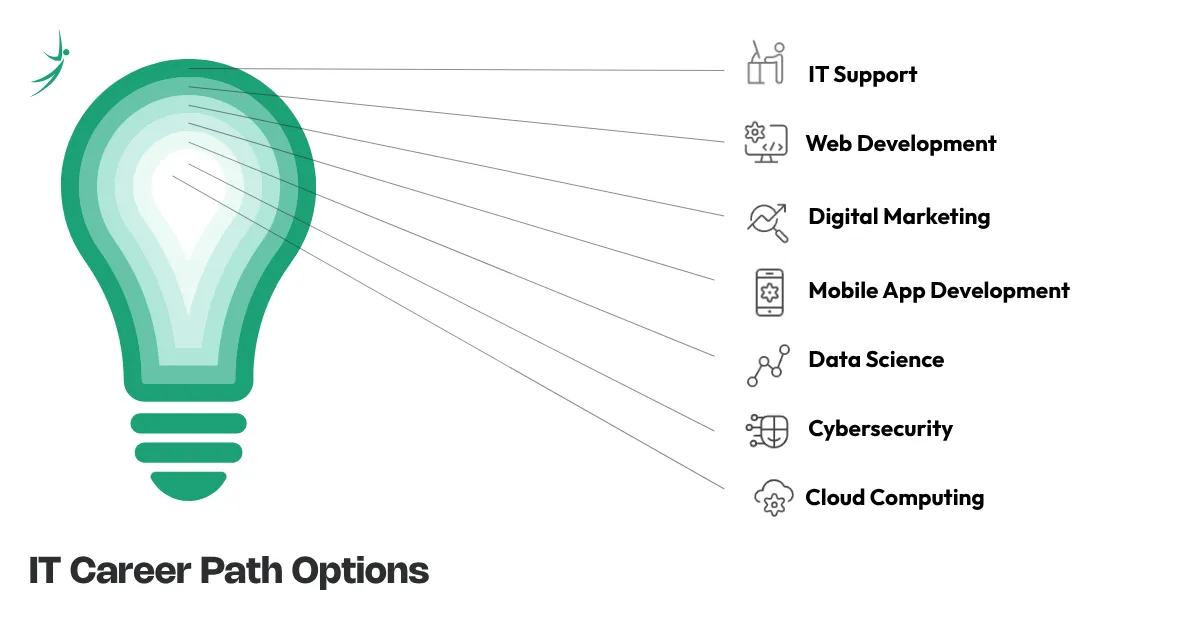
The honest answer: it depends on what you enjoy doing, what you're naturally good at, and what the Nepali job market actually needs. Understanding your career options clearly is the first real step.
Before diving in, it's worth checking out the latest IT skills in demand to see which technologies employers are actively hiring for right now. How many career paths are there in IT? Broadly speaking, there are seven main directions a beginner can take. Here they are with a clear, Nepal-specific verdict for each:
1. Web Development
Build and maintain websites using HTML, CSS, JavaScript, and frameworks like React.js, Node.js, and PHP Laravel. This is the most in-demand IT field for freshers in Nepal right now. Job postings are plentiful, training resources are accessible, and the freelancing market is strong.
- Best for: Getting hired fast, freelancing, and entry-level roles in Nepal.
- IT jobs examples: Frontend Developer, Backend Developer, Full-Stack Developer, WordPress Developer.
2. Mobile App Development
Build apps for Android and iOS. Flutter and React Native are the most requested skills at Nepali companies like Leapfrog Technology and F1Soft. Salary growth once you have 1–2 years of experience is among the highest in the local market.
- Best for: Long-term salary growth, product companies, and startup roles.
- IT jobs examples: Flutter Developer, React Native Developer, Android Developer.
3. Cybersecurity
Protect systems, networks, and data from attacks. Demand is rising sharply worldwide. In Nepal, this is a thin talent pool, which means significantly less competition for trained candidates.
- Best for: High salary ceiling, global job opportunities, government roles.
- IT jobs examples: Cybersecurity Analyst, Ethical Hacker, Security Engineer, SOC Analyst.
4. Data Science & Analytics
Work with datasets, build models, and help organizations make better decisions. Python, SQL, Tableau, and Power BI are standard tools. Cotiviti Nepal and CloudFactory are major local employers in this space.
- Best for: Research-oriented people, remote work, international companies.
- IT jobs examples: Data Analyst, Business Intelligence Analyst, Data Engineer, ML Engineer.
5. Cloud Computing & DevOps
Companies are moving everything to AWS, Microsoft Azure, and Google Cloud. DevOps and cloud engineers are among the highest-paid professionals across the entire IT sector.
- Best for: Highest long-term salary, international remote roles.
- IT jobs examples: Cloud Engineer, DevOps Engineer, Site Reliability Engineer, AWS Solutions Architect.
6. IT Support & Help Desk
The classic entry point into IT. Fix technical issues, manage hardware and software, and keep systems running. IT support jobs in Nepal are available at banks, ISPs, telecom companies, and large enterprises consistently throughout the year.
- Best for: Getting into IT with minimal prior knowledge, building experience fast.
- IT jobs examples: IT Support Engineer, Help Desk Technician, System Administrator, Technical Support Specialist.
7. Digital Marketing & IT
Combining SEO, paid advertising, analytics, and automation. Strong freelancing path and in high demand at agencies, e-commerce businesses, and startups across Nepal.
- Best for: Freelancers, creative-technical hybrid profiles. If this direction appeals to you, there's a dedicated guide on breaking into digital marketing from an IT background worth reading before you commit.
- IT jobs examples: SEO Specialist, Digital Marketing Analyst, PPC Manager, Social Media Strategist.
Quick decision table for choosing the career path in Nepal:
| What career path should I take? | Best Field |
|---|---|
| I want to get hired in Nepal within 6 months | Web Development or IT Support |
| I want the highest long-term salary | Cloud/DevOps or Cybersecurity |
| I want to freelance from anywhere | Web Dev, Digital Marketing, or Data |
| I want to work for international companies | Software Engineering or Cloud |
| I prefer working with people, not deep code | IT Support or Digital Marketing |
Not sure which career path to choose? Ask yourself one question: Do you prefer building things, protecting things, analyzing things, or helping people? That single answer narrows your career options down to one or two realistic fields immediately.
The IT Career Roadmap 2026 — Step-by-Step for Beginners
Here is the actual step-by-step IT career roadmap you should follow in 2026. This is a practical sequence, not a generic checklist.
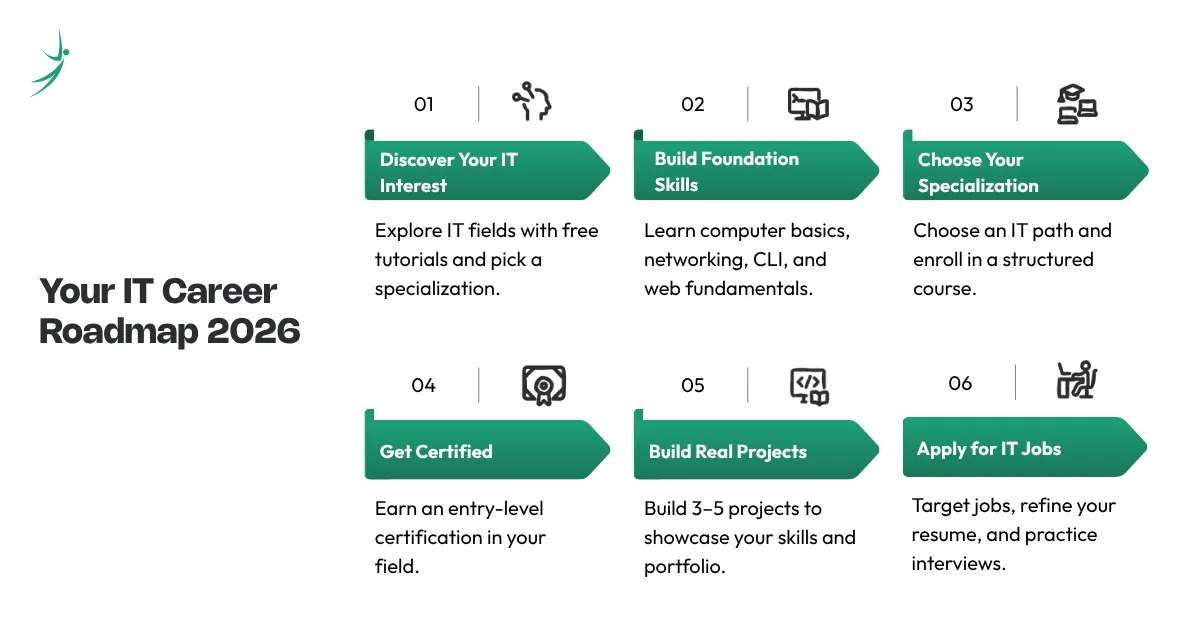
Step 1: Discover Your IT Interest (Week 1–2)
Before you spend money on courses or certifications, spend two weeks exploring. Watch free YouTube tutorials on web development, cybersecurity, data science, and networking. Notice which topics hold your attention past the first 10 minutes.
This matters more than most people think. Choosing a direction you genuinely find interesting means you'll push through the hard parts instead of quitting halfway through.
Action: Pick ONE field. You can always expand later, starting too broad is the fastest way to stay stuck.
Set a concrete career plan right now: "In 90 days, I will complete [specific course], build [specific project], and apply to [number] IT jobs." Write it down. Review it every two weeks. What is your career plan will be the anchor that keeps you consistent when motivation drops.
Step 2: Build Your Foundation Skills (Month 1–3)
Every IT career path shares some foundational knowledge:
- Basic computer literacy — file systems, OS navigation, keyboard shortcuts
- Networking basics — how the internet works, IP addresses, DNS, HTTP/HTTPS
- Command line basics — Terminal (Linux/macOS) or Command Prompt (Windows)
- How the web works — browsers, servers, databases, APIs
For developers: start with HTML, CSS, and JavaScript. For cybersecurity: start with networking fundamentals and Linux. For data: start with Excel, then move to Python and SQL.
Free resources to use: freeCodeCamp, Cisco NetAcad, Khan Academy, Google's IT Support Certificate on Coursera.
For a complete breakdown of what skills each field needs: Skills Required for an IT Career
Step 3: Choose Your Specialization (Month 2–4)
Once you have a feel for the basics, narrow your focus. Go deep into one specialization rather than skimming five things at once.
Use the decision table above. Pick your field, then find a structured course or training program that covers that specific path end-to-end, not scattered YouTube videos, but a curriculum with a clear start and finish. In Nepal, choosing where you train matters as much as what you study, so it's worth evaluating your options carefully.
Step 4: Get Certified (Month 3–6)
Certifications prove your knowledge and signal to employers that you're serious. In Nepal's job market, certifications from recognized bodies carry real weight, especially when you're a fresher without prior work experience.
Entry-level certifications by field:
| Field | Certification to Get |
|---|---|
| IT Support | CompTIA A+ |
| Networking | CompTIA Network+ |
| General IT (beginner) | Google IT Support Professional Certificate |
| Cloud | AWS Cloud Practitioner or AZ-900 (Microsoft Azure) |
| Cybersecurity | CompTIA Security+ |
| Digital Marketing | Google Analytics Certification or Meta Blueprint |
Pick one. Complete it before moving on.
Step 5: Build Real Projects and a Portfolio (Month 4–7)
This step separates people who get hired from people who keep studying forever.
Employers want to see what you can do, not just what certificates you hold. Build 3–5 projects that show real, working skills:
- A functional website or web app (for developers)
- A network simulation using Cisco Packet Tracer (for networking)
- A data dashboard built from real public data (for data science)
- A vulnerability assessment report from a legal practice environment (for cybersecurity)
Upload code to GitHub. Build a simple portfolio website. Every real project you show is worth more than ten bullet points on a resume.
Step 6: Apply for IT Jobs and Get Hired (Month 6–8)
Now you apply, but smart targeting beats mass-applying.
Where to find IT jobs in Nepal for freshers:
- Merojob.com — Nepal's largest job portal
- LinkedIn — Most tech companies post actively here
- Kumarijob.com and Jobsnepal.com
- Company career pages directly: F1Soft, Cotiviti Nepal, CloudFactory, Deerwalk Services, Leapfrog Technology, Vianet, Subisu
- Facebook IT groups — Many Nepali companies still recruit through them
What your resume needs:
- A short, skills-based summary (3 lines max)
- Relevant certifications with the issuing organization
- 2–3 project links (GitHub or portfolio site)
- Any freelance, volunteer, or personal work that shows skill
- Clean, single-page formatting
Practice for technical interviews: LeetCode (developers), TryHackMe (cybersecurity), Kaggle (data science).
How Long Does It Actually Take to Get an IT Job?
Most articles give you one vague answer "6 to 12 months." That's not useful. Here's the real breakdown by field and study intensity:
| IT Field | Part-Time (10 hrs/week) | Full-Time (30–40 hrs/week) |
|---|---|---|
| Web Development | 9–12 months | 5–7 months |
| Mobile App Development | 10–14 months | 6–8 months |
| IT Support | 4–6 months | 2–3 months |
| Cybersecurity | 10–14 months | 6–9 months |
| Data Analytics | 8–12 months | 5–7 months |
| Cloud/DevOps | 12–18 months | 7–10 months |
A few honest factors that affect your timeline:
What makes it faster:
- Structured training with a mentor (vs. self-studying alone)
- Building projects from week 1, not just watching videos
- Applying to jobs before you feel "ready," most freshers wait too long
- Having a clear career plan and sticking to it
What slows people down:
- Switching fields every few weeks
- Studying theory without building anything
- Waiting to get certified before touching real tools
- Not applying until the portfolio is "perfect."
The fastest path to your first IT job is: structured training + real projects + early applications. That combination consistently gets people hired faster than self-paced studying alone.
Common Mistakes Beginners Make on Their IT Career Path
Understanding what not to do is just as important as knowing what to do. These are the most common mistakes that delay beginners sometimes by months.
Mistake 1: Not Knowing Which Career Path to Choose — and Guessing Instead of Testing
"Which career path should I choose?" is the most common question beginners ask, but many answer it by going with whatever a friend did or whatever they saw advertised. The result is three months into a data science course, wondering why it doesn't feel right.
The fix: Spend 1–2 weeks genuinely testing different fields before committing. Watch tutorials. Try a small beginner project. What career path is for me becomes clear once you've actually tried things, not before.
Mistake 2: Trying to Learn Everything at Once
IT has hundreds of tools, languages, and technologies. Beginners often try to study Python, Java, networking, cloud, and cybersecurity simultaneously, then wonder why nothing is sticking.
The fix: Pick one field. Go all the way through it. Get hired. Then expand.
Mistake 3: Skipping the Portfolio
The single most common reason freshers don't get callbacks is having a resume with zero proof of work. A certificate tells an employer you studied something. A working project tells them you can actually do it.
Mistake 4: Waiting Until You're "Ready" to Apply
Most beginners wait until they feel completely ready, meaning they never apply. Applying for IT jobs in Nepal for freshers when you have even 2–3 solid projects and a certification, is enough to get interviews. Interviews themselves teach you more than another month of studying.
Mistake 5: Ignoring Soft Skills
IT companies, especially in Nepal, increasingly assess communication, teamwork, and problem-solving mindset during hiring. Technical skills get you the interview. How you think and communicate gets you the job.
Mistake 6: Choosing a Field Based Only on Salary
"What is the best IT job?" should not be answered by salary alone. If you choose cloud computing purely for the pay but find infrastructure work deeply boring, you'll burn out before you're good enough to earn that salary. Match the field to your natural interest; first salary follows skill.
Mistake 7: Not Having a Career Plan
Why do you want to study an IT course? If your answer is vague, "to get a job" or "IT is good," you're starting without direction. A clear career plan means: what field, what certification, what projects, what job title, what timeline. That specificity is what separates people who get hired in 6 months from people who are still figuring it out after 2 years.
IT Career Path Without a Degree
Can you get an IT job without a college degree? Yes, and this is not just motivation talk.
Google, IBM, Apple, and Tesla have all removed degree requirements for many roles. In Nepal, IT companies care far more about your skills and portfolio than your educational papers. Many of the best developers, analysts, and cybersecurity professionals at top Nepali companies never finished a four-year CS degree.
Here's what matters more than a degree:
- A recognized industry certification (CompTIA, AWS, Google, Microsoft)
- A portfolio with 3–5 real, working projects
- Problem-solving ability — demonstrated through technical tests and interviews
- Clear communication — both written and verbal
- Consistency — a GitHub profile with regular commits tells a stronger story than a transcript
The path without a degree requires more self-discipline, but it is completely open. It jobs no degree are not just possible for many roles in Nepal, it is already the norm.
Read the full guide: How to Start an IT Career Without a Degree
IT Career Salary in Nepal: What to Expect
Here is a realistic picture of IT salaries in Nepal in 2026:
| Role | Fresher (Monthly) | 2–3 Years Experience |
|---|---|---|
| Web Developer | NPR 25,000 – 45,000 | NPR 60,000 – 1,00,000+ |
| Mobile App Developer | NPR 30,000 – 50,000 | NPR 70,000 – 1,20,000+ |
| Data Analyst | NPR 30,000 – 55,000 | NPR 70,000 – 1,10,000+ |
| Cybersecurity Analyst | NPR 35,000 – 60,000 | NPR 80,000 – 1,50,000+ |
| Cloud/DevOps Engineer | NPR 40,000 – 70,000 | NPR 1,00,000 – 2,00,000+ |
| IT Support Engineer | NPR 20,000 – 35,000 | NPR 40,000 – 70,000 |
Remote work for international clients changes these numbers significantly. A developer working remotely for a US or European company from Nepal can earn 3–5x what the local market offers, and this is increasingly common among Skill Shikshya graduates.
How to Start Your IT Career with Skill Shikshya
Skill Shikshya (Best IT Training Institute in Nepal) was built specifically for people who want to enter IT through structured, practical training, not just theory and video watching.
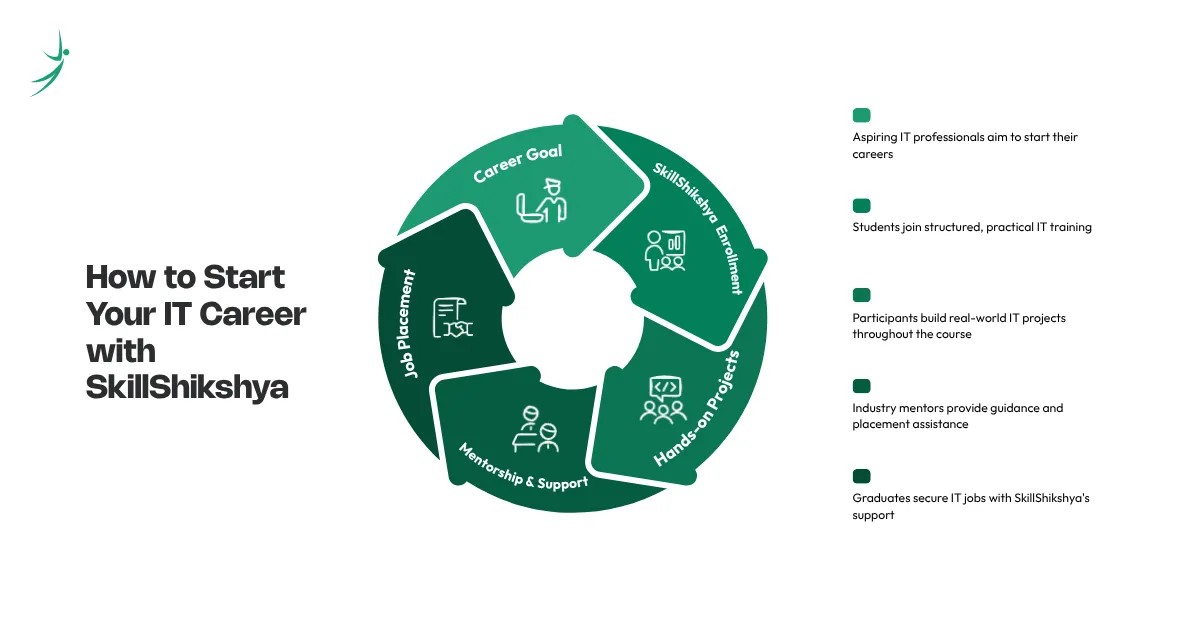
Here's what makes training at Skill Shikshya different from self-studying:
- Job-focused curriculum — courses are built around what Nepal's IT companies actually hire for, not outdated textbook topics
- Hands-on projects — you build real things throughout the course, not just at the end
- Mentors with industry experience — guidance from people who have worked in actual IT roles
- Placement support — resume help, portfolio review, interview prep, and direct connections with hiring companies
- Flexible schedules — evening and weekend batches for working professionals and students
If you're serious about starting your IT career in 2026, the right training significantly shortens how long it takes to get hired and removes the guesswork of figuring out what to learn next.
Explore courses: IT Courses with Job Placement Support at Skill Shikshya
Conclusion
Getting into IT in 2026 is more accessible than it's ever been. Training resources are widely available. Certifications are globally recognized. Companies in Nepal and abroad are looking for skilled professionals, and a university degree is not always a requirement.
What companies do want is proof: proof that you can do the work, that you've built something real, and that you're committed to getting better. AI is not eliminating IT careers; it's eliminating the excuse that IT is too hard to get into.
The IT career roadmap is clear. Pick your direction. Build your foundation. Get certified. Build a portfolio. Apply before you feel perfectly ready. Learn from the process. Keep going.
If you want structured guidance and real placement support, Skill Shikshya (Best IT Training Institute In Nepal) is built for exactly that.
Explore IT Courses at Skill Shikshya and take the first step today.
Frequently Asked Questions
What is a career roadmap in IT?
What is a career, and why does it matter in IT?
What is a IT career and what does it involve day-to-day?
Is an IT career good in Nepal?
Can I get an IT job without a degree in Nepal?
Which IT career is best for the future?
Are IT jobs in demand in Nepal?
How many career paths are there in IT?
What it career path is right for me?
Why do I want to study an IT course?
What skills are required for an IT career?
How do I start a career in IT?
About Author: