IT Skills in Demand (2026) - Technical & Soft Skills Guide | Skill Shikshya
The most in-demand IT skills in 2026 are Artificial Intelligence and Machine Learning, Cloud Computing and DevOps, Cybersecurity, Full Stack Web Development, Data Science, UI/UX Design, Quality Assurance, and Mobile App Development, alongside critical soft skills like problem-solving, communication, and adaptability that employers now evaluate as seriously as technical ability.
Why IT Skills Matter More Than Degrees in 2026
The IT job market has changed fundamentally. A decade ago, a computer science degree was your entry ticket into the tech industry. Today, Nepal's fastest-growing IT companies - from Kathmandu-based startups to outsourcing firms working with international clients- are making hiring decisions based on one thing above everything else: what can you actually build, test, secure, or deploy?
This shift is not unique to Nepal. Globally, organizations are moving away from credential-based hiring toward skills-based hiring, prioritizing candidates who demonstrate real-world capability over those who simply hold the right certificate. If you want to understand what an IT career is and whether it is the right path for you, the answer increasingly comes down to skills, not the institution you attended or the degree you hold.
Understanding which IT skills are in demand is, therefore, the most important research you can do before committing to a learning path. The wrong skills cost you months. The right skills get you hired. At Skill Shikshya: best IT training institute in Nepal, every course is built around exactly this principle, teaching the skills Nepal's IT employers are actively hiring for, with an AI-integrated curriculum that keeps pace with how the industry actually evolves. If you are still figuring out where to begin, our complete guide on how to start a career in IT maps out every step from zero to job-ready.
In this article, we cover the core technical IT skills in demand globally, the soft skills that separate hired candidates from rejected ones, a dedicated breakdown of IT skills in demand specifically in Nepal's job market, and a practical action plan for building these skills fast, whether you are a complete beginner or an experienced professional looking to upskill.
Key insight
The common thread across all these fields is the same — practical skills + real projects + structured training. A degree is optional. A portfolio is not.
Core Technical IT Skills in Demand
Technical skills are the foundation of every IT career. They are the specific, measurable abilities that determine which roles you qualify for, which salary range you can command, and how quickly you progress in the industry. The following are the core technical IT skills that global employers, and Nepal's IT companies specifically, are actively hiring for in 2026. For a complete breakdown of which training programs teach each of these skills in Nepal, see our guide on the best IT training courses in Nepal.
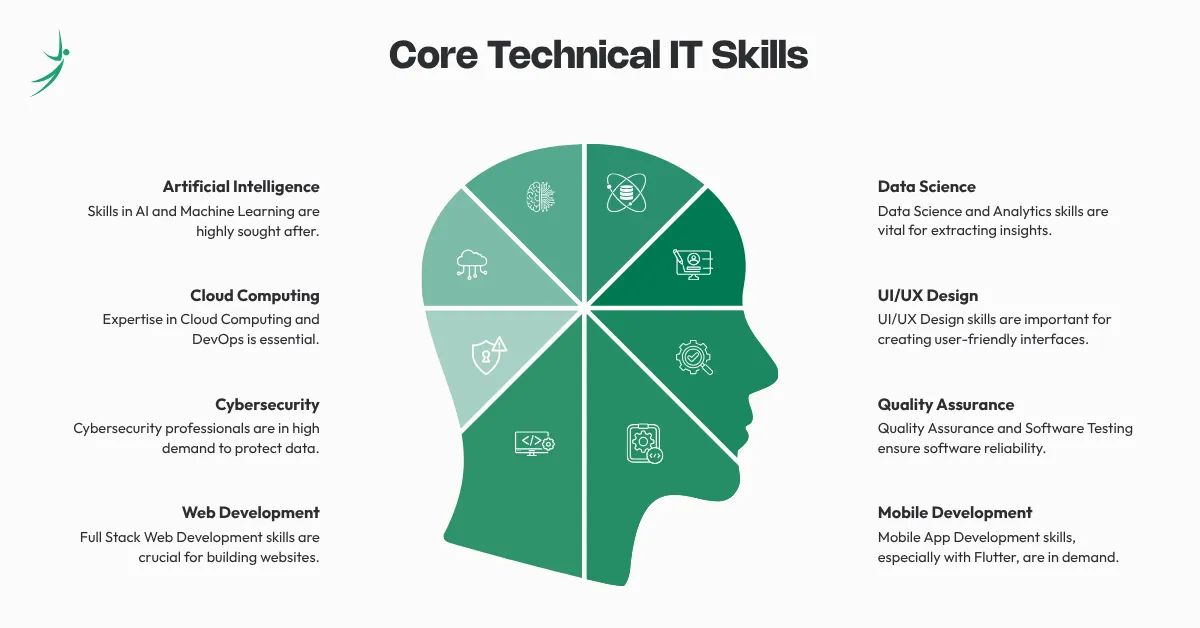
Artificial Intelligence and Machine Learning
AI and Machine Learning have moved from emerging technology to core business infrastructure. Companies across every industry are now building AI-powered products, automating workflows with intelligent systems, and integrating machine learning models into their decision-making processes. The most in-demand AI skills include Python programming, prompt engineering, large language model (LLM) integration, machine learning model development using TensorFlow and Scikit-learn, natural language processing (NLP), and AI agent architecture using frameworks like LangChain and CrewAI. According to data from Indeed, job postings requiring AI skills grew from 5% to over 9% between 2024 and 2025, and that number is accelerating. Organizations now expect even entry-level IT candidates to have foundational AI literacy at a minimum. The professionals who can actually build, deploy, and integrate AI systems are among the highest-paid in the entire industry.
Cloud Computing and DevOps
Cloud Computing and DevOps represent the infrastructure layer of the modern IT industry, and proficiency in these skills is no longer optional for serious IT professionals. Cloud computing involves designing, deploying, and managing applications and infrastructure on platforms like AWS, Microsoft Azure, and Google Cloud. DevOps bridges the gap between development and operations teams, automating the software delivery pipeline for faster, more reliable releases. The specific skills employers look for include Docker and Kubernetes for containerization, CI/CD pipeline automation with Jenkins and GitHub Actions, infrastructure as code with Terraform, Linux fundamentals, and scripting with Python or Bash. According to Pluralsight's 2026 Tech Forecast, based on 1,500+ tech industry insiders, cloud computing ranked as the number one field tech professionals were upskilling in, above even AI. Professionals who combine cloud and DevOps skills command the highest entry-level salaries of any IT specialization.
Cybersecurity
Cybersecurity is one of the fastest-growing and most critically undersupplied IT skills globally. As organizations digitize operations, move to cloud infrastructure, and adopt AI tools, their exposure to cyber threats grows proportionally. The 2025 ISC2 Cybersecurity Workforce Study found that 95% of cybersecurity teams have at least one critical skills gap, meaning demand is consistently outpacing the supply of qualified professionals. Core cybersecurity skills in demand include ethical hacking and penetration testing, network security, vulnerability assessment, threat detection and incident response, and secure cloud configuration. Tools employers look for include Kali Linux, Metasploit, Wireshark, Nmap, and SIEM platforms. Globally recognized certifications like CEH (Certified Ethical Hacker) and CompTIA Security+ significantly increase employability and salary potential in this field.
Full Stack Web Development
Full Stack Web Development remains the most consistently in-demand technical skill across Nepal's IT companies, startups, and outsourcing firms. A full-stack developer can handle both frontend and backend development, making them one of the most versatile and hireable professionals in any tech team. The dominant technology stack in Nepal's job market is MERN, MongoDB, Express.js, React.js, and Node.js, which matches exactly what companies are listing in their job descriptions right now. Core skills include JavaScript, React for frontend, Node.js for backend, REST API development, database management with MongoDB and SQL, version control with Git, and basic deployment knowledge. Full-stack developers who also understand cloud integration and AI-assisted development tools are particularly attractive to employers in 2026.
Data Science and Analytics
Data Science is the skill of extracting meaningful, actionable insights from large datasets, and it is growing fast as Nepal's banking, e-commerce, and fintech sectors adopt data-driven decision-making. Core data science skills include Python with Pandas and NumPy, data visualization with Matplotlib and Power BI, SQL for database querying, statistical analysis, and machine learning fundamentals with Scikit-learn. Data analytics, a more accessible entry point into this field, focuses on tools like Excel, SQL, and Power BI to analyze and present business data clearly. The data analytics market globally is projected to grow to $345 billion by 2030, creating sustained long-term demand for professionals with these skills at every level of expertise.
UI/UX Design
UI/UX Design sits at the intersection of creativity and technology, and it is one of the most accessible technical IT skills for people entering the industry from non-coding backgrounds. UI (User Interface) focuses on how a product looks. UX (User Experience) focuses on how it works and feels for the user. As Nepal's digital product market grows and more businesses invest in apps and platforms, demand for skilled designers who can create intuitive, visually clean experiences is rising steadily. The core tools every UI/UX professional must master include Figma, Adobe XD, Maze for usability testing, and prototyping methodologies. Design thinking, user research, wireframing, and the ability to communicate design decisions to developers and stakeholders are equally important skills that go beyond tool proficiency alone.
Quality Assurance and Software Testing
Quality Assurance is one of the most underestimated yet consistently in-demand IT skills in the industry. Every software product that ships needs to be tested systematically, thoroughly, and repeatedly. QA engineers ensure that what developers build actually works the way it is supposed to. Core QA skills include manual testing, test case design, the Software Development Life Cycle (SDLC) and Software Testing Life Cycle (STLC), and automation testing using tools like Selenium, Postman, Cypress, and JIRA. AI-powered testing tools are now being integrated into QA workflows, automating repetitive test cases and detecting performance issues faster than manual processes, making QA professionals who understand both manual and automated testing particularly valuable. QA is also one of the best entry points into Nepal's IT industry for beginners; it has a shorter learning curve than development and gets you inside a tech company from day one.
Mobile App Development: Flutter
Mobile App Development is one of the fastest-growing technical skill areas in Nepal, driven by the country's rapid adoption of mobile-first digital services across banking, e-commerce, delivery, and edtech. Flutter, Google's open-source framework built on the Dart programming language, is the dominant mobile development technology being taught and hired for in Nepal right now. What makes Flutter particularly powerful is that a single codebase deploys to Android, iOS, web, and desktop simultaneously. Core Flutter skills include Dart fundamentals, Flutter widgets, state management, Firebase integration, REST API consumption, and deployment to the Google Play Store and Apple App Store. Mobile developers who can build and deploy cross-platform apps are more versatile and in demand than single-platform developers, and Flutter freelance opportunities on international platforms like Upwork are particularly strong.
Soft Skills for IT Professionals
This is the section most IT skill guides completely skip, and it is exactly why so many technically capable candidates still struggle to get hired. Technical skills get your resume shortlisted. Soft skills get you the offer. Nepal's IT employers are increasingly vocal about this gap: candidates can write clean code but cannot explain what they built, cannot work in a team under deadline pressure, or cannot handle feedback without becoming defensive. These are not minor issues; they are deal-breakers in collaborative tech environments. The following soft skills are what IT employers in Nepal and globally are actively evaluating during interviews and probation periods in 2026.
Problem-Solving and Analytical Thinking
Problem-solving is the single most universally valued skill across every IT role, from junior developer to senior DevOps engineer. IT work is fundamentally about encountering problems you have never seen before and finding structured, logical ways to resolve them. Employers do not just want candidates who can follow instructions; they want professionals who can debug independently, think through edge cases, and build solutions that account for real-world complexity. Analytical thinking, the ability to break a large, ambiguous problem into smaller, solvable components, is what separates a good IT professional from an exceptional one. This skill cannot be taught in a single session. It is built through consistent practice on real projects, debugging live code, and working through challenges without immediately asking for help.
Communication Skills
In Nepal's IT industry, the ability to communicate clearly is valued almost as highly as technical skill, and for remote and international work, it is arguably more important. IT professionals must communicate with teammates, project managers, clients, and non-technical stakeholders simultaneously. That means explaining a complex technical bug in plain language to a client, writing clear documentation that another developer can follow six months later, and giving precise status updates that help project managers plan accurately. English proficiency is a particular priority for Nepal's IT employers, especially companies working with international clients or on remote projects. Candidates who can communicate technical concepts confidently in English have a measurable advantage in hiring decisions and salary negotiations.
Teamwork and Collaboration
Almost no IT work happens in isolation. Software is built by teams. Products are designed collaboratively. Deployments are coordinated across multiple roles. The ability to work effectively within a team, contributing your part, supporting teammates, respecting deadlines that others depend on, and managing conflict professionally is a non-negotiable soft skill for any IT professional. Nepal's IT companies specifically look for candidates who have demonstrated collaboration through real projects, either academic group work, open-source contributions, or internship experience. Employers evaluate this skill during interviews by asking situational questions about past team experiences. Having concrete, honest answers prepared is essential.
Adaptability and Continuous Learning
The IT industry evolves faster than any other professional field. A tool that was cutting-edge two years ago may already be deprecated. A framework that dominates today's job listings may be replaced within five years. The professionals who sustain long-term IT careers are not necessarily the most technically brilliant; they are the ones who adapt fastest to new technologies, embrace continuous learning as a professional habit rather than a temporary obligation, and stay genuinely curious about how the industry is changing. Employers in 2026 are specifically hiring for learning agility, the demonstrated ability to pick up new tools, frameworks, and methodologies without losing momentum. Your GitHub activity, side projects, certifications, and engagement with tech communities are all signals of this quality that employers can evaluate before you even walk into an interview.
Time Management and Meeting Deadlines
IT projects run on deadlines. Sprints, release cycles, client commitments, and deployment windows all depend on every team member delivering their work on time. Poor time management is one of the most common reasons freshers struggle in their first IT roles, not because they cannot do the work, but because they underestimate how long tasks take, fail to communicate blockers early, and consistently miss the estimates they have committed to. Strong time management in an IT context means breaking your work into clear tasks, accurately estimating, flagging issues before they become delays, and protecting your focus time from unnecessary interruptions. This skill is developed through real project experience, which is exactly why training programs that include live project work are significantly more valuable than those that only teach theory.
IT Skills in Demand in Nepal
Nepal's IT job market has its own specific characteristics that are important to understand separately from global trends. While global IT skills lists are useful for direction, the skills that get you hired in Kathmandu's tech companies, placed in Nepal's outsourcing firms, or secured in remote roles for international clients from Nepal have some important nuances that generic articles completely miss.
Nepal's IT sector currently employs professionals across software companies, outsourcing firms, fintech startups, banks, telecom companies, and e-commerce platforms. Companies like Leapfrog Technology, Cotiviti Nepal, Fusemachines, CloudFactory, Verisk, and F1Soft are among the major employers, and their hiring patterns reveal exactly which skills Nepal's market is actively paying for right now.
Full Stack Development (MERN) remains the single highest-demand skill in Nepal's local job market. Job portals like Merojob, Kumarijob, and Necojobs consistently show more Full Stack and React developer listings than any other IT role. DevOps and Cloud is the fastest-growing hiring category, Nepal's outsourcing companies and fintech firms are aggressively adopting cloud infrastructure, and qualified DevOps engineers are severely undersupplied relative to demand. Cybersecurity is becoming a national priority. Nepal Rastra Bank's Cyber Resilience Guidelines have created mandatory security requirements for financial institutions, directly driving demand for cybersecurity professionals across banking and fintech. Data Science and AI roles are growing fast, led by companies like Fusemachines and CloudFactory, which have built entire business models around AI talent in Nepal. UI/UX Design and QA remain steady, reliable career paths with consistent hiring across Nepal's software product companies.
For remote work specifically, which is one of Nepal's most significant IT career opportunities, the most valued skills are Full Stack Development, Flutter, DevOps, and AI engineering. Nepal's IT professionals working remotely for international clients through platforms like Upwork and Toptal earn two to five times more than local market rates, making remote-ready skills an extremely high-return investment. For a complete salary breakdown by role, see our guide on high-paying IT jobs in Nepal.
One thing Nepal's IT employers consistently emphasize is that global articles underreport: English communication, portfolio quality, and practical project experience are often more decisive hiring factors than technical knowledge alone. A candidate with slightly weaker technical skills but a strong GitHub portfolio, clear English communication, and two completed real-world projects will consistently outperform a technically stronger candidate with no portfolio and poor communication. This is the real gap in Nepal's IT talent market, and it is exactly what the right training institute bridges. For the most thorough comparison of which institutes in Nepal actually deliver on placement, read our complete breakdown of the best IT training institute in Nepal.
How to Build IT Skills Fast in Nepal
Knowing which IT skills are in demand is step one. Building them effectively, without wasting months on the wrong approach, is what actually gets you hired. Here is the most direct, practical path to building job-ready IT skills in Nepal in 2026.
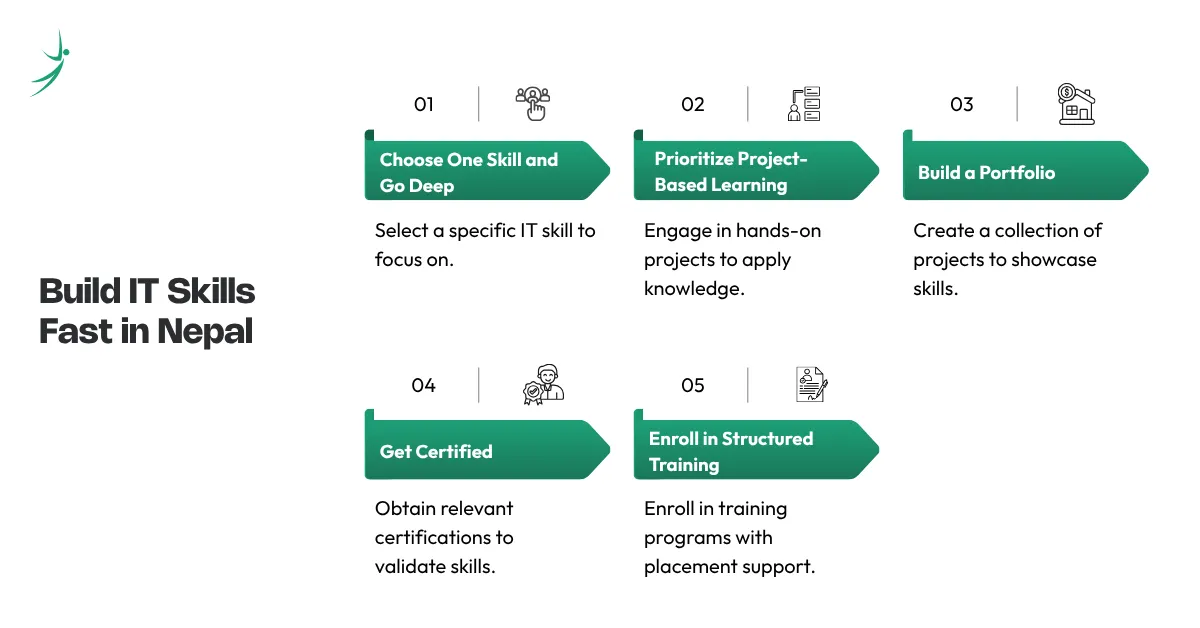
Choose One Skill and Go Deep
The single biggest mistake aspiring IT professionals make is trying to learn everything simultaneously. They start Python, then pivot to web development, then get distracted by cybersecurity, then try UI/UX, and end up with surface-level knowledge in four areas and deep knowledge in none. Employers do not hire generalists at the entry level. They hire specialists with demonstrable depth in one skill. Choose the one skill that aligns with your interest and the market demand data in this article, commit to it completely, and do not move to the next skill until you have built something real with the first one. For help deciding which path fits you, our IT career roadmap breaks down every major IT career path with a step-by-step progression from beginner to job-ready.
Prioritize Project-Based Learning Over Theory
Reading about programming does not make you a programmer. Watching tutorials about UI/UX does not make you a designer. The only thing that builds real IT skills is building real things. Every hour you spend applying a concept to an actual project is worth five hours of passive learning. From day one of your training, ask yourself: What can I build with what I learned today? Start small, a simple webpage, a basic CRUD application, a UI prototype for a problem you actually care about. Then get progressively more complex. Your portfolio of completed projects is ultimately what employers evaluate, not your course completion certificates. This is why IT courses with job placements that include live project work are significantly more valuable than those that only cover theory.
Build a Portfolio That Employers Can See
In Nepal's IT job market, a strong portfolio is often more persuasive than a degree. Your portfolio should be hosted where employers can actually see it, GitHub for development work, Behance or Figma Community for UI/UX design, and a personal portfolio website for everything. Every project in your portfolio should have a clear description of what it does, what technologies you used, what problem it solves, and what you learned building it. Quality matters more than quantity; three well-documented, genuinely useful projects will always outperform ten half-finished tutorials. Keep your GitHub active; employers in Nepal regularly check commit history as a signal of genuine learning activity and professional seriousness.
Get Certified Strategically
Certifications do not replace skills, but the right certification, at the right time, on the right CV, can be the deciding factor between two equally skilled candidates. In Nepal's IT job market, the certifications that carry the most weight are AWS Certified Cloud Practitioner or Solutions Architect for cloud roles, CEH or CompTIA Security+ for cybersecurity, Google Data Analytics Certificate for data roles, and Meta Front-End Developer Certificate for web development. Do not collect certifications randomly. Earn one certification that is directly relevant to the specific role you are targeting, and make sure your practical skills actually match what the certification claims. A certification with no supporting portfolio is unconvincing. A certification supported by real project work is very persuasive. If you want to understand how to start an IT career without a degree, a strategic certification combined with strong project work is exactly the path.
Enroll in Structured Training With Placement Support
Self-learning is possible, but structured training dramatically accelerates the process and removes the most common failure point: not knowing what to learn next. A good IT training program gives you a clear curriculum, real project experience, mentor feedback, peer learning, and critical placement support that connects you to actual employers. The difference between completing a course and landing your first IT job often comes down entirely to the quality of placement support your institute provides. At Skill Shikshya - best IT training institute in Nepal, every course is structured around job readiness, with an AI-integrated curriculum, live project work, and a Job Ready Program that guarantees a job or internship. With a 91% placement rate within 3 months, the training is built around one outcome: getting you hired.
Frequently Asked Questions
Which IT skills are most in demand in Nepal right now?
Can I learn IT skills without a degree in Nepal?
What are the best IT skills for freshers in Nepal?
How long does it take to learn IT skills in Nepal?
Are soft skills really important for IT jobs in Nepal?
Which IT skills have the highest salary in Nepal?
Do I need to know programming to start an IT career in Nepal?
About Author: