Soft Skills Training for Employees in Nepal: What Corporates Actually Need in 2026
Ask any HR head in Kathmandu what slows a good team down, and technical ability rarely comes up first. It is almost always something softer: a manager who cannot give feedback without a fight breaking out, a support team that reads customer frustration two emails too late, or a project group where nobody wants to be the one who names the problem out loud.
That is the gap soft skills training for employees is built to close, and in 2026 it is no longer a nice-to-have sitting next to technical upskilling. It is treated as its own budget line, with its own return on investment case, in the same way corporate training ROI in Nepal has become a standard part of any L&D proposal.
This piece covers what employee soft skills training actually means, what it delivers in measurable terms, which industries in Nepal need it most, and how to build or buy a program that works instead of one that just fills a training calendar.
Quick Answer
- Soft skills training for employees covers communication, emotional intelligence, teamwork, adaptability, time management, and leadership behavior, the human-side skills that determine whether technical knowledge actually gets used well at work.
- The return is measurable. A controlled study published in the Journal of Political Economy found that a year-long soft skills program raised worker productivity by 7.4% and delivered a 256% return on investment within eight months, in a South Asian manufacturing setting close to Nepal's own industry mix.
- Nepal has a documented gap. Roughly 60% of Nepali employers report difficulty finding candidates with the skills they actually need, according to the ILO Nepal Skills Survey, and much of that shortfall sits in communication, adaptability, and problem-solving rather than technical knowledge.
- It is not just an office-job need. Healthcare staff, hospitality teams, bank branches, and customer support desks all show measurable gains from structured communication training, not just tech and management teams.
- The World Economic Forum's Future of Jobs Report 2025 ranks analytical thinking, resilience, and leadership among the top skills employers need through 2030, ahead of most single technical tools.
What Is Soft Skills Training for Employees?
Soft skills training for employees is structured instruction in the interpersonal and behavioral abilities people use to do their job well, separate from the technical or role-specific knowledge that gets them hired in the first place.
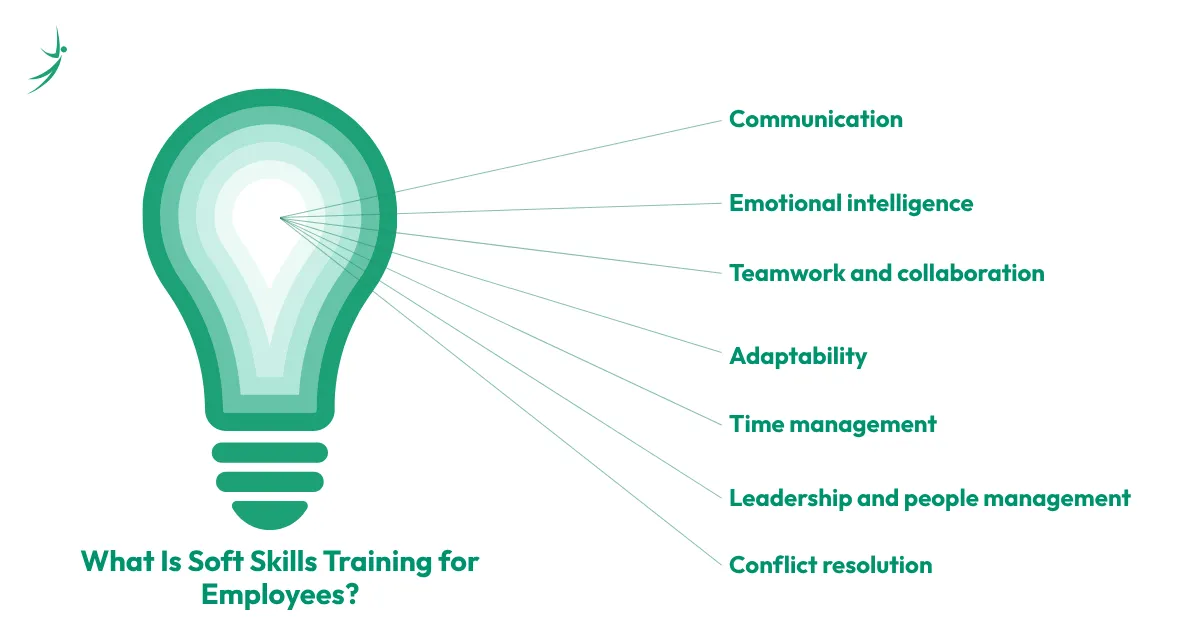
If you are asking what is soft skills training for employees in practical terms, it usually means a program built around a small set of core areas rather than a single subject:
- Communication: clear speaking, writing, and listening, both in person and across tools like email, Slack, or WhatsApp
- Emotional intelligence: recognizing and managing one's own reactions, and reading other people's accurately
- Teamwork and collaboration: working across departments without needing constant supervision
- Adaptability: staying functional and useful when a process, tool, or manager changes
- Time management: prioritizing without being told what to do next
- Conflict resolution: handling disagreement without it turning into a grudge or a resignation letter
- Leadership and people management: for anyone who has to guide, delegate to, or evaluate someone else's work
So what are soft skills in the workplace, concretely? They are the behaviors that decide whether a technically skilled employee is actually pleasant, reliable, and effective to work with. A brilliant developer who cannot explain a delay to a client, or a skilled accountant who cannot handle a disagreement with a vendor without escalating it, both illustrate the same point: technical competence and workplace effectiveness are not the same thing.
Why Soft Skills Training Matters for Nepali Companies in 2026
Two forces are pushing this up the priority list for Nepali employers this year.
- First, the skills gap is documented, not anecdotal. According to the ILO Nepal Skills Survey referenced by the Asia Pacific Career Development Association, more than 60% of employers in Nepal report difficulty finding candidates with the skills they actually need, and a large share of graduates end up in jobs unrelated to their field of study. Academic research on graduate employability in Nepal points to the same conclusion: most university curricula still emphasize theory over the behavioral, practice-based skills that employers actually screen for, including teamwork, adaptability, and communication.
- Second, technical skills are changing faster than they used to, which raises the value of the skills that do not go out of date. The WEF's Future of Jobs Report 2025 found that 39% of core workplace skills are expected to change or become outdated by 2030, and analytical thinking remains the single most valued core skill, considered essential by seven out of ten employers surveyed globally. Resilience, flexibility, and leadership round out the top of that list, ahead of most specific technical tools. A team that learns a new software package every eighteen months but never learns to communicate a delay, resolve a disagreement, or manage a junior colleague is solving the wrong half of the problem.
For Nepali offices specifically, this shows up in very ordinary ways: client emails that read as curt rather than efficient, meetings that run long because nobody manages the agenda, and new managers promoted for technical ability who then struggle to give feedback without damaging morale.
Key Benefits of Soft Skills Training for Employees
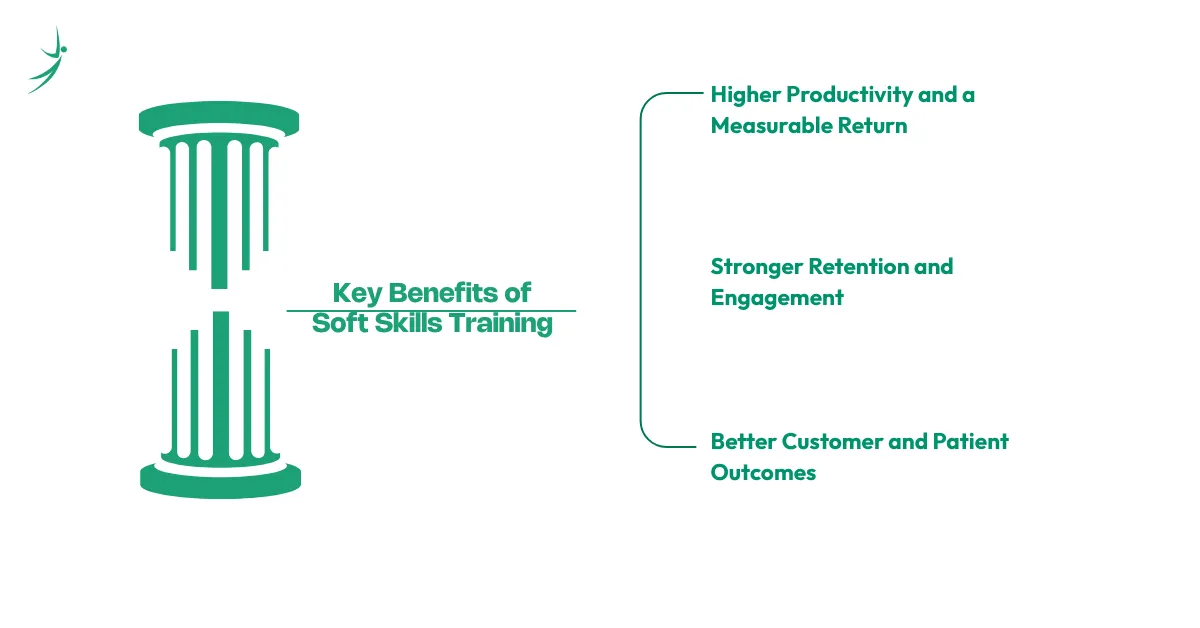
Higher Productivity and a Measurable Return
The strongest evidence here does not come from a training vendor's marketing page. It comes from a controlled study published in the Journal of Political Economy, conducted among garment factory workers in India, an industry and labor market close to Nepal's own manufacturing and services sector. Researchers, including a team from MIT, found that workers who completed a year-long soft skills program (covering communication, problem-solving, and time management) were 7.4% more productive than a control group that received no training. The firms that ran the program saw a 256% return on investment within eight months, calculated from a program cost of roughly 102,000 US dollars against measured benefits of about 360,000 US dollars.
That is not an isolated result. It is consistent with the broader pattern L&D teams see once they start measuring soft skills training for corporate employees the same way they measure any other business investment: the gains show up in output, not just in survey scores about how the training "felt."
Stronger Retention and Engagement
Employee engagement has been sliding worldwide. Gallup's most recent State of the Global Workplace report found that only 20% of employees globally were engaged in their work in 2025, a decline that cost the world economy an estimated 10 trillion US dollars in lost productivity, with South Asia recording the steepest regional drop of any region measured.
Retention economics make the business case even sharper. The Society for Human Resource Management estimates that replacing a single employee costs between 50% and 200% of their annual salary once recruiting, onboarding, and lost productivity during the transition are counted. A soft skills training program that keeps even one team lead or senior officer from walking out the door over a preventable conflict or a communication breakdown with their manager often pays for itself before any productivity gain is even added to the math.
Better Customer and Patient Outcomes
This is where soft skills training for healthcare workers and soft skills training for hospital staff earns its own line item, separate from general office training.
A randomized controlled trial run across health centers in Mashhad, Iran, and published in PMC, the US National Library of Medicine's open archive, found that healthcare providers who received structured communication skills training showed a significant improvement in communication knowledge, and their clients reported significantly higher satisfaction scores just one month later compared to a control group that received routine training only. Separate clinical research has repeatedly linked patient-centered communication directly to better health outcomes, higher patient satisfaction, and even reduced medical expenditure, because patients who understand and trust their provider are more likely to follow through on treatment.
The same logic extends to any customer-facing role in Nepal: bank tellers, hospitality staff, telecom support desks, and hospital reception teams all sit at the exact point where a technically correct answer delivered badly can still lose the customer or, in a hospital's case, the patient's trust.
Soft Skills Training Across Industries: Use Cases for Nepal
Soft skills training is not a one-size program. What a bank branch needs looks different from what a software team or a hospital ward needs.
Healthcare and Hospital Staff
Soft skills training for hospital staff typically centers on patient communication, managing family members under stress, breaking difficult news calmly, and de-escalating tension in a waiting room. Nurses and front-desk staff in particular benefit from short, scenario-based sessions rather than long lecture-style courses, since their schedules rarely allow for a full day away from the ward.
Banking, IT, and Corporate Offices
For banking and IT teams, communication skills training for employees usually focuses on client-facing language, cross-team coordination between technical and non-technical staff, and the specific skill of writing clearly in email and chat, since so much of the workday now happens in text rather than face to face.
Hospitality and Customer-Facing Teams
Customer service soft skills training for hotel, restaurant, and retail staff in Nepal tends to prioritize tone under pressure, complaint handling, and reading a customer's mood quickly, all skills that are difficult to teach through a manual and much easier to teach through role-play and live practice.
Soft Skills Topics Every Corporate Training Program in Nepal Should Cover
If you are scoping a program and want concrete soft skills training examples rather than a vague list, these are the soft skills topics for training that consistently show up across well-designed corporate curricula and the categories tracked by international training providers:
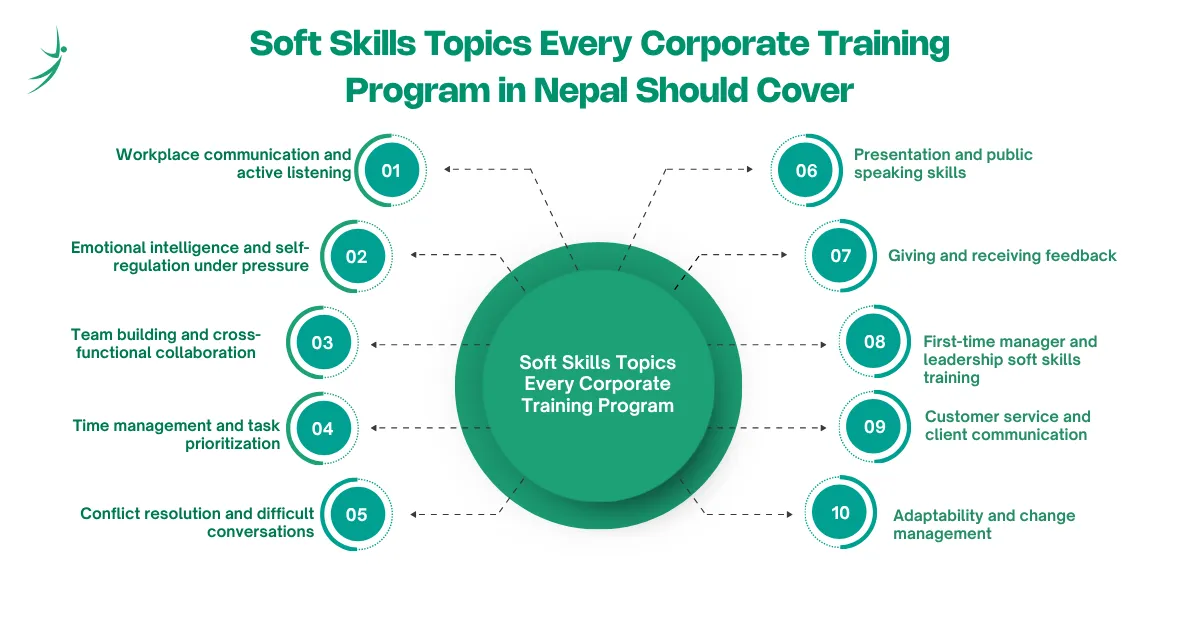
- Workplace communication and active listening (including सञ्चार सीप, communication skills in Nepali language delivery for shop-floor and non-office staff who are more comfortable training in Nepali than English)
- Emotional intelligence and self-regulation under pressure
- Team building and cross-functional collaboration
- Time management and task prioritization
- Conflict resolution and difficult conversations
- Presentation and public speaking skills
- Giving and receiving feedback
- First-time manager and leadership soft skills training
- Customer service and client communication
- Adaptability and change management
A program that tries to cover all ten in one session usually teaches none of them well. Most well-run corporate soft skills training in Nepal picks two or three priority areas based on an actual needs assessment, not a generic checklist.
How to Design Corporate Soft Skills Training That Actually Works
- Start with a needs assessment, not a course catalog. The gap between a customer support team's communication weaknesses and a management team's delegation weaknesses is large. A generic course that tries to serve both usually helps neither.
- Use scenario-based practice over lecture. Recent industry research on 2026 training design points to a consistent pattern: the highest-value corporate training programs use scenario-based simulations and role-play to close the gap between knowing a skill and actually using it under pressure, rather than relying on slides alone.
- Deliver in the language people actually think in. For shop-floor, retail, and hospitality staff especially, offering sessions in Nepali, or a Nepali-English mix, consistently produces better retention than English-only delivery borrowed from an international template.
- Keep sessions short and spaced out. A single eight-hour workshop rarely changes behavior. Shorter sessions spread across several weeks, with practice between them, are far more likely to produce a lasting change in how people actually communicate and collaborate.
- Involve managers, not just individual contributors. Soft skills training for corporate employees that skips first-line managers misses the group with the most day-to-day influence over whether a skill sticks. A manager who was never trained in giving feedback will quietly undo a communication course their team just finished.
Challenges Nepali Companies Face and How to Overcome Them
- "What if we train them and they leave?" This is the most common objection HR hears when pitching a training budget, and it deserves a direct answer: the MIT-affiliated research cited earlier found that soft skills training raised firm productivity without materially affecting wages or staff turnover, meaning the employer captured most of the financial benefit. The bigger risk is usually the reverse: a team that never gets trained and eventually leaves anyway for a company that does invest in them.
- Measuring soft skills is harder than measuring a test score. Unlike a technical certification, there is no single exam that proves someone has become a better communicator. The workaround most Nepali companies use successfully is a simple before-and-after approach: a manager or peer rating on a small set of specific behaviors, repeated 60 to 90 days after training, rather than trying to build an elaborate scoring system from scratch.
- Scheduling around shift work and production floors. Hospital staff, factory teams, and retail workers cannot easily step away for a full-day workshop. Short 90-minute sessions run across several weeks, timed around shift changes, consistently see higher attendance than one long session that forces a choice between training and coverage.
- Skepticism from leadership about soft, unquantifiable benefits. This is best addressed before the program starts, not after, by agreeing on two or three specific metrics (a retention comparison, a customer satisfaction score, an internal communication survey) that leadership will actually look at once training ends.
Case Study: What Happens When Soft Skills Training Actually Works
The clearest documented case study in this space is not a corporate testimonial. It comes from the peer-reviewed research already cited above. In the garment manufacturing study published in the Journal of Political Economy, factory workers who completed a structured, year-long soft skills program covering communication, problem-solving, and time management became measurably more productive than a matched control group that received no training. The productivity gain held even eight months after the program ended, and the firms running the program recovered their investment multiple times over. Critically, the workers who received training did not see higher pay or leave their jobs at a higher rate than untrained peers, which means the financial return stayed with the employer that made the investment.
The lesson for Nepali businesses considering the same move is straightforward: the return on soft skills training does not depend on picking an unusually motivated team or a lucky year. It shows up in a controlled study across an entire factory workforce, in an economy and industry structure not far from Nepal's own.
Future Trends in Soft Skills Training for Employees
- AI-assisted practice is becoming standard, not experimental. Corporate training providers are increasingly using AI-driven role-play tools that let an employee practice a difficult client conversation or a performance review with a simulated counterpart before trying it with a real person, closing the gap between knowing a technique and actually using it under pressure.
- Human skills are rising in relative value as automation absorbs routine technical tasks. The WEF's own skill-priority rankings show resilience, leadership, and analytical thinking climbing the list even as AI and big data literacy grow fastest in raw demand, because the skills that decide how well a person uses a new tool are not the same as the skills needed to operate the tool itself.
- Bite-sized, spaced-out delivery is replacing the single-day workshop. Employers increasingly favor short sessions delivered over several weeks with practice built in between, over the traditional one-off seminar model that dominated soft skills training in Nepal for the past decade.
- Measurement is maturing. More companies are moving from "did people enjoy the session" feedback forms toward the kind of before-and-after behavioral tracking already used in the corporate training ROI conversation more broadly.
How to Choose the Right Soft Skills Training Provider in Nepal
If you are searching for soft skills training near me or comparing options for corporate soft skills training in Kathmandu, a few criteria separate a program that changes behavior from one that just fills a calendar slot:
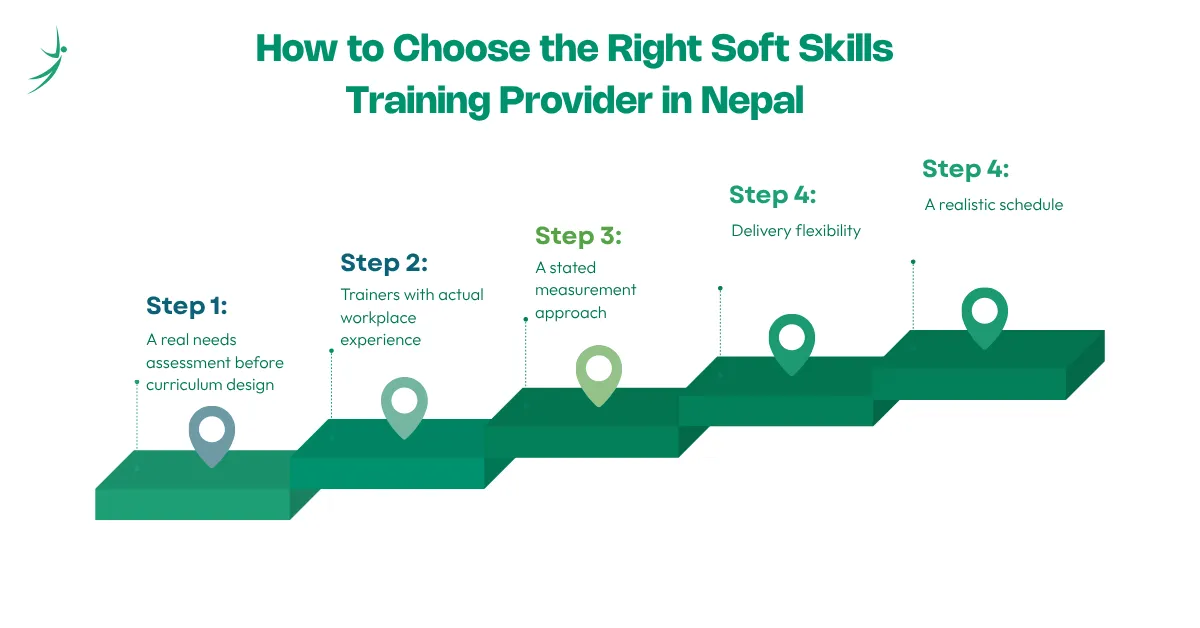
- A real needs assessment before curriculum design, not a fixed course description applied to every client
- Trainers with actual workplace experience in the industry they are training, not just a training certification
- A stated measurement approach, agreed before the program starts, so results can be checked against a baseline
- Delivery flexibility, including on-site, online, and hybrid options, and Nepali-language delivery for non-office staff
- A realistic schedule that respects shift patterns and production demands rather than assuming everyone can disappear for a full day
For a full breakdown of what to check before signing with any provider, see what Nepali businesses need to verify before committing to a corporate training budget.
Measuring ROI and Success Metrics for Soft Skills Training
Employee soft skills training can be measured with the same discipline used for any other training category. Three checkpoints work well in practice:
- A pre-training baseline. Rate specific, observable behaviors (response time on client emails, number of escalated conflicts, manager feedback scores) before training starts.
- A post-training check at 60 to 90 days. The same metrics, measured again, show whether the training changed actual behavior rather than just being well-received in the room.
- A retention and engagement comparison between trained and untrained teams over the following 12 months, given how strongly the Gallup and SHRM research above ties engagement and retention to investment in people.
For the full financial case, including how to present this to a finance team that wants numbers rather than testimonials, see the complete corporate training ROI breakdown.
Conclusion and Next Steps
Soft skills training for employees in Nepal has moved well past the "nice extra" category. The research is specific: a documented 256% ROI from a controlled study in a comparable South Asian labor market, a measurable link between communication training and patient satisfaction in healthcare settings, and a national skills gap that more than 60% of Nepali employers say they feel directly. What separates a program that works from one that does not is rarely the topic list. It is whether the training was built around an actual need, delivered in a format people can realistically attend, and measured against something concrete afterward.
Skill Shikshya designs corporate soft skills training around the specific communication, leadership, and teamwork gaps a company actually has, not a fixed curriculum applied to every client. Visit https://skillshikshya.com/corporate-training to talk through what a measurable program would look like for your team.
Frequently Asked Questions
What is soft skills training for employees?
What are soft skills in the workplace, exactly?
What are some soft skills training examples for corporate employees?
Is soft skills training for healthcare workers different from general corporate training?
How much does soft skills training cost in Nepal?
How do you measure the success of soft skills training?
Can soft skills training be delivered in Nepali instead of English?
About Author: