Corporate Training Trends in Nepal 2026 | Skill Shikshya
Corporate trends in learning and development move faster than most companies in Nepal can track, and 2026 is turning out to be one of the years where the gap between "how training used to work" and "how it actually works now" is widest. Some people still search for this topic under the misspelling corporate trendz, or type coporate training instead of corporate training both land on the same shift. At Skill Shikshya, we sit inside this shift daily running corporate training in Nepal for banks, IT companies, and government agencies and this article breaks down exactly what is corporate training looking like this year, what's driving it, and what a company should actually do about it.
What Is Corporate Training, and Why Does It Keep Changing?
Corporate training is a structured learning program an employer arranges for its staff, built around a specific business skill or outcome rather than generic classroom theory different in scope from a public course an individual signs up for alone. The corporate training meaning hasn't changed much over the years; what's changed is the delivery, the tools, and the urgency behind it.
If someone asks what corporate training programs are supposed to solve today that they didn't solve five years ago, the honest answer is AI adoption, faster staff turnover, and a much shorter shelf life for any given technical skill. Why corporate training is important in 2026 specifically comes down to one fact: a static skill set is a depreciating asset in almost every corporate job in Nepal right now.
Business Trends Meaning: How This Connects to the Bigger Picture
Business trends meaning, in plain terms, refers to the observable shifts in how companies operate, hire, and compete over time. A business trends report from any major research house in 2026 will point to the same handful of forces AI adoption, skills shortages, and tighter retention pressure and corporate training sits at the intersection of all three. Corporate development trends and business development trends both increasingly treat workforce learning as a core growth lever, not a side budget line, which is exactly why corporate training trends deserve the same attention a company would give to a sales or marketing trend report.
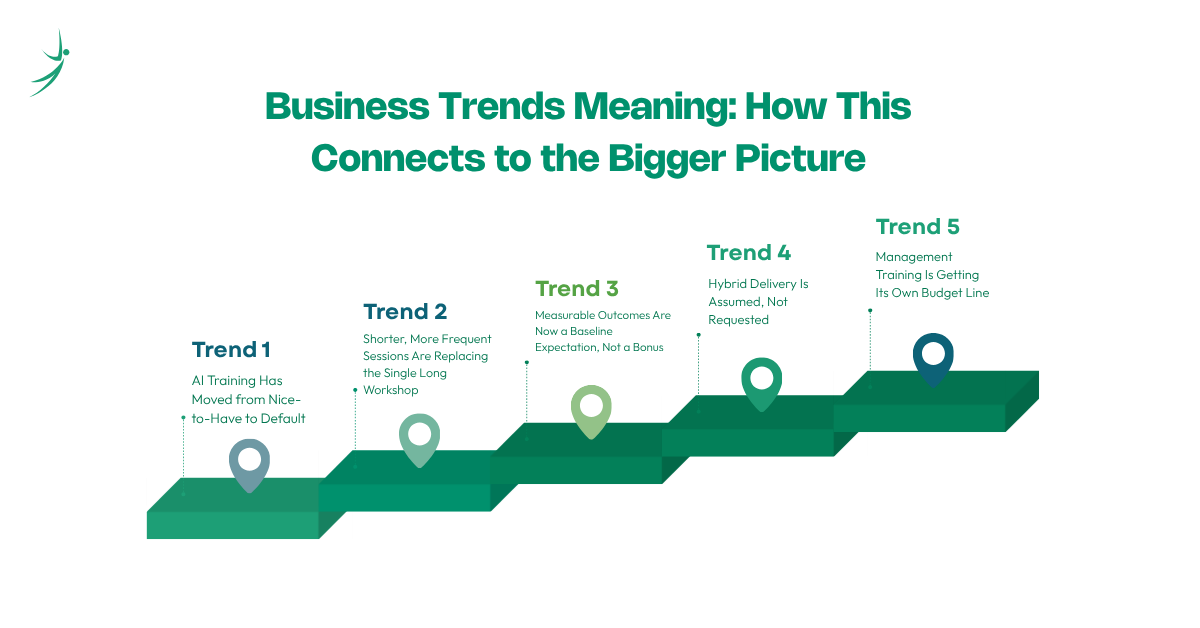
Trend 1: AI Training Has Moved from Nice-to-Have to Default
The World Economic Forum's 2025 Future of Jobs report projects that 39% of core workplace skills will be outdated by 2030, and 77% of employers surveyed say they're committed to reskilling staff to work alongside AI rather than replacing them. McKinsey research separately found that roughly 4 in 5 employees want to learn how to use AI in their own profession not as IT specialists, but as marketers, accountants, and customer service staff. In Nepal, this shows up as AI modules getting added to corporate training courses that had nothing to do with AI two years ago.
Trend 2: Shorter, More Frequent Sessions Are Replacing the Single Long Workshop
The old model one multi-day workshop, once a year is being replaced by shorter modules spread across weeks. This isn't a fad; it matches what adult-learning research has shown for years about retention, and it's now showing up directly in how corporate training program structures are being redesigned across Kathmandu's banking and IT sectors.
Trend 3: Measurable Outcomes Are Now a Baseline Expectation, Not a Bonus
Buyers comparing corporate training companies in 2026 increasingly ask for a placement rate, a completion rate, or a specific before-and-after metric before signing the same way they'd evaluate any other vendor, whether they found that provider through referral, a directory, or one of the many corporate training websites and corporate training platforms now competing for attention online. Training-effectiveness research shows measurable performance improvements of roughly 22% within three to six months when a program targets a specific, real skill gap rather than general awareness.
Trend 4: Hybrid Delivery Is Assumed, Not Requested
With teams spread across Kathmandu, regional branches, and remote arrangements, a corporate training institute that can only deliver in one physical location is at a real disadvantage. Hybrid a mix of on-site, online, and self-paced has gone from a nice option to the default expectation.
Trend 5: Management Training Is Getting Its Own Budget Line
Gallup research consistently finds that around 70% of a team's engagement level traces back to its direct manager, not company policy or pay. That statistic is driving a real shift: a growing share of organizations in the 2025 Training Industry Report are increasing management training in Nepal and project management training in Nepal budgets specifically for 2026, separate from general technical training spend. Some providers now describe this shift as corporate training 2: a deliberately AI-integrated, outcome-tracked version of the traditional annual workshop, with corporate training for leadership treated as its own dedicated track rather than folded into general staff training.
Corporate Governance Trends and Compliance Pressure
Corporate governance trends are pushing in the same direction as skills training. Nepali companies working with international partners, banks under regulatory review, and government-adjacent organizations increasingly need documented staff training records, not informal mentoring, to satisfy audit and compliance requirements. This is quietly becoming one of the biggest drivers of formal corporate training programs, even in companies that previously treated training as optional.
Who These Trends Apply To: Private, Public, and Social Enterprises in Nepal
These trends aren't limited to private companies. Enterprise in Nepal covers a wide range of organization types, and the training pressures above apply differently to each:
- Private enterprise banks, IT companies, and manufacturing firms adapting fastest to AI training and measurable ROI expectations.
- Public enterprise in Nepal government-owned corporations and agencies facing growing pressure for documented training records tied to corporate governance trends.
- Social enterprise in Nepal NGOs and development organizations needing project management training and reporting skills just as much as any private business.
What a Corporate Job Actually Looks Like in This Shift
A corporate work example helps ground all of this. An example of a corporate job affected by these trends might be a bank's operations analyst now expected to use AI-assisted reporting tools, or an IT company's project coordinator running project management training refreshers every quarter instead of once a year. If you're searching for an example of corporate job roles most affected by these shifts, operations, HR, and IT support functions consistently top the list. Corporate jobs in Nepal across banking, telecom, and manufacturing are all seeing the same pattern: the corporate concept of a fixed job description is loosening as AI tools reshape day-to-day tasks. Corporate Nepal from small startups to large public enterprises is built on exactly these kinds of roles, which is why training trends translate into real day-to-day changes, not abstract policy shifts.
Some companies also maintain an informal corporate club Nepal-style peer group alongside formal training, where staff share what they've picked up from a corporate training program between formal sessions a low-cost supplement to structured learning, not a replacement for it. Whether your team calls this corporate training nepal-wide practice a "lunch and learn" or something else entirely, the function is the same: reinforcing what corporate training courses already covered.
What "Best" Looks Like Right Now
Every list of the best company in Nepal or the best company of Nepal shares one trait in 2026: visible, structured investment in staff learning. The same holds internationally top corporate companies in world rankings, from Google to Microsoft, are known as much for internal training culture as for their products. A best corporate company to work for isn't necessarily the highest payer; it's the one whose staff can point to a real corporate training courses catalog and see their own growth mapped against it. If the goal is to be named a best corporate company in your sector, corporate training is one of the most direct paths there not a side initiative.
Corporate IT Training and the Enterprise Skills Layer
A growing share of corporate training program content in 2026 is really about preparing staff for enterprise-level systems, whatever their department. Depending on the sector, this includes training on an enterprise system for finance or HR, enterprise software used for daily operations, enterprise application integration between different company tools, enterprise banking platforms for financial institutions, and enterprise customer service software for support teams. Basic enterprise computing literacy has become nearly as important for non-technical staff as it is for developers, since most mid-sized and large organizations in Nepal now run some form of enterprise software rather than standalone tools.
In simple enterprise meaning, an enterprise is any organized business activity small or large and enterprise value increasingly includes how well-trained and adaptable its workforce is, not just what's on the balance sheet. A company's enterprise life, from its systems to its daily culture, depends on the people running it, wherever its enterprise locations happen to be.
Corporate Training Team Building in a Trend-Driven Year
Corporate training team building has shifted too. The trust-fall-and-icebreaker version is fading in favor of sessions built around real friction points poor handoffs between departments, unclear decision-making during a project because a training budget under more scrutiny in 2026 needs to show a specific result, not just a pleasant afternoon.
Corporate Event Trends Tied to Learning
Corporate event trends are converging with training trends too: fewer standalone "away day" events, more learning-integrated gatherings where a portion of a corporate event doubles as a hands-on workshop. This reflects the same measurable-outcomes pressure showing up everywhere else even a team event increasingly needs to justify its budget with a learning component attached.
Short Courses and the Rise of Modular Learning
Short term courses in Nepal are one of the clearest signs of the shift toward modular learning. Rather than committing to a long program upfront, companies are increasingly booking a short term course to test a specific skill gap an AI fundamentals session, a one-day project management training refresher before committing to a longer corporate training program.
How to Become a Corporate Trainer in This Environment
How to become a corporate trainer in Nepal is a question we hear often, including from people already working in HR or technical roles. What is corporate trainer work like today? It means combining real industry experience in IT, finance, or a technical field with facilitation skill built through practice, and increasingly, comfort teaching AI-related content even outside a technical department. What is a corporate trainer's most valuable trait in 2026 specifically: being able to translate a fast-moving trend into a session a non-specialist team can actually use the same week.
Best Practices for Adapting to These Trends
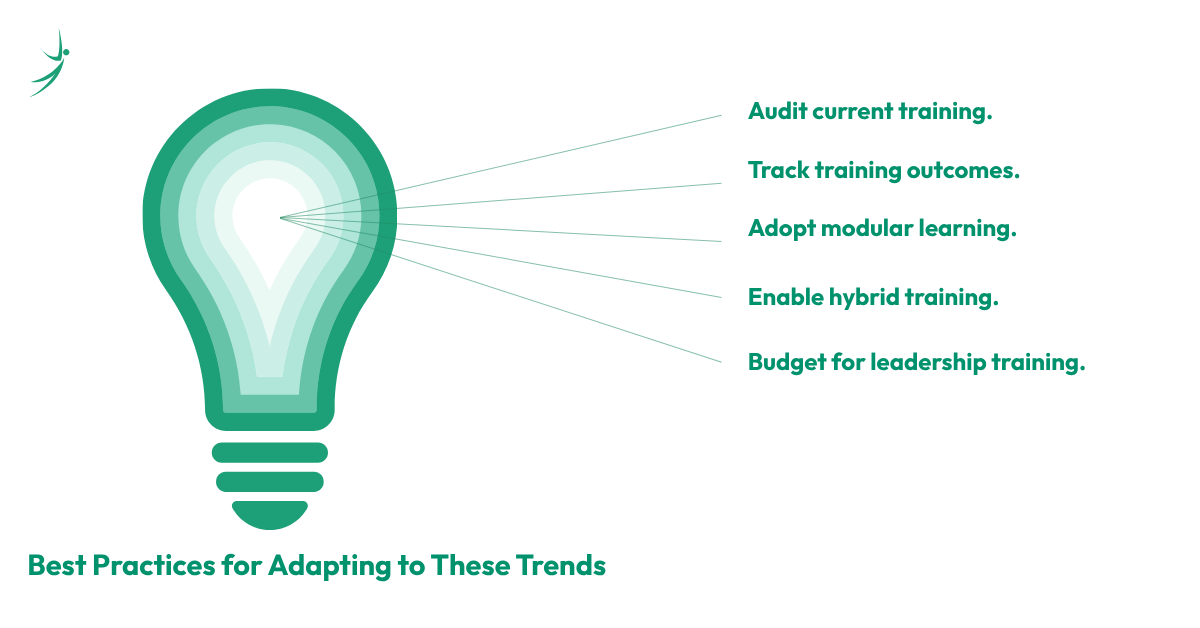
- Audit your current corporate training courses against the five trends above not every program needs an overhaul, but most benefit from at least one AI-related update.
- Ask any corporate training provider in Nepal for a completion rate or outcome metric, not just a course description our own guide to choosing the right corporate training partner walks through exactly what to ask before signing.
- Shift at least one long annual workshop into a shorter, modular format this year as a test.
- Confirm hybrid delivery is genuinely available, not just offered on paper.
- Set aside a specific budget line for management and project management training in Nepal, separate from technical skills training.
Case Example
A mid-sized Kathmandu-based financial services firm restructured its annual compliance training into four shorter quarterly sessions in early 2026, adding a short AI-assisted reporting module to the second session based on staff requests. Completion rates rose compared to the prior single annual session, and the firm reported fewer reporting errors in the two quarters following the AI module specifically a direct, trackable result tied to one of the trends above rather than a vague improvement.
(Real corporate training pictures from sessions like this one small-group breakouts, AI-module walkthroughs, completion-certificate handovers help ground a case study like this in something visible rather than just a number; alt text such as "corporate training pictures Kathmandu 2026" carries search value alongside the visual proof.)
Measuring Whether These Trends Are Actually Paying Off
- Time-to-productivity for new hires before and after a training update
- Error or rework rate in the specific task any new module targets
- Retention in the 12 months following a program worth tracking closely, since replacing an employee typically costs 1.5 to 2 times their annual salary once recruiting and lost productivity are counted
- Completion rate across shorter modular sessions versus the old single-workshop format
Conclusion and Action Steps
Corporate trends in training aren't slowing down in 2026, and the companies adapting fastest aren't necessarily spending more they're spending more precisely. Before your next planning cycle:
- Map your current corporate training program against the five trends in this article.
- Ask your current or prospective corporate training provider in Nepal how they're adapting to at least three of them.
- Pick one long-format program to convert into a shorter, modular one this quarter as a test.
Skill Shikshya builds corporate training in Nepal around exactly these shifts: AI-integrated by default, modular where it makes sense, and measured against real outcomes. Visit skillshikshya.com/corporate-training to talk to our team about what a trend-adapted program would look like for yours.
Frequently Asked Questions
What is corporate training, in simple terms?
Why is corporate training important in 2026 specifically?
What is corporate trainer work like today, and how do I become one?
What are corporate training trends most companies in Nepal are missing?
Is corporate training only relevant for large companies?
About Author: