Digital Marketing Career Roadmap Nepal 2026
So you want to start a digital marketing career in Nepal? You're in the right place.
I’m Prakash Bhandari, a digital marketing professional with over five years of hands-on experience working on real campaigns, real businesses, and real results. In this guide, I’m sharing something I truly wish I had when I started: a clear, step-by-step digital marketing career roadmap that actually works.
No fluff. No confusion. Just the exact path from "I don't know anything" to "I'm getting hired" or "I'm landing clients."
Why Learning Digital Marketing Needs a Roadmap
Here's what happens without a roadmap:
Most people begin by trying to break into digital marketing without clearly understanding the fundamentals. They jump straight into tools, ads, or SEO without knowing how everything actually connects. If you're just starting, it's important to first build a clear foundation and understand the core concepts of how digital marketing works.

Sound familiar?
The scope of digital marketing in Nepal is huge right now. Companies need digital marketers. The salary of digital marketing in Nepal ranges from NPR 20,000 for beginners to NPR 150,000+ for experienced pros, which is why many learners start exploring different training options available in Nepal before choosing where to begin. But here's the catch: most people learn in the wrong order.
Common Mistakes Beginners Make (Tools Before Basics)
- Mistake #1: They start with Facebook Ads before understanding who they're advertising to.
- Mistake #2: They learn SEO tools before knowing what search intent means.
- Mistake #3: They chase certificates instead of building real skills.
When I hire digital marketing interns in Nepal, I can spot this immediately. They know how to use Meta Ads Manager but can't explain why their ad failed. These are exactly the kind of pitfalls that derail many students when entering the tech field.
Starting your marketing journey at a recognized IT training institute in Nepal provides hands-on experience with real campaigns, SEO tools, and analytics platforms that accelerate career growth.
Perspective of a Working Digital Marketing Professional
I'm going to be straight with you.
This digital marketing roadmap isn't theory. It's the exact sequence I follow when training someone from scratch. It's what worked for me, and what I've seen work for dozens of people breaking into digital marketing jobs in Nepal.
Follow this roadmap in order. Don't skip steps. Don't rush. And you'll have a solid digital marketing career path within 6-12 months.
Let's start.
6–12 Month Step-by-Step Digital Marketing Roadmap
Timeline: Week 1-2 | Goal: Understand what you're getting into
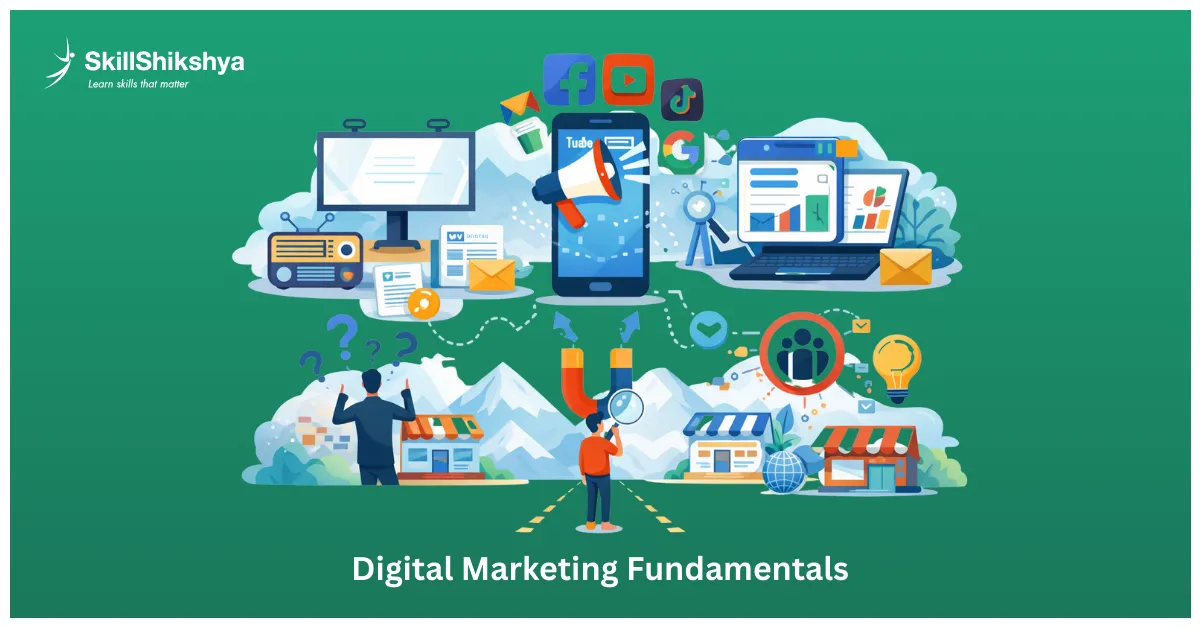
What Digital Marketing Is and How It Works
Before you touch any tool, you need to answer one question: What is digital marketing in Nepal actually doing for businesses?
Here's your action step:
Spend 30 minutes today observing your own online behavior. Notice:
- How did you find the last product you bought online?
- Which social media posts made you stop scrolling?
- What made you click on an ad?
That's digital marketing. It's about being present where your customers are (online) and guiding them from "I have a problem" to "This solution works."
In Nepal, this matters because internet penetration reached 56% in 2025, and it's growing rapidly. Your future customers are already online. Digital marketing is how you reach them.
Difference Between Traditional and Digital Marketing
- Traditional marketing in Nepal: Radio ads, newspaper ads, billboards. You pay, you broadcast, you hope someone sees it. No tracking.
- Digital marketing: Facebook ads, Google search ads, Instagram content. You target specific people, you track every click, you know exactly what's working.
- Your action step: Find one local Nepal business that advertises traditionally (newspaper/radio) and one that advertises digitally (Facebook/Instagram). Compare their reach and engagement. You'll immediately see the difference.
As you want to learn more about traditional vs modern digital marketing, you can see our full review of it.
Key Digital Marketing Channels Overview
Here are the main channels you'll work with for digital marketing in Nepal:
- Search Engine Marketing (Google): People actively searching for solutions
- Social Media Marketing (Facebook, Instagram, TikTok): Building awareness and community
- Content Marketing (Blogs, Videos): Educating and attracting audiences
- Email Marketing: Direct communication
- Paid Advertising: Accelerating results with budget
Your action step: This week, just observe. Don't learn yet. Notice how businesses use these channels. Follow 5 Nepal businesses on social media and subscribe to their emails. Watch what they do.
Role of Digital Marketing in Business Growth
Simple truth: A business without digital marketing in 2026 is invisible.
Your action step: Talk to 3 local business owners this week. Ask them: "How do you get new customers?" You'll hear either "mostly referrals" (struggling) or "through our social media and ads" (growing).
That conversation will show you why digital marketing matters.
Marketing & Consumer Psychology Basics
Timeline: Week 2-3 | Goal: Learn how people think and buy
This is where most digital marketing courses in Nepal fail you. They skip straight to tactics. We're not doing that.
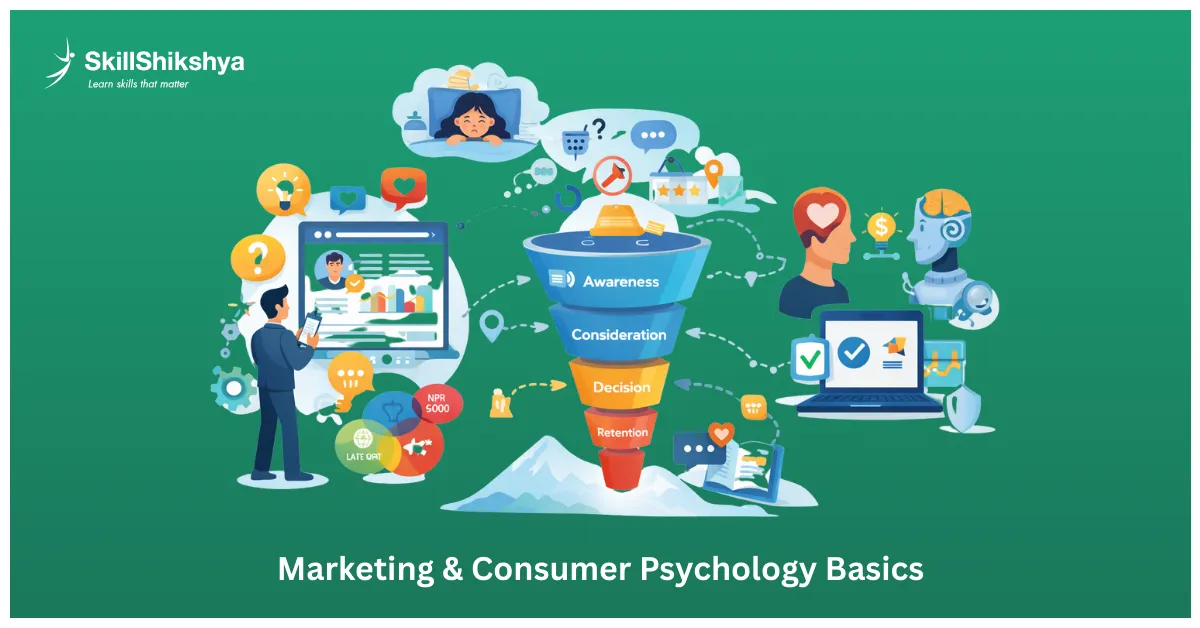
Understanding the Target Audience and Buyer Persona
Step 1: Pick one business type (example: coffee shop, coaching institute, clothing brand).
Step 2: Answer these questions:
- Who is their ideal customer? (Be specific: "college students aged 18-24 in Kathmandu.")
- What problem does this customer have?
- Where do they spend time online?
- What words do they use when talking about their problem?
Your action: Create 3 buyer personas this week using real businesses you know. Write them down. This is the foundation of everything in digital marketing.
Customer Journey and Marketing Funnel
People don't buy immediately. They go through stages:
- Stage 1 - Awareness: "I have a problem" (They discover you through content/ads)
- Stage 2 - Consideration: "I'm researching solutions" (They follow you, read reviews)
- Stage 3 - Decision: "I'm ready to buy" (They need a final push)
- Stage 4 - Retention: "I'm a happy customer" (They buy again, refer others)
Your action: Pick one product you bought recently. Write down your own journey through these 4 stages. What content influenced you at each stage? This is how you'll create campaigns later.
Branding, Positioning, and Value Proposition
Simple exercise: Complete this sentence for any business:
"We help [target audience] to [achieve goal] by [unique method], unlike [competitors] who [their approach]."
Example: "We help working professionals in Nepal learn digital marketing through live projects and real campaigns, unlike courses that only teach theory."
Your action: Write this for 3 different Nepal businesses. This teaches you positioning, which you'll use when creating ads and content.
How Users Think, Search, and Make Decisions Online
Key insight: People search based on their stage in the journey.
- Awareness stage: "How to grow Instagram followers."
- Consideration stage: "best social media management tools."
- Decision stage: "social media marketing course Kathmandu price."
Your action: Open Google. Type 3 different search queries related to digital marketing in Nepal. Notice how the results change. Notice the ads. This is search intent, and it's critical for SEO and ads.
Content & Communication Skills
Timeline: Week 4-5 | Goal: Learn to communicate value clearly
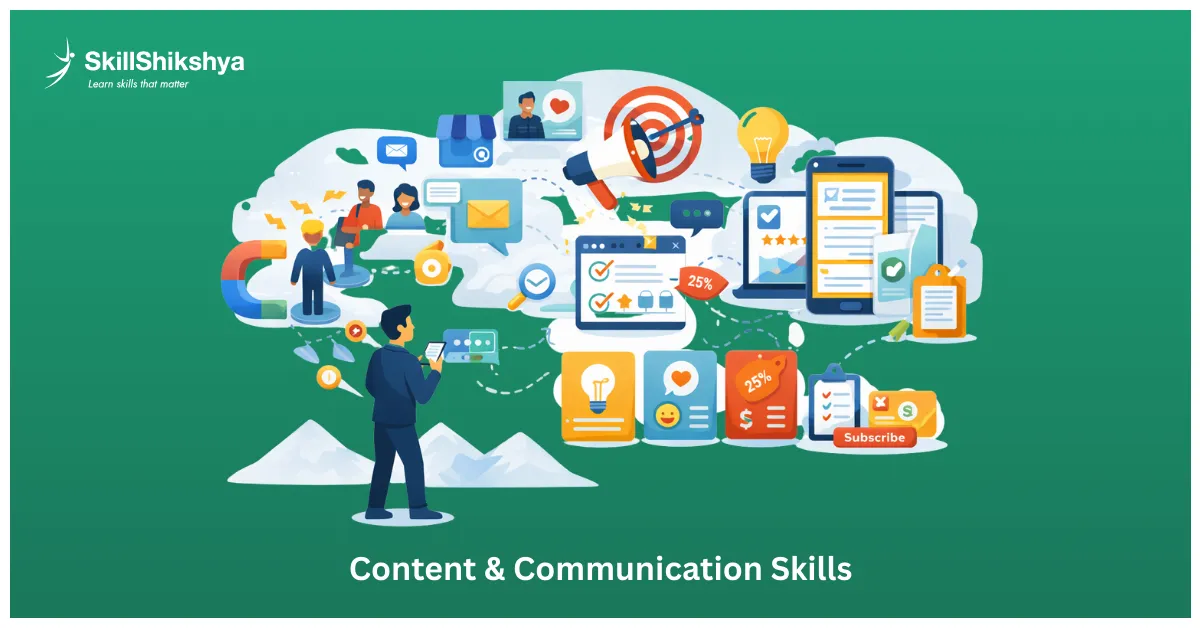
Importance of Content in Digital Marketing
Everything you do in digital marketing involves content. Your ad copy. Your social media caption. Your email subject line. Your website text.
Bad content = wasted money. Good content = results.
Your action: This week, screenshot 10 social media posts from Nepal brands that made you stop scrolling. Analyze why. What hook did they use? What emotion did they trigger? What action did they ask for?
Basics of Content Writing and Storytelling
Formula that works:
- Hook (first line grabs attention)
- Problem (the reader sees themselves)
- Solution (you offer the answer)
- Proof (testimonial, stat, example)
- Call to Action (tell them what to do next)
Your action: Write 5 social media posts this week using this formula.
Topics: digital marketing skills, learning tips, career advice. Post them on your own profile. See which ones get engagement.
Social Media Content Types (Educational, Engagement, Conversion)
The 60-30-10 rule:
- 60% Educational content (tips, how-tos, value)
- 30% Engagement content (questions, polls, behind-the-scenes)
- 10% Conversion content (offers, testimonials, sales)
Your action: Follow 5 successful Nepal digital marketers on Instagram or LinkedIn. Track their content for one week. Count how many posts fit each category. You'll see this pattern.
Copywriting Basics (Hooks, CTAs, Headlines)
Your 3-step action plan:
- Day 1-2: Collect 20 ad headlines from Facebook/Instagram that made you stop. Study the pattern.
- Day 3-4: Write 10 headlines for the digital marketing course Nepal ads. Use different hooks: questions, bold statements, curiosity gaps.
- Day 5-7: Practice writing CTAs (Call to Action). Don't just say "Click here." Say "Get your free roadmap" or "See if you qualify."
Social Media Marketing Foundations
Timeline: Week 6-8 | Goal: Build organic social media presence

How Social Media Platforms Work
Simple truth: Platforms want engagement. The more people interact with your content (like, comment, share, save), the more the platform shows it to others.
Your action:
Week 6: Create a professional social media page (Facebook or Instagram) for yourself as a digital marketer. Even if you're learning, position yourself as someone documenting the journey.
Post topic: "Starting my digital marketing career in Nepal - Here's my roadmap for the next 6 months."
Organic vs Paid Social Media
- Organic: Free, but slow. You post consistently, engage with the community, and grow naturally.
- Paid: Fast, but costs money. You pay platforms to show your content to specific audiences.
Your action: For the next 3-4 weeks, focus only on organic. Post 3-4 times per week. Topics: what you're learning about digital marketing, tips you discover, and questions you have.
Why? Because if you can't succeed organically, paid ads won't save you. You need to understand the platform first.
Content Planning and Consistency
Your posting schedule (Week 6-8):
- Monday: Tip or lesson learned
- Wednesday: Question or engagement post
- Friday: Personal story or case study
Your action: Use your phone's notes app. Every Sunday, plan your 3 posts for the week. Write them in advance. This is how professionals work.
Community Engagement and Basic Insights
Daily actions (spend 15 minutes):
- Reply to every comment on your posts within 1 hour
- Engage with 10 posts in your niche (digital marketing Nepal content)
- Answer questions in relevant Facebook groups
Your action: Check your insights every Saturday. Which post got the most saves? That's valuable content. Do more of that.
Search Engine Optimization (SEO) Basics
Timeline: Week 9-11 | Goal: Understand organic search and start blogging
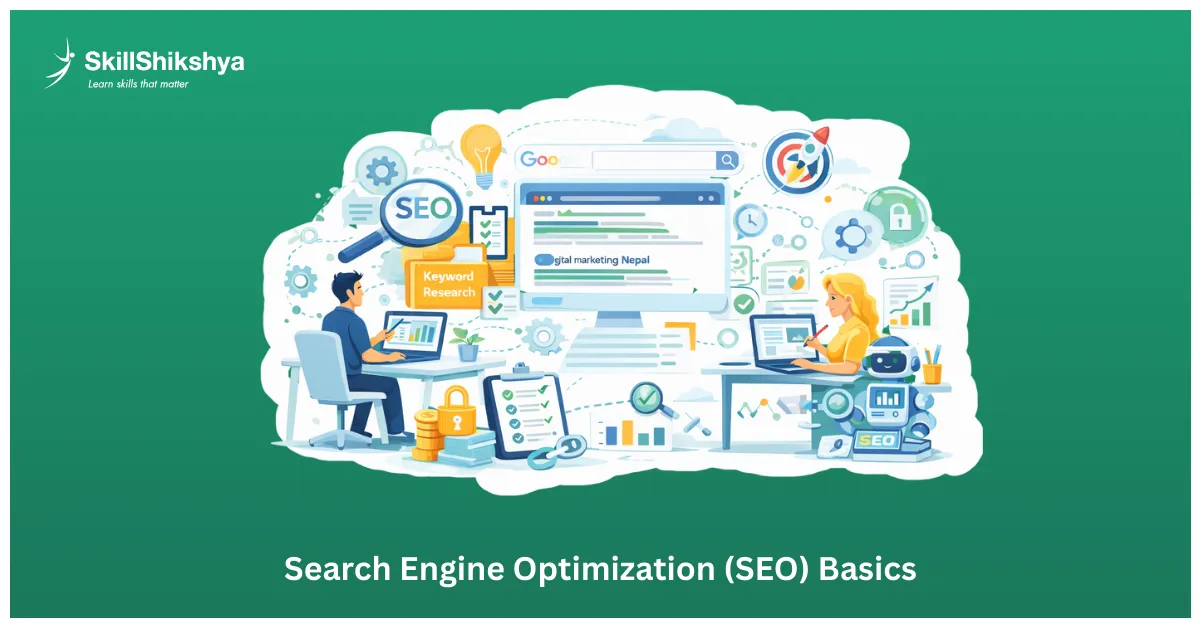
How Search Engines Work
Simple version: Google wants to show the best answer to every search query.
When someone searches "digital marketing jobs in Nepal," Google scans millions of pages and ranks them by relevance, quality, and user experience.
Your action: Search 5 different keywords related to the digital marketing scope in Nepal. Open the top 3 results for each. Notice what they have in common. That's what Google likes.
Keyword Research and Search Intent
Your step-by-step process:
Step 1: Open Google Keyword Planner (free tool, need a Google account)
Step 2: Type "digital marketing Nepal" and see related keywords
Step 3: Look for keywords with clear intent:
- "digital marketing course in Nepal" = someone wants training
- "digital marketing salary in Nepal" = someone researching careers
- "digital marketing internship in Nepal" = someone ready to apply
Your action: Make a list of 20 keywords related to the digital marketing career path in Nepal. Save this. You'll use it for your content.
On-Page SEO Fundamentals
Your blog post checklist:
- Primary keyword in title (example: "Digital Marketing Career Roadmap")
- Keywords in the first 100 words naturally
- Keywords in 2-3 subheadings
- Use related keywords (LSI) throughout
- Add internal links to your other posts
- Optimize images (name them with keywords)
- Write meta description
Your action: This seems technical, but it's not. Just write naturally first, then check these boxes.
Content Optimization and Blogging Basics
Week 9-11 Challenge: Write 4 blog posts
Post 1: "How to Start Digital Marketing in Nepal: Beginner's Guide" Post 2: "Digital Marketing Skills Every Nepal Professional Needs" Post 3: "Digital Marketing Career in Nepal: Salary, Jobs, and Growth" Post 4: "Best Ways to Learn Digital Marketing in Nepal (Free + Paid)."
Format for each post:
- 1,000-1,500 words
- Clear H2 and H3 headings
- Short paragraphs (2-3 sentences)
- Add personal experience
- Include 1-2 images
Your action: Publish one post per week on Medium, LinkedIn, or your own blog.
Intro to Technical and Off-Page SEO
Don't worry about this yet. Just know:
- Technical SEO: Site speed, mobile-friendliness (WordPress themes handle this)
- Off-page SEO: Backlinks from other websites (comes later when your content is good)
Your action for now: Focus on writing great content. Technical stuff comes after you understand the basics.
Performance Marketing (Paid Ads)
Timeline: Week 12-14 | Goal: Run your first paid campaign

Basics of Online Advertising
Key principle: You pay platforms (Facebook, Google) to show your content to specific people.
Unlike traditional advertising, you can:
- Target by location, age, interests, behavior
- Set an exact budget (even NPR 500 per day)
- Track every rupee spent and every result
Your action: Don't run ads yet. This week, just study ads. Screenshot 20 Facebook/Instagram ads from Nepal businesses. Analyze: Who are they targeting? What's their hook? What's their offer?
Meta Ads and Google Ads Overview
Meta Ads (Facebook & Instagram):
- Best for: Awareness, community building, visual products
- Targeting: Based on interests, demographics, behaviors
- Good for: Local businesses, e-commerce, courses
Google Ads:
- Best for: Capturing intent (people actively searching)
- Targeting: Based on keywords and search queries
- Good for: Services, immediate needs, high-intent purchases
Your action: Decide which platform fits your first campaign. For learning, I recommend starting with Meta Ads (easier and cheaper to test).
Campaign Objectives and Structure
Before spending a single rupee, answer these:
- What's your goal? (Awareness? Leads? Sales?)
- Who's your audience? (Be specific: "25-35 year olds in Kathmandu interested in career change")
- What's your message? (What will make them stop and click?)
- What's your offer? (Free guide? Discount? Consultation?)
- What's your budget? (Start small: NPR 3,000-5,000 for testing)
Your action: Write this down before moving forward. No plan = wasted money.
Audience Targeting Fundamentals
Your first campaign targeting (keep it simple):
- Location: Your city (Kathmandu, Pokhara, etc.)
- Age: 20-35 (typical for digital marketing career seekers)
- Interests: Digital marketing, online courses, career development, social media marketing
- Placement: Facebook and Instagram feed only (avoid everything else at start)
Your action: Create a Meta Business account. Explore Ads Manager. Don't run anything yet. Just get familiar with the interface.
Budgeting, Testing, and Optimization Mindset
Your first campaign plan (Week 14):
- Budget: NPR 5,000 total (NPR 500/day for 10 days)
- Goal: Test 3 different ad creatives
- Audience: Same targeting, split budget equally
- Metric to watch: Cost per result (lead, click, or whatever your goal is)
Your action: Create 3 different ad images/videos with 3 different hooks. Let them run for 3-4 days. Kill the worst performer. Scale the best one.
This is how professionals work. Test small, then scale what works.
Analytics & Data Understanding
Timeline: Week 15-16 | Goal: Learn to read data and make decisions

Importance of Data in Digital Marketing
Truth bomb: Without data, you're guessing. With data, you're growing.
Every decision I make is based on numbers:
- Which content to create more of? (Data tells me)
- Which ad to scale? (Data tells me)
- Which audience to target? (Data tells me)
Your action: Stop making decisions based on feelings. Start making them based on what the numbers show.
Understanding Key Metrics and KPIs
The only metrics that matter at your stage:
For Social Media:
- Reach (how many people saw your content)
- Engagement rate (% of people who interacted)
- Saves (most important - means high value)
For Paid Ads:
- Cost per click (CPC)
- Click-through rate (CTR)
- Cost per lead/conversion
- Return on ad spend (ROAS)
For Website/Blog:
- Page views
- Time on page
- Bounce rate
Your action: Open Instagram Insights (if you have a business account). Look at your posts from the last month. Which ones performed best? Do more of that type.
Basics of Google Analytics and Platform Insights
Week 15 setup:
- Step 1: If you have a blog, install Google Analytics (free)
- Step 2: Connect your social media accounts to Meta Business Suite
- Step 3: Check insights once per week (every Sunday)
Your action: Create a simple spreadsheet.
Track weekly:
- Total followers gained
- Best performing post (and why)
- Total website visitors
- If running ads: total spent, total results, cost per result
Using Data to Improve Campaigns
Week 16 challenge: Run a 7-day analysis
Look at your last campaign (or organic content) and ask:
- What worked? (High engagement, low cost, good results)
- What didn't work? (Low engagement, high cost, bad results)
- What can I test differently? (New audience, new message, new creative)
Your action: Based on this analysis, adjust your next week's content or ad campaign. This is optimization.
Essential Digital Marketing Tools
Timeline: Week 17-18 | Goal: Build your digital marketing toolkit
SEO and Keyword Research Tools
Start with free, upgrade later:
- Google Keyword Planner (free): Keyword research
- Google Search Console (free): Track your website in search
- Ubersuggest (limited free): SEO analysis
- AnswerThePublic (free): Find questions people ask
Your action: Bookmark these tools. Spend 1 hour exploring each. Do keyword research for "digital marketing roadmap," "learn digital marketing nepal," and related terms.
Social Media Management Tools
Week 17 tools to set up:
- Meta Business Suite (free): Manage Facebook and Instagram
- Canva (free version is enough): Create graphics
- CapCut (free mobile app): Edit videos
Your action: Create 5 post templates in Canva this week. Save them. Use them repeatedly. Professionals don't design from scratch every time.
Ad Management and Tracking Tools
Week 18 focus:
- Meta Ads Manager: Run Facebook/Instagram ads
- Google Tag Manager: Track conversions (learn basics on YouTube)
- Meta Pixel: Install on website for tracking
Your action: If you have a website, install Meta Pixel this week. If you don't have a website yet, skip this. Come back when you do.
Design and Productivity Tools Used by Marketers
Complete your toolkit:
- Canva: Graphics
- InShot or CapCut: Video editing
- Grammarly (free): Writing checker
- Notion or Google Sheets: Project planning
- Chrome extensions: SEO Minion, Keywords Everywhere
Your action: Install all free versions. Play with each for 30 minutes. You'll use these daily.
Strategy & Campaign Planning
Timeline: Week 19-20 | Goal: Think like a strategist, not just a doer
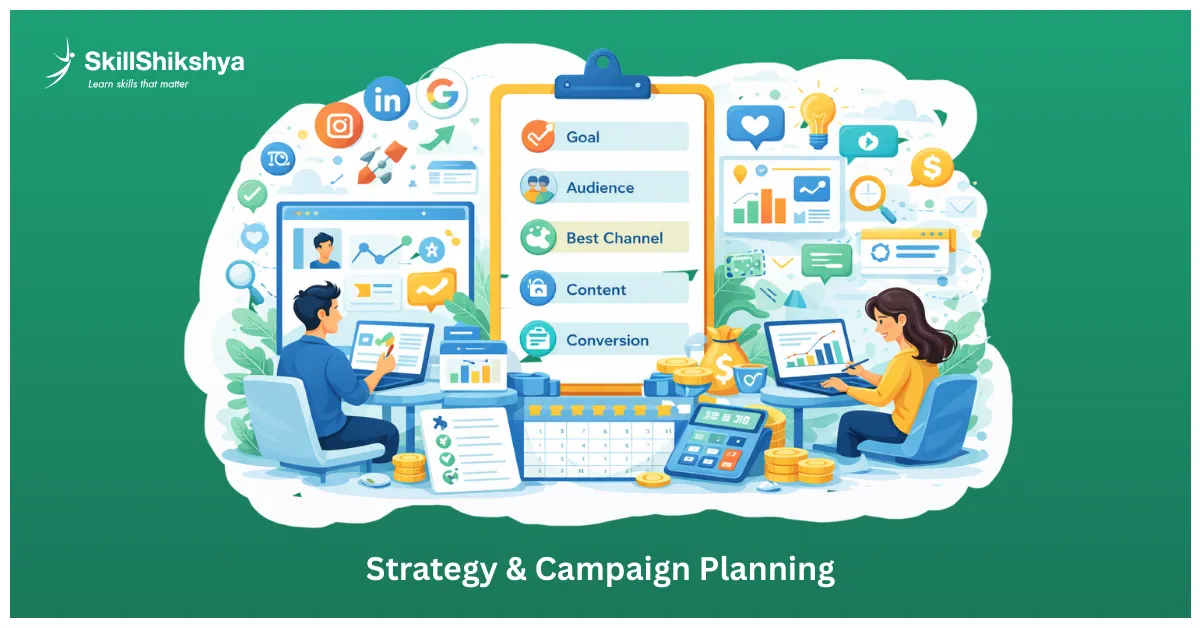
Building a Digital Marketing Strategy
Your strategy framework (use this for any business):
- Step 1: What's the business goal? (10 new clients per month? NPR 100,000 in sales?)
- Step 2: Who's the target audience? (Be specific)
- Step 3: What's the best channel to reach them? (Facebook? Google? Instagram?)
- Step 4: What content will attract them? (Educational? Entertainment? Offers?)
- Step 5: How will we convert them? (Landing page? DM? Phone call?)
Your action: Pick one local Nepal business. Write a complete digital marketing strategy using this framework. Even if they never see it, this exercise builds your thinking.
Selecting the Right Channels for a Business
Simple decision tree:
- B2B business (selling to companies)?: LinkedIn + Google Search
- Local business (restaurant, salon, gym)?: Facebook + Instagram + Google Business
- E-commerce (selling products online)?: Facebook + Instagram + TikTok
- Service business (coaching, consulting)?: LinkedIn + Facebook + Content Marketing
Your action: Analyze 5 Nepal businesses. Evaluate which channels they use and which they're missing. This teaches you channel strategy.
Content Calendar and Campaign Planning
Week 20: Create your first 30-day campaign plan
Theme: "Digital Marketing Career Month"
- Week 1 posts: Why digital marketing? (Awareness)
- Week 2 posts: Skills you need (Education)
- Week 3 posts: How to learn (Consideration)
- Week 4 posts: Apply for jobs/internships (Action)
Your action: Use a simple Google Sheet. Plan 12 posts (3 per week). Write headlines. Schedule them. Execute this campaign over the next month.
Budget Allocation and Goal Setting
If you had NPR 50,000 for digital marketing in Nepal, here's how to split it:
- 50% on proven channels (Facebook ads to the tested audience)
- 30% on testing new platforms or audiences
- 20% on tools and learning
Your action: Even if you don't have a budget yet, practice this thinking. If a client gives you NPR 20,000, where would you spend it and why?
Practical Learning & Live Projects
Timeline: Week 21-24 | Goal: Build a real portfolio with real results
This is where you separate yourself from everyone who just took digital marketing courses in Nepal.
Importance of Hands-On Practice
Truth: You don't need permission to practice. You need projects.
Your options:
- Start your own page/blog (document your digital marketing journey)
- Offer free work to small businesses (NGOs, local shops, friends' businesses)
- Run personal projects (sell something online, even a small one)
Your action: Choose one project this week. Commit to 3 months. This becomes your portfolio.
Working on Real or Simulated Projects
Project ideas for beginners:
- Project 1: Grow an Instagram page from 0 to 500 followers in 90 days (topic: digital marketing tips Nepal)
- Project 2: Run a Facebook ad campaign with an NPR 5,000 budget (promote a free digital marketing guide)
- Project 3:Write 10 SEO-optimized blog posts and track their Google rankings
Your action: Pick ONE. Don't try all three at once. Complete one successfully. Document everything.
Running Organic and Paid Campaigns
Week 21-22: Organic campaign
- Post consistently for 2 weeks
- Engage with your niche community daily
- Track growth and engagement
Week 23-24: Paid campaign
- Set up a simple lead generation ad (NPR 3,000-5,000 budget)
- Target: People interested in digital marketing careers in Nepal
- Offer: Free roadmap or checklist
- Track:Cost per lead
Your action: Screenshot everything. Save all metrics. This is your portfolio proof.
Performance Analysis and Optimization
After each campaign, fill this out:
- Goal: What was I trying to achieve?
- Results: What actually happened? (numbers)
- Cost: How much did I spend (time or money)?
- What worked: Which posts/ads performed best?
- What failed: Which ones flopped?
- Next time: What will I do differently?
Your action: Create a "Campaign Analysis" document. Update it after every project. This is how professionals learn.
Learning Through Mistakes and Iterations
- My biggest mistake: I once spent NPR 15,000 on an ad targeting "everyone in Nepal interested in business." Zero conversions.
- What I learned: Broad targeting = wasted money. Specific targeting = results.
- Your action: Expect to fail. When you do, write down exactly what went wrong and what you'll test next. Failure is data.
Portfolio & Personal Branding
Timeline: Week 25-26 | Goal: Package your skills for employers/clients

Creating a Digital Marketing Portfolio
Your portfolio must have:
- Your story (how you got into digital marketing)
- Skills you've mastered (SEO, social media, ads, analytics)
- 3-5 projects with real results
- Screenshots/proof of work
- Testimonials (even if from practice projects)
Your action: Create a simple portfolio on:
- Option 1: Google Slides (convert to PDF)
- Option 2: Notion page (free, looks professional)
- Option 3:Simple website (WordPress, Wix)
Showcasing Projects and Results
- Don't just say: "I managed social media."
- Say instead: "Grew Instagram from 50 to 600 followers in 90 days through consistent educational content and community engagement. Engagement rate: 6.2%."
- Your action: For every project, write it as: Challenge → Solution → Results (with numbers).
Building a Professional LinkedIn Presence
Week 25 LinkedIn setup:
- Day 1: Professional photo, headline with keywords ("Digital Marketing Specialist | Helping Nepal Businesses Grow Online")
- Day 2: Write a compelling About section (your story, skills, what you offer)
- Day 3: Add your projects to the Experience section (even personal projects count)
- Day 4-7:Post 5 times about digital marketing in Nepal (tips, learnings, insights)
Your action: Connect with 50 digital marketing professionals in Nepal. Engage with their content daily.
Positioning for Jobs, Internships, or Freelancing
- For jobs: Highlight teamwork, results, eagerness to learn
- For internships: Highlight projects you've done, tools you know, and a growth mindset
- For freelancing:Highlight client results, your niche, and testimonials
Your action: Rewrite your positioning for each path. Which one are you pursuing? Optimize your LinkedIn and portfolio for that specific audience. If you're interested in building income streams while learning, freelancing offers flexibility that complements your studies.
Career Paths in Digital Marketing
Timeline: Week 27-28 | Goal: Choose your direction
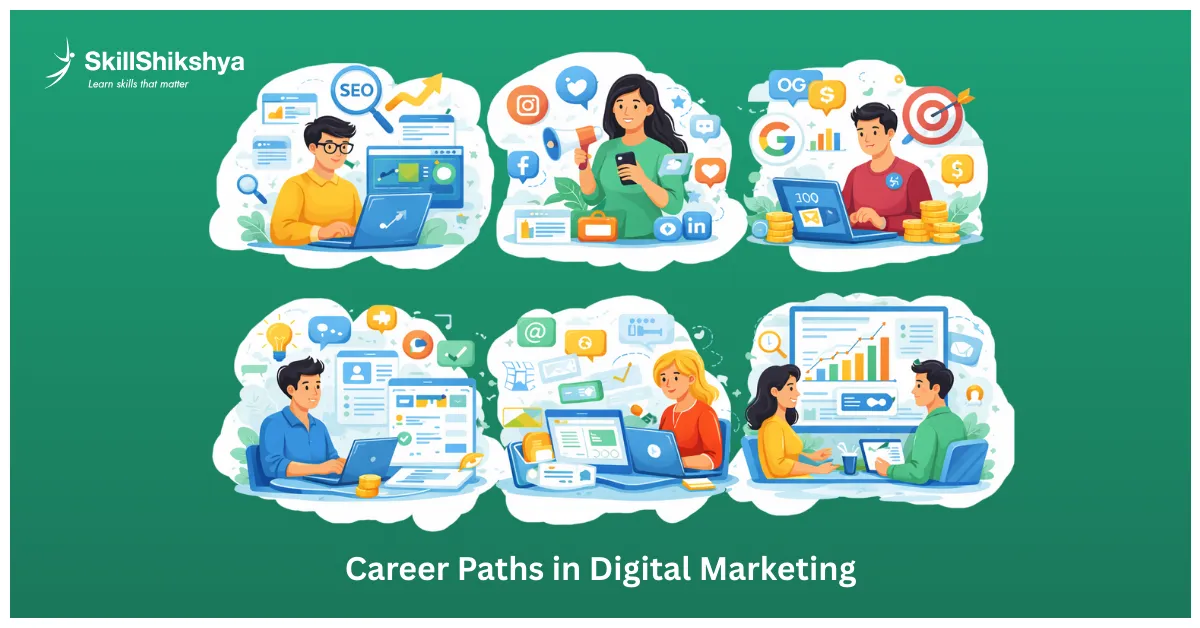
Different Roles in Digital Marketing
Explore these roles (spend 1-2 days researching each):
- SEO Specialist - Focus: Rankings, content, technical optimization. This specialization has its own career trajectory worth exploring if you love data and long-term strategies
- Social Media Manager - Focus: Community, content, engagement
- Performance Marketer - Focus: Paid ads, conversions, ROI
- Content Marketer - Focus: Blogging, videos, storytelling
- Email Marketer - Focus: Automation, nurturing, retention
- Digital Marketing Manager - Focus: Strategy, team management, multi-channel
Your action: Based on what you've practiced for 27 weeks, which role excites you most? Research digital marketing jobs in Nepal for that specific role.
Specialization vs Full-Stack Marketer
Full-stack marketer: You can do everything (SEO, ads, social media, content)
- Good for: Freelancing, small businesses, startups
- Salary range in Nepal: NPR 30,000-80,000
Specialist: You master one area deeply (just SEO or just Facebook Ads)
- Good for: Agencies, larger companies, high-skill demand
- Salary range in Nepal:NPR 50,000-150,000+
Your action: You don't need to decide immediately. Most people start as generalists, then specialize based on what they enjoy and what pays well.
Agency, In-House, and Freelance Career Paths
- Agency: Work with multiple clients, fast-paced, diverse projects, steep learning curve
- In-house: One company, deeper focus, stability, slower pace
- Freelance:Independence, flexibility, higher income potential (but inconsistent at start)
Your action: Research 5 digital marketing agencies in Nepal. Check their job postings. See what skills they want. Apply even if you're not 100% ready.
Importance of Continuous Learning
The field changes constantly. Facebook's algorithm updates. Google releases new ranking factors. TikTok becomes a marketing channel. AI tools disrupt everything.
Your action: Set aside 2-3 hours every week for learning.
Subscribe to:
- Social Media Examiner
- Nepal-based digital marketing groups on Facebook
Conclusion (Professional Advice)
Timeline: Week 29-30 | Goal: Take action and start your career
Focus on Fundamentals Before Tools
You've spent 28 weeks on this roadmap. Here's what you should have by now:
- Understanding of digital marketing fundamentals
- Real projects with measurable results
- Portfolio showcasing your work
- LinkedIn presence with content
- Hands-on experience with ads, SEO, and social media
Next step: Don't wait for perfection. You're ready to apply for a digital marketing internship in Nepal or an entry-level job.
Practice Matters More Than Certificates
Harsh truth: I've never been asked for my certificates. I've always been asked: "What results have you delivered?"
Your portfolio matters. Your projects matter. Your ability to explain strategy matters.
Certificates are nice to have, but not enough on their own.
Your action: If you followed this roadmap, you have 6 months of real practice. That's worth more than any certificate alone.
Consistency and Learning Mindset
The digital marketing career path isn't a straight line.
You'll have weeks where nothing works. Campaigns that fail. Content that flops. Rejections from jobs.
Keep going. The ones who succeed aren't the most talented. They're the most consistent.
Your action: Commit to showing up daily. Even 1 hour of focused work beats 8 hours once a week.
Salary Expectations in Nepal
| Level | Monthly Salary (NPR) |
|---|---|
| Beginner / Intern | 20,000 – 30,000 |
| 1–2 Years Experience | 40,000 – 70,000 |
| Experienced / Specialist | 80,000 – 100,000+ |
| Freelancers | Depends on clients & results |
Final Guidance from a Working Digital Marketer
If you're reading this and still haven't started:
- Today - Week 1: Pick one thing from this roadmap and do it today. Create that social media page. Write that first blog post. Screenshot 10 ads for analysis.
- Week 2-12: Follow the fundamentals section strictly. Don't skip ahead to paid ads just because they look exciting.
- Week 13-24: Run real projects. Document everything. Build your portfolio.
- Week 25-30:Package your skills, apply for jobs, start freelancing, or pitch clients.
The scope of digital marketing in Nepal is massive. Businesses need you. But they need someone who understands strategy, not just tools. This digital marketing career roadmap works if you work it.
I spent 5 years learning through trial and error. You can compress that into 6-12 months by following this exact path. The salary of a digital marketer in Nepal for beginners starts at NPR 20,000-30,000. But with 1-2 years of real experience and proven results? You'll easily reach NPR 60,000-100,000+.
Not sure if digital marketing is for you? The tech field offers multiple paths - from visual design careers to programming and beyond. Explore what resonates with your interests and strengths.
Start today. Follow the roadmap. Build your proof. Get hired.
And remember: every expert in digital marketing in Nepal started exactly where you are right now. The only difference? They started.
Your turn.
Frequently Asked Questions
Is digital marketing a good career in Nepal in 2026?
What is the best digital marketing roadmap for beginners in Nepal?
Can I start a digital marketing career without prior experience?
What is the salary of a digital marketer in Nepal?
What skills are required to become a digital marketer in Nepal?
How long does it take to learn digital marketing properly?
Do I need a degree to get a digital marketing job in Nepal?
Can I learn digital marketing without a course in Nepal?
How can beginners get their first digital marketing job or internship in Nepal?
Is digital marketing a long-term career?
About Author:

Meet Mr. Prakash Bhandari, a Digital Marketer at Skill Shikshya. He brings real-world marketing experience to learners, guiding them through campaigns, strategies, and hands-on projects to build practical, career-ready skills.