DevOps Salary in Nepal 2026: How Much Can You Actually Earn?
The tech landscape in Nepal is undergoing a massive shift. As local tech firms, outsourcing giants, and international product startups rapidly move away from traditional on-premise infrastructure, the demand for automation has skyrocketed. If you are an IT professional, computer science student, or a career switcher eyeing a lucrative technical path, understanding the devops salary in Nepal is the first step toward mapping out your future.
The salary of devops engineer professionals reflects their status as some of the highest-paid tech talent in the country. For those exploring this field for the first time, understanding the complete DevOps career guide can help you see how salary growth, skills, and certifications fit into a long-term technology career path.
But what can you realistically expect to make per month and per year in 2026? Let’s dive straight into the numbers, career paths, and practical skills that drive financial growth in this field. If you're planning to enter the profession, enrolling in a DevOps training program can help you build the cloud, automation, and CI/CD skills employers actively seek.
How much Does a DevOps Engineer Earn in Nepal?
When calculating a realistic devops salary, it helps to look at both monthly gross earnings and annual packages across different experience tiers. In Nepal’s current market, compensation is heavily influenced by whether you work for a local software company, an international outsourcing house (like Leapfrog, Cedar Gate, or Fusemachines), or a remote foreign client. The expanding scope of DevOps across cloud computing, automation, cybersecurity, and platform engineering is one of the primary reasons skilled professionals continue to command higher salaries.
On average, a devops engineer salary in Nepal ranges from NPR 35,000 per month for beginners to well over NPR 350,000+ per month for seasoned veterans. This translates into a yearly spectrum of approximately NPR 420,000 to NPR 4,200,000+.
The 2026 Salary Breakdown by Experience
Comparing Earnings Across Different Experience Levels
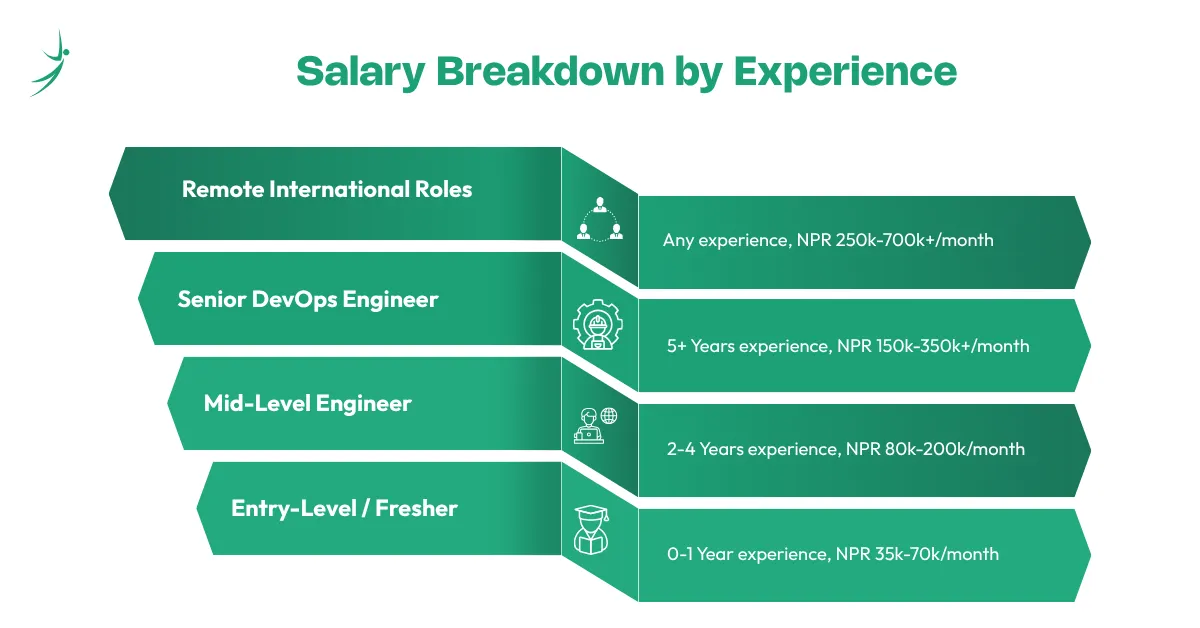
| Experience Level | Average DevOps Salary Per Month (NPR) | Estimated Annual Salary (NPR) |
| Entry-Level / Fresher (0–1 Year) | NPR 35,000 – NPR 70,000 | NPR 420,000 – NPR 840,000 |
| Mid-Level Engineer (2–4 Years) | NPR 80,000 – NPR 200,000 | NPR 960,000 – NPR 2,400,000 |
| Senior DevOps Engineer (5+ Years) | NPR 150,000 – NPR 350,000+ | NPR 1,800,000 – NPR 4,200,000+ |
| Remote International Roles (Any) | NPR 250,000 – NPR 700,000+ | NPR 3,000,000 – NPR 8,400,000+ |
DevOps Salary for Freshers in Nepal
Breaking into the industry can feel daunting, but a fresher devops salary is still significantly higher than many alternative entry-level IT roles in Nepal.
Fresh Graduate Salary Expectations
As a fresh graduate with zero industry experience but strong foundational knowledge, your starting devops salary per month will hover around NPR 35,000 to NPR 60,000. If you begin via a structured devops job in Nepal as an intern or trainee, expect a stipend between NPR 10,000 and NPR 25,000 per month. Most paid internships convert into full-time roles within 3 to 6 months based on production performance.
Many employers prefer candidates who have completed practical training through the best DevOps course in Nepal, especially when evaluating entry-level applicants with limited professional experience
Skills Employers Expect from Beginners
To secure the upper end of a junior salary band, freshers must demonstrate competence beyond basic coding:
- Linux Fundamentals: Comfort handling file systems, permissions, and basic bash scripting.
- Version Control: Complete proficiency with Git workflows, branching, and pull requests.
- Cloud Foundations: Initial hands-on familiarity with core services on platforms like AWS or Microsoft Azure.
- Container Basics: Knowing how to write a simple Dockerfile and run containers locally.
Common Mistakes That Keep Salaries Low
Many beginners get stuck in low-paying loops because they focus purely on memorizing tool names rather than building architectures. Missing basic networking concepts (like subnets, DNS, and HTTP codes) or ignoring system security practices will restrict your earning leverage during early salary negotiations.
DevOps Jobs in Nepal: What Roles Are Actually Hiring?
The umbrella term "DevOps" encompasses several specialized career pathways, each carrying distinct tasks, operational focus, and compensation scales.
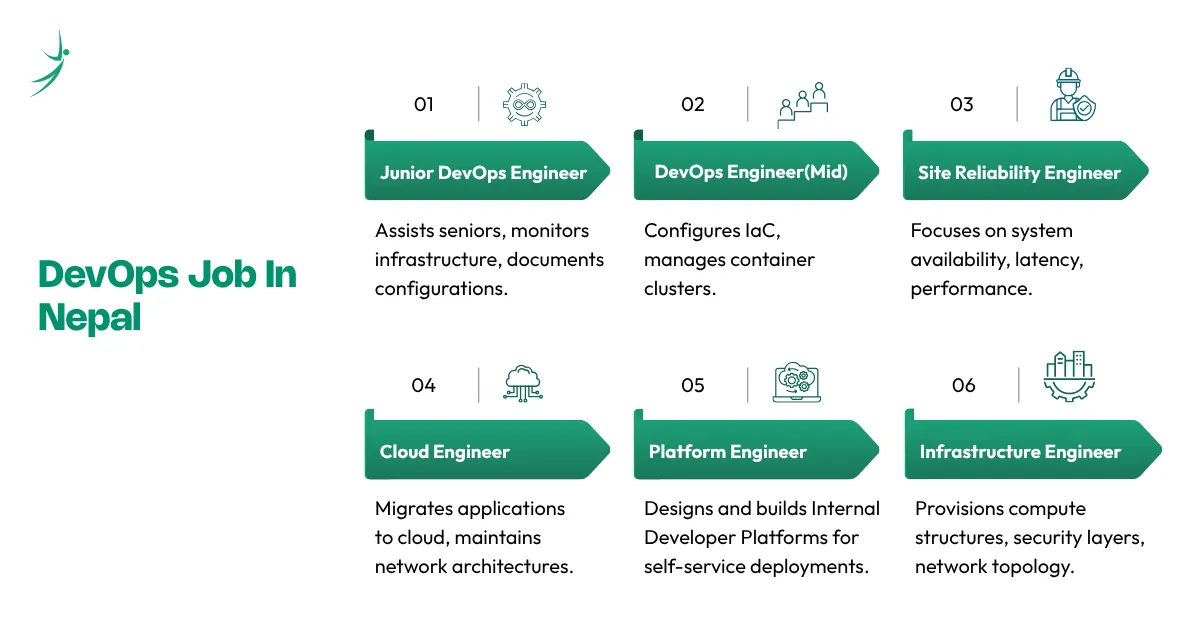
1. Junior DevOps Engineer
- Responsibilities: Assisting seniors in maintaining CI/CD automation pipelines, monitoring infrastructure health, managing user access controls, and documenting server configurations.
- Junior DevOps Engineer Salary: NPR 35,000 – NPR 70,000 per month.
- Career Prospects: Fast growth path to a mid-level engineer within 1.5 to 2 years of active production exposure.
2. DevOps Engineer (Mid-Level)
- Responsibilities: Configuring infrastructure as code (Terraform), managing production container clusters (Kubernetes), designing reliable build pipelines, and troubleshooting deployment blockers.
- Salary Range: NPR 80,000 – NPR 200,000 per month.
- Career Prospects: High local mobility and expanding opportunities to pick up part-time freelance consulting work.
3. Site Reliability Engineer (SRE)
- Responsibilities: Focusing heavily on system availability, latency, performance, efficiency, and emergency response management. SREs apply software engineering principles directly to infrastructure scaling problems.
- Site Reliability Engineer Salary: NPR 120,000 – NPR 280,000+ per month.
- Career Prospects: Elite engineering tier with significant value in international financial systems, fintech apps, and large SaaS platforms.
4. Cloud Engineer
- Responsibilities: Migrating legacy on-premise applications to public cloud systems, managing storage resources, and maintaining network architectures across multi-cloud environments.
- Cloud Engineer Salary Nepal: NPR 60,000 – NPR 180,000 per month.
- Career Prospects: Transition smoothly into specialized Cloud Architecture roles.
5. Platform Engineer
- Responsibilities: Designing and building Internal Developer Platforms (IDPs) that enable internal development teams to execute self-service deployments smoothly without manually configuring underlying servers.
- Salary Range: NPR 100,000 – NPR 250,000 per month.
- Career Prospects: Highly sought after by larger enterprise organizations running massive development departments.
6. Infrastructure Engineer
- Responsibilities: Provisioning core compute structures, system security layers, network topology, and database backups.
- Salary Range: NPR 70,000 – NPR 160,000 per month.
- Career Prospects: Evolving smoothly into automated cloud-focused infrastructure engineering.
DevOps Certifications That Boost Salaries
Earning professional global certifications validates your skills directly to local employers and international clients, helping you jump salary brackets faster.
AWS Certified DevOps Engineer – Professional
- Difficulty Level: High (Requires deep knowledge of complex provisioning systems and multi-account automation).
- Employer Demand: Extremely high, as AWS remains the dominant cloud provider utilized by Nepali IT businesses.
- Salary Impact: Can increase baseline local offers by 25% to 40%.
- Ideal Career Stage: Mid-level to advanced professionals.
Microsoft Certified: DevOps Engineer Expert
- Difficulty Level: High (Focuses deeply on enterprise delivery pipelines and hybrid setups).
- Employer Demand: Strong among enterprise development houses working with .NET environments and corporate cloud migrations.
- Salary Impact: Provides a substantial competitive advantage in corporate IT departments.
- Ideal Career Stage: Mid-level to senior system administrators or engineers.
Google Professional Cloud DevOps Engineer
- Difficulty Level: High (Emphasizes Site Reliability Engineering principles, system monitoring, and microservices management).
- Employer Demand: Growing rapidly as more modern product startups pick up Google Cloud Platform (GCP) resources.
- Salary Impact: Differentiates you significantly in a crowded local talent market.
- Ideal Career Stage: Advanced mid-level or aspiring SRE specialists.
Certified Kubernetes Administrator (CKA) / CKAD
- Difficulty Level: Very High (100% performance-based practical lab exam).
- Employer Demand: Critical. Companies running complex containerized microservices heavily prioritize CKA holders to manage production clusters.
- Salary Impact: One of the highest yielding credentials; frequently unlocks immediate senior-tier salary brackets.
- Ideal Career Stage: Mid to Senior engineers handling orchestration layers.
Docker Certified Associate
- Difficulty Level: Moderate (Validates core container configuration and runtime safety concepts).
- Employer Demand: Excellent for entry-to-mid level roles to prove immediate utility.
- Salary Impact: Helps freshers bypass lowest-tier starting offers.
- Ideal Career Stage: Freshers, junior engineers, and system admins switching tracks.
What Actually Affects Your DevOps Salary?
Two professionals with the same job title in Kathmandu can have vastly different paychecks. Here are the core factors driving those variances:
- Experience Level: Raw years spent managing high-traffic production environments, resolving real downtime incidents, and handling architectural failure points.
- Cloud Platform Expertise: Masterful knowledge of AWS, Microsoft Azure, or Google Cloud Platform services, including identity management, secure networking, and cost optimization.
- Kubernetes and Containerization Skills: Moving beyond basic container building into running auto-scaling, self-healing Kubernetes clusters in live production.
- CI/CD Automation Experience: Crafting efficient pipelines using tools like Jenkins or GitHub Actions that handle testing, security scanning, and deployments autonomously.
- Linux and System Administration Skills: Deep comfort with operating system internals, shell scripting, networking stack tuning, and log analysis.
- Infrastructure as Code (IaC): The ability to model complete cloud environments declaratively using Terraform so that infrastructure can be version-controlled and destroyed or recreated instantly.
- Remote Work Experience: Previous exposure working across international time zones, handling asynchronous communication channels, and managing distributed setups.
- Communication and Collaboration Skills: The capacity to break down complex architectural blockers clearly for developers, business managers, and stakeholders without technical jargon.
DevOps Salary in Nepal vs International Salaries
To understand the global leverage of your skills, it is helpful to compare the domestic salary scale in Nepal with dominant international tech markets.
According to salary data from Glassdoor, Kumari Job, and industry reports, the following estimates provide a general comparison of DevOps salaries across different markets.
Global Salary Comparison Table (2026 Estimates)
| Country | Average Monthly Salary (NPR Equivalent) | Average Annual Salary (USD Equivalent) |
| Nepal | NPR 35,000 – NPR 350,000+ | $4,000 – $32,000+ |
| India | NPR 80,000 – NPR 450,000+ | $8,000 – $40,000+ |
| United States | NPR 1,200,000 – NPR 2,500,000+ | $110,000 – $220,000+ |
| United Kingdom | NPR 800,000 – NPR 1,600,000+ | £55,000 – £110,000+ |
| Australia | NPR 950,000 – NPR 1,900,000+ | A$100,000 – A$200,000+ |
| Canada | NPR 850,000 – NPR 1,700,000+ | C$90,000 – C$180,000+ |
The Tools You'll Actually Use on the Job
To understand how software flows from a developer's laptop into a live application, it helps to visualize the complete automated lifecycle that DevOps professionals build and manage every day.
To manage this continuous cycle effectively, you will work with an ecosystem of essential DevOps tools used across cloud infrastructure, automation, monitoring, and deployment workflows.Employers look for practical comfort across these specific toolsets:
- AWS / Azure / Google Cloud Platform: The modern foundation of enterprise infrastructure. Public cloud providers remove physical hardware management bottlenecks.
- Docker: Standardizes applications into lightweight, isolated containers, ensuring software runs identically across development, staging, and production environments.
- Kubernetes: Automates the scaling, networking, and deployment of thousands of containerized applications across cloud clusters.
- Terraform: Allows engineers to define complete infrastructure architectures via clean configuration files, making environments reproducible and auditable.
- Jenkins / GitHub Actions / GitLab CI/CD: Automated engines that automatically compile code, run tests, and deploy builds every time a developer updates the central repository.
- Prometheus & Grafana: Essential metrics gathering and dashboard visualization systems used to track infrastructure health and alert teams to performance anomalies.
- Linux (Ubuntu/CentOS): The base operating system powering the vast majority of web servers and cloud containers worldwide.
How to Start and Actually Grow Your DevOps Salary
Following a structured DevOps roadmap can help you learn the right technologies in the correct order while avoiding common beginner mistakes.
Step 1: Master the Foundational Basics
Do not jump straight into complex tools. Start by learning how the web works. Understand TCP/IP, DNS routing, HTTP protocols, SSH key management, and basic Linux administration. Write simple Bash and Python scripts to automate file cleanups or system checks.
Step 2: Learn Version Control and Containerization
Gain complete comfort using Git. Create an account on GitHub, track your code changes, and practice resolving merge conflicts. Once confident, learn how to containerize basic web applications (like a simple Node.js or Python backend) using Docker.
Step 3: Pick One Cloud Provider and Automate It
Focus your attention on AWS or Microsoft Azure. Learn how to launch virtual computer instances, configure secure virtual networks (VPCs), and manage storage access. Next, learn to deploy those exact services programmatically using Terraform instead of clicking buttons in the web dashboard.
Step 4: Build a Live, Automated Portfolio Project
Create a public GitHub repository that proves your skills. Set up a pipeline using GitHub Actions so that whenever you update your code, the pipeline automatically tests the application, builds a Docker image, and deploys it to your cloud infrastructure. Document the entire architecture in a clean README file.
Step 5: Network and Target the Right Positions
Share your learning journey, deployment breakthroughs, and technical challenges on LinkedIn. Apply for specialized junior positions or internships at outsourcing agencies. Focus entirely on gaining hands-on production exposure during your first year, your salary growth will scale rapidly once you have live systems experience under your belt.
Train with Skill Shikshya
Transitioning into an elite technology career requires a structured approach, access to live systems, and professional guidance. Skill Shikshya provides a comprehensive, practical training methodology designed to turn ambitious tech enthusiasts into job-ready professionals.
What You Will Master
Our curriculum focuses completely on the real-world skills employers prioritize:
- Hands-on Cloud Deployments: Architecting and securing production resources on AWS.
- Production Infrastructure as Code: Building enterprise environments using Terraform.
- Advanced Container Orchestration: Configuring and managing auto-scaling Kubernetes clusters.
- Automated Production Pipelines: Building production-grade CI/CD workflows with GitHub Actions.
Why Choose Skill Shikshya?
- Practical Lab Work: Learn by building on live systems rather than just watching video tutorials.
- Real-World Project Portfolios: Build a validated, public engineering portfolio designed to stand out to hiring managers.
- Direct Industry Mentorship: Learn directly from experienced, senior engineering professionals actively working in the field.
- Career Support: Receive resume refinement support, targeted interview preparation, and direct connections to high-paying tech openings in Nepal.
Take control of your professional future today. Maximize your earning potential, master the global cloud ecosystem, and build a rewarding career.
Enroll in the Skill Shikshya DevOps Training Program.
Frequently Asked Questions
What is the DevOps salary in Nepal in 2026?
What is the DevOps salary for freshers in Nepal?
Does DevOps pay well in Nepal?
Is DevOps in demand in Nepal?
What skills increase DevOps salary the most?
Which DevOps certification has the highest salary impact?
Can I work remotely as a DevOps engineer from Nepal?
How long does it take to become a DevOps engineer?
Is AWS enough to get a DevOps job?
Is This the Right Time to Get Into DevOps in Nepal?
About Author: