Best Data Science and Machine Learning Tools Every Professional Should Know (2026 Guide)
The landscape of artificial intelligence and analytics is evolving at an unprecedented speed. To extract meaningful insights, automate business processes, and deploy reliable predictive models, modern teams rely on an end to end software toolkit. Choosing the best data science tools and best machine learning tools enables data professionals to build scalable pipelines, accelerate experimentation, and reduce model drift in production environments. Whether you are an absolute beginner starting your learning journey through a best Data Science and Machine Learning Course in Nepal or an experienced practitioner refining your deployment stack, mastering modern data science tools and machine learning tools is the key to thriving in today's tech industry.
Why Choosing the Right Data Science and Machine Learning Tools Matters
Selecting the right ecosystem directly impacts code performance, team productivity, and model reliability. Modern enterprise environments require seamless integration between data collection, exploratory analysis, model training, and continuous monitoring.
How tools impact productivity and model accuracy
Using optimized tools reduces compute overhead and prevents data processing bottlenecks. High performance frameworks leverage distributed compute and GPU acceleration, allowing engineers to train complex architectures in minutes rather than days. For those understanding data science fundamentals, selecting proper frameworks ensures clean data transformation, which directly drives higher model accuracy.
Why companies build different tech stacks
Different business verticals require specialized software architectures:
- Startups prioritize developer velocity, low licensing costs, and rapid prototyping tools.
- Enterprise FinTech and Healthcare prioritize compliance, strict data governance, real time transaction processing, and deterministic audit trails.
- AI Product Companies require low latency inference servers, GPU orchestration, and specialized large language model frameworks.
Difference between learning concepts vs learning tools
Theoretical knowledge provides the mathematical foundation of statistics, calculus, linear algebra, and probability. However, practical industry implementation relies on translating those theoretical equations into computational workflows. A complete professional toolkit requires mastering both foundational theory and production software execution.
How recruiters evaluate tool proficiency
Recruiters and hiring managers evaluate candidates based on practical engineering capabilities. Beyond listing raw skills on a resume, candidates must demonstrate hands on problem solving, version control workflows, model packaging, and API deployment. Mastering core tools aligned with essential data scientist skills serves as direct proof of job readiness when following a comprehensive guide on starting a career in data science.
The Most used Data Science and Machine Learning Tools
Explore the most popular tools used by data scientists and machine learning engineers for data analysis, visualization, model development, deployment, and collaboration from industry standards to modern AI-powered platforms.
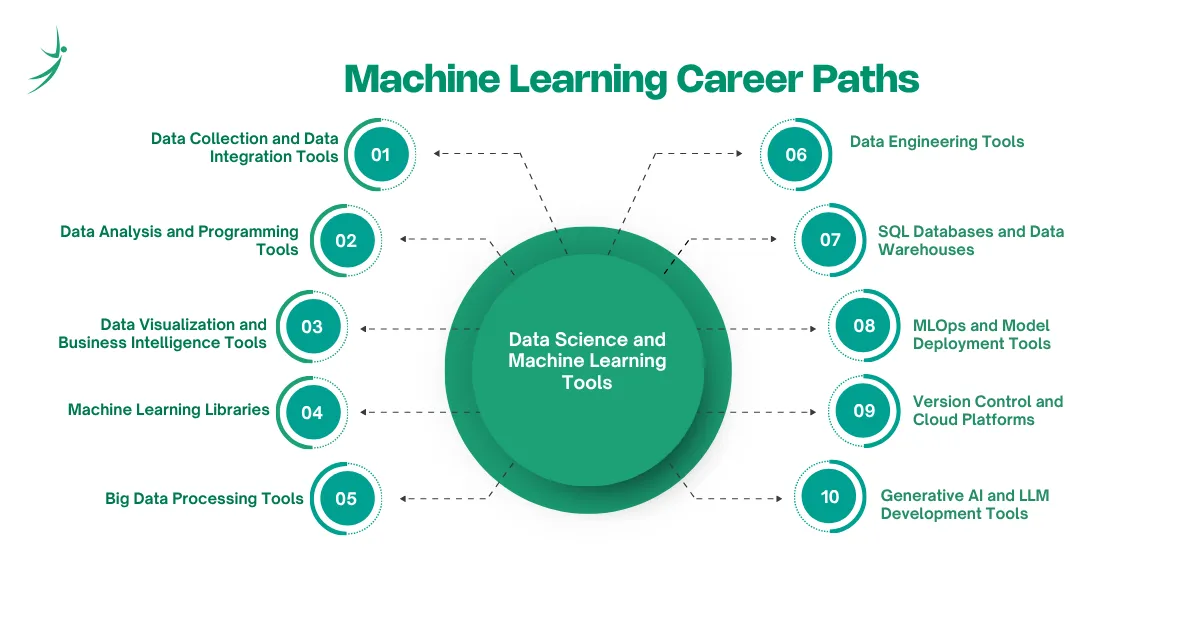
Data Collection and Data Integration Tools
- Apache Kafka: Apache Kafka is an open source distributed event streaming platform built for high throughput, real time data feeds. It enables organizations to ingest billions of continuous data events per second from microservices, IoT devices, and transactional databases into centralized storage layers.
- Apache NiFi: Apache NiFi offers an intuitive graphical interface designed to automate data flows between disparate software platforms. It provides robust capabilities for real time data routing, data transformation, backpressure management, and detailed lineage tracing across enterprise cloud environments.
- Airbyte: Airbyte is a leading open source data integration platform that simplifies ELT data pipelines. Featuring hundreds of pre-built, customizable connectors, Airbyte allows data teams to seamlessly extract records from third party APIs and load them into cloud data warehouses within minutes.
Data Analysis and Programming Tools
Programming languages and interactive notebook environments serve as the primary execution workspace for data manipulation, experimentation, and statistical evaluation.
- Python: Python remains the undisputed industry standard language across data engineering, data science, and artificial intelligence. Its clear syntax, massive active developer community, and unmatched ecosystem of python libraries make it the most versatile programming foundation. For a deeper look at script execution and ecosystem setup, check out our guide on using Python for data science.
- R: R is a programming environment created specifically for statistical computing, epidemiological research, and formal academic analysis. It excels at complex hypothesis testing, statistical modeling, and publishing publication ready statistical charts.
- Jupyter Notebook: Jupyter Notebook is an interactive open source web environment that combines live code, markdown text, mathematical equations, and inline data visual plots into a single reproducible document. It is the gold standard workspace for initial exploratory data analysis.
- Google Colab: Google Colab brings cloud hosted Jupyter Notebook environments directly to your web browser. It provides free and paid tier access to powerful cloud GPUs and TPUs, allowing data scientists to execute deep learning models without needing expensive local hardware.
When analyzing data workflows, understanding the data science vs data analytics distinction helps professionals select the right execution environment for business reporting versus predictive modeling.
Data Visualization and Business Intelligence Tools
Translating raw numerical datasets into compelling, actionable visual dashboards is essential for driving enterprise business strategy.
- Tableau: Tableau is an enterprise level Business Intelligence platform renowned for its drag and drop visualization capabilities, real time database connectivity, and executive dashboard sharing features across large organizational teams.
- Microsoft Power BI: Microsoft Power BI is a dominant cloud based analytics and visualization service that integrates seamlessly with Microsoft Office 365, Azure data platforms, and enterprise SQL databases, making scalable corporate reporting highly accessible.
- Matplotlib: Matplotlib is the core graphical python library for data science scripting. It provides foundational control over plot customization, figure creation, axis scaling, and static graphic generation.
- Seaborn: Built on top of Matplotlib, Seaborn provides a high level interface for drawing statistical graphics. It includes built in color palettes and automatic aggregation features for rendering elegant distribution plots, heatmaps, and pair plots.
- Plotly: Plotly is a modern graphing framework that enables developers to generate fully interactive, web based charts. It integrates smoothly with web applications and Python dashboards, allowing end users to zoom, hover, and filter data dynamically.
Machine Learning Libraries
Traditional predictive modeling relies on optimized algorithms packaged into flexible code interfaces.
- Scikit-learn: Scikit-learn is the essential open source machine learning library in Python. Built upon NumPy, SciPy, and Matplotlib, it features clean implementations of regression, classification, clustering, dimensionality reduction, and model evaluation modules.
- XGBoost: XGBoost (eXtreme Gradient Boosting) is an optimized distributed gradient boosting library engineered for extreme performance and accuracy. It dominates competitive data science benchmarks on structured, tabular datasets.
- LightGBM: LightGBM is a fast, high performance gradient boosting framework developed by Microsoft that uses tree based learning algorithms. It utilizes leaf wise tree growth, drastically reducing memory usage and accelerating training speed on massive tabular data.
- CatBoost: CatBoost is an advanced gradient boosting framework designed by Yandex that handles categorical features natively without requiring manual pre-encoding. It provides high out of the box performance with minimal hyperparameter tuning.
Developers exploring these frameworks should review what machine learning is and examine the machine learning vs data science comparison to understand where predictive algorithms sit within broader enterprise architectures. Additionally, choosing the right python library machine learning stack depends heavily on dataset dimensionality and inference speed goals.
Big Data Processing Tools
When data volumes exceed single machine memory limits, distributed computing frameworks scale data transformation across compute clusters.
- Apache Spark: Apache Spark is a lightning fast unified analytics engine designed for big data and machine learning processing. Its in memory computing engine enables enterprise level batch processing, real time streaming, and distributed machine learning via PySpark.
- Hadoop: Apache Hadoop is a legacy open source framework that pioneered distributed storage (HDFS) and distributed data processing (MapReduce), enabling companies to manage massive unstructured data across commodity hardware servers.
- Databricks: Databricks is a unified cloud analytics platform founded by the original creators of Apache Spark. Built upon Lakehouse architecture, Databricks unifies data engineering, business intelligence, data science, and generative AI inside a collaborative workspace.
Data Engineering Tools
Modern machine learning platforms rely on robust backend data infrastructure managed by data engineering pipelines.
- Apache Airflow: Apache Airflow is an open source platform used to programmatically author, schedule, and monitor complex data workflow Directed Acyclic Graphs (DAGs), ensuring dependable ETL pipeline automation.
- Data Build Tool: DBT enables data analysts and engineers to transform raw data inside cloud data warehouses using standard SQL queries. It brings software engineering best practices like version control, testing, and documentation to SQL transformations.
- Snowflake: Snowflake is a fully managed cloud data warehouse built for multi cloud environments. Its decoupled storage and compute architecture allows data teams to query massive datasets concurrently without performance degradation.
Understanding these platforms is vital when examining the data engineer vs data scientist breakdown to understand how data pipelines supply clean training data to ML models.
SQL Databases and Data Warehouses
Relational database management systems and enterprise data warehouses serve as the foundational source of structured enterprise business data.
- PostgreSQL: PostgreSQL is a powerful, open source object relational database system known for reliability, feature robustness, complex SQL support, and geographic spatial extensions via PostGIS.
- MySQL: MySQL is one of the most widely deployed relational database management systems globally, powering web applications, digital storefronts, and cloud services with fast read performance.
- BigQuery: Google Cloud BigQuery is a serverless, highly scalable enterprise cloud data warehouse with a built-in SQL query engine capable of executing multi-terabyte queries in seconds.
- Amazon Redshift: Amazon Redshift is a fully managed, petabyte scale cloud data warehouse that integrates natively with AWS analytical services, S3 data lakes, and business intelligence dashboards.
MLOps and Model Deployment Tools
Machine Learning Operations (MLOps) frameworks bridge the operational gap between offline experimental notebooks and continuous production deployment.
- MLflow: MLflow is an open source platform designed to manage the end to end machine learning lifecycle. It offers core modules for tracking parameters and metrics, packaging code models, and managing centralized model registries.
- Docker: Docker simplifies application packaging by containerizing code, library dependencies, and configuration files into lightweight, isolated execution containers. It guarantees model reproducibility across development and server environments.
- Kubernetes: Kubernetes is an open source container orchestration platform that automates the deployment, scaling, load balancing, and operational management of containerized ML inference services in production.
- FastAPI: FastAPI is a modern, high performance web framework written in Python for building APIs. Its high execution speed, automatic Swagger documentation, and asynchronous handling make it the top choice for serving machine learning models via REST endpoints.
Version Control and Cloud Platforms for Data Science and Machine Learning
Version Control Tools
Version control systems ensure computational code history, data schemas, and model artifacts are systematically tracked across collaborative engineering teams.
- Git: Git is a distributed version control system designed to track source code changes, manage software branching strategies, and support smooth code merging across collaborative software development projects.
- GitHub: GitHub is a cloud hosting platform for Git version control repositories. It provides code review workflows, issue tracking, continuous integration pipelines (GitHub Actions), and open source collaboration features.
- DVC (Data Version Control): DVC is an open source version control system built specifically for machine learning projects. It extends Git to track large data files, machine learning datasets, intermediate code pipelines, and trained model binary files.
Cloud Platform
Cloud hyper scalers provide managed, scalable compute, automated hyperparameter tuning, and seamless enterprise API deployments.
- AWS SageMaker: AWS SageMaker is a fully managed cloud service that provides developers and data scientists with the ability to build, train, tune, and deploy machine learning models quickly at enterprise scale.
- Google Vertex AI: Google Vertex AI is a unified machine learning platform that simplifies building, deploying, and maintaining AI applications. It combines Google Cloud data infrastructure, AutoML capabilities, and managed MLOps tools.
- Microsoft Azure Machine Learning: Azure Machine Learning is an enterprise cloud service designed to accelerate the ML project lifecycle. It provides MLOps workflow automation, automated machine learning (AutoML), and enterprise governance controls.
Generative AI and LLM Development Tools (2026)
The exponential growth of Generative AI has introduced specialized development tools designed to build Retrieval Augmented Generation (RAG) applications, agentic workflows, and custom fine tuned language models.
- Hugging Face: Hugging Face is the central open source hub for pretrained transformer models, datasets, and AI applications. Its popular Transformers data science library allows developers to download, fine tune, and deploy state of the art NLP and multimodal architectures.
- LangChain: LangChain is an open source developer framework created to build applications powered by Large Language Models (LLMs). It simplifies prompt chaining, external document context integration, dynamic memory storage, and agentic decision flows.
- Ollama: Ollama is a lightweight local execution engine that allows developers to run open source LLMs (such as Llama 3, Mistral, and Gemma) directly on local hardware without sending private data to external cloud APIs.
- OpenAI API: The OpenAI API grants developers direct access to flagship generative models (including GPT 4o and specialized reasoning models) for automated text generation, code synthesis, embeddings, and real time multimodal analysis.
- LlamaIndex: LlamaIndex is a data framework designed specifically to connect custom private data sources to Large Language Models. It excels at data ingestion, indexing, and structured retrieval required for building high precision RAG platforms.
Complete Comparison Table: Data Science and Machine Learning Tools
| Tool | Category | Primary Use | Difficulty Level | Industry Popularity |
| Python | Programming | Data analysis, ML script execution, API automation | Beginner | Dominant (Global Standard) |
| Jupyter Notebook | Interactive Workspace | Exploratory data analysis & prototyping | Beginner | Universal |
| SQL (PostgreSQL/MySQL) | Database Management | Data extraction & transactional querying | Beginner | Universal |
| Tableau / Power BI | Business Intelligence | Interactive dashboarding & executive reporting | Intermediate | High Enterprise |
| Scikit-learn | Machine Learning | Classical ML model training & pre-processing | Beginner to Intermediate | Standard |
| PyTorch | Deep Learning Framework | Neural networks, computer vision, GenAI | Intermediate to Advanced | Dominant (Research & AI) |
| Apache Spark | Big Data Processing | Distributed batch processing & big data analytics | Advanced | High Enterprise |
| MLflow | MLOps Platform | Experiment tracking & model lifecycle management | Intermediate | High |
| Docker | Containerization | Packaging model applications & dependencies | Intermediate | Universal Developer Standard |
| AWS SageMaker | Cloud ML Platform | Managed cloud training & enterprise API serving | Advanced | High Enterprise |
| LangChain | LLM Framework | RAG applications, agentic AI, LLM chains | Intermediate | Rapidly Growing |
The Data Science Tool Stack Companies Actually Use
In production environments, companies do not rely on a single isolated software package. Instead, they engineer integrated technology stacks across every operational phase.
Here is how modern enterprises combine these software suites across major industry verticals:
Startups
- Data Stack: PostgreSQL, Airbyte, Python, Jupyter Notebook, Scikit-learn, FastAPI, Docker, Streamlit.
- Focus: Speed of execution, minimal operational cost, and quick deployment to cloud providers like Render or AWS.
FinTech
- Data Stack: Apache Kafka, Snowflake, dbt, Python, XGBoost, LightGBM, MLflow, Docker, Kubernetes, AWS SageMaker.
- Focus: Low latency streaming, fraud detection precision, strict audit security, and robust MLOps pipeline tracking.
Healthcare
- Data Stack: PostgreSQL, Apache Airflow, Python, PyTorch, OpenCV, MLflow, Docker, Azure Machine Learning.
- Focus: Highly secure handling of unstructured imaging data, high model interpretability, and compliance with data privacy standards.
E-commerce
- Data Stack: Airbyte, BigQuery, dbt, Python, LightGBM, Implicit Recommendation Engine, Tableau, FastAPI, Google Vertex AI.
- Focus: Automated customer segmentation, dynamic pricing algorithms, demand forecasting, and real time analytics.
AI Companies
- Data Stack: Apache Kafka, Databricks, PyTorch, Hugging Face Transformers, LangChain, LlamaIndex, Qdrant Vector DB, Docker, Kubernetes, AWS.
- Focus: Scalable multimodal model fine tuning, RAG integration, vector similarity search, and low latency LLM serving.
Building portfolio projects using these multi tool integrations is essential. Explore candidate project blueprints in our guide to real world data science projects.
Which Data Science and Machine Learning Tools Should Beginners Learn First?
Attempting to learn every existing platform simultaneously causes cognitive overload and burnout. Beginners should adopt a structured, step by step learning progression.
- Python: Master basic data structures, control flow, functions, and modular code writing.
- Jupyter Notebook: Gain hands-on experience writing interactive computational scripts.
- Pandas & NumPy: Learn how to manipulate data frames, clean missing values, and execute linear algebra computations.
- Matplotlib & Seaborn: Practice exploratory data analysis by plotting statistical distributions.
- SQL: Master structured database querying, table joins, window functions, and group aggregations.
- Scikit-learn: Build, evaluate, and tune fundamental machine learning models.
- Git & GitHub: Commit your project code, structure clean public repositories, and track changes.
- Tableau or Microsoft Power BI: Build visual business dashboards to showcase insights to stakeholders.
- TensorFlow or PyTorch: Learn neural network mechanics once classical machine learning is fully mastered.
Following a structured study plan ensures long term success. You can inspect our detailed step by step data science roadmap to align your learning milestones. Choosing a trusted institutional learning path like choosing the best data science course in Nepal provides expert guidance and structured portfolio development. Furthermore, reviewing the regional market landscape and data science salary trends in Nepal helps students set clear career targets.
Common Mistakes Beginners Make When Learning Data Science and ML Tools
Navigating the vast ecosystem of computational tools requires avoiding critical traps that stall learning progression:
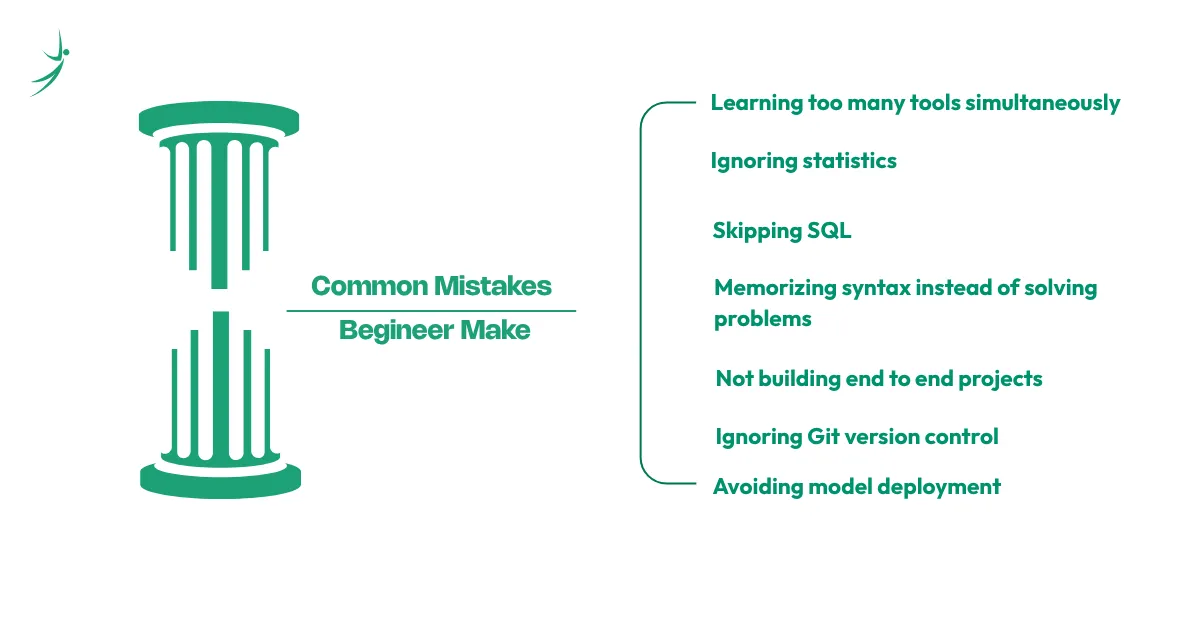
- Learning too many tools simultaneously: Trying to learn R, Python, Julia, Tableau, Power BI, and Apache Spark at the exact same time creates confusion. Focus on mastering Python and SQL before expanding your toolkit.
- Ignoring statistics: Tool proficiency without statistical backing leads to misinterpreting metrics, overfit models, and faulty business decisions.
- Skipping SQL: Many beginners jump directly into deep learning while neglecting SQL, even though real world industry jobs require frequent database data extraction.
- Memorizing syntax instead of solving problems: Do not memorize code lines. Focus on understanding algorithmic concepts and referencing official framework documentation.
- Not building end to end projects: Completing isolated tutorial exercises is not enough. You must build complete end to end projects starting from raw data ingestion to deployed web interfaces.
- Ignoring Git version control: Failing to manage project source code using Git makes collaborative engineering and technical portfolio presentation difficult.
- Avoiding model deployment: Stopping at model training inside a notebook leaves projects incomplete. Packaging your model into an API endpoint using FastAPI and Docker sets you apart from typical applicants.
Practicing problem solving avoids these common pitfalls. To test your practical knowledge, review our list of top data science interview questions and evaluate the expanding long term future scope of data science.
Conclusion
Mastering modern data science and machine learning starts with learning the right tools—not every tool. Focus on core categories like programming, databases, visualization, machine learning frameworks, MLOps, and generative AI. Build end-to-end projects that showcase data processing, model development, and deployment to demonstrate real-world skills. As AI continues to evolve, keeping your toolkit up to date will help you succeed as a Data Analyst, Data Scientist, Machine Learning Engineer, or AI Specialist.
Ready to transform your technical passion into a professional tech career? Join Skill Shikshya's best Data Science and Machine Learning Course in Nepal. Gain hands-on experience with industry tools, build real world portfolio applications, and launch your journey toward high growth AI engineering opportunities today.
Frequently Asked Questions
What are the most important data science and machine learning tools?
Which data science tools should beginners learn first?
Is Python enough for data science?
Which machine learning library is best?
What visualization tools do data scientists use?
What are MLOps tools?
What tools do AI engineers use?
Which cloud platform is best for machine learning?
About Author:

Dhiraj Bashyal is a Machine Learning Engineer at Vrit Technologies, with 3 years of hands-on experience in applied AI and machine learning. He brings that industry experience directly into the classroom, teaching Data Science and Machine Learning at Skill Shikshya, where he helps learners build a practical, project-ready foundation in Python, ML workflows, and real-world data problem-solving.