How to Use AI for Studying Without Becoming Dependent on It
Ask most students how they use AI to study, and you'll get some version of "I ask ChatGPT when I'm stuck." Ask them what happens when they don't have AI open, and the honest answer is often quieter: they're not sure they could get unstuck on their own anymore.
That gap is the real story behind ai for studying in 2025–2026. Adoption has moved faster than almost any technology in the history of education the HEPI Student Generative AI Survey 2025 found that 92% of undergraduates now use AI tools in some form, up from 66% just a year earlier, and 88% specifically for assessments, up from 53%. Among younger students the shift is even sharper: RAND's American Youth Panel recorded AI use for homework rising from 48% to 62% between May and December 2025 alone.
The question worth asking isn't whether you should use AI while studying that decision has effectively already been made for you by how fast everyone around you has adopted it. The real question is how to use it so it makes you sharper instead of quietly making you dependent. That's what this guide covers: where AI genuinely helps you learn, where it substitutes for learning instead, and how to tell the difference in the moment, not after your exam results tell you.
If part of the reason you're reading this is that you want to get properly good at working with AI, not just survive it, it's worth knowing that Skill Shikshya's hands-on generative AI training built for students exists for exactly that more on where that fits further down.
Why "Best AI Tools" Lists Miss the Point
Search "best AI for studying" and you'll get a list of app names that will be outdated within a year new models launch, old ones get renamed, and pricing changes constantly. What doesn't change nearly as fast is how learning actually works: you build understanding by retrieving information from memory, struggling with a problem before seeing the answer, and explaining ideas in your own words. Any AI habit that skips those steps trades a few minutes of comfort now for weaker recall later.
So instead of another tool list, here's a use-case framework the same six use cases hold whether you're using a free ai learning website, a paid one, or whatever launches next year.
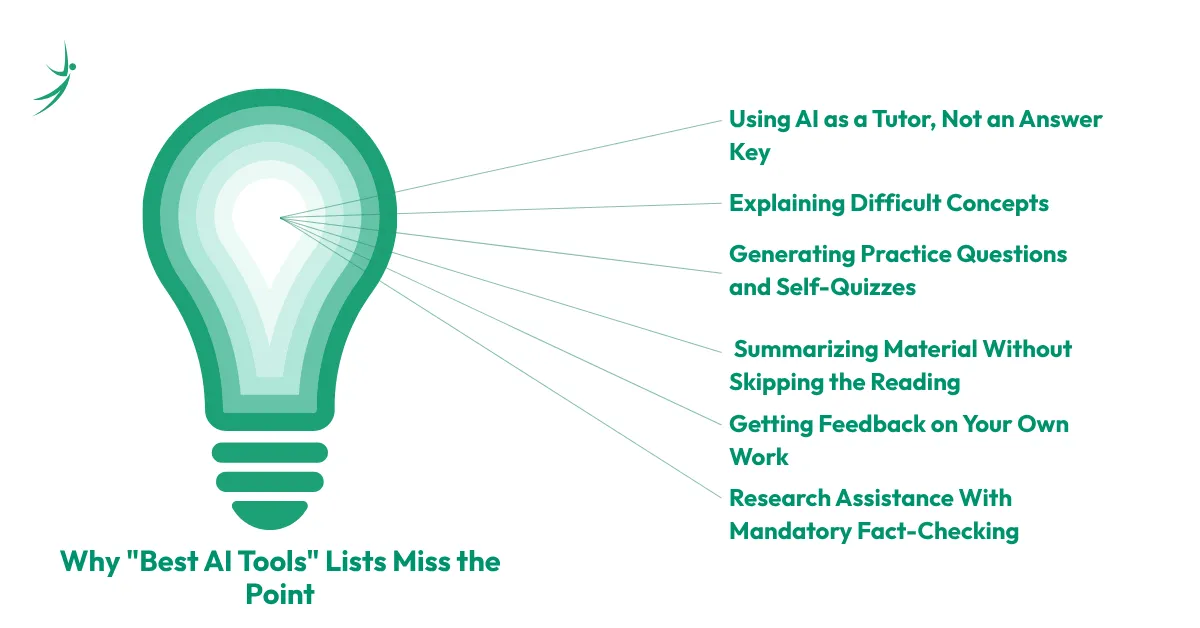
1. Using AI as a Tutor, Not an Answer Key
The single biggest difference between students who get smarter with AI and students who get lazier with it is one instruction: ask the AI to walk you toward the answer instead of handing it to you.
Concretely, that means prompting for a Socratic approach "don't give me the answer, ask me guiding questions until I get there" rather than "solve this for me." A tutor that questions you builds the same muscle a human tutor does. An answer key just gives you a finished product to copy, which is functionally no different from copying a classmate's homework.
2. Explaining Difficult Concepts (and Then Explaining Them Back)
AI is genuinely good at reframing a hard concept in a different way a second explanation, a different analogy, a simpler vocabulary level when your textbook or lecturer's explanation hasn't landed. That's a real use case with no downside, as long as you close the loop: after the AI explains something, explain it back to the AI (or to a notebook, or to a friend) without looking at the original text. If you can't, you didn't actually learn it you just recognized it while reading, which research on cognitive offloading shows is a much weaker form of retention than active recall.
3. Generating Practice Questions and Self-Quizzes
This is one of the most underused, highest-value study applications of AI, and one none of the "don't rely on AI" articles mention. Ask AI to generate quiz questions from your own notes or textbook chapter, at increasing difficulty, and answer them closed-book. This uses AI to manufacture the retrieval practice and spaced repetition that decades of learning-science research show is the single most reliable way to move information from short-term to long-term memory and it's a use case where AI adds effort for you rather than removing it.
4. Summarizing Material Without Skipping the Reading
Summarizing is where the line between "study aid" and "shortcut" gets thin fastest. Using AI to summarize a chapter you've already read, as a way to check what you retained, is a legitimate study tool. Using AI to summarize a chapter you haven't read, so you never have to read it, isn't studying it's outsourcing the studying itself. If you're looking for the best ai for studying notes, the honest answer is: any tool works, as long as you write your own first draft of notes before you ask AI to help you compress, restructure, or fill gaps in them.
5. Getting Feedback on Your Own Work
Feeding AI a draft essay, a solved problem set, or a project and asking "what's weak here, and why" is a strong use case, because the thinking and the first attempt are still entirely yours AI is reviewing, not authoring. This mirrors what a good mentor does: point at the gap, not fill it in for you. It's also one of the use cases Skill Shikshya's own structured IT training path after plus two leans on mentors and AI feedback loops working together on projects, rather than AI replacing the mentor.
6. Research Assistance With Mandatory Fact-Checking
AI is a fast way to get oriented on an unfamiliar topic, surface search terms you wouldn't have thought of, and point toward primary sources. It is not a citation-safe source by itself. That distinction matters more than most study guides admit which brings us to the part of this topic every competing article glosses over.
This same shift from manually digging through sources to directing an AI system to surface them for you is also reshaping entire careers built on research and content skills; how AI is reshaping search and content careers is worth a read if you're curious what that looks like once you're out of the classroom and into a job.
Why Copying AI Answers Hurts Learning (the Actual Research)
This isn't a vague warning there's a growing body of 2025 research quantifying exactly what happens when studying gets replaced by AI-generated output.
A widely cited MIT Media Lab study had participants write essays either unaided, using a search engine, or using ChatGPT, while recording their brain activity. The ChatGPT group showed the weakest neural connectivity and the least ownership over what they'd "written" the researchers coined the term cognitive debt for the gradual erosion of independent thinking skill that builds up when a tool consistently does the cognitive work for you.
A 2025 Microsoft and Carnegie Mellon study presented at CHI, surveying knowledge workers on generative AI use, found that higher confidence in AI output was directly associated with less critical evaluation of that output people who trusted the tool more, checked it less.
A 2025 study in Frontiers in Education using a Technology Acceptance Model on university students found that heavy AI reliance without questioning the output led to measurably reduced decision-making capability, and flagged younger students as disproportionately vulnerable to this "cognitive outsourcing" effect.
A separate 2025 study in Acta Psychologica, surveying 580 Chinese university students, found that AI dependence was associated with lower critical thinking, and traced the mechanism specifically to cognitive fatigue students who leaned on AI heavily reported being too mentally tired to engage critically with the output, which then reinforced the reliance in a feedback loop.
The pattern across all four studies is consistent: the damage isn't from using AI it's from using AI as a replacement for your own first attempt, rather than as a second opinion after one
AI Hallucinations: Why "Can AI Reason?" Is the Wrong Question
Every AI chatbot is a large language model a system trained to predict the statistically likely next word based on patterns in its training data. That's genuinely how AI learns: through exposure to enormous volumes of text, not through understanding the way a human does. It has no built-in way to know what's true, only what's probable-sounding. That's why the honest answer to "can AI reason" is: it can simulate reasoning steps convincingly, but it isn't verifying facts against reality the way a human checking a source would.
This shows up as hallucination confident, fluent, entirely fabricated information and it's not a rare edge case. Independent benchmarking from Vectara's hallucination leaderboard puts even the best-performing models at roughly 0.7–1.5% hallucination rates on tightly grounded summarization tasks, but general open-ended factual questions run far higher averaging around 9% across models, and spiking to 33–48% on newer "reasoning" models answering specific factual questions about people and events. Fabricated citations and sources are one of the most common and most academically dangerous forms this takes, since a fake source can look identical to a real one until you actually try to find it.
The practical rule: treat any AI-generated fact, date, statistic, name, or citation as unverified until you've checked it against a real source the same way you'd treat an unsigned note from a stranger. This is non-negotiable for anything going into an assignment, and it's good practice even for casual studying, because a wrong fact learned confidently is harder to unlearn later than one you never learned at all.
Fact-Checking AI Without Losing the Time You Saved
Fact-checking doesn't have to erase AI's speed advantage if you build it into the workflow instead of treating it as an afterthought:
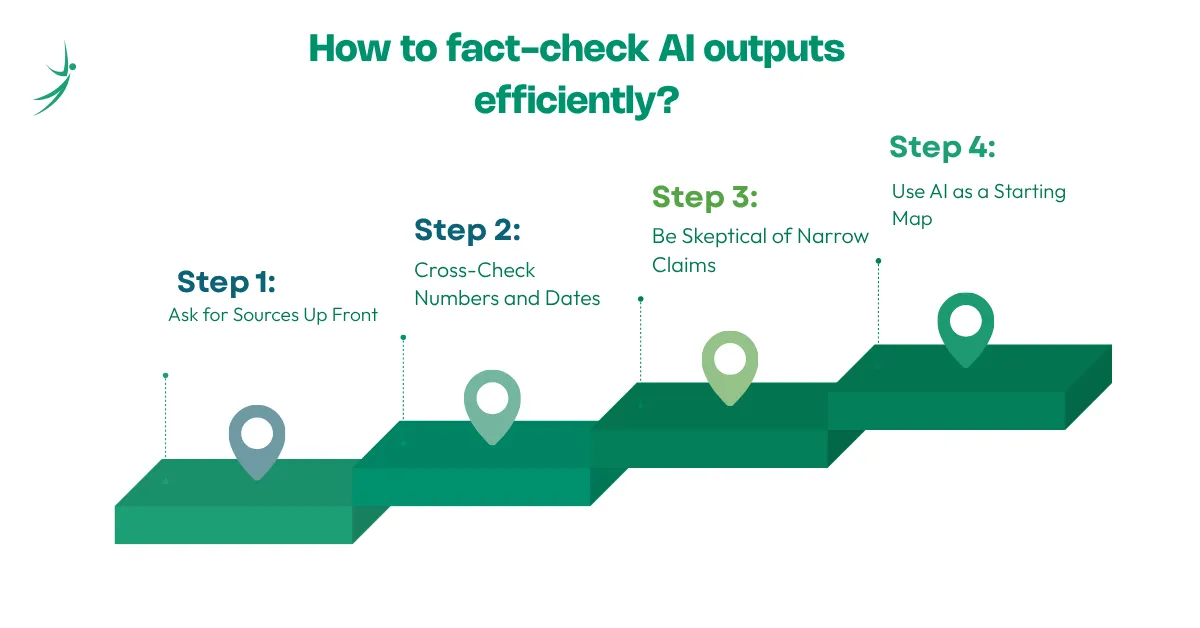
- Ask for sources up front, then open at least one and confirm the claim is actually in it AI sometimes cites a real source that doesn't say what it claims.
- Cross-check specific numbers and dates against a second source, especially anything that will appear in a citation or exam answer.
- Be more skeptical of narrow, specific claims than broad ones hallucination rates climb sharply on niche facts (names, exact figures, obscure events) compared to general knowledge.
- Use AI outputs as a starting map, not a destination a list of leads to verify, not a finished answer to submit.
Maintaining Independent Thinking
There's a simple gut check worth running periodically, especially during exam season when the temptation to lean harder on AI peaks: close the AI tab and ask yourself why am I studying this in the first place, and whether you could explain what you just "learned" to someone else without it. If the honest answer is no, the AI did the studying and you did the typing.
It also helps to be able to answer, without hesitation, where am I studying right now meaning which skill you're actually building versus which shortcut you're taking. A useful personal rule: use AI to check your thinking, never to replace your first attempt at it. Write the first draft, solve the first pass, form the first opinion with your own head before AI enters the loop at all. That single habit preserves almost all of AI's speed benefits while avoiding nearly all of the cognitive-debt research findings above.
Appropriate vs. Inappropriate AI Use: A Quick Reference
| Appropriate (builds skill) | Inappropriate (replaces skill) |
|---|---|
| Quizzing yourself on material you've already studied | Asking AI to "just give me the answers" for an assignment |
| Getting a second explanation after trying to understand the original | Skipping the original material and reading only the AI summary |
| Getting feedback on a draft you wrote yourself | Asking AI to write the draft from scratch |
| Using AI to generate practice problems | Asking AI to solve your homework problems |
| Using AI to organize research leads you'll verify yourself | Copying AI-generated facts and citations without checking them |
| Asking AI to explain why an answer is correct after you attempt it | Pasting a question and moving on without engaging with the explanation |
If You Actually Want to Study AI (Not Just Use It)
Everything above is about using AI as a study aid for any subject. But a large number of people searching around this topic actually mean something different they want to study artificial intelligence itself as a subject or career path. If that's you, the path looks different from downloading an app:
What to study for artificial intelligence, at a foundational level, comes down to three pillars: programming (Python is the standard entry point across the industry), mathematics (statistics and linear algebra underpin how models are trained), and increasingly, prompt engineering and applied AI tool usage, since most real-world jobs today involve directing AI systems rather than building models from scratch. What do you need to study artificial intelligence beyond that depends on the depth you're aiming for a foundational, applied-AI skill set for the job market looks very different from a research-track machine learning degree.
If you're wondering how to study AI after 12th in Nepal specifically, you generally have two realistic tracks: a formal computer science or IT degree that builds toward machine learning over several years, or a shorter, practical, project-based course that gets you working with real AI tools and workflows in months rather than years which is the more common starting point for students who want to be job-ready quickly. Skill Shikshya's hands-on generative AI training designed for plus-two and SEE-graduate students is built around exactly that second track practical prompt engineering, AI-assisted content and design workflows, and portfolio-building rather than pure theory. For students who want the programming foundation first, a beginner-friendly Python and automation track is the more natural starting point, since ai learning with python remains the standard route into the field.
If your interest leans toward the applied, business side using AI inside marketing, operations, or client-facing work rather than building it that's a different track again, closer to what's covered in Skill Shikshya's full course catalog, which includes AI-integrated options across design, marketing, and data analytics for students who want AI fluency without a pure-coding path.
Whichever direction fits, the fastest way to figure out which of these tracks actually matches your background and goals is a conversation, not another Google search Skill Shikshya's free one-on-one career counselling session exists specifically to map that out before you commit to a course.
The Bottom Line
AI adoption among students went from a minority habit to a near-universal one in about eighteen months, and the research on what happens when it's used carelessly is now catching up just as fast pointing consistently at the same mechanism: cognitive debt builds when AI replaces your first attempt at thinking, not when it reviews your attempt after the fact. The tools you use to study will keep changing every year. The rule that keeps you actually learning while you use them won't: think first, verify always, and let AI check your work instead of doing it.
Frequently Asked Questions
What are the best AI studying tools?
Are there any good ai studying tools free to use?
What's the best AI for studying, according to Reddit and student communities?
Can AI reason like a human?
How does AI actually learn?
Can AI help with note-taking, and what's the best AI for studying notes?
What to study for artificial intelligence if I want to work in the field?
What do you need to study artificial intelligence at a beginner level?
How do I study AI after 12th in Nepal?
Are there good ai courses for beginners, including an ai learning online course or ai learning website free option?
Can I use AI for learning coding, or for ai learning with python specifically?
Is AI useful for ai for learning english or other language study?
Are there ai for business courses worth taking?
About Author: