How to Become an AI Engineer in Nepal in 2026 (Complete Career Guide)
Career Guide •27 Aug 2026•14 min Read
If you have typed "how to become an AI engineer" into Google more than once this year, you are not alone. LinkedIn ranked AI engineer as its fastest-growing job title for two years running, and Nepal's own job boards are now listing dozens of open AI and generative AI roles at any given time. The confusing part is not whether the career exists. It is that most guides written for the US or Europe skip the two questions a Nepali reader actually has: what does this look like with local salaries and local companies, and can a self-taught person without a computer science degree actually get hired.
This guide answers both. It covers what an AI engineer does day to day, the exact skill order to learn from scratch, real salary numbers from Nepali job portals, and where the jobs are, both local and remote.
What Does an AI Engineer Actually Do?
An AI engineer builds and deploys systems that use trained models to perform a task: writing text, recognizing images, answering questions from a document, or automating a workflow. The AI engineer job description usually covers four things.
- Taking a pre-trained or fine-tuned model and wiring it into a real application
- Building data pipelines that feed clean information into that model
- Testing, evaluating, and monitoring model output once it is live
- Working with product and backend teams so the AI feature actually ships
This is different from an AI research engineer, whose job is closer to inventing or improving the models themselves, often inside a research lab. Most AI engineer jobs, in Nepal and abroad, sit on the applied side: using tools like OpenAI's API, Anthropic's Claude, LangChain, and vector databases rather than training a model from a blank slate.
There is no official "full form" for AI engineer the way there is for an acronym like CEO. AI simply stands for Artificial Intelligence, so the title reads as Artificial Intelligence Engineer, a software engineer who specializes in building AI-powered systems.
Why AI Engineering Is in Demand Right Now
The demand behind this career is not hype. A few figures, all from named sources rather than a single blog's opinion:
- LinkedIn's Jobs on the Rise report placed AI engineer at the top of the fastest-growing job titles list for the second year running.
- The World Economic Forum's Future of Jobs Report projects 170 million new roles globally by 2030 against 92 million displaced, a net gain of 78 million, with AI and machine learning specialist roles named among the fastest-growing categories.
- PwC's 2026 Global AI Jobs Barometer, built from more than a billion job postings across 27 countries, found that workers with AI skills earn a wage premium of up to 62%, and as high as 118% in some sectors.
- The U.S. Bureau of Labor Statistics reports a median salary of $140,910 for computer and information research scientists, a closely related occupational category, with 20% projected job growth from 2024 to 2034, far above the 3% average for all occupations.
Locally, LinkedIn currently lists well over a hundred open AI and machine learning roles tagged to Nepal, spanning titles like AI/ML Engineer, Generative AI Developer, and Automation Specialist. Kathmandu-based firms such as Fusemachines and F1Soft are actively hiring for these roles, alongside a growing number of startups and outsourcing companies serving international clients. Is AI engineering in demand in Nepal specifically, not just globally? The listings above say yes, and AI engineer demand here is still young enough that early movers have far less competition than in web development or QA.
AI engineering in Nepal is at an early enough stage that a well-built portfolio can outweigh years of formal experience, which is unusual for most tech careers.
The AI Engineer Roadmap: How to Start From Scratch
Here is the order that actually works for AI engineering from scratch, based on what Nepali and international job listings ask for, not a generic computer science syllabus.
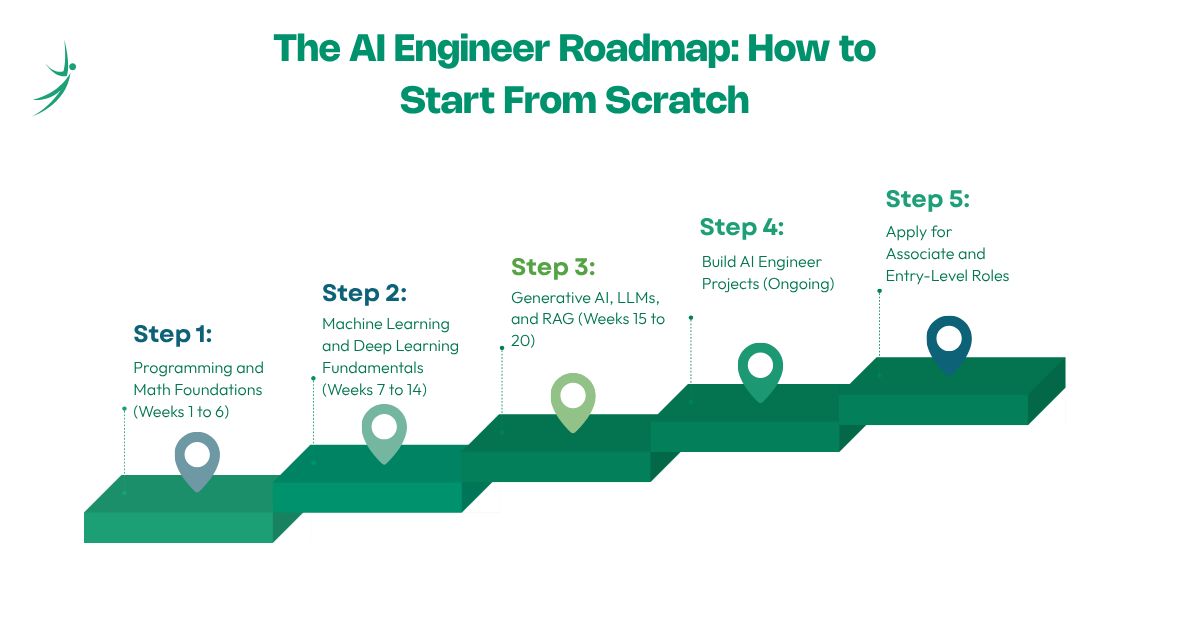
Step 1: Programming and Math Foundations (Weeks 1 to 6)
Python is non-negotiable. You need enough comfort with Python to manipulate data structures, write functions, and read someone else's code without panicking. Alongside Python, spend focused time on:
- Linear algebra basics (vectors, matrices) — needed to understand how models actually compute
- Probability and statistics — needed to interpret model output and evaluate accuracy
- Git and GitHub — every AI engineer job posting in Nepal now expects a public portfolio here
Step 2: Machine Learning and Deep Learning Fundamentals (Weeks 7 to 14)
This is where most learners either commit or drop off. Cover supervised and unsupervised learning, then move into neural networks with a library like PyTorch or TensorFlow. You do not need to master research-level deep learning theory. You need enough understanding to know why a model is failing and what to try next.
Step 3: Generative AI, LLMs, and RAG (Weeks 15 to 20)
This is the layer that separates a 2026 AI engineer from a 2020 machine learning engineer. Learn:
- How large language models (LLMs) like GPT, Claude, and Gemini actually work at a conceptual level
- Prompt engineering and structured outputs
- Retrieval-Augmented Generation (RAG), the technique that lets an LLM answer questions from your own documents instead of just its training data
- Vector databases (Pinecone, Chroma, or Weaviate) and embeddings
- Agent-building tools such as LangChain or LangGraph, and how AI agents plan and take multi-step actions
Step 4: Build AI Engineer Projects (Ongoing)
Employers in Nepal consistently say they weigh a working GitHub project higher than a certificate with no code behind it. Strong beginner AI engineer projects include:
- A RAG chatbot that answers questions from a set of Nepali government or agriculture documents
- A resume screening tool that ranks candidates against a job description
- An automation agent that reads incoming customer messages and drafts replies for review
- A fine-tuned classification model solving a real, local problem (spam detection in Nepali text, for example)
Three finished, documented projects on GitHub will do more for your job search than a fourth certificate.
Step 5: Apply for Associate and Entry-Level Roles
Once you have a portfolio, target titles like AI engineer associate, junior AI engineer, or ML engineer intern rather than senior positions. Nepali companies hiring at this level are generally more interested in demonstrated project work and problem-solving ability than a specific degree.
Skills and Qualifications You Actually Need
The AI engineer qualifications employers ask for most often, technical first:
Python, and ideally one additional language such as SQL for data work
- PyTorch or TensorFlow
- REST APIs and how to call them from code
- Cloud basics on AWS, Azure, or Google Cloud
- Git-based version control
Common AI engineer tools worth learning hands-on: Hugging Face Transformers, LangChain, n8n or Make for no-code automation layers, Docker for deployment, and a vector database of your choice.
A bachelor's degree in computer science, IT, or a related field is preferred by many employers, but it is not always required. Several Nepali IT firms hiring for entry-level AI roles now list "or equivalent project experience" alongside their degree requirement, particularly for candidates who can show real GitHub activity.
Best AI Engineering Courses in Nepal and Online
There is no single AI engineer best course for everyone. It depends on budget and how much structure you need.
AI engineer free course options worth starting with (AI engineer courses free of cost, before you spend anything):
- Google's Machine Learning Crash Course
- DeepLearning.AI's short courses on RAG and prompt engineering (many are free to audit)
- freeCodeCamp's Python and machine learning certifications
Structured, paid options, including AI engineer course online formats:
- Microsoft Learn's AI engineer training path, which leads toward the AI-102 certification exam
- edX's AI and machine learning professional certificates, several run by IBM
- Skill Shikshya's Generative AI and Agentic Systems Course, a Kathmandu-based 2.5-month program covering LLM APIs, RAG pipelines, and agent-building tools with in-person project support
AI engineer course fees for local, instructor-led programs in Nepal typically run lower than the cost of an equivalent bootcamp abroad, with the advantage of in-person mentorship and access to a local hiring network. Before enrolling anywhere, check whether the course actually has you build and deploy a project, not just watch video lectures.
AI Engineer Jobs in Nepal and Remote Opportunities
Where do AI engineers work in Nepal? Mostly three types of employer, and AI engineer jobs salary expectations shift a lot depending on which one you target:
- Established IT companies and outsourcers (Fusemachines, F1Soft, and similar) building AI features for international clients
- Startups building their own AI products, often smaller teams with broader responsibilities
- Remote-first international companies hiring Nepali AI engineers directly, paying in USD
Searches for AI engineer jobs remote have grown fast, and AI engineer remote work is genuinely accessible from Nepal. Platforms like Himalayas and Upwork list positions ranging from full-time remote AI engineer roles to project-based freelance work in prompt engineering and RAG system building. A degree matters less here than a portfolio and the ability to communicate clearly in written English during async collaboration.
AI Engineer Salary in Nepal (2026)
This is the section where sources disagree the most, so it is worth being transparent about the spread rather than quoting one number as gospel.
| Level | Monthly salary (NPR) | Source pattern |
|---|---|---|
| Entry-level / fresher | 30,000 – 70,000 | NecoJobs, Kumarijob |
| Mid-level (2-5 yrs) | 60,000 – 150,000 | NecoJobs, Kumarijob |
| Senior / specialist | 150,000 – 400,000+ | NecoJobs, industry sources citing firms like Fusemachines |
Some aggregator sites report far lower averages, in some cases under NPR 30,000 a year, but these are typically built from fewer than ten self-reported entries and do not match what is actually advertised on Nepali job portals right now. Treat single-digit-sample "average salary" figures with caution and weight the ranges above, which are consistent across multiple independent portals, more heavily.
For comparison, the U.S. Bureau of Labor Statistics puts the median salary for computer and information research scientists at $140,910 (2024 data), and separate BLS occupational data for AI and machine learning specialists specifically shows a median of $135,980, rising to $214,670 at the 90th percentile. Remote roles paying in USD close a meaningful part of that gap for Nepal-based engineers.
AI Engineer Salary Worldwide (2026)
Nepal is not the only market where salary sources disagree with each other. Every country's numbers vary depending on which portal, city, and company tier you look at, so the ranges below are drawn from multiple sources per country rather than a single figure.
| Country | Typical range (annual, local currency) | Approx. USD | Source pattern |
|---|---|---|---|
| United States | $120,000 – $310,000 base depending on level | $120,000 – $310,000 | U.S. Bureau of Labor Statistics; industry salary guides |
| United Kingdom | £52,775 – £150,000 | ~$67,000 – $190,000 | PayScale, Levels.fyi, industry salary guides |
| India | ₹6 LPA – ₹80 LPA | ~$7,200 – $96,000 | upGrad, Amity Online, industry salary guides |
| Canada | CAD 85,000 – 145,000 | ~$62,000 – $106,000 | Industry salary guides |
| Australia | AUD 130,000 – 170,000 | ~$85,000 – $112,000 | Industry salary guides |
| Remote (LATAM-based, paid by US firms) | — | $120,000+ | Industry salary guides |
The pattern holds everywhere: senior AI engineers, and anyone with production LLM, RAG, or MLOps experience, earn a clear premium over generalist software engineers, and remote work is closing the gap between what someone earns based in Kathmandu, Bengaluru, or São Paulo versus San Francisco. This is the same wage-premium effect PwC's Global AI Jobs Barometer documented earlier in this guide, just visible at the country level instead of the individual level.
People often use these titles interchangeably, but they are not the same job.
| Role | Focus | Typical background |
|---|---|---|
| AI engineer | Applying existing models to build products | Software engineering plus applied ML |
| AI research engineer | Improving or inventing new model architectures | Master's or PhD, published research |
| Machine learning engineer | Building and maintaining ML pipelines and infrastructure | Overlaps heavily with AI engineer |
| Data scientist | Extracting insight from data, statistical modeling | Statistics, analytics-first background |
For someone starting from scratch in Nepal without a research background, AI engineer and machine learning engineer are the two realistic entry points. AI research engineer roles are rare locally and usually require advanced degrees.
Is AI Engineering Hard? Common Challenges
AI engineering is not harder than general software engineering, but it asks you to be comfortable with more uncertainty. A traditional program either works or throws an error. A model can run without errors and still give a wrong or misleading answer, which means testing and evaluation take on a different character.
The three challenges beginners report most often, and what actually helps:
- Math anxiety. You need working familiarity with linear algebra and probability, not a mathematics degree. Most learners get enough from a focused four-week refresher.
- Tooling changes fast. The specific library matters less than understanding the underlying concept (what an embedding is, what RAG solves) so you can pick up the next tool quickly.
- Portfolio paralysis. Many beginners keep tutorials open forever and never ship an original project. Set a two-week deadline for your first project and publish it even if it is rough.
AI Engineer Interview Questions to Prepare For
A realistic entry-level to mid-level interview will mix conceptual and applied questions, such as:
- Explain the difference between supervised and unsupervised learning.
- What is Retrieval-Augmented Generation, and when would you use it over fine-tuning?
- Walk through how you would evaluate whether an LLM-based feature is performing well in production.
- What is overfitting, and how do you detect it?
- Describe a project where you had to debug unexpected model output.
Interviewers at Nepali IT companies increasingly ask candidates to walk through a GitHub project live rather than answer purely theoretical questions, so be ready to explain your own code in detail.
Conclusion and Next Steps
Becoming an AI engineer in Nepal in 2026 does not require a foreign degree or years of theoretical study before you can start applying. It requires learning in the right order: Python and math fundamentals first, machine learning and deep learning next, generative AI and RAG after that, and real projects running the whole time.
If you are choosing between teaching yourself from free resources and joining a structured, project-based program, read Skill Shikshya's guide on the best IT training institutes in Nepal to compare options, or look at the Generative AI and Agentic Systems Advanced Course directly if you already know this is the path you want.
Frequently Asked Questions
AI engineer full form: what does AI actually stand for?
There is no formal acronym expansion beyond Artificial Intelligence Engineer. AI stands for Artificial Intelligence; the title describes a software engineer specializing in AI systems.
How to become AI engineer without a degree?
Yes, it is possible, particularly for entry-level and remote roles. A strong GitHub portfolio, demonstrated project work, and clear communication skills can substitute for a formal degree at many Nepali and international companies, though some employers still prefer or require one.
AI engineer free course: which one should you start with?
Google's Machine Learning Crash Course and DeepLearning.AI's short courses on prompt engineering and RAG are strong, genuinely free starting points before committing to a paid, structured program.
AI engineer course fees: how much does training cost in Nepal?
Costs vary by provider and format. Local, instructor-led diploma programs in Kathmandu are generally priced well below international bootcamps of similar length, and several include placement support.
Is AI engineering in demand in Nepal specifically?
Yes. Job listings on Nepali portals for AI, generative AI, and automation roles have grown steadily through 2026, and AI engineer demand currently outpaces the number of trained local candidates.
AI engineer jobs remote: can you actually work from Nepal?
Yes. Remote AI engineer roles and freelance contracts, particularly in prompt engineering and RAG system building, are actively available to Nepal-based engineers through platforms like Himalayas and Upwork, often paying in USD.
How much AI engineer earn in Nepal, realistically?
It depends heavily on experience and whether you are paid in NPR or USD. See the salary table above; entry-level typically starts around NPR 30,000 to 70,000 a month, with senior and remote-international pay going well beyond that.
What tools do AI engineers use day to day?
Python, PyTorch or TensorFlow, Hugging Face Transformers, LangChain, a vector database such as Chroma or Pinecone, Docker, and a cloud platform such as AWS or Azure.
What projects should a beginner AI engineer build?
Start with a RAG chatbot over a small document set, then a classification or automation project solving a real local problem. Two or three finished, documented projects outperform a stack of certificates with no code behind them.
Is AI engineering harder than regular software engineering?
Not inherently harder, but it requires comfort with probabilistic, sometimes unpredictable model output rather than deterministic code, which changes how you test and debug.
How does AI engineer salary compare between Nepal and the rest of the world?
Nepal's entry-level pay (NPR 30,000-70,000 a month) sits well below US, UK, and even Indian city-hub salaries in absolute terms, but the gap narrows sharply for remote roles paid in USD, which is why many Nepal-based AI engineers target international remote positions once they have two or three solid projects behind them.