How to Become a Flutter Developer in Nepal: Complete Career Guide (2026)
career-guides •1 Sept 2026•17 min Read
Nepal's IT sector has a mobile-app problem worth having: too many product ideas, not enough developers who can ship for Android and iOS at the same time. That gap is exactly why so many students, career switchers, and self-taught coders now want to become a Flutter developers instead of picking a single native platform. One language, one codebase, two app stores and a job market in Kathmandu, Pokhara, and beyond that's still catching up to demand.
This guide breaks down what a Flutter developer actually does, the skills and training path that gets you hired, realistic salary numbers for Nepal, where the remote and part-time work is, and how to build a CV that survives the first filter. It's written for beginners, students choosing a specialization, and working professionals thinking about a switch not for people who already ship production Flutter apps.
Why Flutter Developer Careers Matter in Nepal Right Now
Nepal's software companies, fintech platforms, and startups have shifted to mobile-first products over the last few years, and building two separate native apps for every idea is expensive for a small team. That's the practical reason Flutter development has grown from a niche skill to a standard line item in Nepali IT job postings.
A few forces are driving this locally:
- Digital payments and fintech growth. Wallet apps, banking apps, and merchant tools all need fast, reliable mobile experiences, and most of these companies build or maintain their app in Flutter rather than running two separate native teams.
- Startup budgets stay lean. A three- or four-person startup team can't usually afford separate Android and iOS engineers, so a single Flutter developer (or a two-person Flutter team) covers both platforms.
- Remote and outsourced work has opened up. International clients on Upwork, Toptal, and direct contracts increasingly hire Flutter developers from Nepal because the framework's single-codebase model makes remote collaboration and handoff simpler.
- Google keeps investing in it. Flutter is Google's own cross-platform toolkit, and it's what Google Pay's team eventually migrated to at global scale, alongside brands like BMW, which rebuilt its My BMW app on Flutter for more than 45 countries. That kind of backing keeps the framework relevant instead of trendy-then-gone.
None of this means the path is easy it means the demand is real, but only for developers who can actually build and ship, not just complete a tutorial series. If you're still weighing Flutter against other IT specializations entirely, a broader look at what different tech roles actually involve is worth reading before you commit.
What Does a Flutter Developer Actually Do?
A Flutter developer builds mobile (and often web and desktop) applications using Google's Flutter framework and its programming language, Dart, from a single codebase that compiles natively for iOS and Android. In practice, the day-to-day flutter developer work looks less like "writing code" and more like a mix of these:
- Translating Figma or Adobe XD designs into pixel-accurate, responsive screens using Flutter's widget system
- Wiring the app to a backend through REST APIs or GraphQL, and handling loading, error, and empty states properly
- Managing app state as features grow, using a pattern like Provider, Riverpod, BLoC, or GetX
- Integrating Firebase or a custom backend for authentication, push notifications, and analytics
- Debugging performance issues janky animations, memory leaks, slow builds using Flutter DevTools
- Preparing and submitting builds to the Google Play Store and Apple App Store, including signing, versioning, and store compliance
- Working inside a team: code review, Git branching, sprint planning, and QA handoff
It's a frontend-leaning, product-facing role, but the best Flutter developers in Nepal's job market also understand enough backend logic (Node.js, Django, or Laravel APIs, for instance) to debug integration issues without waiting on someone else.
Key Benefits of Becoming a Flutter Developer
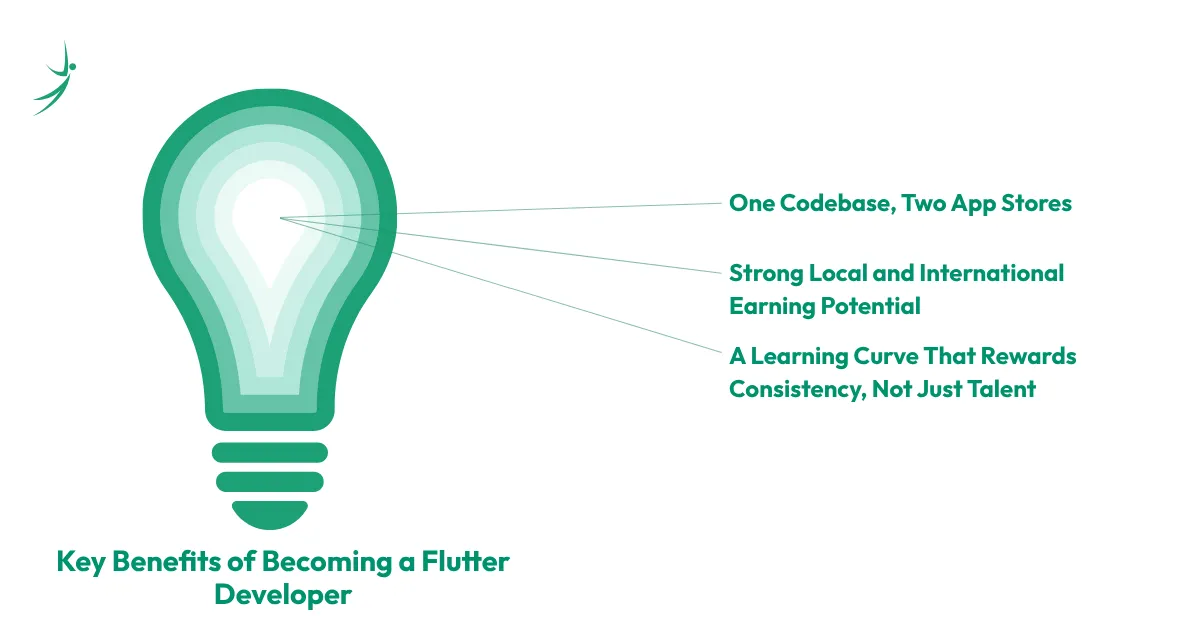
One Codebase, Two App Stores
The core pitch of Flutter is that you write your UI and logic once in Dart and ship it to Android and iOS (and, increasingly, web and desktop) from the same project. According to developer-adoption data compiled from Stack Overflow's cross-platform framework survey, roughly 46% of developers building cross-platform apps report using Flutter the largest single share among any cross-platform toolkit, ahead of React Native. For a Nepali developer, that translates into one skill set that opens two platforms' worth of job listings instead of one.
Strong Local and International Earning Potential
Because a single Flutter developer can realistically maintain both platforms, companies pay for that leverage. Local salaries scale meaningfully with experience, and freelance or remote contracts with international clients typically pay several times the local market rate in NPR terms a genuine path to a flutter developer remote income without relocating.
A Learning Curve That Rewards Consistency, Not Just Talent
Dart is a relatively approachable language if you already know any object-oriented language, and Flutter's hot reload feature means you see UI changes in under a second, which shortens the feedback loop dramatically compared to native Android or iOS development. This doesn't make Flutter "easy" it makes the first six months less discouraging, which matters when you're trying to stay consistent enough to actually finish projects.
Flutter Developer Career Paths and Work Models
One of the more underrated advantages of the framework is how many different flutter developer work arrangements it supports. You're not locked into one type of job.
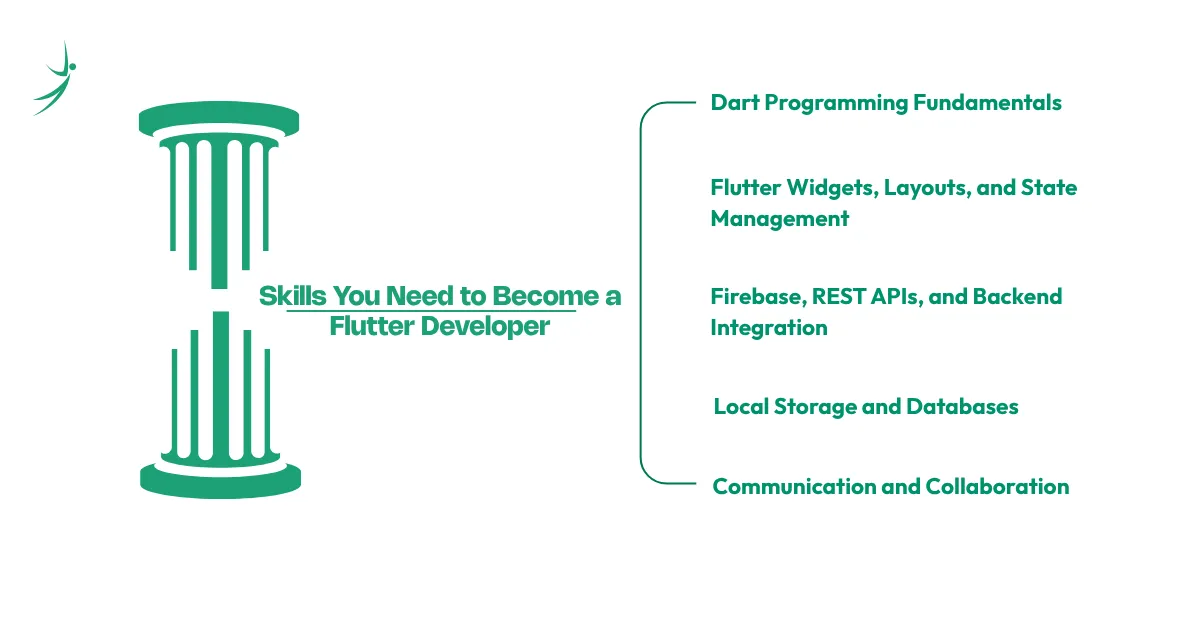
Full-Time Flutter Developer Jobs in Nepal
The most common entry point: joining a software company, digital agency, fintech, or startup as a junior or associate Flutter developer. These roles are listed regularly on platforms like Kumari Job, Merojob, and Job Axle, along with direct applications through company career pages at firms building consumer or enterprise apps in Kathmandu and Lalitpur.
Flutter Developer Remote and Work-From-Home Roles
Because a Flutter codebase, Git repository, and project management board can be accessed from anywhere, flutter developer work from home arrangements are common both for Nepali companies offering hybrid or remote contracts, and for international companies hiring Nepali developers directly as remote team members.
Flutter Developer Internship Local and Remote
Internships are the standard bridge from "I built some apps" to "I have professional experience." Many Nepali IT companies run 3–6 month internship programs, and a growing number of international startups now offer a flutter developer internship remote position specifically because Flutter's tooling makes async, asynchronous collaboration easier than native development across time zones.
Freelance and Part-Time Flutter Work
If you're a student or already employed elsewhere, flutter developer part time jobs and freelance contracts (via Upwork, Fiverr, Toptal, or direct referrals) are a realistic way to build a portfolio and income simultaneously, though this route demands more self-discipline since there's no team structure holding you accountable to deadlines.
Skills You Need to Become a Flutter Developer
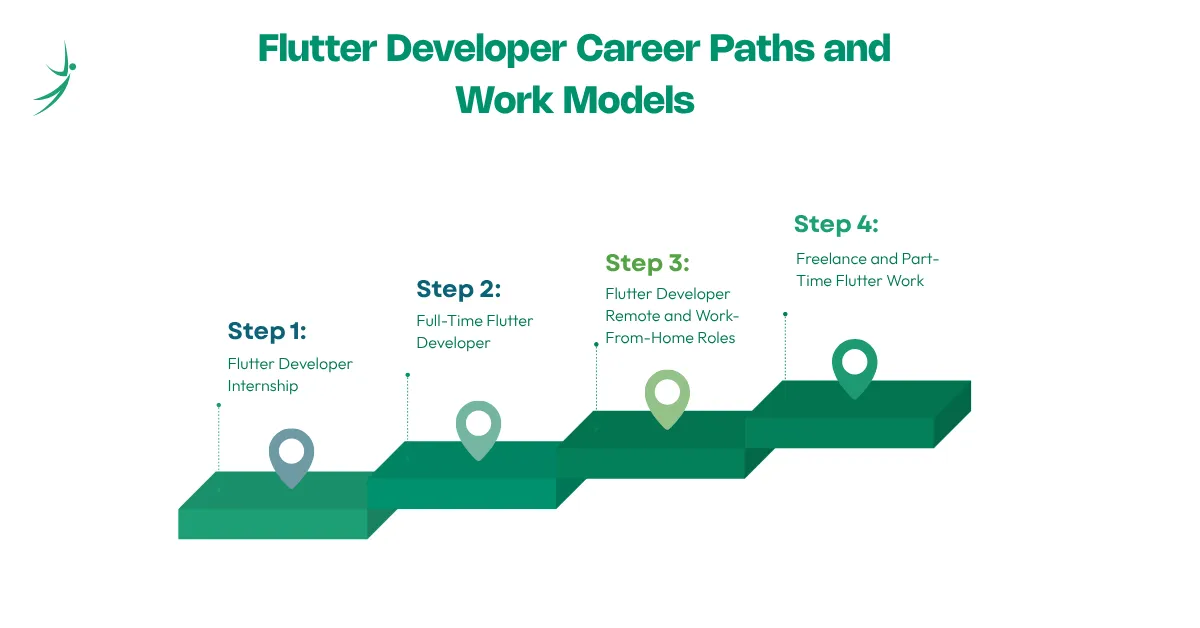
Dart Programming Fundamentals
Dart is the language Flutter is built on, and you can't shortcut around it. You need real comfort with variables and types, null safety, asynchronous programming (Future, async/await, Streams), classes, and object-oriented patterns not just enough to copy-paste from a tutorial.
Flutter Widgets, Layouts, and State Management
Flutter apps are built entirely out of widgets, so you need to understand the widget tree, the difference between stateless and stateful widgets, and how to build responsive layouts that don't break on different screen sizes. Once your app grows past a few screens, state management becomes non-negotiable most job listings expect familiarity with at least one of Provider, Riverpod, BLoC, or GetX.
Firebase, REST APIs, and Backend Integration
Almost every production app needs a backend. You'll need to know how to consume REST APIs, parse and serialize JSON, handle authentication tokens, and use Firebase for common needs like login, real-time data (Firestore), and push notifications.
Local Storage and Databases
Offline-first behavior is expected in most consumer apps now. Learn SQLite, Hive, or shared preferences for local storage, plus enough SQL/NoSQL theory to reason about how your app should behave without a live connection.
Git, Testing, and Deployment
Version control (Git, GitHub/GitLab), basic widget and unit testing, and the process of publishing to the Google Play Store and Apple App Store including app signing, bundle configuration, and store review requirements are all part of being job-ready, not optional extras.
Communication and Collaboration
This gets left off most skill lists, but it shouldn't be. Employers consistently mention communication as a differentiator between candidates with similar technical ability the ability to explain a technical blocker to a non-technical product manager, or push back on an unrealistic deadline professionally, matters in every serious interview loop.
Step-by-Step Roadmap: How to Become a Flutter Developer in Nepal
- Learn Dart before you touch Flutter seriously. Spend two to three weeks purely on Dart syntax, null safety, and async programming using the free, official Dart language documentation before layering Flutter on top.
- Work through Flutter's official learning pathway. Google's own Flutter documentation and learning resources are free, current, and written by the team that maintains the framework a stronger foundation than most paid courses alone.
- Build three to five real projects, not clones of the same to-do app. A weather app, an expense tracker with local storage, and a small e-commerce UI with API integration show three different skill sets: networking, persistence, and state management.
- Push everything to GitHub with real commit history. Employers in Nepal's IT market check GitHub activity before scheduling interviews. A messy but active repository beats a polished single commit.
- Get structured, mentor-led training if you're stalling out alone. Self-teaching works, but a structured flutter developer course with project reviews and a syllabus built around what companies are actually hiring for shortens the time between "I know the syntax" and "I can ship."
- Apply for internships or junior roles before you feel fully ready. Nobody feels fully ready. Practical experience real bugs, real code review, real deadlines teaches things no course can.
- Keep building after you're hired. Flutter and Dart get meaningful updates multiple times a year; developers who stop learning after their first job plateau within two years.
Flutter Developer Salary in Nepal (2026)
Salary bands vary by company size, project complexity, and whether you're on a local payroll or a remote/international contract. These figures reflect a realistic composite of current job listings and market conversations in Nepal's IT sector treat them as a planning range, not a guarantee.
| Experience Level | Typical Monthly Salary (NPR) | Notes |
|---|---|---|
| Entry-level (0–2 yrs) | 25,000 – 45,000 | Often starts as internship or trainee role |
| Mid-level (2–5 yrs) | 50,000 – 90,000 | State management + API integration expected |
| Senior (5+ yrs) | 100,000 – 160,000+ | Architecture, mentoring, technical decisions |
| Remote / freelance (international clients) | 150,000 – 300,000+ | Often paid hourly or per project in USD |
A few things shape where you land in these bands:
- Portfolio depth matters more than certificates at the entry level three strong, functioning apps beat five half-finished ones.
- Niche skills Firebase Cloud Functions, CI/CD pipelines, native platform channels, or clean architecture push you toward the top of each band.
- Remote clients pay in the client's market rate, which is why freelance and international remote work consistently out-earns local full-time roles once you have 2+ years of experience.
How to Build a Flutter Developer CV That Gets Interviews
A flutter developer cv in Nepal's competitive junior market needs to prove you can build, not just that you've studied. A few practical adjustments make a real difference:
- Lead with a GitHub or portfolio link, not a summary paragraph. Recruiters skim; a working app link converts better than adjectives.
- List projects with what they actually do, not just "Built a Flutter app." Specify the state management approach, the API or backend used, and one problem you solved (e.g., "handled offline sync using Hive when the network dropped mid-session").
- Quantify wherever honest. "Reduced app load time by X%" or "Integrated 6 REST endpoints for a booking flow" reads stronger than generic bullet points.
- Keep it to one page for junior roles two only once you have several years and multiple shipped products to show.
- Match keywords to the job post. If the listing mentions BLoC, Firebase, or CI/CD and you have that experience, use those exact terms; many companies and recruiters scan for them before a human reads the CV closely.
- Research the flutter developer company before the interview, not just the job description check their published apps on the Play Store and App Store, their GitHub organization if they have one, and recent reviews, so you can ask informed questions instead of generic ones.
Challenges New Flutter Developers Face and How to Overcome Them
- A saturated junior market. Flutter's approachable learning curve means the entry-level pool is crowded with beginners who've only completed tutorials. Fix: build something no tutorial covers a niche utility app, a local business tool, an open-source package so your portfolio doesn't look identical to everyone else's.
- Framework and ecosystem churn. Dart and Flutter ship meaningful updates multiple times a year, and state-management "best practice" opinions shift. Fix: pick one state management approach, get genuinely good at it, and treat new patterns as additions to your toolkit rather than reasons to restart from zero.
- Performance and scale problems only show up later. A simple app runs fine on any approach; performance issues, memory leaks, and janky animations appear once an app has real users and real data. Fix: deliberately study Flutter DevTools and profiling early, even on small projects, so debugging performance isn't a mystery when it matters.
- Isolation when learning solo or working remote. Without a team around you, it's easy to develop bad habits nobody corrects. Fix: get code reviewed by a mentor, an online community, or a structured course even if you're mostly self-taught.
Real Career Paths: How Nepali Developers Actually Break In
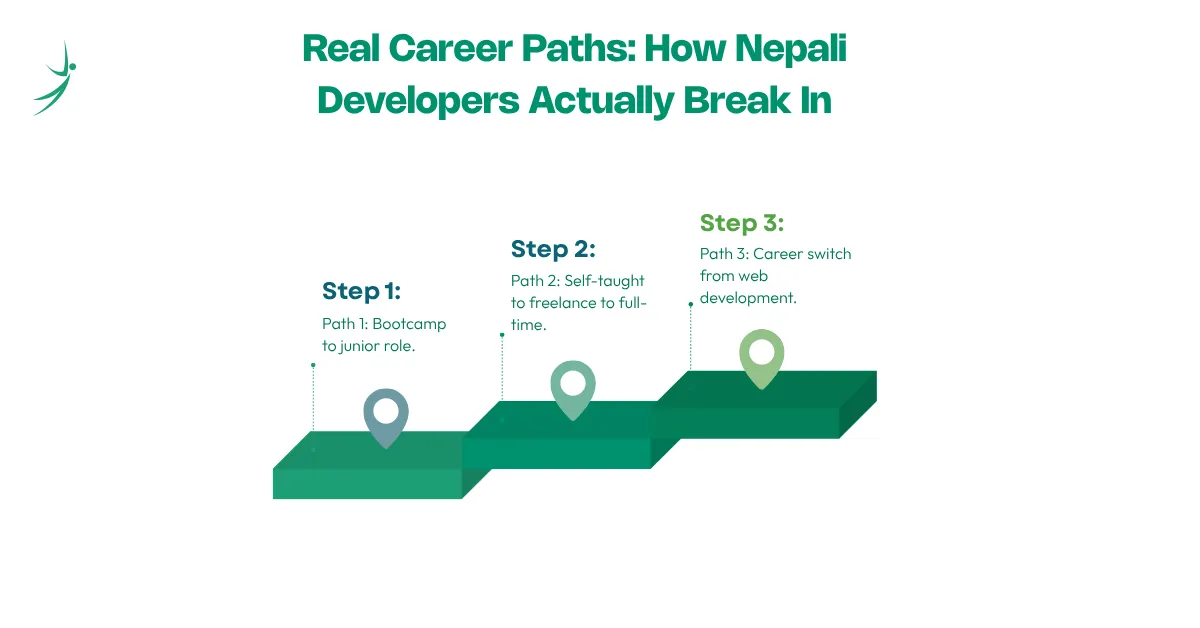
Path 1: Bootcamp to junior role.
A BCA or CSIT graduate with limited practical coding experience completes a structured, project-based Flutter program, builds a 3–4 app portfolio during training, and converts a guaranteed internship into a junior developer offer at the same or a partner company within 3–4 months of finishing.
Path 2: Self-taught to freelance to full-time.
A self-taught developer spends six months building small apps and contributing to open-source Flutter packages, picks up small freelance jobs on Upwork to build a rating and real client feedback, and eventually transitions into a full-time remote role once a repeat client offers a permanent contract.
Path 3: Career switch from web development.
A developer already comfortable with JavaScript or React learns Dart (which shares enough structural logic with typed languages to shorten the ramp-up) and moves into mobile development within a single company, using existing backend and API knowledge as leverage rather than starting from zero.
None of these paths skip the fundamentals they just sequence the learning, building, and job-hunting differently based on the person's starting point. For a closer look at what separates candidates who convert training into a real offer from those who don't, this breakdown of what actually gets Job Ready Program graduates hired is a useful next read.
Future Trends in Flutter Development (2026 and Beyond)
- AI-assisted development is now standard, not experimental pairing Flutter with AI coding assistants for UI generation, debugging suggestions, and boilerplate reduction is increasingly expected knowledge rather than a bonus skill.
- Flutter's reach beyond mobile keeps expanding. Web and desktop support (Windows, macOS, Linux) from the same codebase mean "Flutter developer" increasingly means "cross-platform app developer," not just mobile.
- Kotlin Multiplatform is a real competitor to watch, particularly for teams already invested in the Android/Kotlin ecosystem, but it hasn't displaced Flutter's dominant share of cross-platform job postings and tutorials.
- On-device and edge AI integration running lightweight ML models directly inside Flutter apps for offline features is moving from niche to mainstream in fintech and health-tech apps specifically.
- Enterprise adoption keeps growing, evidenced by large organizations like BMW and Google's own Google Pay team standardizing on Flutter for multi-country, multi-brand app strategies rather than treating it as a startup-only tool.
For Nepali developers, the practical takeaway is simple: don't just learn "Flutter for mobile." Learn Flutter as a general-purpose UI framework, and treat AI-assisted tooling as part of the standard workflow rather than a separate skill to learn later.
How to Choose the Right Flutter Developer Training or Course
Not all training is equal, and the difference shows up fastest in whether you actually get hired afterward. When evaluating a flutter developer training program or course, check for:
- A project-based curriculum, not just recorded lectures you should be building real apps from week one, not week ten.
- Mentors with current industry experience, ideally people actively working on production Flutter apps, not only teaching from a fixed slide deck.
- A portfolio outcome, meaning you graduate with 3+ working apps and a GitHub history you can show a recruiter, not just a certificate.
- Internship or placement support, since the biggest barrier for most beginners isn't learning to code it's converting that skill into a first professional opportunity.
- Coverage of the full stack a job actually requires: Dart, Flutter, state management, Firebase/API integration, Git, and deployment — not just the UI-building basics.
If you're weighing your options in Kathmandu specifically, Skill Shikshya's Flutter Mobile App Development Job Ready Program is structured around exactly this Dart, state management, API integration, and a guaranteed internship rather than a widget-by-widget tutorial series with no path to employment.
Measuring Your Progress: Career Milestones and Success Metrics
Instead of vaguely "getting better," track concrete markers so you know whether your learning is actually converting into job-readiness:
- Month 1–2: You can build a static, multi-screen UI from a design file without referencing a tutorial for every widget.
- Month 3–4: You've shipped at least one app that talks to a real API and handles loading/error states properly.
- Month 5–6: You've picked and implemented one state management pattern confidently, and your GitHub shows consistent commit activity, not one big upload.
- Post-training: You can explain, in an interview, why you chose a specific architecture or package not just that you used it.
- First 6 months on the job: You're contributing to code review discussions, not just receiving feedback silently.
These aren't official benchmarks they're a practical way to notice if you're stalling at a specific stage so you can address it before it becomes a pattern.
Conclusion and Action Steps
Becoming a Flutter developer in Nepal in 2026 isn't about picking a trendy framework it's about picking a genuinely in-demand, well-backed skill set that opens local jobs, remote contracts, freelance income, and internship pathways at the same time. The framework itself is beginner-friendly enough to get started quickly, but the job market is competitive enough that tutorials alone won't get you hired.
If you're starting today: learn Dart properly, build real projects instead of clones, put everything on GitHub, and get feedback from people who already work in the field through a mentor, a community, or a structured flutter developer course. The demand in Nepal's IT sector is real; the developers who convert that demand into a career are the ones who treat building as the actual skill, not a side effect of watching tutorials.
Frequently Asked Questions
What is the salary of a Flutter developer in Nepal?
Entry-level Flutter developers typically start around NPR 25,000–45,000 per month, mid-level developers earn NPR 50,000–90,000, and senior developers can earn NPR 100,000–160,000 or more. Remote and freelance work with international clients often exceeds these local ranges significantly.
Is Flutter a good career choice in Nepal?
Yes Flutter development is one of the more stable tech career paths in Nepal right now because of consistent local demand from fintech and startups, combined with strong remote and freelance opportunities that aren't capped by the local salary ceiling.
Do I need a computer science degree to become a Flutter developer?
No, though a background in BCA, CSIT, BIT, or Computer Engineering helps with foundational concepts. In practice, employers weigh a strong portfolio, GitHub activity, and demonstrated project experience more heavily than the degree itself.
How long does it take to become job-ready in Flutter?
With consistent, project-based learning, most beginners reach a junior-developer skill level in four to six months. Self-taught learners without structure or feedback often take significantly longer to reach the same point.
Can I find remote or work-from-home Flutter developer jobs from Nepal?
Yes. Flutter's single-codebase model makes remote collaboration straightforward, and Nepali developers regularly work remote or work-from-home contracts for companies in the US, Europe, Australia, and the Gulf, often sourced through LinkedIn, Upwork, or direct referrals.
What's the difference between a Flutter developer course and a job-ready program?
A course typically teaches the framework's mechanics. A job-ready program adds structured projects, portfolio-building, CV preparation, mock interviews, and placement or internship support the pieces that actually convert learning into an offer.