What is Digital Marketing? A Complete Guide for Beginners | Skill Shikshya
What is Digital Marketing?
Digital marketing is the promotion of products, services, or brands through digital channels such as search engines, social media, websites, email, and mobile apps. If you are new to this field and want to get started with digital marketing from scratch, our complete beginner's guide walks you through everything step by step. For a deeper look at how online promotion differs from conventional advertising, read our full breakdown of traditional marketing vs digital marketing.
At its core, the digital marketing definition comes down to one idea: using the internet and digital technology to connect with your target audience, deliver your message, and drive measurable results.
The term covers a wide range of activities from writing a blog post optimized for Google, to running a Facebook ad campaign, to sending a promotional email to your subscribers. What ties all of these together is that they happen through digital devices and platforms, and every action can be tracked, measured, and improved.
Digital marketing is not a single strategy. It is an ecosystem of channels, tools, and tactics that work together to help businesses grow online.
How Does Digital Marketing Work?
Digital marketing works by attracting the right audience, engaging them with valuable content, and guiding them toward a decision, whether that is making a purchase, signing up for a service, or enrolling in a digital marketing training. If you want to know exactly what to learn and in what order, follow our step-by-step digital marketing roadmap.
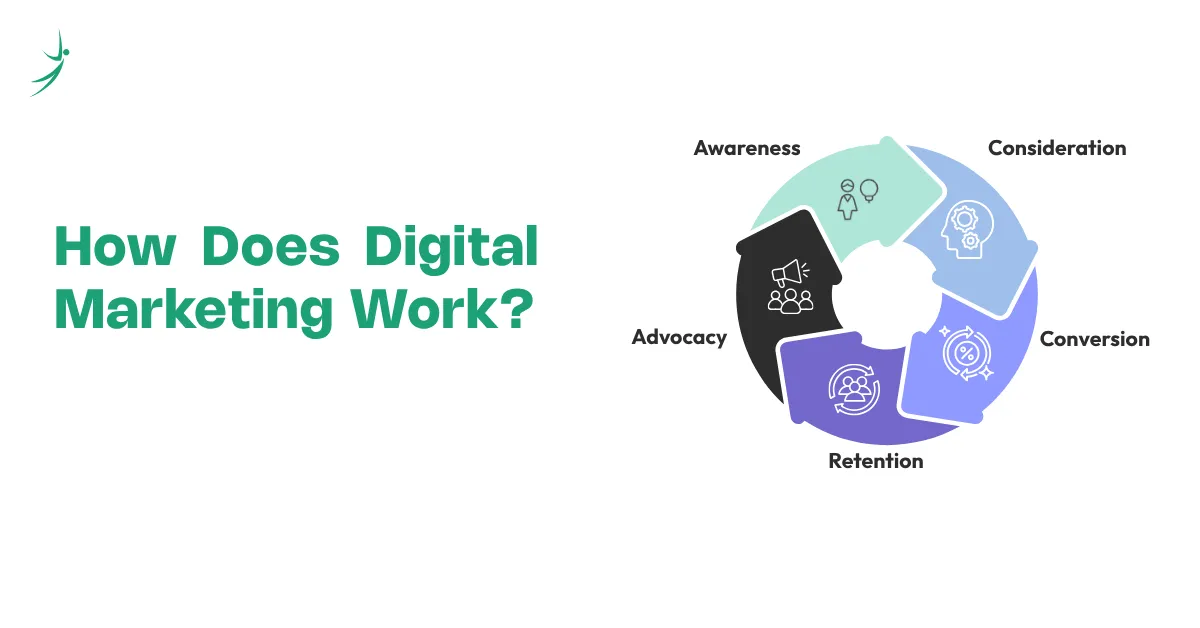
This journey follows what marketers call the digital marketing funnel, a step-by-step process that mirrors how real people make decisions online:
- Awareness: The customer discovers your brand for the first time. This happens through a Google search, a social media post, a YouTube video, or a blog article. Your job at this stage is to show up and make a strong first impression. Example: Sita, a fresh graduate in Kathmandu, Googles "how to get into digital marketing" and finds Skill Shikshya's blog post. She had never heard of Skill Shikshya before, but now she has.
- Consideration: The customer is now aware of you and starts comparing options. They read your blog, browse your website, watch your videos, and look at reviews. Your job here is to build trust and demonstrate value. Example: Over the next few days, Sita reads more Skill Shikshya articles, watches course preview videos, and compares them with two other institutes she found online.
- Conversion: The customer decides to take action, they buy, sign up, or enroll. Your job is to make this step as easy and compelling as possible through clear calls to action, strong landing pages, and well-timed offers. Example: Sita sees a Skill Shikshya Facebook ad offering a free demo class, attends it, and enrolls in the Digital Marketing Course that same evening.
- Retention: The relationship does not end at the sale. Email marketing, loyalty programs, and ongoing content keep customers coming back. Retained customers are far more valuable than new ones. Example: After enrolling, Sita receives a welcome email series, weekly learning tips, and exclusive alumni content, keeping her engaged throughout the course.
- Advocacy: Happy customers become brand advocates. They share your content, leave reviews, and refer others effectively, becoming an extension of your marketing team. Example: Sita lands her first digital marketing job, posts about Skill Shikshya on LinkedIn, and refers two college friends to the course, all without Skill Shikshya spending a single rupee.
Each stage of this funnel uses different digital marketing channels and tactics. Understanding where your audience is in this journey is what separates effective digital marketing from random online activity.
B2B vs B2C Digital Marketing
Not all digital marketing is the same. How you market a software product to a company is fundamentally different from how you market a pair of shoes to an individual. This is the core distinction between B2B and B2C digital marketing, and understanding the difference is essential before exploring the digital marketing channels and strategies that best fit your goals.
- B2B digital marketing (Business-to-Business) targets other companies and professional decision-makers. The buying process is longer, more research-driven, and involves multiple stakeholders. The goal is typically to generate leads, build relationships, and nurture prospects over time.
- B2C digital marketing (Business-to-Consumer) targets individual consumers. The buying process is shorter, more emotion-driven, and often involves a single decision-maker. The goal is typically to drive immediate action, a purchase, a signup, or a download.
Here is how the two approaches differ across key areas:
| Factor | B2B Digital Marketing | B2C Digital Marketing |
|---|---|---|
| Target Audience | Companies, professionals, decision-makers | Individual consumers |
| Buying Process | Long, research-driven, multi-stakeholder | Short, emotion-driven, individual |
| Content Type | Case studies, whitepapers, webinars, LinkedIn posts | Social media, videos, influencer content, ads |
| Primary Channels | LinkedIn, email marketing, SEO, webinars | Instagram, Facebook, TikTok, Google Ads |
| Tone | Professional, data-driven, logical | Conversational, emotional, engaging |
| Goal | Lead generation, relationship building | Immediate conversions, brand loyalty |
| Sales Cycle | Weeks to months | Minutes to days |
| Example | A software company targeting HR managers | A clothing brand targeting young adults |
Despite these differences, both B2B and B2C digital marketing share the same foundation: understanding your audience, delivering value through the right channels, and measuring results. The strategy changes, but the principles remain the same.
Digital Marketing Channels
Understanding digital marketing channels is at the heart of any successful digital marketing strategy. A channel is simply the platform or medium through which you reach your audience online. Each channel serves a different purpose, attracts a different audience, and requires a different approach.
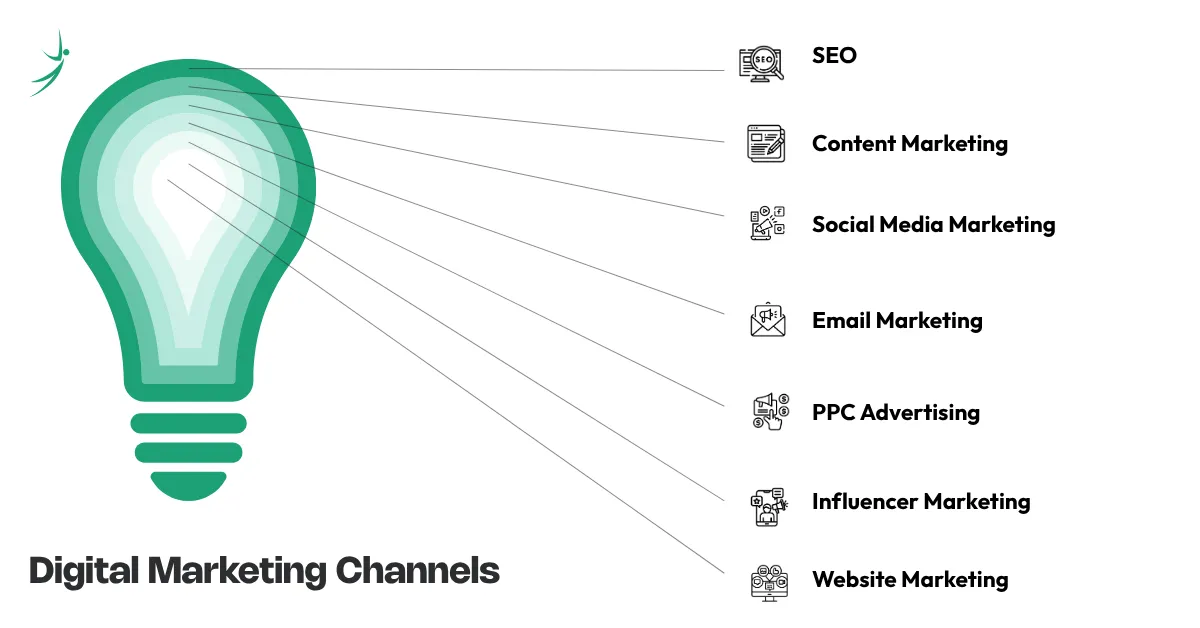
Here are the core digital marketing channels every marketer should know:
1. Search Engine Optimization (SEO)
SEO is the practice of optimizing your website so it ranks higher on search engines like Google. When someone searches "best digital marketing course in Nepal," SEO is what determines whether your page appears on page one or page ten.
SEO involves three core areas: on-page optimization (content and keywords), off-page optimization (backlinks and authority), and technical SEO (site speed, structure, and crawlability). Mastering these requires building strong digital marketing skills across both technical and creative disciplines. It is one of the most powerful long-term digital marketing channels because it drives free, organic traffic that compounds over time.
2. Content Marketing
Content marketing is the practice of creating and distributing valuable content, such as blogs, videos, guides, infographics, and podcasts, to attract and engage a target audience. Rather than directly promoting a product, content marketing builds trust by educating and informing.
The article you are reading right now is an example of content marketing. It provides value to the reader while positioning Skill Shikshya as a credible authority on digital marketing.
3. Social Media Marketing
Social media marketing uses platforms like Facebook, Instagram, LinkedIn, TikTok, and YouTube to build brand awareness, engage audiences, and drive traffic. Each platform serves a different purpose. LinkedIn works best for B2B and professional audiences, while Instagram and TikTok are more effective for reaching younger, consumer-focused audiences.
Social media marketing can be organic (posting content for free) or paid (running targeted ad campaigns). The most effective strategies combine both.
4. Email Marketing
Email marketing is one of the oldest and highest-ROI digital marketing channels available. It involves sending targeted, personalized messages directly to a subscriber's inbox, whether that is a welcome email, a promotional offer, a newsletter, or a follow-up sequence.
Unlike social media, where algorithms control who sees your content, email gives you direct, unfiltered access to your audience. Every subscriber on your list is someone who has actively chosen to hear from you.
5. Pay-Per-Click Advertising (PPC)
PPC is a paid digital marketing channel where you run ads on platforms like Google Ads or Facebook Ads and only pay when someone clicks on your ad. It is one of the fastest ways to drive targeted traffic to your website because your ads appear immediately, without waiting for organic rankings to build.
Google Search Ads, Display Ads, Facebook Ads, and Instagram Ads all fall under the PPC umbrella. PPC works best when combined with strong landing pages and a clear conversion goal.
6. Influencer Marketing
Influencer marketing involves partnering with social media personalities who have an established, engaged audience. When an influencer recommends your product or service to their followers, it carries far more trust than a traditional advertisement.
Influencer marketing is particularly effective for B2C brands targeting younger audiences on Instagram, YouTube, and TikTok.
7. Website Marketing
Your website is the foundation of all your digital marketing efforts. Every channel, SEO, social media, email, and PPC, ultimately drives traffic back to your website. A well-designed, fast, and conversion-optimized website turns visitors into leads and customers.
Website marketing involves optimizing your site's design, user experience, page speed, and content to ensure every visitor has the best possible chance of converting.
KPIs in Digital Marketing
A KPI or Key Performance Indicator is a measurable value that shows how effectively your digital marketing efforts are achieving your business goals. Tracking the right KPIs in digital marketing is what separates businesses that grow intentionally from those that guess and hope.
Without KPIs, you are running campaigns blind. With the right KPIs, every decision is backed by data, you know what is working, what is not, and exactly where to improve.
Why KPIs Matter in Digital Marketing
Unlike traditional marketing, where results are difficult to measure, digital marketing gives you access to precise, real-time data. Every click, impression, open, scroll, and purchase leaves a trackable signal. KPIs help you make sense of that data and connect it to real business outcomes.
The key is not tracking everything; it is tracking the right things. Vanity metrics like total page views or follower counts can look impressive, but tell you very little about actual business performance. The KPIs below are the ones that actually matter.
KPIs by Digital Marketing Channel
SEO KPIs
| KPI | What It Measures | Why It Matters |
|---|---|---|
| Organic Traffic | Number of visitors from search engines | Shows how well your SEO is performing |
| Keyword Rankings | Position of your pages on Google | Tracks visibility for target keywords |
| Click-Through Rate (CTR) | % of people who click your result after seeing it | Measures how compelling your title and meta description are |
| Bounce Rate | % of visitors who leave without taking action | Indicates content relevance and user experience |
| Domain Authority (DA) | Overall strength of your website | Predicts ability to rank for competitive keywords |
| Backlinks | Number of sites linking to yours | Measures off-page SEO strength |
Content Marketing KPIs
| KPI | What It Measures | Why It Matters |
|---|---|---|
| Time on Page | How long do visitors stay on your content | Indicates content quality and engagement |
| Pages per Session | How many pages a visitor views per visit | Shows how well your internal linking is working |
| Social Shares | How often is content shared on social media | Measures content reach and resonance |
| Return Visitors | % of visitors who come back | Indicates content value and brand loyalty |
| Leads Generated | Number of leads from content | Connects content directly to business outcomes |
Social Media Marketing KPIs
| KPI | What It Measures | Why It Matters |
|---|---|---|
| Reach | Number of unique users who saw your content | Measures brand visibility |
| Engagement Rate | Likes, comments, shares as a % of reach | Shows how well the content resonates with the audience |
| Follower Growth Rate | The speed at which your audience is growing | Tracks brand momentum on social platforms |
| Social Media Traffic | Visitors coming to your site from social media | Connects social activity to website performance |
| Share of Voice | Your brand mentions vs competitors | Measures brand presence in your industry |
Email Marketing KPIs
| KPI | What It Measures | Why It Matters |
|---|---|---|
| Open Rate | % of recipients who open your email | Measures subject line effectiveness |
| Click-Through Rate (CTR) | % of recipients who click a link in your email | Measures email content and CTA effectiveness |
| Conversion Rate | % of email recipients who complete a desired action | Connects email directly to business outcomes |
| Unsubscribe Rate | % of recipients who opt out | Indicates email relevance and frequency |
| List Growth Rate | The speed at which your email list is growing | Tracks long-term email marketing health |
PPC Advertising KPIs
| KPI | What It Measures | Why It Matters |
|---|---|---|
| Cost Per Click (CPC) | How much you pay per ad click | Measures ad spend efficiency |
| Cost Per Acquisition (CPA) | How much you spend to acquire one customer | Connects ad spend directly to business results |
| Return on Ad Spend (ROAS) | Revenue generated per dollar spent on ads | The ultimate PPC performance metric |
| Quality Score | Google's rating of your ad relevance | Affects your ad position and cost |
| Impression Share | % of times your ad appeared vs total eligible impressions | Measures ad visibility and competitiveness |
Overall Business KPIs
These cut across all channels and connect digital marketing directly to business performance:
| KPI | What It Measures | Why It Matters |
|---|---|---|
| Conversion Rate | % of visitors who complete a desired action | The most important metric across all channels |
| Customer Acquisition Cost (CAC) | Total cost to acquire one new customer | Measures overall marketing efficiency |
| Customer Lifetime Value (CLV) | Total revenue a customer generates over their lifetime | Determines how much you can afford to spend on acquisition |
| Return on Investment (ROI) | Revenue generated vs total marketing spend | The ultimate measure of marketing success |
| Marketing Qualified Leads (MQLs) | Leads that are likely to become customers | Connects marketing activity to sales pipeline |
How to Choose the Right KPIs
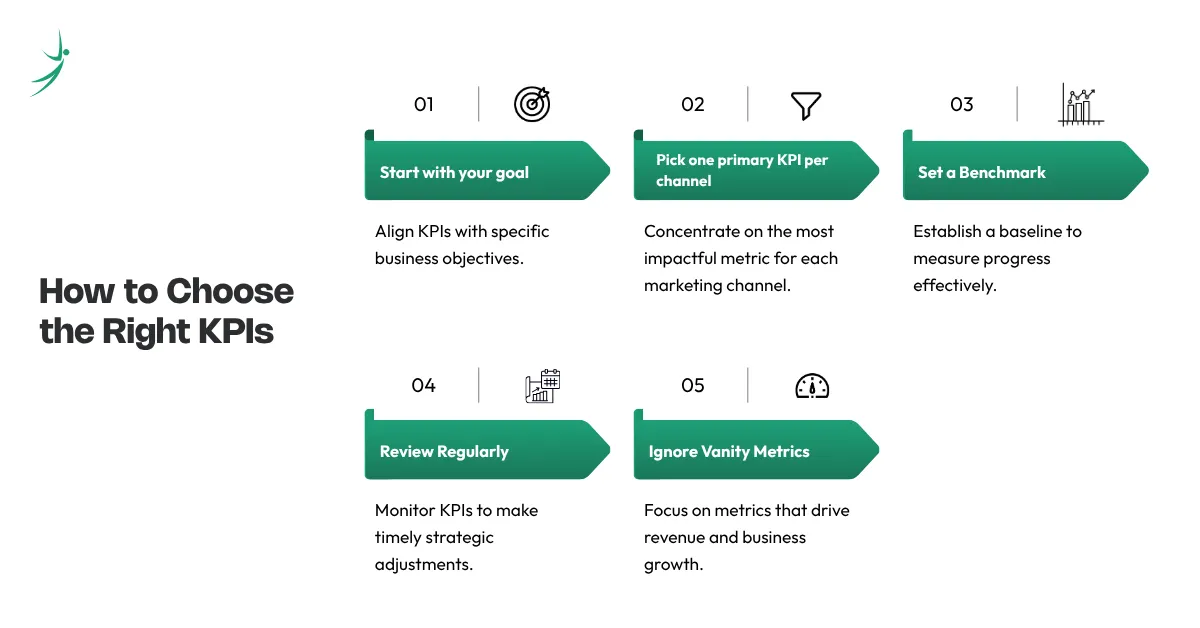
With so many metrics available, it is easy to get overwhelmed. Here is a simple framework for choosing the right KPIs for your business:
1. Start with your goal: Are you trying to build awareness, generate leads, or drive sales? Your goal determines your KPIs.
2. Pick one primary KPI per channel: Focus on the metric that most directly reflects success for that channel. For SEO, it is organic traffic. For email, it is the conversion rate. For PPC, it is ROAS.
3. Set a benchmark: Know your current numbers before you start. Without a baseline, improvement is impossible to measure.
4. Review regularly: KPIs are only useful if you act on them. Review your key metrics weekly or monthly and adjust your strategy accordingly.
5. Ignore vanity metrics: Follower counts, total impressions, and page views feel good but rarely connect to revenue. Focus on metrics that move the business forward.
Benefits of Digital Marketing
The benefits of digital marketing go far beyond simply having an online presence. When executed well, digital marketing becomes one of the most powerful growth engines a business can build, delivering results that traditional marketing simply cannot match.
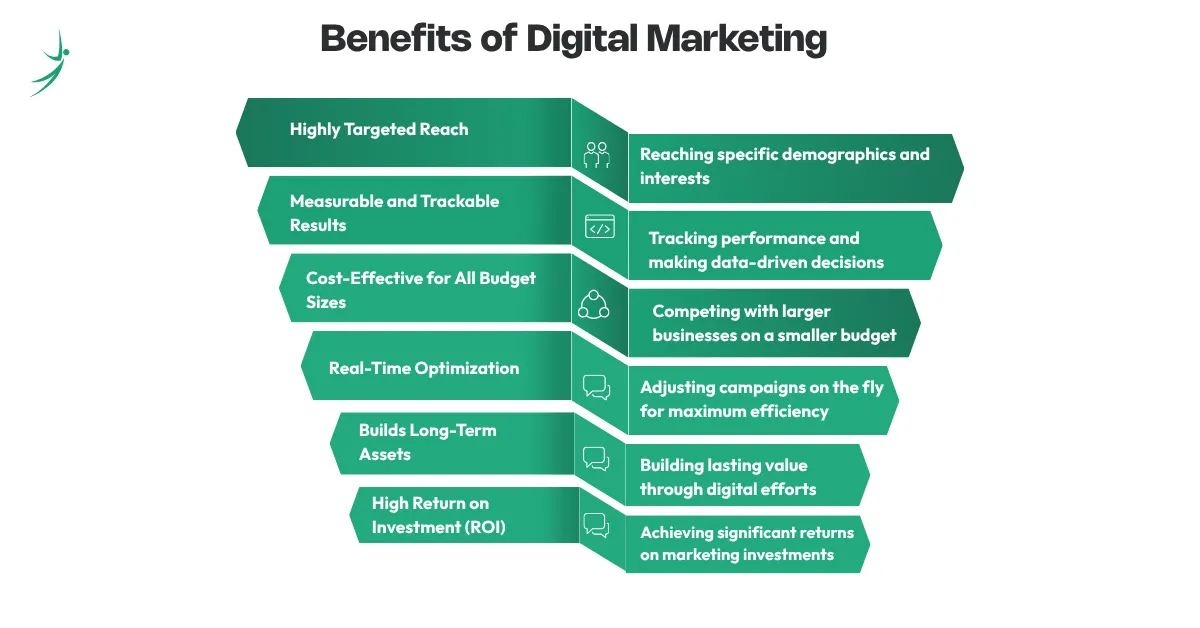
Here is why businesses and professionals around the world, including in Nepal, are investing heavily in digital marketing:
Highly Targeted Reach
Digital marketing lets you reach exactly the right person at exactly the right time. Unlike a billboard that everyone sees regardless of interest, digital marketing lets you target by age, location, interests, job title, online behavior, and more.
A digital marketing course providers in Nepal, for example, can run a Facebook ad that appears only to 18-30 year olds in Kathmandu who have shown interest in online education. That level of precision is simply not possible with traditional marketing.
Measurable and Trackable Results
Every action in digital marketing is measurable. You know exactly how many people saw your ad, clicked your link, read your blog, opened your email, and made a purchase. This data lets you make smarter decisions, eliminate wasteful spending, and double down on what actually works.
Compare this to a newspaper ad you spend the money, it goes out, and you have no reliable way of knowing how many people saw it or acted on it.
Cost-Effective for All Budget Sizes
Digital marketing levels the playing field. A small business or a new training institute in Nepal can compete with much larger competitors through smart SEO and content marketing without needing a massive advertising budget.
You can start a blog for free, create social media content at no cost, and build an email list with minimal investment. As your budget grows, you scale with paid advertising. No other marketing medium offers this kind of flexibility.
Real-Time Optimization
In traditional marketing, once your ad is printed or your TV spot is aired, it cannot be changed. Digital marketing is different. If a campaign is not performing, you can adjust the targeting, change the creative, rewrite the copy, or pause it entirely, all in real time.
This agility means your marketing budget is always working as efficiently as possible.
Builds Long-Term Assets
Unlike paid advertising that stops the moment your budget runs out, certain digital marketing efforts build permanent assets. A well-optimized blog post continues to drive organic traffic for years. An email list grows and compounds over time. A strong social media following becomes a direct communication channel you own.
These are assets that appreciate the longer you invest in them.
High Return on Investment (ROI)
When done right, digital marketing consistently delivers one of the highest ROIs of any marketing channel. Email marketing in particular is known for delivering exceptional returns, with studies showing an average return of $36 for every $1 spent.
Combined with the measurability of digital marketing, this means you can continuously optimize your spend and improve your ROI over time.
Challenges of Digital Marketing
Digital marketing offers an enormous opportunity, but it is not without its difficulties. Understanding the challenges of digital marketing before you start is what separates those who build sustainable strategies from those who burn out after a few months of inconsistent results.
Here are the most significant challenges marketers face and how to approach them:
The Digital Landscape Changes Constantly
Google updates its search algorithm hundreds of times per year. Social media platforms change how they distribute content overnight. New channels emerge, and old ones lose relevance. What worked brilliantly six months ago may deliver poor results today.
Staying current requires continuous learning, reading industry blogs, following algorithm updates, testing new approaches, and adapting quickly. This is one of the reasons structured education in digital marketing has become so valuable.
High Competition and Shrinking Organic Reach
As more businesses invest in digital marketing, competition for attention increases. Ranking on the first page of Google is harder than it was five years ago. Organic reach on social media platforms has declined significantly as platforms push businesses toward paid advertising.
Standing out in a crowded digital space requires better content, smarter strategy, and consistent long-term effort, not shortcuts.
Information Overload
The internet is flooded with digital marketing advice, much of it contradictory, outdated, or simply wrong. For beginners, especially, knowing what to trust, what to prioritize, and where to start is genuinely overwhelming.
This is why learning digital marketing through a structured, expert-led course is far more effective than trying to piece together free information from dozens of different sources.
Measuring ROI Across Multiple Channels
While digital marketing is measurable, measuring it accurately across multiple channels is complex. A customer might discover your brand through a Google search, follow you on Instagram, click an email link, and finally convert through a retargeting ad. Which channel gets the credit?
Attribution, the process of assigning value to each touchpoint in the customer journey, remains one of the most complex challenges in digital marketing. Getting it wrong leads to poor budget allocation and wasted spending.
Building and Maintaining Consistent Content
Content marketing and SEO require consistent, high-quality output over a long period of time. Many businesses start strong and then lose momentum, publishing less frequently, reducing quality, and ultimately abandoning their strategy before it has time to deliver results.
Digital marketing rewards consistency above almost everything else. The businesses that win are rarely those with the biggest budgets; they are the ones that show up consistently over the long term.
Data Privacy and Changing Regulations
Growing concerns around data privacy have led to significant regulatory changes, such as GDPR in Europe, increasing cookie restrictions, and platform-level privacy updates like Apple's iOS changes that limit ad tracking. These shifts directly affect how digital marketers collect data, target audiences, and measure results.
Skill Gap and Talent Shortage
Mastering the right skills across multiple disciplines- SEO, content creation, paid advertising, analytics, and social media takes time, practice, and the right education. Finding or becoming a professional who is genuinely skilled across these areas is one of the biggest challenges in the industry today.
In Nepal, particularly, the demand for skilled digital marketers is growing faster than the supply, creating a significant opportunity for those who invest in building real, practical skills through a digital marketing course.
Who Should Learn Digital Marketing?
Alt text: Illustration showing who should learn digital marketing, including students, working professionals, business owners, and freelancers.
The scope of digital marketing as a career and skill set has never been wider. Whether you are just starting out or looking to add a high-value skill to your existing expertise, digital marketing has something to offer, but it is particularly valuable for certain groups of people.
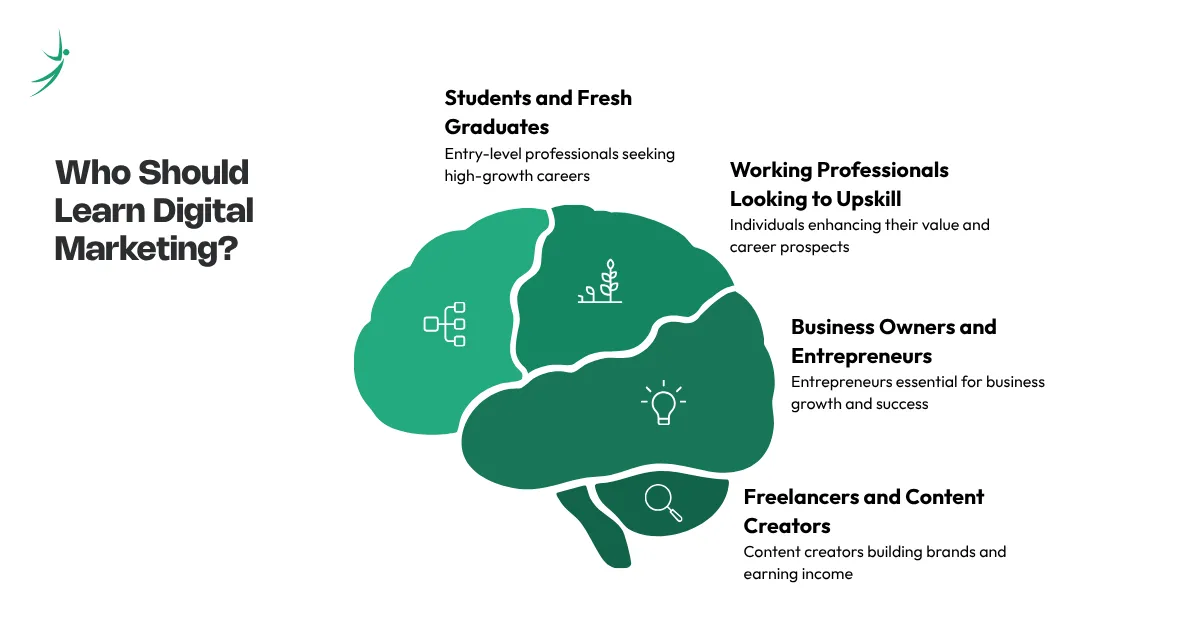
Students and Fresh Graduates
If you are a student or a fresh graduate trying to figure out your next step, digital marketing is one of the most accessible and high-growth career paths available today. You do not need a specific academic background; what matters is your willingness to learn, experiment, and stay current.
Entry-level digital marketing roles are in high demand across Nepal and globally. Explore the top digital marketing courses in Nepal to find the right program for your goals, and check out our detailed breakdown of digital marketing salary in Nepal to understand what you can expect to earn.
Working Professionals Looking to Upskill
If you are already working in any field, adding digital marketing skills makes you significantly more valuable. Whether you are in sales, communications, business development, or even a completely unrelated field, understanding how digital marketing works gives you an edge that most of your peers simply do not have.
Many professionals use digital marketing skills to transition into higher-paying roles, take on freelance projects, or move into marketing leadership positions.
Business Owners and Entrepreneurs
If you own a business or are building a startup, digital marketing is not optional; it is essential. Understanding how to reach your audience online, generate leads, and convert them into customers is the difference between a business that grows and one that stagnates.
Even if you eventually hire a marketing team, understanding digital marketing yourself means you can make smarter decisions, evaluate your team's performance, and avoid being misled by poor strategy.
Freelancers and Content Creators
Digital marketing skills are the backbone of any successful freelance or content creation career. Whether you want to grow a YouTube channel, build a personal brand, run a blog, or offer services to clients, SEO, social media marketing, email marketing, and analytics are skills you will use every single day.
Freelance digital marketing is also one of the most flexible and accessible ways to earn income remotely from anywhere in Nepal or the world.
Is Digital Marketing a Good Career in Nepal?
Absolutely. Nepal's digital economy is growing rapidly. More businesses are moving online, e-commerce is expanding, and the demand for skilled digital marketers is rising faster than the local talent supply. This gap represents a genuine opportunity for anyone willing to invest in building real digital marketing skills.
The scope of digital marketing in Nepal is particularly strong in areas like SEO, social media management, content creation, and performance marketing, with salaries and freelance rates rising consistently year on year.
Start Your Digital Marketing Journey with Skill Shikshya
If you see yourself in any of the groups above, the next step is clear. At Skill Shikshya, our Digital Marketing Classes are built specifically for people who want practical, job-ready skills, not just theory.
You will learn from industry experts, work on real campaigns, build a portfolio that gets you hired, and join a community of learners and professionals who are navigating the same journey.
The best time to start was yesterday. The next best time is today.
Frequently Asked Questions
What is digital marketing, and how does it work?
What is the digital marketing definition in simple terms?
What are the main types of digital marketing?
What is the difference between B2B and B2C digital marketing?
What are the most important KPIs in digital marketing?
What are the biggest challenges of digital marketing?
About Author: