What is Cybersecurity? A Complete Guide for Beginners | Skill Shikshya
What is Cybersecurity?
Cybersecurity is the practice of protecting computers, networks, systems, and data from unauthorized access, theft, damage, and digital attacks. If you are completely new to this field and want to understand where to begin, our detailed guide on the structured path into the profession lays out every step clearly.
At its core, the cybersecurity definition comes down to one idea: defending the digital world from those who want to exploit it. Whether it is a hacker trying to steal your bank credentials or a criminal organization targeting a hospital's patient records, cybersecurity professionals are the last line of defense.
The cybersecurity meaning extends far beyond antivirus software. It is an entire discipline covering network defense, ethical hacking, risk management, cloud security, digital forensics, and much more. Every device connected to the internet, every database holding sensitive data, and every piece of software running critical infrastructure depends on people who understand how to protect it.
Cybersecurity is not a single job title or a single tool. It is an ecosystem of roles, technologies, frameworks, and strategies that work together to keep the digital world safe.
How Does Cybersecurity Work?
Cybersecurity works by identifying threats, building defenses, monitoring systems, and responding rapidly when something goes wrong. It is a continuous cycle, not a one-time fix, because the threat landscape evolves every single day. If you want to know exactly what to learn and in what order, follow our step-by-step cybersecurity career roadmap.
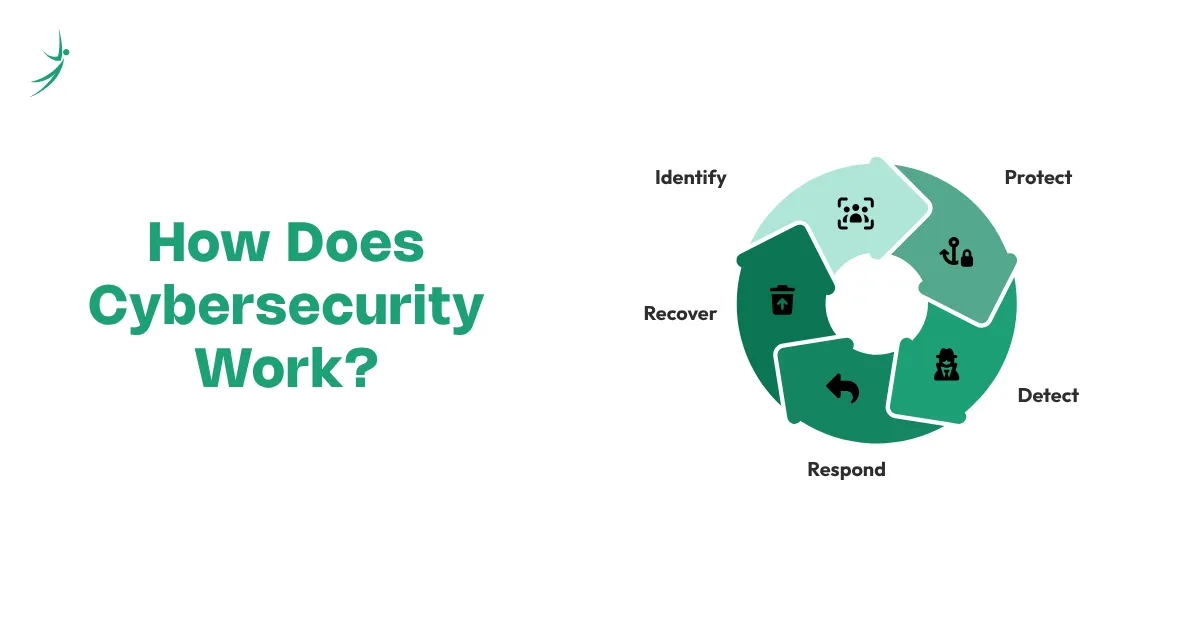
The process follows five core functions, drawn from the NIST Cybersecurity Framework, the most trusted global standard for managing digital risk:
- Identify: Understanding what assets exist, what data is sensitive, and where vulnerabilities live. You cannot protect what you have not mapped.
- Protect: Implementing controls, such as firewalls, encryption, access policies, and user training, to reduce the chance of a successful attack.
- Detect: Using monitoring tools and security systems to spot unusual activity as early as possible, often before real damage is done.
- Respond: Activating a response plan when a breach or incident occurs containing the damage, investigating the cause, and communicating with stakeholders.
- Recover: Restoring systems, closing the gaps that were exploited, and returning operations to normal after an incident.
Each of these five stages uses a different set of professional tools that security teams rely on daily, from network scanners to SIEM platforms to forensics software. Understanding the full toolset is a key part of becoming job-ready in this field. Start your journey toward a security career with our Cybersecurity Course in Nepal designed for practical learning, industry tools, and real-world cybersecurity skills.
What Are the 5 Types of Cybersecurity?
Cybersecurity is not one field; it is several, each focused on a different layer of the digital environment. Understanding the 5 types of cybersecurity helps you see the full picture and decide where you want to specialize.
1. Network Security
Network security protects the infrastructure that connects devices, routers, switches, firewalls, and the traffic that flows between them. It defends against unauthorized access, traffic interception, and man-in-the-middle attacks. Tools like firewalls, intrusion detection systems (IDS), and VPNs fall under this domain.
2. Application Security
Every piece of software, whether a mobile banking app or an e-commerce website, has potential vulnerabilities. Application security focuses on identifying and fixing flaws in code before attackers can exploit them. Techniques include code reviews, penetration testing, and secure development lifecycle (SDLC) practices.
3. Cloud Security
As businesses move infrastructure to cloud platforms like AWS, Azure, and Google Cloud, securing that environment becomes critical. Cloud security covers data protection, identity management, compliance enforcement, and continuous monitoring within cloud platforms.
4. Endpoint Security
An endpoint is any device that connects to a network, such as a laptop, smartphone, tablet, or server. Endpoint security ensures that each device is protected through antivirus software, patch management, device encryption, and remote wipe capabilities when a device is lost or compromised.
5. Information Security (InfoSec)
Information security is the broadest category. It covers the protection of all forms of data, whether stored digitally, printed on paper, or transmitted across networks. InfoSec includes policies, legal compliance, and governance frameworks as much as it does technical controls.
Beyond these five core domains, specialized areas like operational security (OpSec), IoT security, critical infrastructure protection, and identity and access management (IAM) continue to grow as the digital environment expands.
| Threat | What It Is | Real-World Example |
|---|---|---|
| Phishing | Deceptive emails tricking users into revealing credentials | Fake bank email asking you to "verify your account" |
| Malware | Malicious software designed to damage or gain unauthorized access | Virus embedded in a pirated software download |
| Ransomware | Malware that encrypts data and demands payment for the key | WannaCry attack that shut down NHS hospitals in 2017 |
| Man-in-the-Middle (MITM) | Attacker secretly intercepts communication between two parties | Intercepting data on unsecured public Wi-Fi |
| SQL Injection | Malicious code inserted into a database query to extract data | Pulling all user credentials from a website's database |
| DDoS Attack | Overwhelming a server with traffic until it crashes | Flooding an e-commerce site during its peak sales period |
| Social Engineering | Psychologically manipulating people into revealing confidential information | Impersonating IT support to obtain an employee's password |
| Zero-Day Exploit | Attacking a vulnerability before the software vendor has a patch available | Exploiting a newly discovered flaw in a widely used operating system |
Cybersecurity risks are not abstract. Every business with a website, every individual using online banking, and every government managing citizen data is a potential target. Knowing these threats by name and behavior is foundational to both defending against them and building a career in this field.
Cybersecurity Frameworks and Best Practices
A cybersecurity framework is a structured set of guidelines that organizations follow to manage and reduce digital risk. These are not rigid rulebooks; they are adaptable blueprints proven to work across industries and organization sizes.
The major frameworks every professional should know:
- NIST Cybersecurity Framework (CSF): The most widely adopted global standard, built around Identify, Protect, Detect, Respond, and Recover. Used by organizations of every size across every sector.
- ISO/IEC 27001: An international standard for information security management systems (ISMS), common in enterprise environments and required in many compliance contexts.
- CIS Controls: A prioritized set of 18 safeguards developed by the Center for Internet Security, particularly practical for organizations building defenses from the ground up.
- Zero Trust Architecture: A philosophy of "never trust, always verify"; every user, device, and request must be authenticated, even if it originates from inside the network perimeter.
Cybersecurity best practices that apply regardless of which framework you follow:
- Use strong, unique passwords and enable multi-factor authentication (MFA) on every account and system.
- Keep software and systems updated; the majority of successful attacks exploit known vulnerabilities that already have patches available.
- Encrypt sensitive data both in transit (while moving between systems) and at rest (while stored).
- Apply least privilege access, give users only the access they actually need to do their jobs, nothing more.
- Conduct regular security audits and penetration tests to find weaknesses before attackers do.
- Train employees on recognizing phishing and social engineering. Human error remains the leading cause of successful breaches
- Have an incident response plan ready before you need it. Organizations that plan ahead recover faster and suffer less damage.
Cybersecurity vs Ethical Hacking: What Is the Difference?
One of the most common questions from beginners is how cybersecurity and ethical hacking relate to each other. The short answer: ethical hacking is a subset of cybersecurity. For a thorough breakdown of how the offensive and defensive sides of security differ, that comparison maps out which career path fits which personality and skill set.
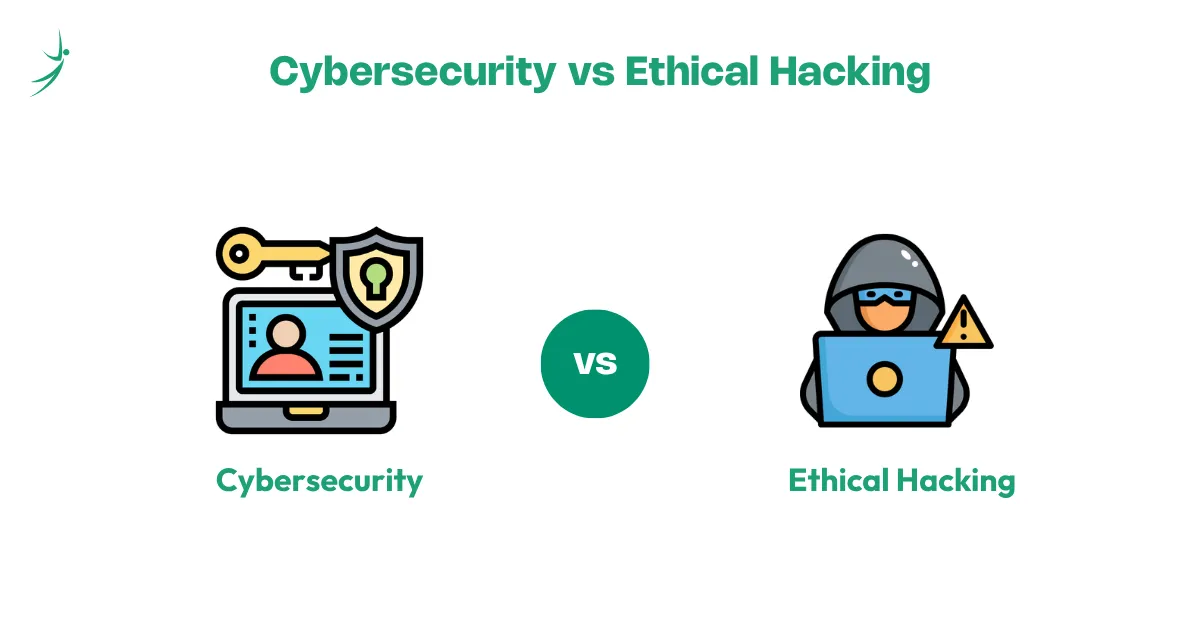
Here is the quick version:
| Cybersecurity (Defensive) | Ethical Hacking (Offensive) | |
| Goal | Protect systems from attacks | Simulate attacks to find weaknesses |
| Approach | Build and monitor defenses | Think and act like an attacker |
| Key Roles | SOC Analyst, Security Engineer | Penetration Tester, Red Team |
| Certifications | CompTIA Security+, CISSP | CEH, OSCP, eJPT |
| Mindset | Guardian | Adversarial thinker |
Both sides are essential. The best defenders understand how attackers think, and the best attackers understand what strong defenses look like. Most successful security careers involve exposure to both.
Cybersecurity and AI: What Is Changing?
AI in cybersecurity is one of the most important developments in the field today. Artificial intelligence is simultaneously becoming the most powerful tool available to defenders and the most dangerous weapon in an attacker's arsenal.
How AI is strengthening cyber defenses:
- Threat detection at scale: AI-powered SIEM tools analyze millions of events per second and flag anomalies that a human analyst would miss.
- Behavioral analytics: Machine learning models learn what "normal" looks like for a user or system, then flag deviations in real time, often catching insider threats and compromised accounts early.
- Automated response: AI can automatically isolate a compromised endpoint or block a suspicious IP address before human intervention is even possible.
- Phishing detection: Natural language processing identifies subtle signs of phishing in email content far faster and more consistently than manual review.
How AI is empowering attackers:
- AI-generated phishing: Large language models generate convincing, personalized phishing emails at scale with no grammar errors and no obvious red flags.
- Deepfakes for social engineering: AI-generated audio and video are being used to impersonate executives and trick employees into transferring funds or sharing credentials.
- Automated vulnerability scanning: Attackers can now discover and exploit vulnerabilities faster than defenders can patch them.
The rise of LLMs in cybersecurity, both as defensive tools and as attack vectors, means the field is evolving faster than ever. Whether AI will replace cybersecurity jobs is a question worth addressing directly: no. AI eliminates repetitive tasks but increases the overall demand for human judgment in threat assessment, policy decisions, incident investigation, and ethical governance. Professionals who understand both cybersecurity and AI together will be among the most sought-after in the industry over the next decade.
Scope of Cybersecurity in Nepal
Nepal's digital economy is expanding rapidly. Government services are moving online. Banks are deploying digital platforms. E-commerce is growing. Startups are scaling. And with every new digital system comes a new risk.
The industry reach continues to expand faster than local talent can keep up with. Here is what the current landscape looks like:
- Demand outpacing supply: Nepal has far more open cybersecurity positions than trained professionals to fill them, giving skilled candidates significant leverage.
- Government sector: Nepal's government is actively building cybersecurity infrastructure through institutions like Nepal Telecom and ministries managing sensitive citizen data.
- Banking and finance: Nepal Rastra Bank has mandated cybersecurity compliance for financial institutions, driving aggressive hiring across the sector.
- ISPs and telecoms: Internet service providers are investing in dedicated security teams as their infrastructure scales.
- Freelance and remote work: Many Nepali cybersecurity professionals work remotely for international clients, earning in USD while living in Nepal, one of the most compelling aspects of a career in this field.
- Growing local community: CTF competitions, bug bounty programs, and security meetups are creating a vibrant local ecosystem for learning, networking, and career building.
Cybersecurity Salary in Nepal and Globally
One of the most common questions from beginners is what this career actually pays. For a detailed, role-by-role breakdown of what professionals earn at each level in Nepal and globally, including the impact of certifications on salary, this resource covers the full picture.
Here is the overview:
| Level | Role Examples | Nepal (NPR/month) | Global (USD/year) |
|---|---|---|---|
| Entry Level | SOC Analyst, Security Intern | NPR 30,000 – 60,000 | $55,000 – $75,000 |
| Mid Level | Security Analyst, Pen Tester | NPR 70,000 – 1,50,000 | $80,000 – $110,000 |
| Senior Level | Security Engineer, CISO | NPR 1,50,000 – 3,00,000+ | $120,000 – $200,000+ |
| Freelance / Remote | Bug Bounty, Consulting | Variable | $50 – $200/hr |
Cyber security salary in Nepal has increased significantly over the past three years as awareness of digital risk has grown across both the private and public sectors. Professionals with even one recognized certification command a meaningful salary premium over uncertified peers, making certification one of the highest-ROI investments available to anyone entering the field.
Cybersecurity Careers: Roles and Job Titles
Cybersecurity is not a single job. It is a career ecosystem with roles ranging from highly technical to policy-focused, from defensive to offensive, from individual contributor to organizational leadership.
Technical roles in cybersecurity:
- Cybersecurity Analyst: Monitors systems, investigates alerts, and responds to security incidents. The most common entry-level role and the natural starting point for most professionals.
- Cybersecurity Engineer: Designs and builds the security systems, tools, and infrastructure that organizations rely on.
- Penetration Tester (Ethical Hacker): Simulates real attacks to find vulnerabilities before real attackers do. One of the most in-demand and well-paid specializations.
- SOC Analyst: Works in a dedicated Security Operations Center, monitoring threats in real time, often around the clock.
- Digital Forensics Analyst: Investigates cybercrimes by recovering and analyzing digital evidence for legal and corporate purposes.
- Cloud Security Architect: Designs secure cloud environments on AWS, Azure, and GCP as businesses migrate off on-premises infrastructure.
- Threat Intelligence Analyst: Tracks threat actors, analyzes attack patterns, and produces intelligence that helps organizations stay ahead of emerging threats.
Non-technical and leadership roles:
- GRC Analyst (Governance, Risk, Compliance): Develops security policies, manages organizational risk, and ensures regulatory compliance. No deep technical background required.
- Cybersecurity Consultant: Advises organizations on their overall security posture, strategy, and vendor selection.
- CISO (Chief Information Security Officer): The most senior security role in an organization, responsible for the entire security program and reporting directly to executive leadership.
For those preparing for interviews across any of these roles, the questions employers commonly ask candidates is a practical resource to review before any interview.
Who Should Learn Cybersecurity?
The scope of cybersecurity as a career and skill set has never been wider. Whether you are just starting out or looking to add a high-value skill to your existing expertise, cybersecurity has something to offer, but it is particularly valuable for certain groups of people.
Students and Fresh Graduates
If you are a student or a fresh graduate trying to figure out your next step, cybersecurity is one of the most accessible and high-growth career paths available today. You do not need a computer science degree; what matters is curiosity, a problem-solving mindset, and the willingness to keep learning. Entry-level roles are in high demand across Nepal and globally. Explore the best cybersecurity programs available locally to find the right starting point for your goals.
Working IT Professionals
If you are already in development, networking, systems administration, or any related IT role, cybersecurity is a natural and high-value upskill. Security is no longer a separate department it is embedded in every layer of technology. Understanding the technical and professional skills required across roles makes you significantly more employable and opens doors to substantially higher salaries.
Business Owners and Entrepreneurs
You do not need to become a security engineer. But understanding the basics of cybersecurity risks, data protection regulations, and vendor security practices is now a business-critical skill. A single data breach can cost more than months of revenue and permanently damage customer trust. Business owners who understand security make better hiring decisions, ask better questions of their teams, and avoid catastrophically expensive mistakes.
Government and Public Sector Employees
Nepal's e-governance initiatives depend on secure infrastructure. Professionals working in government IT, banking, telecoms, and public institutions are increasingly required to understand and implement cybersecurity policies and controls as regulatory requirements tighten across the sector.
Can Cybersecurity Professionals Work From Home?
Yes, and this is one of the career's most significant practical advantages. Many cybersecurity roles are fully remote, including SOC analysts, penetration testers, GRC consultants, and threat intelligence professionals. Remote work is particularly valuable for Nepal-based professionals who want to access global salary levels while remaining in-country.
Is Cybersecurity a Good Career in Nepal?
Absolutely. Nepal's digital economy is growing rapidly. More businesses are moving online, the financial sector is expanding its digital infrastructure, and the demand for skilled cybersecurity professionals is rising faster than the local talent supply. This gap represents a genuine opportunity for anyone willing to invest in building real, practical skills.
Our step-by-step guide for anyone entering the field walks through exactly how to transition into cybersecurity regardless of your current background. And if you want to see what the journey looks like from the inside, Manjil Shrestha's path from student to cybersecurity internship is a practical example of what is genuinely possible with the right preparation.
Start Your Cybersecurity Journey with Skill Shikshya
If you see yourself in any of the groups above, the next step is clear. At Skill Shikshya, our Cybersecurity Training in Nepal is built for learners who want practical, job-ready skills not just theory.
You will learn from experienced security professionals, work on real-world scenarios and labs, build a portfolio that demonstrates your capability to employers, and join a community of security professionals navigating the same path.
The threat landscape will not wait. Neither should you.
Frequently Asked Questions
What is cybersecurity in simple terms?
What is the cybersecurity definition used by professionals?
What are the 5 types of cybersecurity?
What is the scope of cyber security in Nepal?
What is the cybersecurity salary in Nepal?
Will cybersecurity jobs be replaced by AI?
About Author: