What is UI/UX? The Ultimate Guide to Your Design Career in Nepal (2026 Edition)
In the digital-first landscape of 2026, every swipe and click is a deliberate interaction crafted by professionals. If you have ever wondered why some apps are a breeze while others are a headache, you are already thinking about getting into UI/UX. With a massive surge in demand for ui ux designer jobs in Nepal, understanding these terms is the first step toward a lucrative career.
With a massive surge in demand for ui ux designer jobs in Nepal, understanding these terms is the first step toward a lucrative career. Many beginners choose to start with UI/UX design course in Nepal to gain practical experience and build a strong portfolio.
What is UI/UX?
UI/UX is one of the most in-demand skill sets in the digital world today and also one of the most misunderstood. If you have ever used an app that just felt easy to navigate, or abandoned a website because it was confusing and clunky, you have already experienced the difference between good and bad UI/UX design firsthand.
So what does UI/UX actually mean?
- UI (User Interface): It refers to the visual layer of a digital product everything you see and interact with on a screen. Buttons, icons, typography, colors, spacing, and layout all fall under UI design. A UI designer is responsible for how a product looks.
- UX (User Experience): It refers to the overall experience a person has while using a product. It covers the logic, flow, and feel of the interaction, how easy it is to complete a task, how intuitive the navigation is, and how satisfied the user feels after using the product. A UX designer is responsible for how a product works.
While UI and UX are often combined into a single role or course title and both work toward the same goal of creating better digital products they are distinct disciplines. Great UI without strong UX produces a product that looks beautiful but is frustrating to use. Strong UX without thoughtful UI produces a product that works well but feels unpolished and unprofessional.
Together, UI/UX design determines whether users stay or leave, whether customers trust a brand, and ultimately whether a product succeeds or fails.
Why UI/UX Design Matters More Than Ever in 2026
In 2026, the competition for users' attention has never been fiercer. Every business from a Kathmandu-based startup to a global e-commerce brand lives or dies by the quality of its digital experience.
Consider this: Research consistently shows that users form a first impression of a website in under 0.05 seconds. If the interface looks outdated or the navigation is confusing, users leave and they rarely come back.
UI design in 2026 has evolved dramatically. Modern trends include immersive micro-interactions, AI-powered personalization, voice UI, dark mode optimization, and accessibility-first design. The bar for what users expect from a digital product has risen sharply, and the designers who understand how to meet that bar are in extraordinary demand.
For Nepal in particular, the boom in tech startups, fintech platforms, e-commerce, and digital services has created an urgent need for skilled UI/UX designers who can build world-class products for local and international markets. That is exactly where a strong education in UI &UX design becomes your most valuable career investment.
UI vs UX: Understanding the Difference
Before you decide which path to pursue or whether to pursue both it helps to understand exactly where UI ends and UX begins.
| Factor | UI Design | UX Design |
| Full Form | User Interface Design | User Experience Design |
| Focus | Visual design and aesthetics | Flow, logic, and usability |
| Key Tools | Figma, Adobe XD, Sketch | Figma, Maze, Miro, Notion |
| Core Skills | Typography, color theory, layout | Research, wireframing, prototyping |
| Output | High-fidelity mockups, design systems | User flows, personas, usability tests |
| Goal | Make it look right | Make it work right |
| Analogy | The interior design of a building | The architecture and floor plan |
In practice, most job titles in Nepal and globally including UI/UX designer jobs expect professionals who can do both. Employers want designers who can conduct user research, build wireframes, create beautiful interfaces, and validate their work through testing.
This is why learning UI and UX together, rather than one in isolation, gives you a decisive advantage in the job market.
The UI/UX Design Process: How It Works
Great design is never accidental. Every product that feels effortless to use was built through a deliberate, research-driven process. Here is how the standard UI/UX design process works:
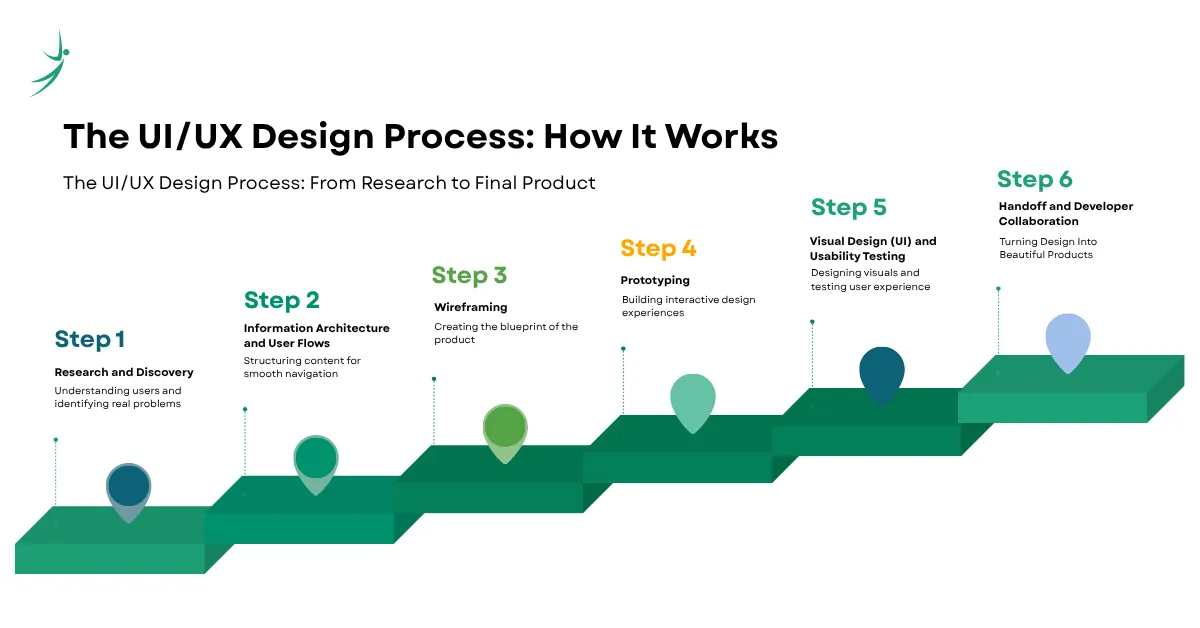
Research and Discovery
Every design project begins with understanding the user. UX designers conduct interviews, surveys, and competitive analyses to map out who the user is, what they need, and what problems they face. This stage produces user personas fictional but research-based profiles of your target users and empathy maps that capture what users think, feel, say, and do.
Example: A startup in Kathmandu building a digital payment app might interview 20 potential users to understand their frustrations with existing apps, their comfort level with technology, and what features they prioritize.
Information Architecture and User Flows
Before any visual design happens, the UX designer maps out the structure of the product. Information architecture defines how content is organized and how users move through the product. User flows are visual diagrams showing every possible path a user can take from entry to completion of a task.
Wireframing
A wireframe is a low-fidelity, black-and-white sketch of a screen layout think of it as the blueprint before the building goes up. Wireframes establish the placement of elements without worrying about colors, fonts, or visuals. They allow designers and stakeholders to validate structure and logic before investing time in high-fidelity design.
Prototyping
A prototype is an interactive, clickable version of the wireframe. It simulates how the real product will work, allowing designers to test user flows and identify friction points early. Tools like Figma make prototyping fast and collaborative.
Visual Design (UI) and Usability Testing
With structure validated, the UI designer steps in to apply the visual layer brand colors, typography, iconography, imagery, spacing, and interactive states (hover, active, disabled). This is where a product's personality comes alive.
Then ,before anything is handed to developers, usability tests are conducted with real users. Watching someone use your prototype where they hesitate, where they get confused, what they love provides insights no amount of internal discussion can match.
Handoff and Developer Collaboration
The final stage is handing off design specifications to developers. Good UI/UX designers document their work thoroughly, spacing, colors, typography scales, interaction notes so developers can implement the design accurately.
This process is iterative, not linear. Designers loop back to earlier stages as new information emerges, and the best designers treat every launch as the beginning of a new research cycle.
Core Skills Every UI/UX Designer Needs
Whether you are looking for a UI/UX internship in Nepal, applying for entry-level UI/UX designer jobs with 0 experience, or building toward a senior role, these are the skills that will define your career trajectory.
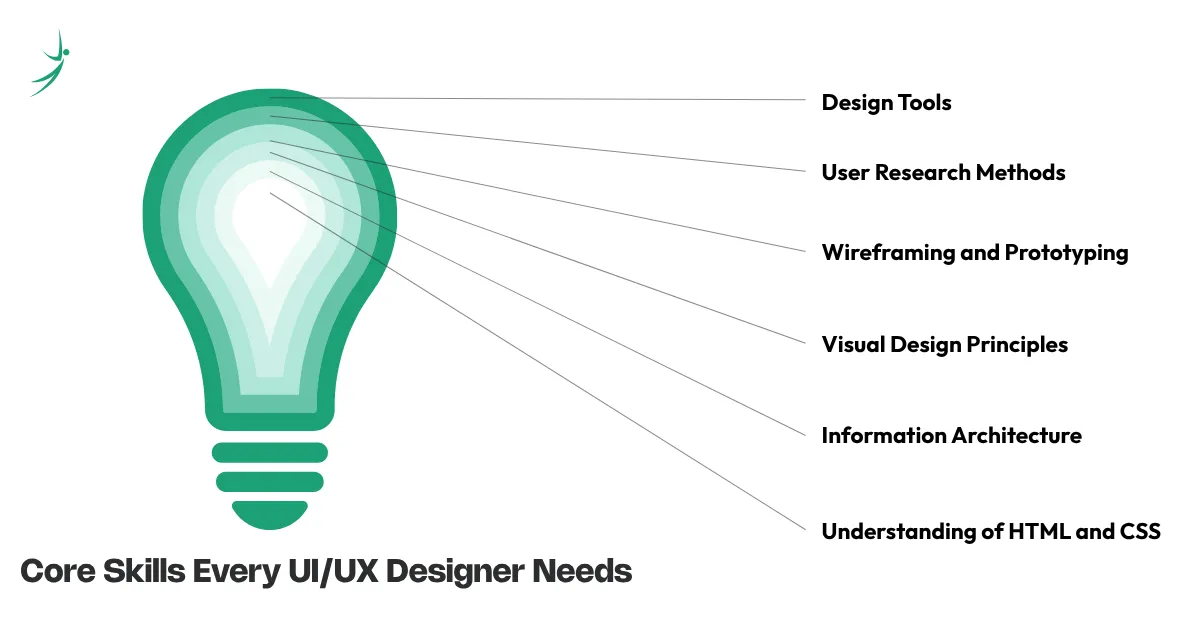
- Design Tools: The industry standard tool is Figma for UI/UX designers , a cloud-based design platform that covers wireframing, UI design, prototyping, and team collaboration in a single interface. Knowing Figma is non-negotiable for any designer entering the market in 2026. Adobe XD and Sketch are also commonly used, though Figma has become the dominant choice globally and in Nepal.
- User Research Methods: Conducting user interviews, creating surveys, running usability tests, and synthesizing findings into actionable insights. Research is the foundation of every design decision a UX designer makes.
- Wireframing and Prototyping: The ability to translate a concept into a structured wireframe and then an interactive prototype is one of the most frequently tested skills in UI/UX designer job interviews and during UI/UX hackathons.
- Visual Design Principles: Colour theory, typography, layout grids, white space, visual hierarchy, and accessibility standards (WCAG). These principles determine whether a UI feels polished or amateurish.
- Information Architecture: Organizing and labelling content in a way that users can navigate naturally, including sitemap structures, navigation menus, and content categorization.
- Understanding of HTML and CSS (Bonus): You do not need to be a developer, but designers who understand how code works communicate far more effectively with engineering teams and avoid designing elements that are impractical to build.
Explore the complete UI/UX design roadmap to learn the step-by-step path to becoming a job-ready designer.
UI UX Career Paths in Nepal
Nepal's digital economy is growing at an impressive pace. E-commerce platforms, fintech startups, travel tech companies, international outsourcing firms, and digital agencies are all actively looking for skilled UI/UX designers. Here is a look at the major career paths available to you.
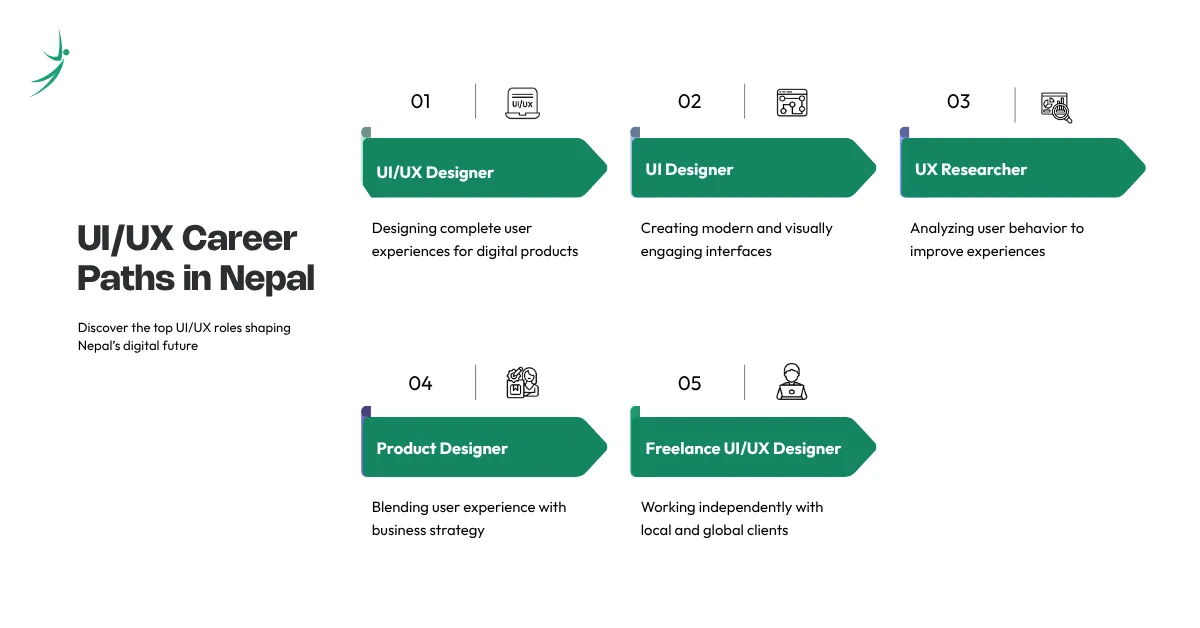
UI/UX Designer
The most common entry-level and mid-level role. You will work across the full design process from research to final handoff on web and mobile products. UI/UX designer jobs in Nepal are available across Kathmandu-based tech companies, agencies, and remote-first organizations.
UI Designer
A more specialized role focused on the visual layer design systems, component libraries, brand consistency, and high-fidelity mockups. Strong visual instincts and a deep command of Figma and design principles are essential.
UX Researcher
A role dedicated entirely to understanding users. UX researchers plan and conduct research studies, analyze behavioral data, and translate findings into design recommendations. This path is growing in larger tech organizations.
Product Designer
A broader role that blends UI/UX with product strategy. Product designers think about not just how a product looks and works, but why it should exist and whether it is solving the right problem. This is typically a more senior title.
Freelance UI/UX Designer
Many designers in Nepal build thriving freelance careers, working with clients locally and internationally through platforms like Upwork, Toptal, and direct referrals. A strong portfolio and a targeted niche can generate excellent income without requiring a full-time employment relationship.
UI/UX Internships in Nepal
If you are just starting out, a UI/UX internship in Nepal is one of the fastest ways to build real-world experience, develop your portfolio, and get your foot in the door of a professional team.
What to expect from a UI/UX intern role in Nepal:
- Working on live product design tasks under the guidance of senior designers
- Contributing to wireframes, prototypes, and user research studies
- Participating in design critiques and team reviews
- Building your portfolio with real project work you can show employers
Many companies in Kathmandu actively look for UI/UX interns in Nepal through platforms like Merojob, LinkedIn, and direct applications to tech companies and agencies. In the best IT Training Institute In Nepal, students regularly secure internships through our industry network before or shortly after completing the course.
A UI/UX internship is not just experience, it is often the direct path to a full-time offer. Many companies use internships as extended trial periods, and strong interns frequently convert to permanent UI/UX designer vacancies in Nepal.
UI/UX Designer Jobs in Nepal: What the Market Looks Like
The demand for UI/UX jobs in Nepal is growing faster than the supply of qualified professionals. Here is what the current market looks like:
Who is hiring UI/UX designers in Nepal?
- IT companies and software development firms in Kathmandu and Lalitpur
- Digital agencies specializing in web and mobile product design
- Fintech and payment platforms (rapidly expanding sector)
- E-commerce companies
- International remote-first companies hiring Nepali talent
- NGOs and development organizations with digital product needs
What do employers look for?
Most UI/UX designer vacancies in Nepal emphasize portfolio quality above everything else. Employers want to see how you think through a design problem, not just final polished screens. A well-documented case study showing your research, wireframes, iterations, and final solution is more powerful than a degree certificate alone.
Can you get a job with 0 experience?
Yes but only with a strong portfolio. Designers who graduate from structured programs like Skill Shikshya's UI/UX course with 3-4 real portfolio projects, a completed internship, and the ability to articulate their design decisions confidently are landing junior designer roles regularly, even as first-time job seekers.
Challenges of UI/UX Design
While a career in design is rewarding, it comes with its own set of hurdles. Understanding the challenges of ui/ux before you start is what separates professionals from hobbyists. Whether you are taking a ui ux online course or a physical one, you will likely face these industry realities:
- Balancing Aesthetics with Usability: One of the biggest traps for a ui ux designer 0 experience level is focusing too much on how an app looks and not enough on how it works. A design might look stunning (UI), but if the user can’t find the "checkout" button, the experience (UX) fails. Finding the "sweet spot" between beauty and function is a constant challenge.
- Keeping Up with "UI Design 2026" Trends: The design world moves at lightning speed. What was considered modern two years ago may look "dated" today. Staying relevant requires continuous learning about new design systems, accessibility standards, and tools like Figma. This is why professionals often attend a ui ux hackathon to sharpen their skills and see what others are building.
- Explaining the Value of UX to Clients: In Nepal, many businesses still think ui/ux just means "making a website look pretty." A major challenge for designers is educating stakeholders that UX research like user interviews and testing is just as important as the final colors. Without this, even a high salary of a ui ux designer in Nepal won't stop a product from failing if it doesn't solve a user problem.
- Designing for Local vs. Global Markets: If you are working on ui/ux designer jobs in Nepal, you have to design for local nuances. This includes catering to varying internet speeds, diverse language requirements (Nepali/English), and specific cultural expectations. Conversely, if you are working for international clients, you must adapt to global standards, which requires a versatile ui ux design mindset.
- Bridging the "Experience Gap": The jump from being a student to landing your first ui ux internship in Nepal can feel daunting. Many companies post a ui ux designer vacancy in Nepal asking for "1-2 years of experience," even for junior roles. Overcoming this requires a strong portfolio built through real-world projects, which is a core focus of our ui ux design course in Nepal.
- Cross-Platform Consistency: Ensuring that a design looks and feels the same on a cheap smartphone, a high-end tablet, and a 27-inch desktop monitor is technically demanding. Responsive design is a non-negotiable skill for anyone looking at ui ux openings in 2026.
How to Overcome These Challenges?
The best way to navigate these hurdles is through structured mentorship. Instead of just searching for ui ux near me, look for a program that offers:
- Practical Projects: To help you handle the "real-world" friction between UI and UX.
- Placement Support: To help you transition from a ui ux intern Nepal to a full-time professional with a competitive ui ux salary in Nepal.
- Modern Curriculum: That covers everything from basic wireframes to ui design 2026 trends.
At Skill Shikshya, we don't just teach you how to use design tools; we teach you how to solve these industry challenges head-on.
Common Misconceptions About UI/UX Design
- "You need to be artistic to be a UI designer." Creativity helps, but UI design is far more about systems thinking than artistic talent. Some of the best designers have backgrounds in mathematics, engineering, or psychology, not fine art.
- "UX is just making things look nice." UX design has almost nothing to do with visual aesthetics. It is about research, logic, testing, and problem-solving. Many UX designers produce work that looks entirely wireframe-level but delivers more business value than a polished visual skin.
- "You need years of experience to get hired." A strong portfolio of 3-4 well-documented case studies, even for projects you built during a course, consistently outweighs years of undocumented experience.
- "UI and UX are the same thing." As covered in this guide, they are distinct disciplines that complement each other. Treating them as synonymous is a signal to hiring managers that someone is still at the surface level of the field.
- "You need to know how to code." Coding knowledge is a bonus, not a requirement. Designers who understand development constraints communicate better with engineers but you will not be rejected from a UI/UX role because you cannot write JavaScript.
Is UI/UX a Good Career in Nepal?
Absolutely and the timing has never been better.
Nepal's technology sector is maturing rapidly. The combination of growing local demand, strong international outsourcing opportunities, and a genuine shortage of skilled UI/UX designers means that qualified professionals entering the market today are in an enviable position.
UI/UX designer vacancy in Nepal listings have increased significantly year-on-year. Companies that once outsourced design entirely are now building in-house teams. International remote-first companies are actively recruiting Nepali designers. The freelance market is growing. And as more Nepali startups raise funding and scale their products, the demand for senior designers is outpacing the supply dramatically.
The investment in learning UI/UX ,the time, effort and course fee pay back quickly for those who commit fully and build a strong portfolio before they start applying.
Start Your UI/UX Design Journey with Skill Shikshya
If you see yourself in any of the profiles above student, professional, entrepreneur, or freelancer the path forward is clear.
At Skill Shikshya, our UI/UX Design Course is built specifically for people who want practical, job-ready skills. Not just theory. Not just watching tutorials and hoping something sticks.
You will:
- Learn industry-standard tools, starting with Figma, from the ground up
- Build a professional portfolio of 3-4 real project case studies
- Work through live briefs and design challenges with mentor feedback
- Get support finding UI/UX internships and jobs through our industry network
- Join a community of designers who are on the same journey
Whether you are looking for a UI/UX design course in Nepal that fits around a full-time schedule, or you want to go deep and fast-track your career change, Skill Shikshya has a path for you.
The best time to start was yesterday. The next best time is today. Explore the Skill Shikshya UI/UX Design Course.
Frequently Asked Questions
What is UI/UX design?
What is the difference between UI and UX design?
Can I get a UI/UX job with 0 experience?
How long does it take to learn UI/UX design?
Is there a UI/UX internship opportunity in Nepal?
What tools do UI/UX designers use?
About Author: