Job Ready Program vs Traditional Courses: Which Wins?
Job Ready Program vs traditional courses, which is better? Job Ready Program wins for anyone who wants guaranteed employment faster. JRP is a 3-month industry-integrated training model that combines real mentorship, real client projects, and a 100% guaranteed internship after course completion, all in one program. Traditional courses deliver theoretical training with no internship guarantee, leaving students to find employment on their own after graduating. JRP graduates are employed within 1 month of completing the program at an average salary of 25,000 NRs. Traditional course graduates spend an average of 6 additional months searching for their first opportunity after finishing. If speed, guaranteed placement, and real-world experience matter to you, explore Job Ready Program and enroll today.
WHY THIS COMPARISON MATTERS
Every year, thousands of students and job seekers in Nepal face the same decision. They want to build a career in tech or digital fields. They know they need training. But when they look at their options, they find two very different paths: traditional courses that have been around for decades, and a new model called Job Ready Program that promises something no traditional course ever has.
This is not a minor difference in curriculum or teaching style. It is a fundamental difference in what each model is designed to deliver. One is designed to teach. The other is designed to employ. Understanding that distinction is what this comparison is about.
The stakes of this decision are real. Choose the wrong path, and you spend 3 months in training followed by 6 months of unemployment, 9 months of your life invested with no guaranteed outcome. Choose the right path, and you are employed within 4 months of starting, with a real portfolio, a real internship certificate, and a salary already coming in.
WHAT EACH MODEL ACTUALLY IS
Before comparing outcomes, it is important to understand what each model actually does.A traditional course in Nepal follows a structure that has not changed significantly in 20 years. A student enrolls, attends classes for 2 to 3 months, completes assignments, and receives a certificate. The quality of teaching varies significantly between institutes. Some are excellent. Most are adequate. But all of them share one fundamental limitation: the course ends with the certificate. What happens after is entirely the student's responsibility.
The Job Ready Program is built on a completely different foundation. JRP is Nepal's first industry-integrated training model. Students are taught by active industry professionals using real client projects from week one. Every concept is applied immediately to real work. By the time the course ends after 3 months, every student has a professional portfolio of documented results and a guaranteed internship placement already arranged with a partner company. See how JRP's industry-integrated model works and understand why the structure itself is what makes the guarantee possible.
The difference is not cosmetic. It is architectural. Traditional courses were built to educate. JRP was built to employ.
THE 5 FACTORS THAT DECIDE WHO GETS HIRED FASTER
When comparing Job Ready Program vs traditional courses in Nepal, five factors determine which path produces faster, more reliable employment outcomes.
Infographic showing five hiring factors: faster employment, quality learning through real projects, guaranteed internships, strong outcomes (portfolio and job offer), and high return on cost.
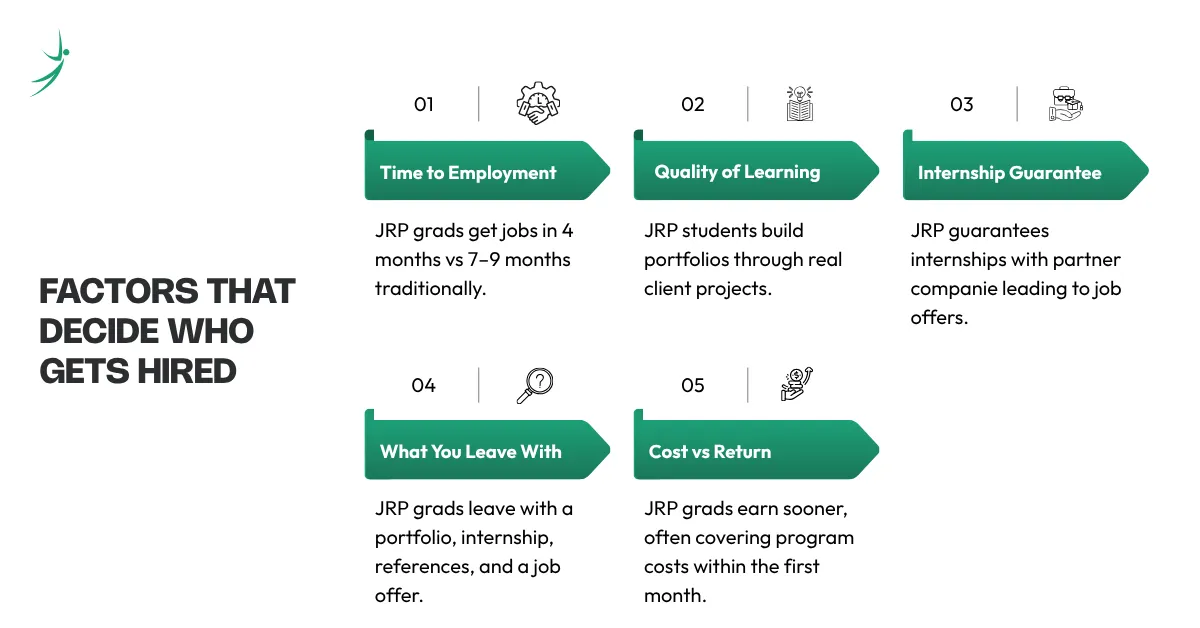
Factor 1: Time to employment
Traditional course: 3 months of training plus 4 to 6 months of independent job searching equals 7 to 9 months before first employment on average. Many students take longer.
JRP: 3 months of training plus internship arranged immediately after completion equals employment within 4 months on average. 98% of JRP graduates are employed within 1 month of completing their internship.
The difference is 3 to 5 months of productive, earning time that traditional course graduates spend searching, while JRP graduates are already building their careers.
Factor 2: Quality of learning experience
Traditional courses spend the majority of their time on theory. Students work on practice datasets, sample assignments, and simulated problems designed to teach concepts rather than build real capability. This is not necessarily bad; it is a structural limitation of a model that has no real client relationships built into it.
JRP students work on real client projects from week one. Every assignment has real stakes, real feedback, and real consequences. By week 8, the portfolio a JRP student has built contains actual documented outcomes from actual client work, the kind of evidence that hiring managers find genuinely compelling in interviews. For a deeper look at what this difference means for your actual career, read our complete introduction to Job Ready Program, which breaks down the model in full detail.
Factor 3: Internship guarantee
This is the most significant difference between the two models and the one that most directly determines the speed of employment.
Traditional courses offer no internship guarantee. Some provide placement assistance, a vague commitment to help students find opportunities after graduation. In practice, this means a list of companies to apply to and a CV review. The student still faces rejection, ghosting, and an uncertain timeline.
JRP guarantees the internship as a structural part of the program. A formal commitment agreement is signed at enrollment. A mentor readiness assessment is completed before the course ends. After the 3-month training, every student who meets the professional standard is matched to a partner company from JRP's network of 50+ active hiring partners. The student does not apply. JRP arranges. 95% of graduates receive a full-time offer from their internship company directly.
Factor 4: What you leave with
A traditional course graduate leaves with: a certificate, theoretical knowledge, and practice assignments.
JRP graduates leave with: a professional portfolio of real client work, a completed internship certificate, industry references from both their mentor and internship company, and in 95% of cases, a full-time job offer already in hand.
In Nepal's 2026 hiring market, hiring managers are no longer impressed by certificates alone. They want portfolio evidence of real work and professional references from people who have seen the candidate perform under real conditions. JRP graduates arrive at every interview with both. Traditional course graduates arrive with neither. Discover the skills JRP builds that guarantee employment and why each one gives JRP graduates a decisive hiring advantage.
Factor 5: Cost vs return
On the surface, traditional courses and JRP are similarly priced in Nepal's market, both typically ranging from 12,000 to 30,000 NRs depending on the program.
But the real cost comparison looks very different when you factor in the time gap. A traditional course graduate who spends 6 months searching for employment after graduating loses 6 months of potential salary. At Nepal's average entry-level salary of 20,000 NRs per month, that is 120,000 NRs in lost earnings, on top of the course fee paid.
A JRP graduate who is employed within 4 months of starting the program begins earning immediately upon completion of the internship. The program effectively pays for itself within the first month of employment. The true cost of a traditional course is not the fee. It is the fee plus the months of lost earnings while searching for a job that was never guaranteed.
THE COMPARISON TABLE
| Factor | Traditional Course | Job Ready Program |
|---|---|---|
| Duration | 2 to 3 months | 3 months |
| Teaching method | Classroom theory | Industry mentors, real projects |
| Internship | Not guaranteed | 100% guaranteed after the course |
| Portfolio | Practice assignments | Real client work with documented results |
| Time to employment | 7 to 9 months average | 4 months average |
| Job offer source | Self-sourced applications | Direct from the internship company |
| Employment rate | Variable, untracked | 98% after the internship |
WHO SHOULD CHOOSE WHICH
The honest answer is that traditional courses still serve a purpose, but a very narrow one.
A traditional course makes sense if you already have strong industry connections who will hire you regardless of internship experience, if you are studying a field where theoretical knowledge alone qualifies you for certification-based roles, or if you are supplementing existing professional experience with a specific technical credential.
For everyone else, fresh graduates, career changers, working professionals looking to move into tech or digital fields, and anyone without an existing professional network in Nepal, the Job Ready Program is the objectively stronger choice. The guarantee removes the uncertainty. The real project work builds genuine capability. The industry mentor relationships build the network that gets referrals. And the employment outcome is documented, tracked, and backed by 3,000+ completed internships.
The difference between a job-ready program and a normal course is ultimately the difference between a training program that ends with knowledge and one that ends with employment. If your goal is employment, and for most people reading this, it is, then the choice is straightforward. Schedule your free JRP consultation to understand which program track fits your background and career goals before the next batch closes.
CONCLUSION
The comparison between Job Ready Program vs traditional courses in Nepal comes down to one fundamental question: Do you want a program that ends with a certificate or one that ends with employment?
Traditional courses have their place. But for anyone aiming to enter Nepal's tech or digital job market as quickly as possible, with real experience, a real portfolio, and a guaranteed internship behind them, JRP is not just the better option. It is the only option that guarantees the outcome.
The next JRP batch is forming now. Begin your Job Ready Program journey today and take the first step toward guaranteed employment before you even finish the program.
Frequently Asked Questions
Is a job-ready program better than a traditional course in Nepal?
What is the difference between a job-ready program and a normal course?
Which course gets you hired faster in Nepal?
Is there a short course with an internship in Nepal that guarantees placement?
What is the best IT course in Nepal for getting a job quickly?
Is JRP worth it compared to a traditional course?
About Author: