IT Training for Adults, Coding for Kids: How Skill Shikshya's & YCA Work Together
If you are looking for IT training for adults and coding for kids in Nepal that do not feel like two separate decisions, here is the short answer: at Skill Shikshya, they are not.
- Skill Shikshya trains SEE graduates, +2 graduates, career-switchers, and working professionals in job-ready IT skills at its Sankhamul campus in Kathmandu.
- Young Crafts Academy is its sister academy, teaching live, project-based coding to children from Grade 1 to Grade 10, ages 6 to 16, in Scratch, Python, web development, AI, and robotics.
A child who starts with block-based coding at age seven can, years later, walk into IT courses built for +2 graduates without switching institutes, mentors, or philosophies. This guide walks through how the two academies connect, what a child or a young adult can actually study at each stage, and why Nepali families are increasingly looking for one trusted place to handle both ends of a tech education.
Why Nepali Families Are Looking for One Place That Covers Both Coding for Kids and IT Training for Adults
Most institutes in Nepal pick a lane:
- Some teach children Scratch and Python and stop there.
- Others train +2 graduates and working professionals in web development, cybersecurity, or digital marketing, and have never taught anyone under 18.
That split creates a real gap. A child who spends three or four years building games in Scratch and Python at a kids' coding academy usually stops around age 14 or 15, either because the academy's curriculum runs out or because the family assumes "real" IT training starts later, at a completely different kind of institute. The pause is not usually because the child lost interest. It happens because nobody built a bridge from the last kids' coding class to the first adult-level course.
The timing makes closing that gap worth the effort:
| Signal | What it shows |
|---|---|
| Market size | Nepal's IT services market was valued at roughly USD 263 million in 2025 and is projected to keep expanding through 2032, with cybersecurity and cloud services as the fastest-growing segments |
| Skills gap | Industry write-ups on Nepal's tech sector consistently point to a shortage of trained, job-ready professionals as the main bottleneck to growth, not a shortage of open roles |
Put those two together, and the case for starting technology education early, then continuing it with real IT training instead of letting it stop after a school coding club, is fairly direct.
Coding Classes for Kids in Nepal: Where Young Crafts Academy Starts the Journey
For families weighing where a child's tech education should begin, coding classes for kids in Nepal at Young Crafts Academy are built around age and grade rather than one fixed curriculum:
| Grade / Age | What They Learn |
|---|---|
| Grade 1 to 3 (age 6 to 8) | Scratch, logic games, simple animation projects |
| Grade 4 to 6 (age 9 to 11) | Python foundations, basic game design, first web pages |
| Grade 7 to 10 (age 12 to 16) | Advanced Python, web and app development, AI and machine learning basics, portfolio projects like a published Roblox game or a Bluetooth-controlled robot |
Two things make this approach different from a typical school coding club:
- Every class is live, not a recorded video.
- Every course ends in a real project, not a worksheet, something a child can actually show a parent, a teacher, or a school fair judge.
That project-based approach lines up with where Nepal's own curriculum is heading. Nepal's Curriculum Development Centre has revised the Grade 9 and 10 computer science syllabus to bring in Artificial Intelligence, Python programming, cybersecurity, and web technology alongside the traditional content. A child who already has hands-on practice in these areas walks into secondary school computer science with a head start rather than a first exposure.
IT Courses After SEE in Nepal: The First Step Into Skill Shikshya
Some students are ready to move faster than the school calendar allows. For a student who has just appeared for or passed SEE, IT courses after SEE in Nepal at Skill Shikshya offer a way to start building real, employable skills before +2 even begins, instead of spending that gap year waiting for results.
These are shorter, foundational programs in areas like web development, graphic design, and digital fundamentals, built for a student who is still finding their direction but wants that time to count. For a student who spent Grade 9 or 10 learning Python or web basics through a coding program like Young Crafts Academy's, this is where that early exposure starts paying off: the syntax and logic are no longer unfamiliar, so the SEE-stage courses build on real prior practice instead of starting from zero.
IT Training for +2 Completed Students: Building on the Coding Foundation
The bigger step happens after +2. IT training for +2 completed students at Skill Shikshya spans twelve-plus career-focused tracks, including:
- Foundational web development
- Python programming and browser automation
- UI/UX design
- Cybersecurity and digital safety
- Digital marketing
- Graphic and video design
Each track is built around real projects and mentors currently working in the field, not theory alone. This is also the stage where the two-academy pathway pays off most visibly: a student who came up through Young Crafts Academy's Python or web development tracks is not learning HTML, CSS, or basic Python syntax for the first time in a +2 classroom full of complete beginners. They are extending skills they already have into a structured, portfolio-driven, job-ready program. That head start does not replace the +2 course, but it changes how much of it feels genuinely new.
Whether you're interested in software development, design, cybersecurity, AI, or digital marketing, choosing the right training after +2 can accelerate your career. Explore all Skill Shikshya courses to find the program that matches your interests and career goals.
How Skill Shikshya & YCA Work Together
Structurally, Skill Shikshya and Young Crafts Academy are run as one family business, not two separate companies that happen to share a market:
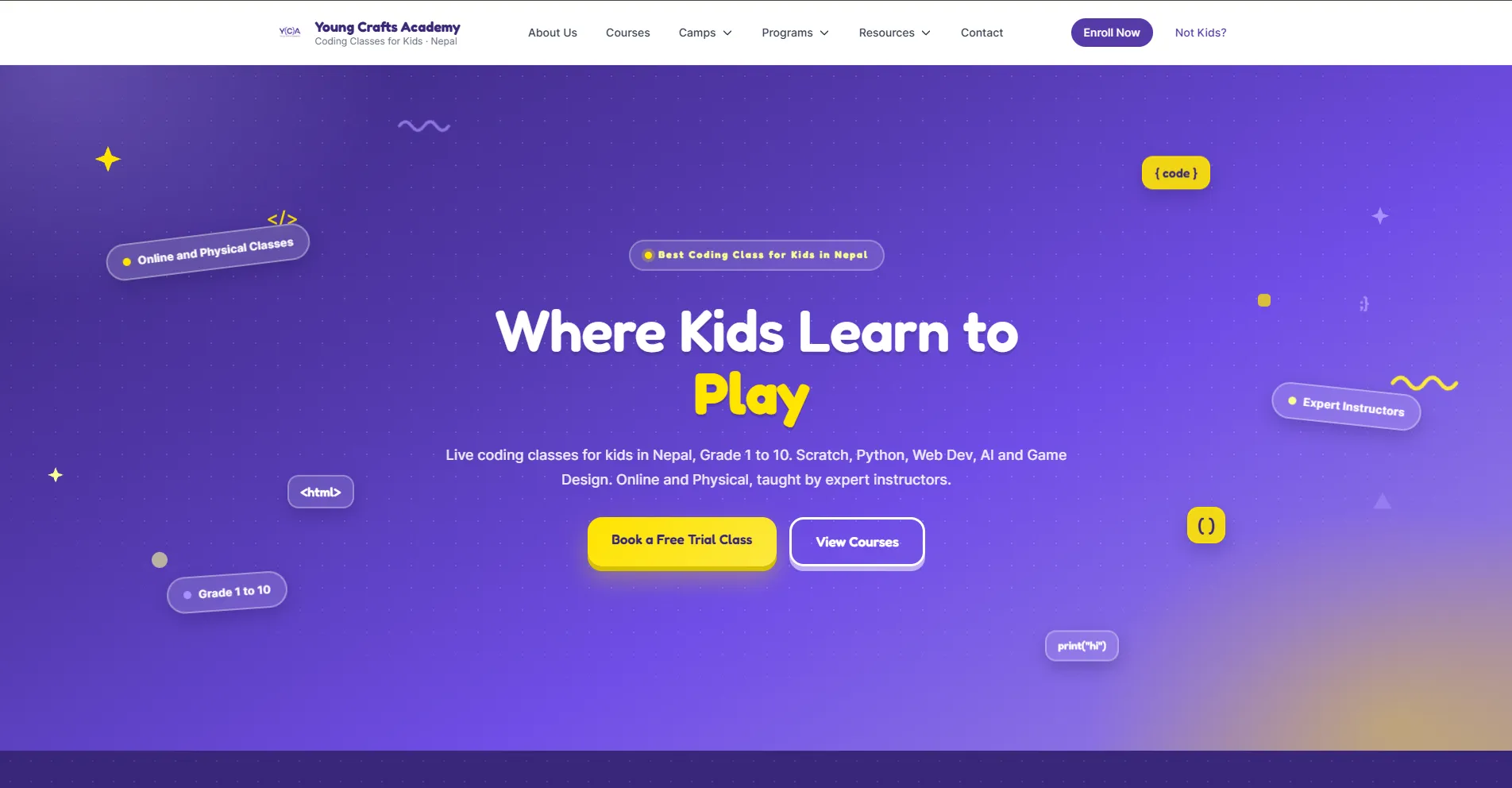
- Young Crafts Academy's own site describes itself as managed by Skill Shikshya.
- Both operate out of the same Sankhamul, Kathmandu neighborhood.
- Skill Shikshya's main navigation carries a dedicated "YCA · Kids" link.
- Young Crafts Academy's navigation carries a "Not Kids?" link straight back to Skill Shikshya's adult programs.
In practice, that means a parent does not have to vet a second, unrelated institute once their child outgrows kids' coding classes, and a family does not have to explain their child's learning history from scratch to a new set of mentors. The same philosophy runs through both academies:
- Live instruction, not passive video-watching
- Real projects over theory
- Mentors who work in the industry they teach
For a fuller picture of what that later stage actually looks like, course by course, our guide on steps to start an IT career after +2 in Nepal breaks down the options in detail.
IT Training Institute in Nepal: Why the Adult Side of the Story Matters Too
It is worth being direct about the adult half of this pairing, because it is the half that ultimately has to deliver a career. As an IT training institute in Nepal, Skill Shikshya's numbers look like this:
| Metric | Figure |
|---|---|
| Students trained | 10,000+ |
| Placement rate | 91% within 3 months of course completion |
| Hiring partners | 1,000+ |
| Industry mentors | 45+ |
| Batch options | Morning, evening, weekend, and online |
That last row matters for the pathway story specifically: the transition from "child who learned to code" to "adult with an actual IT career" does not depend on relocating or rearranging a working professional's entire schedule. For a family still deciding where a child's coding hobby should eventually lead, or an adult weighing whether to formalize skills picked up informally, a free online consultation is the fastest way to map an actual course plan against a specific goal, rather than guessing from a course catalog alone.
Best Career Path for Kids Interested in Technology: A Stage-by-Stage Roadmap
Pulling the whole pathway into one view, here is what the best career path for kids interested in technology can look like when it runs through both academies:
| Stage | Age / Grade | What They Study | Where |
|---|---|---|---|
| Young Explorers | Grade 1 to 3, age 6 to 8 | Scratch, logic and sequencing games, animation projects | Young Crafts Academy |
| Junior Builders | Grade 4 to 6, age 9 to 11 | Python foundations, basic game design, first web pages | Young Crafts Academy |
| Tech Innovators | Grade 7 to 10, age 12 to 16 | Advanced Python, web/app development, AI basics, robotics, portfolio projects | Young Crafts Academy |
| Bridge Stage | SEE-appeared / SEE-passed | Foundational IT courses, web development, digital fundamentals | Skill Shikshya |
| Career Launch | +2 completed | Web development, Python, cybersecurity, UI/UX, digital marketing, and more, with internship support | Skill Shikshya |
| Working Professional | Any age | Corporate and upskilling training, masterclasses, career-switch programs | Skill Shikshya |
No single stage requires the one before it. A +2 graduate with zero coding background can still enrol directly at Skill Shikshya. But for families thinking years ahead rather than one course at a time, this is the shape the path takes when a child starts early and keeps going with the same institute family.
Start the Path Today
Whether your child is about to pick their first Scratch project, or you are a +2 graduate deciding what comes next, the path between coding for kids and real IT training does not have to be two separate searches:
- For a child: Book a free trial class at Young Crafts Academy
- For an adult: Reach out to Skill Shikshya's counsellors to map out a course plan
Frequently Asked Questions
Is Young Crafts Academy part of Skill Shikshya?
What age should a child start coding in Nepal?
Can my child move from kids' coding classes straight into an adult IT course?
What IT courses can I join after SEE or +2 in Nepal at Skill Shikshya?
Do I need prior coding experience to join Skill Shikshya after +2?
Does Skill Shikshya help with job placement after training?
Is it expensive to move from coding classes to full IT training in Nepal?
About Author: