How to Build a Portfolio That Actually Gets You Hired (2026)
A degree tells an employer what you studied. A portfolio tells them what you can actually do and increasingly, it's the second one that gets the interview. If you've been wondering how to build a portfolio that does more than sit unopened in a folder, the honest answer starts with a survey result worth sitting with: in a study of hiring professionals across specialist, manager, and hiring-manager roles, 71% agreed or strongly agreed that a portfolio's quality directly influences their decision to hire a candidate.
This guide covers exactly how to build a portfolio that earns that kind of attention what to include, how to structure it, which platform to use, and the mistakes that quietly sink otherwise strong work. Whether you're asking how do i build a portfolio from complete scratch or how to make a good portfolio out of work you already have, the structure below applies whether you're a student, a career switcher, or already employed and looking to move. If you're still early enough to be choosing a direction entirely, this overview of where different tech and design paths lead is worth reading alongside this guide, since the specialization you pick shapes what your strongest portfolio pieces will eventually look like.
Why Building a Portfolio Matters More Than Ever in 2026
The job market has shifted in a way that makes a portfolio less optional than it used to be.
- Skills-based hiring is now the dominant approach, not the exception. Recent hiring research shows 94% of employers believe skills-based hiring predicts job performance better than resumes alone, and 81% of companies now practice it up from 73% in 2023. A portfolio is the clearest possible evidence of skill, which is exactly what this shift rewards.
- Portfolio quality is a measurable hiring factor, not a soft nice-to-have. That 71% figure from hiring professionals isn't an outlier opinion it reflects a broad cross-section of specialists, advisors, and hiring managers with real involvement in hiring decisions.
- Attention spans during screening are short, and portfolios are judged just as fast as resumes. The same fast-scanning behavior that shapes CV screening applies here a portfolio needs to communicate its strongest point almost immediately, not build slowly toward it.
- Remote work has made proof of work more important than proximity or reputation. When a hiring manager can't casually observe how you work day to day, a portfolio becomes one of the few reliable signals they have before an interview.
Key Benefits of Learning How to Build a Portfolio Properly
It Replaces Claims With Evidence
Anyone can write "strong problem-solving skills" on a CV. A portfolio forces you to show the problem, your actual approach, and the outcome which is a fundamentally harder thing to fake convincingly, and employers know it.
It Works Across Fields, Not Just Creative Ones
A portfolio isn't just for designers and photographers anymore. Developers use GitHub repositories and live demos, writers use published samples, marketers use campaign case studies, and data analysts use dashboards and documented projects — the kind of applied, AI-assisted analytics work covered in this roadmap into business data analytics is exactly the sort of material that turns into a strong portfolio piece. Whatever field you're in, the underlying principle show, don't just tell carries across all of them.
However You're Asking: Make, Create, Build, or Put Together It's the Same Process
People search this topic using dozens of different phrasings. Grouped by intent, here's the full picture all of them point to the same underlying process covered in this guide.
Quick or Shorthand Searches
- how do you build a portfolio
- how do i build a portfolio
- how to build portfolio
- how do you do a portfolio
- how to do a portfolio
- how make a portfolio
- build a portfolio
- build portfolio
- building portfolio
- build my portfolio
"Make" and "Create" Variants
- how to make portfolio
- how can i make a portfolio
- how do i make a portfolio
- how do you make a portfolio
- how can i make portfolio
- making a portfolio
- make a portfolio
- how to create a portfolio
- how do i create a portfolio
- how to create portfolio
- how do you create a portfolio
- creating a portfolio
- creating portfolio
- create a portfolio
- create portfolio
- create my portfolio
- appportfolio
Looking for a Specific Quality Bar
- how to make a good portfolio
- how to make the best portfolio
- how to make a great portfolio
- how to create professional portfolio
Assembly and Structure-Focused Phrasings
- how to put together a portfolio
- how do you put together a portfolio
- portfolio how to make
- how to set up a portfolio
- design a portfolio
- portfolio building
- how to write a portfolio
- where to make portfolio
Format-Specific: Online, Web, and Design Portfolios
- how to build an online portfolio
- creating an online portfolio
- how to make online portfolio
- how do you make an online portfolio
- how to build a web portfolio
- how to make a web portfolio
- how to build a portfolio site
- how to build a design portfolio
- how to create a design portfolio
- how to create a portfolio for graphic design
- how to make portfolio for graphic design
- how to make a portfolio for work
Every single phrase above, however it's worded, typed, or misspelled, is asking the same core question this guide answers in full: what goes into a portfolio, how it should be structured, and how to present it in a way that gets you noticed.
The Complete Portfolio Structure: What to Actually Include
This is the structure that consistently performs well, based on both developer-specific and creative-industry portfolio research.
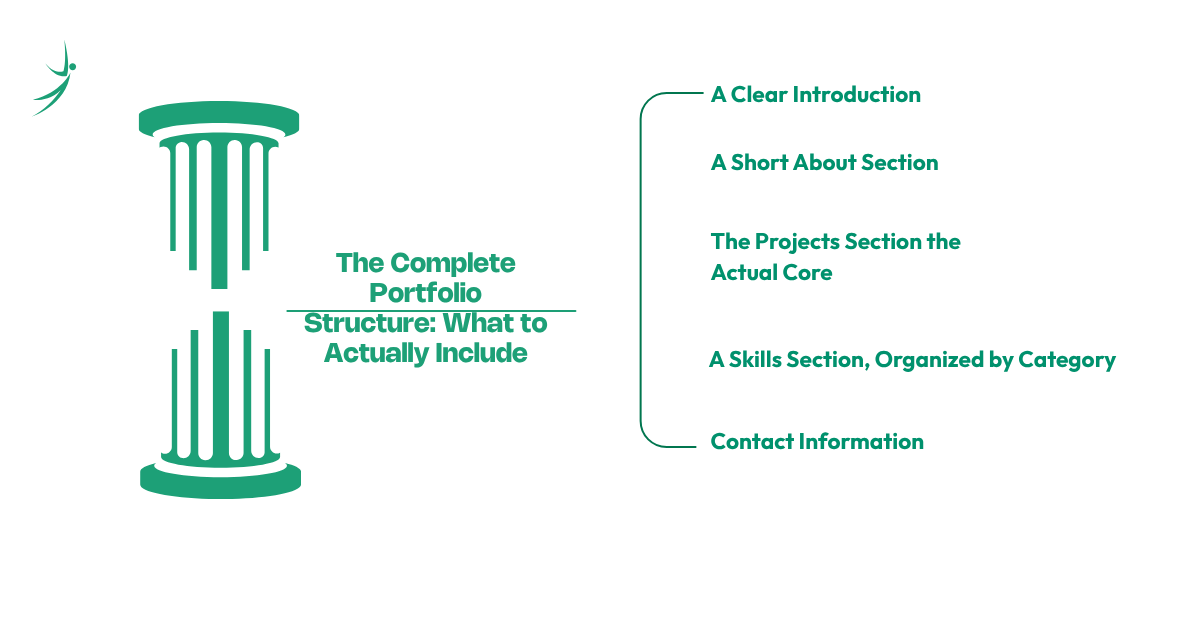
1. A Clear Introduction (Hero Section)
Your name, your role or specialization in one line, and a clear next step for the visitor view your work, or contact you. This section has roughly the same few seconds of attention a CV's top section gets, so it needs to communicate who you are immediately, not build up to it.
2. A Short About Section
Two to four sentences on your background and what drives your work. According to the University of the Arts London's official careers guidance, an online portfolio should include a dedicated About section alongside your project work — it's where personality and context live, separate from the work itself.
3. The Projects Section the Actual Core
For each project, include:
- The problem you were solving, in plain language
- Your approach, including tools or technologies used
- The result, ideally with a live link, screenshot, or measurable outcome
- A short, scannable description most reviewers skim rather than read fully, so front-load the most important detail
Quality consistently outperforms quantity here. Four to six strong, varied projects beat fifteen similar or unfinished ones a pattern echoed across both design-industry and developer-focused portfolio research alike.
4. A Skills Section, Organized by Category
Group skills logically (for a developer: languages, frameworks, tools; for a designer: software, design systems, specializations) rather than listing them as one unbroken line. This is scannable for a human reviewer and clearer for anyone comparing you against a specific role's requirements.
5. Contact Information
Email address, and links to relevant professional profiles GitHub, LinkedIn, Behance, or a platform relevant to your field. Make this easy to find, not buried at the bottom of a long page.
Best Practices for Building a Portfolio That Gets Noticed
- Be selective, not exhaustive. UAL's official guidance is direct on this point: it's better to have a few high-quality pieces than a large volume of work that's merely acceptable.
- Put your strongest work first. Reviewers rarely browse a portfolio front to back with equal attention the first one or two pieces often determine whether they continue at all.
- Use a live, working link wherever possible. A deployed project or an accessible piece of work is worth more than a description of what it would look like if someone bothered to check.
- Keep descriptions brief and specific. Long-form case studies are frequently skimmed rather than read in full a tight, clear summary of the problem and outcome communicates more efficiently than a lengthy narrative.
- Update it regularly. A portfolio is a living document, not a one-time project refreshing it every few months with new work and removing outdated pieces keeps it credible.
- Promote it deliberately. Link to it from your CV, LinkedIn, email signature, and relevant professional platforms a strong portfolio that nobody finds does no work for you. Robert Half's staffing research specifically recommends featuring it prominently on your LinkedIn profile itself, not just linking out to LinkedIn from your portfolio, since many hiring managers search there before anywhere else.
- Organize by relevance or by impact, not just chronology. The same Robert Half research outlines two structures that consistently work better than a simple timeline: grouping work by industry relevance if you're targeting a specific niche, or grouping by the problem solved and leading with your highest-impact results regardless of when they happened.
- Test it before you share it. Check that images load quickly, navigation is intuitive, everything displays correctly on mobile, and every caption has been proofread ideally by someone other than you. A slow-loading or broken portfolio can cost you an interview before a reviewer even reaches your best work.
Where to Actually Build It: Platforms and Tools
Where to make portfolio content live depends heavily on your field:
- Developers typically use a personal site (often hosted free via GitHub Pages) alongside an active GitHub profile showing real commit history, not just finished projects the same GitHub habit worth building early if you're coming up through a structured Python and Django training path or a mobile-focused program.
- Designers and creatives often use Behance, or a dedicated portfolio builder like Wix or Adobe Portfolio, prioritizing visual presentation. If you're still deciding whether graphic design or UI/UX is the better fit for how you want to build your portfolio, this comparison of the two paths is worth reading before you commit to a platform.
- Writers frequently link directly to published work, or use a simple personal site with a clean writing archive.
- Students and career changers across fields can start with a simple, clean personal site rather than overengineering the platform choice before there's meaningful work to put on it the platform matters far less than what's actually inside it.
Challenges in Building a Portfolio and How to Overcome Them
- Not having "enough" work yet. This stops more people than any other single obstacle. The fix: build something you personally need or find genuinely interesting a small tool, a redesigned version of an app you use daily, a written piece on a topic you know well. Passion projects consistently demonstrate initiative even without professional experience behind them. If you'd rather build that experience inside a structured program than entirely alone, Skill Shikshya's guaranteed-internship training model is designed specifically to generate real, portfolio-worthy project work before you ever apply.
- Overloading it with too much. More isn't more here a portfolio with everything you've ever made reads as unfiltered rather than impressive. The fix: apply the same selectivity UAL recommends a handful of your strongest pieces, not a complete archive.
- Broken links and outdated work. A portfolio that hasn't been checked in months often has at least one dead link or an outdated project description. The fix: review it on a fixed schedule every few months rather than only when you happen to remember.
- Generic, templated presentation. A portfolio built entirely from an unmodified template can undercut otherwise strong work, since the presentation itself is part of what's being judged, particularly in creative and design fields. The fix: customize enough that it reflects you specifically, even if the underlying template stays largely the same.
- Describing work instead of showing it. Writing paragraphs about a project instead of linking to it or showing it directly is a common and avoidable mistake. The fix: lead with the artifact the live link, the screenshot, the demo and use text to add context, not replace the evidence itself.
Real Examples: How a Portfolio Actually Changes Outcomes
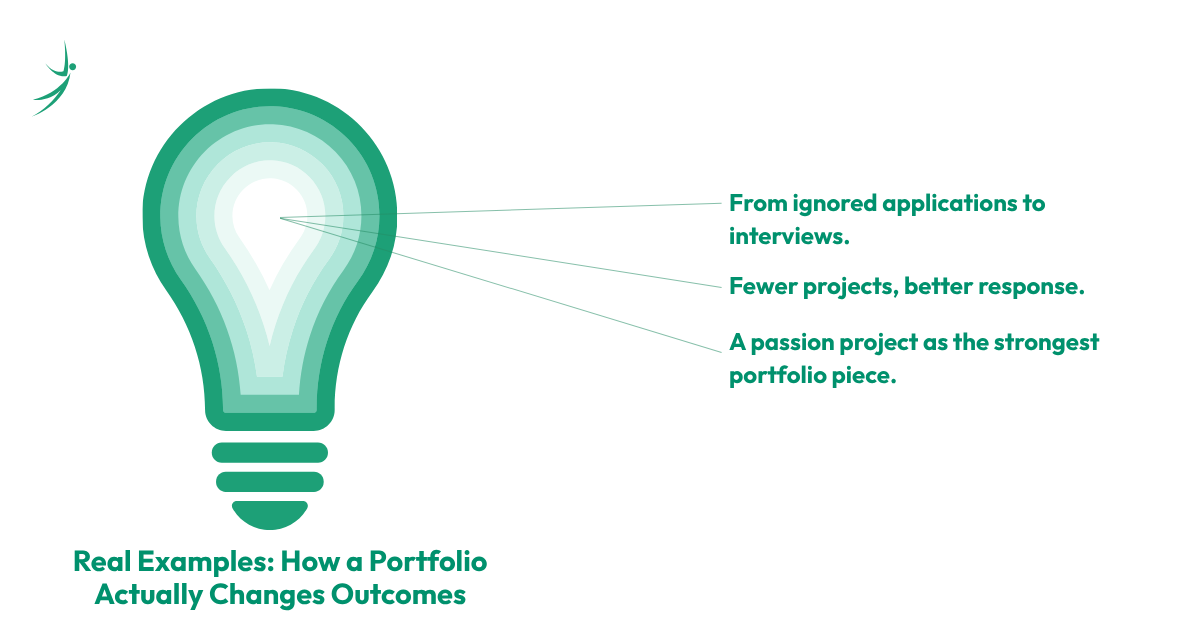
Case 1 From ignored applications to interviews.
A self-taught developer applying with a generic CV and no portfolio link received almost no responses. After building a simple site featuring three live projects each with a clear problem/approach/result breakdown the same base level of skill produced multiple interview requests within a few weeks, without any change to the underlying experience.
Case 2 Fewer projects, better response.
A design applicant initially included over a dozen projects of varying quality and relevance. Trimming the portfolio down to five strong, varied pieces following the same "quality over quantity" principle UAL and multiple developer-focused guides both independently recommend measurably improved engagement, since reviewers no longer had to dig through weaker work to find the good pieces.
Case 3 A passion project as the strongest portfolio piece.
A career switcher with no formal professional projects built a small tool solving a problem from their previous, unrelated job. That single project, presented with a clear problem statement and outcome, became the centerpiece of their portfolio and the specific project most frequently mentioned in interviews proof that relevance and clarity can outweigh sheer professional experience.
Future Trends: How Portfolios Are Changing
- AI-assisted work is increasingly expected to be shown, not hidden. Rather than avoiding mention of AI tools, portfolios that transparently explain how AI was used as part of the process and where human judgment shaped the result are becoming a stronger signal than portfolios that pretend AI tools don't exist in the workflow at all. Robert Half's research frames this specifically: a single caption line like "used AI to generate several headline directions, then selected and refined the two worth testing" keeps the focus on your judgment rather than the tool itself, and reads far stronger than either hiding AI use entirely or over-explaining the prompts behind it.
- Verifiable, live evidence is being weighted more heavily than static descriptions. As it becomes easier to generate polished-sounding project write-ups, reviewers increasingly favor portfolios with real, checkable links over ones relying purely on descriptive text.
- Video and interactive walkthroughs are growing, particularly for technical roles. A short recorded walkthrough of a project's functionality is becoming a meaningful supplement to a static write-up, especially where a live demo alone doesn't fully convey the complexity behind it.
- Niche specialization is standing out more than broad generalism. A portfolio clearly focused around one specialization a particular industry, technology, or design style increasingly outperforms a portfolio that tries to demonstrate equal skill across too many unrelated areas at once.
How to Choose the Right Approach for Your Field
- If you're in a technical field, prioritize live, working demos and a clean, active GitHub profile over visual polish alone.
- If you're in a creative or design field, prioritize visual presentation and curation platforms like Behance exist specifically because visual browsing matters more than text in these fields.
- If you're early-career with limited professional work, prioritize genuine passion projects over stretching thin professional experience to fill space.
- If you're switching careers, prioritize relevance over volume one strong project connecting your previous experience to your new direction often outperforms several unrelated pieces.
Measuring Whether Your Portfolio Is Actually Working
- Track engagement, not just existence. If you have analytics available, check whether visitors are actually reaching your projects section, or dropping off before they get there.
- Track application-to-interview conversion before and after meaningful portfolio changes. If tightening your portfolio to fewer, stronger projects doesn't move this number over a reasonable number of applications, the issue may be elsewhere in your job search process.
- Ask directly when you get the chance. In interviews or informal conversations, asking a hiring contact what stood out or didn't in your portfolio is one of the fastest ways to get direct, unfiltered feedback most job seekers never bother to collect.
Conclusion and Action Steps
Learning how to build a portfolio that actually gets you hired comes down to a small number of consistent principles, however you phrase the search that brought you here: be selective rather than exhaustive, lead with evidence rather than description, keep it current, and structure it so the strongest work is impossible to miss in the first few seconds of attention. The 71% of hiring professionals who say portfolio quality shapes their decisions aren't looking for perfection they're looking for clear, honest proof that you can do the work you're claiming you can do.
If you're building yours today: pick three to six of your strongest pieces, describe each with a clear problem, approach, and result, make sure every link actually works, and put it somewhere you'll actually keep updated. The candidates who get hired off the strength of their portfolio aren't necessarily the most talented people applying they're the ones who made that talent impossible to overlook in the time they were actually given.
If what's actually missing is the underlying work to put in your portfolio, not the portfolio format itself, Skill Shikshya runs project-based training across development, design, and data tracks specifically built to give you that material before you need it.
Frequently Asked Questions
How do I build a portfolio with no professional experience?
How many projects should be in a portfolio?
Should I build an online portfolio or a printed one?
How often should I update my portfolio?
Do I need a personal website, or can I use a platform like Behance or GitHub Pages?
About Author: