How to Become a Data Scientist: Complete Guide for Beginners (2026) | Skill Shikshya
In the modern digital age, data has become the most valuable asset for businesses looking to stay competitive. Organizations generate massive volumes of information daily, creating an unprecedented demand for skilled professionals who can extract actionable insights from raw data. If you are ready to master this field and secure a future-proof career, enrolling in a best data science course in Nepal at Skill Shikshya is your best first step. Engaging in structured data science learning ensures you build the technical expertise required to solve complex corporate challenges.
What Is Data Science?
To understand the core data science meaning, one must look at how businesses leverage data to make informed decisions. A formal data science definition describes it as a multidisciplinary field that combines scientific methods, processes, algorithms, and systems to extract knowledge from structured and unstructured data. If you are interested in understanding what is data science, it is essential to look at how it impacts daily life.
Some clear data science examples include the personalized recommendation engines used by Netflix, fraud detection systems in banking, and predictive text features on your smartphone. When looking at the ecosystem, it is also helpful to understand the core differences between data science vs data analytics vs data engineering to see how various professionals handle corporate data assets.
What Does A Data Scientist Do?
A data scientist is part statistician, part computer scientist, and part business strategist. They don't just look at numbers; they uncover the stories hidden within data to solve complex real-world problems.
Key responsibilities of a data scientist
- Collecting vast amounts of structured and unstructured data from multiple sources.
- Cleaning and validating data to ensure accuracy and consistency.
- Building predictive models and machine learning algorithms to forecast future trends.
- Analyzing data to optimize business performance and internal processes.
- Communicating findings to stakeholders through clear data visualizations.
When navigating these responsibilities, understanding the technical breakdown of data engineer vs data scientist helps clarify how data professionals collaborate within an organization. Different data science roles carry unique operational focuses depending on the company's size and structure.
Why Choose a Career in Data Science?
Choosing a career in this field opens up a world of continuous innovation and financial stability.
- High demand across industries: From healthcare and finance to e-commerce and entertainment, almost every sector relies on data. This widespread adoption means that data science hiring trends remain resilient globally, making it one of the safest career paths available today.
- Excellent salary potential: Data professionals are among the highest-paid individuals in the tech industry. The average data science salary in Nepal has grown significantly over the last few years, reflecting the immense value these experts bring to companies. For a detailed breakdown of potential earnings, check out our detailed guide on data science salary in Nepal.
- Opportunities in Nepal and globally: The overall data science scope is expanding rapidly. There is an increasing number of data science opportunities both locally and internationally. Tech hubs across the world are constantly looking for talented individuals to fill high-level technical positions.
- AI and data-driven decision making: Modern businesses no longer rely on guesswork. They use data-driven decision-making processes powered by AI algorithms. Exploring the massive future scope of data science reveals how deeply interconnected this field is with the future of global automation.
Where Do You Begin? A Step-by-Step Roadmap to Become a Data Scientist
If you are starting completely from scratch, following a structured data science roadmap will keep you focused and prevent you from feeling overwhelmed. You can also refer to our detailed step by step data science roadmap for a visual breakdown of the learning path, or read our comprehensive guide on how to get into data science.
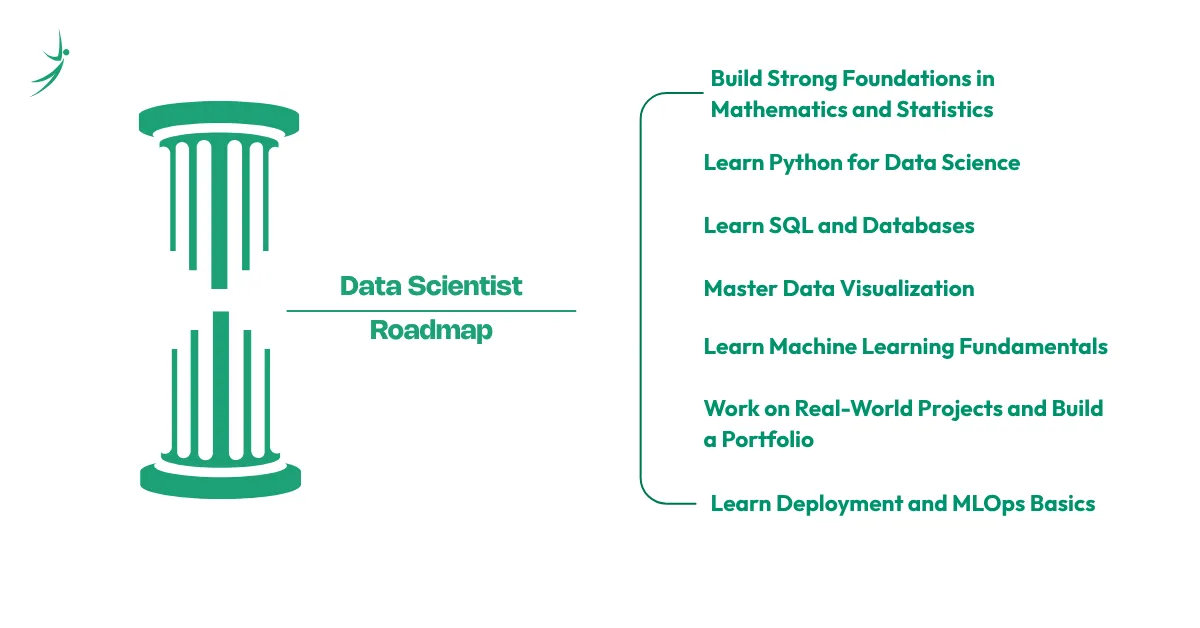
1. Build Strong Foundations in Mathematics and Statistics
Before writing code, you need to understand the math that powers the algorithms. Meeting basic data science requirements starts with mastering these core subjects:
- Probability: Crucial for calculating the likelihood of future outcomes.
- Statistics: Essential for data distribution analysis, hypothesis testing, and regression analysis.
- Linear Algebra: The backbone of machine learning algorithms, especially matrix operations.
- Basic Calculus: Needed to understand optimization techniques like gradient descent.
2. Learn Python for Data Science
Python is the most popular language in the data community due to its simplicity and powerful ecosystem. Starting data science with python is highly recommended for beginners. You will need to focus on:
- Python basics: Syntax, loops, functions, and data structures.
- NumPy: Used for high-performance scientific computing and array operations.
- Pandas: The ultimate tool for data manipulation and analysis.
- Data manipulation: Learning how to clean, filter, and transform messy datasets.
To excel in this step, consider using Python for data science to streamline your code workflows. Mastering various data science libraries will make your data manipulation processes significantly faster.
3. Learn SQL and Databases
Data does not always live in neat CSV files. Most corporate data is stored in relational databases. You must master SQL to interact with these systems:
- Writing queries: Learning how to select, filter, and aggregate records efficiently.
- Data extraction: Joining multiple tables to pull comprehensive datasets for analysis.
- Database concepts: Understanding the architecture of relational and non-relational databases.
4. Master Data Visualization
Data is useless if stakeholders cannot understand it. Data visualization turns complex numbers into intuitive charts and graphs:
- Matplotlib: A fundamental plotting library for creating static visualizations in Python.
- Seaborn: Built on top of Matplotlib, used for making more attractive statistical graphics.
- Power BI or Tableau: Industry-standard business intelligence tools used for creating interactive dashboards.
- Data storytelling: The art of presenting data insights in a way that drives strategic business action.
5. Learn Machine Learning Fundamentals
Machine learning allows systems to learn from data and improve over time without explicit programming. When comparing machine learning vs data science, it becomes clear that machine learning is a core subset of the broader data ecosystem.
- Supervised learning: Training models on labeled data (e.g., linear regression, classification).
- Unsupervised learning: Finding hidden patterns in unlabeled data (e.g., clustering algorithms).
- Model evaluation: Using metrics like accuracy, precision, and recall to test your models.
- Scikit-learn: The primary Python library used for implementing machine learning models.
To dive deeper into these concepts, explore the fundamentals of what is machine learning and the basics of what is deep learning. While most modern developers prefer Python, some legacy statistical sectors still utilize data science with r for specialized academic research.
6. Work on Real-World Projects and Build a Portfolio
Theoretical knowledge won't get you hired. You must prove your skills by building practical data science science projects.
- Kaggle: Participate in data competitions to test your skills against global developers.
- GitHub: Store your clean, well-documented code online so recruiters can review your work.
- End-to-end projects: Build projects that cover everything from data collection and cleaning to model deployment.
Case studies: Write short summaries explaining the business problem your project solved.
7. Learn Deployment and MLOps Basics
Moving a machine learning model from your local computer to a production server is an invaluable skill:
- APIs: Using frameworks like FastAPI or Flask to expose your model to web applications.
- Streamlit: Building quick, interactive web interfaces for your data projects.
- Docker (basic): Packaging your application to ensure it runs smoothly on any system.
- Cloud deployment: Getting familiar with basic cloud services like AWS or Google Cloud Platform.
Essential Skills Every Data Scientist Needs
To succeed in this competitive job market, you need a balanced blend of hard and soft skills. Reviewing our guide on essential data scientist skills highlights the core competencies required by modern employers.
- Technical Skills: Your technical toolkit must include programming proficiency, statistical modeling, database management, and machine learning deployment capability. Learning data science from scratch requires dedicating time daily to refine these technical elements.
- Analytical Thinking: A data expert must approach business challenges with an analytical mindset, questioning assumptions and breaking down complex problems into testable hypotheses.
- Business Understanding: Data insights are meaningless if they do not align with commercial goals. You must understand how your company generates revenue and where data can optimize efficiency.
- Communication & Storytelling: You will frequently present complex technical findings to non-technical managers. Translating mathematical models into clear corporate strategies is a superpower.
Tools Every Data Scientist Should Learn
Using the right software simplifies your workflow and boosts productivity. For a comprehensive review, read about the must-have data science tools utilized by industry professionals.
| Tool | Category | Primary Use Case |
| Python | Programming | Data manipulation, automation, and machine learning |
| SQL | Database Management | Querying data from relational databases |
| Jupyter Notebook | IDE | Prototyping code, documentation, and data exploration |
| Power BI / Tableau | Business Intelligence | Creating corporate dashboards and visualizations |
| Git & GitHub | Version Control | Tracking code modifications and collaborating with teams |
| Excel | Spreadsheets | Quick data inspections and basic statistical calculations |
| TensorFlow / Scikit-learn | Machine Learning | Building deep learning and predictive models |
How Becoming a Data Scientist Shapes Your Career
Understanding the core components of algorithmic engineering is only the foundation. The real reason to pursue a career in data science is what it delivers: unmatched professional leverage, exceptionally high earnings, and long term strategic value that compounds year after year as you master advanced analytics.
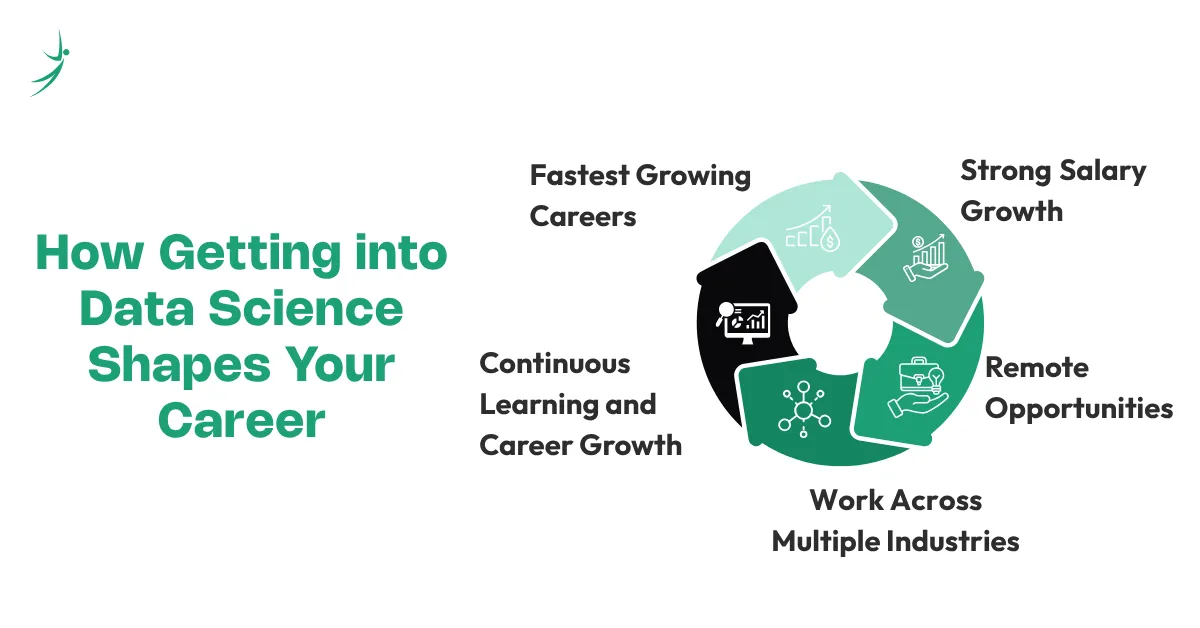
1. One of the Fastest Growing Careers
Analytical roles are highly resilient during structural economic shifts because they are tied directly to corporate survival and operational efficiency. Every major enterprise, modern fintech startup, and e-commerce platform needs engineers who can decode user trends and optimize business models. Because an analytical expert transforms raw information into predictive systems, businesses prioritize these hires to maintain a competitive edge. Securing a position as a data science intern is rapidly becoming the standard entry point for top tech firms. For passionate beginners, completing real world analytics pipelines puts you significantly ahead of your peers. You can explore how structured training translates into corporate roles by reading our collection of inspiring student data science placements.
2. Strong Salary Growth
Advanced data analytics commands some of the highest compensation packages in the modern technology market at every single level. According to recent market analysis, corporate hiring indices, and tech sector metrics, the earning potential in this field is remarkably strong. The expanding baseline for a professional data science salary in nepal reflects how deeply modern organizations value algorithmic optimization.
| Experience Level | Nepal (NPR/month) | India (INR/year) | USA (USD/year) |
| Entry-Level (0-1 years) | NPR 40,000 - 65,000 | ₹5 - 9 LPA | $85,000 - $110,000 |
| Mid-Level (2-4 years) | NPR 80,000 - 1,70,000 | ₹10 - 20 LPA | $120,000 - $160,000 |
| Senior-Level (5+ years) | NPR 1,80,000 - 3,50,000+ | ₹22 - 40 LPA+ | $170,000 - $240,000+ |
3. Remote and International Opportunities
This analytical discipline is perfectly tailored for flexible, decentralized execution. Processing pipelines, cloud database deployment, and predictive modeling can all be managed seamlessly from absolutely any location with a secure internet connection. For developers based locally, this opens up direct access to premium data science opportunities across global tech hubs without requiring physical relocation. Landing a competitive data science remote internship lets you collaborate with international data teams, bringing global currency compensation straight to your local environment while elevating your professional portfolio.
4. Work Across Multiple Industries
Unlike highly specialized niche development tracks, the foundational data science scope spans across every modern commercial industry. You are never locked into a single sector. A skilled analyst can easily pivot from optimizing transaction security in banking to automating diagnostic pipelines in healthcare. This multi industry agility makes the overall data science scope in nepal incredibly vibrant as local logistics companies, telecoms, and digital agencies scale up their technical teams to build automated solutions. To better visualize this industry wide integration, check out our insights on the long term future scope of data science.
5. Continuous Learning and Career Growth
Every analytical concept you master in this computational ecosystem accelerates your technical growth. Fundamental statistical modeling makes machine learning intuitive. Clean exploratory data analysis makes complex predictive model evaluation seamless. Pushing through the initial learning phases builds high level architectural skills that compound throughout your career. Senior analytics professionals do not just write basic database queries: they become Data Architects, Machine Learning Leads, and Chief Data Officers who direct enterprise technology strategies.
What's Next After Learning Data Science?
Once you have mastered the foundational core, you can specialize in various high-paying technical roles depending on your personal interests:
- Machine Learning Engineer: Focuses on building, optimizing, and deploying scalable machine learning models.
- AI Engineer: Specializes in building advanced artificial intelligence systems, neural networks, and automation pipelines.
- Data Analyst: Concentrates on analyzing historical data to generate reports and business insights.
- Business Intelligence Analyst: Uses visualization tools to help executives track corporate performance metrics.
- Data Engineer: Builds the data pipelines and architectures that data scientists use to extract information.
When you feel ready to apply for these positions, reading through frequently asked data science interview questions will help you ace your technical assessments. You can also gain motivation by exploring real student success stories and data science placements from our academy graduates.
Learn Data Science with Skill Shikshya
If you want a structured learning experience with expert mentorship and job placement support, finding the best data science course in Nepal is critical. Skill Shikshya offers the best data science course designed to take you from a complete beginner to a job-ready professional.
Our premier data science course in Kathmandu offers a comprehensive data science full course package featuring an updated data science syllabus that covers Python, SQL, machine learning, and advanced analytics.
If you are looking for a fast-track option, our intensive data science 3 months course can give you the core skills needed to enter the professional market quickly. Furthermore, we provide cutting-edge data science with generative ai course options to ensure you stay ahead of modern automation trends.
Frequently Asked Questions
About Author:

He/She