Frontend Developer Career Roadmap 2026: From Student to Professional in Nepal
If you are a student in Nepal who has spent hours searching for a clear frontend developer roadmap and found nothing built for your actual situation you are in the right place.
Most frontend roadmaps you find online are written for developers in the US or India. They mention salaries in USD, recommend platforms that don't ship to Nepal, and ignore everything specific about the Nepali IT market where to apply, what companies pay, which skills actually matter for Kathmandu-based employers, and how to compete for remote jobs from Pokhara or Biratnagar.
This guide changes that.
This is the complete frontend developer career roadmap for Nepal in 2026 built from competitor analysis, real salary data, and the specific realities of Nepal's IT job market. Whether you are a +2 student who just discovered coding, a BIT/BCA student wanting a clear learning path, or a working professional switching careers into frontend development, this article gives you the full picture.
The front end web developer roadmap below is divided into phases, covering every skill from the very basics to what a senior frontend developer uses daily. By the end, you will know exactly what to learn, in what order, and how to turn that learning into your first job or first freelance client.
What Is Frontend Development and Why Does It Matter?
Front end development meaning: Frontend development is the practice of building everything a user sees and directly interacts with in a web browser buttons, menus, forms, animations, page layouts, and the overall visual experience of a website or web application.
A frontend developer writes code using three technologies that power every website on the internet: HTML (structure), CSS (visual style), and JavaScript (interactivity and logic). Every website you use daily Hamro Patro, Daraz, IME Pay, or a SaaS tool built out of Kathmandu has a frontend developer behind its interface.
The role of a front end developer goes beyond just making things look good. They are responsible for:
- Converting Figma design mockups into real, working web pages
- Making websites fully responsive across mobile, tablet, and desktop
- Writing accessible HTML so people with disabilities can use the web
- Consuming REST APIs and GraphQL endpoints to display real data
- Writing tests to catch bugs before they reach real users
- Keeping websites fast through performance optimization techniques
- Understanding Core Web Vitals and how they affect SEO rankings
Is frontend development a separate field from backend? Yes. Frontend is what users see. Backend is what runs behind the scenes databases, servers, authentication logic. A frontend developer does not manage servers or databases though knowing how they work helps greatly. If you want to do both, that path leads to full-stack development, which you can learn after building strong frontend foundations see all available paths at Skill Shikshya.
Is Front End Developer a Good Career in Nepal?
Short answer: Yes and the timing is particularly good right now. Here is why the frontend career in Nepal makes sense in 2026:
- Nepal's IT sector added over 3,000 registered IT companies in the past four years, and nearly all of them need web interfaces built.
- Remote work has opened international salaries to developers sitting in Kathmandu, Lalitpur, or even smaller cities.
- Demand consistently outpaces supply. Companies like Vrit Technologies, Leapfrog Technology, Cotiviti Nepal, Deerwalk, and Cloudfactory still struggle to find well-trained junior frontend developers.
- Entry into the field does not require a degree only demonstrable skills and a portfolio
- The frontend career roadmap is one of the most linear in tech. The learning curve is steep but predictable.
Frontend Developer Salary in Nepal: 2026 Data
Here is a detailed, data-backed breakdown of the frontend developer salary in Nepal at every career stage. This is compiled from PayScale 2026, Glassdoor 2025, NecoBjobs, and WorldSalaries data.
| Career Level | Experience | Monthly Salary (NPR) | USD Equivalent |
| Intern / Frontend development intern | 0–6 months | NPR 5,000 – 15,000 | ~$37 – $112 |
| Frontend developer trainee | 0–6 months | NPR 15,000 – 25,000 | ~$112 – $187 |
| Junior Frontend Developer | 0–2 years | NPR 20,000 – 50,000 | ~$150 – $375 |
| Mid-Level Developer | 2–5 years | NPR 50,000 – 100,000 | ~$375 – $750 |
| Senior Frontend Developer | 5+ years | NPR 150,000 – 250,000+ | ~$1,125 – $1,875+ |
| Remote / International Client | Varies | NPR 150,000 – 400,000+ | $1,000 – $3,000+ |
| Freelance Developer | Varies | NPR 100,000 – 300,000+ | $750 – $2,500+ |
(Sources: PayScale 2026, Glassdoor 2025, NecoBjobs, WorldSalaries)
Key insight on frontend salary: Glassdoor reports that senior frontend developers in Kathmandu earn up to NPR 1,600,000 per year. That is NPR 133,000+ per month which puts experienced developers among the highest earners in Nepal's private sector without requiring an MBA or a foreign degree.
Remote work completely changes the math. A Nepali developer working for a US-based startup earning $25/hour works roughly 160 hours per month that is $4,000/month or about NPR 540,000. This is why the investment in proper training pays for itself within the first few months of employment.
What do frontend developer interns in Nepal earn? Most paid frontend development intern roles in Nepal pay NPR 5,000 to NPR 15,000 per month. Some internships are unpaid avoid those after you have a portfolio. Your time has value once you can demonstrate skills.
The Complete Frontend Developer Roadmap 2026
This is the front end developer full roadmap structured as ordered phases. This is not a dump of every possible technology it is the exact sequence that mirrors how Nepal's top IT companies evaluate candidates in 2026.
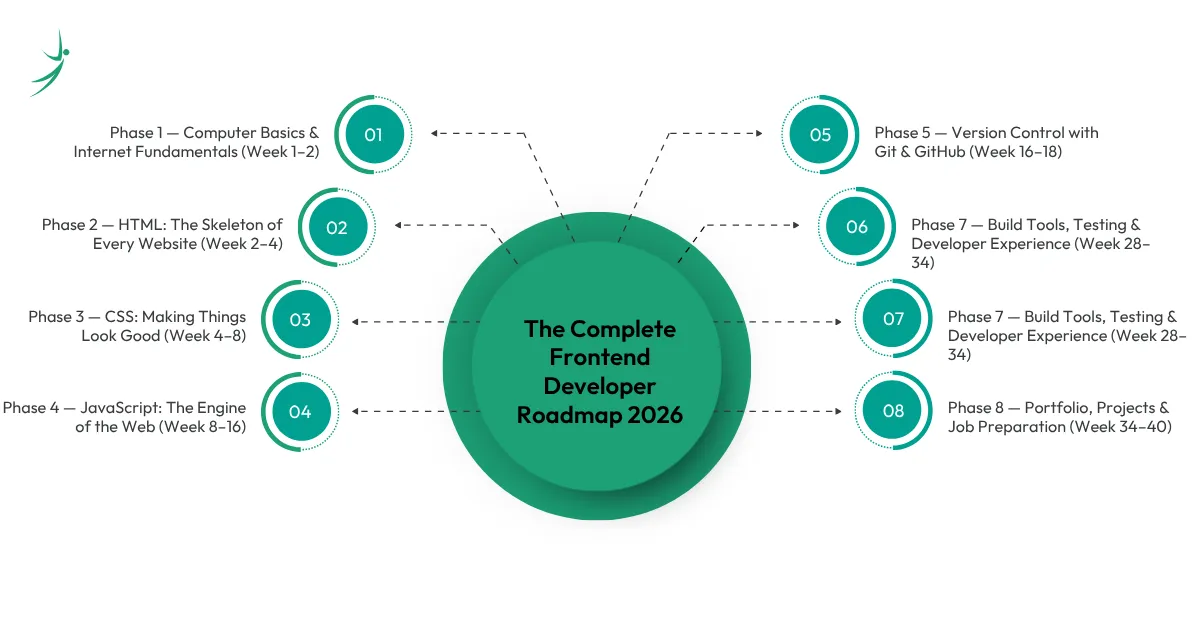
The roadmap for front end developer 2025 and 2026 are very similar in foundation but differ in tooling. We have updated this for 2026 specifically.
Phase 1: Computer Basics & Internet Fundamentals (Week 1–2)
Before writing a single line of code, you need to understand the environment you are working in.
What to cover:
- How a computer's operating system works
- File and folder management; command line basics
- How the internet works: DNS resolution, HTTP/HTTPS protocol
- What a browser does vs what a web server does
- How a request travels from a browser to a server and back
- What HTML, CSS, and JavaScript files actually do in a browser
- This is the foundation. Skip it and you will hit confusion walls constantly as you advance.
Why this matters: Developers who skip this phase are constantly confused later when debugging network errors, understanding hosting, or reading browser DevTools output. One week here saves weeks of confusion later.
Phase 2: HTML: The Skeleton of Every Website (Week 2–4)
HTML is the first real skill on any roadmap for front end developer. It is not a programming language it is a markup language that defines the structure and content of web pages.
What to master:
- Semantic HTML5: <header>, <nav>, <main>, <section>, <article>, <footer>, <aside>
- Headings hierarchy (H1–H6) and why it matters for SEO
- Forms: text fields, checkboxes, radio buttons, dropdowns, textareas, buttons
- Tables — building structured data displays
- HTML media: images with proper alt attributes, <video>, <audio>
- Links, anchors, and how href and relative paths work
- HTML accessibility: ARIA roles, tabindex, <label for> associations
- Meta tags: description, Open Graph, viewport, character set
- HTML document structure: <!DOCTYPE>, <html>, <head>, <body>
Why semantic HTML matters in 2026: Google's algorithm and screen readers both parse your HTML to understand page content. Bad HTML means bad SEO and inaccessible pages. Employers and technical interviewers can tell immediately whether a developer writes clean HTML or sloppy HTML.
Phase 3: CSS: Making Things Look Good (Week 4–8)
CSS Cascading Style Sheets is where your pages go from plain text to polished, beautiful interfaces. Modern CSS in 2026 is far more capable than it was even three years ago.
What to master:
- Box model: content, padding, border, margin
- Selectors: class, ID, attribute, pseudo-class, pseudo-element
- Flexbox: one-dimensional layouts (rows and columns
- CSS Grid: two-dimensional complex layouts
- Media queries and responsive design (mobile-first approach)
- CSS Custom Properties (variables)
- CSS transitions and keyframe animations
- BEM methodology for scalable, maintainable CSS naming
- SASS/SCSS basics nesting, variables, mixins
- CSS specificity and the cascade
Tools to practice CSS:
- CSS Tricks: best reference for layouts
- Flexbox Froggy: game-based flexbox learning
- Grid Garden: game-based grid learning
Common mistake: Students rush CSS and jump to JavaScript or React before they can confidently build a responsive layout from a Figma mockup. This creates serious gaps later. Spend real time here.
Understanding how designers think also helps frontend developers work better with design teams. If you want to go deep into the design side, learning how product designers use Figma and UX principles before writing a pixel of CSS changes how you see every layout you build.
Phase 4: JavaScript: The Engine of the Web (Week 8–16)
JavaScript is the most important language in frontend development. According to the Stack Overflow Developer Survey 2025, JavaScript is used by 66% of professional developers worldwide making it the most popular language for over a decade running.
Core JavaScript concepts to master:
- Variables: var, let, const and when to use each
- Data types: strings, numbers, booleans, arrays, objects, null, undefined
- Functions: declarations, expressions, arrow functions
- Control flow: if/else, switch, for, while, forEach
- Array methods: map(), filter(), reduce(), find(), some(), every()
- Object manipulation: spread operator, destructuring, computed keys
- ES6+ features: template literals, default parameters, rest/spread, modules (import/export)
- DOM manipulation: querySelector, addEventListener, modifying innerHTML, classList
- Events: click, submit, change, keydown, focus, blur
- Async JavaScript: callbacks → Promises → async/await
- Fetch API: GET, POST requests, handling JSON responses
- Error handling: try/catch/finally
- Local storage and session storage
- The event loop and execution context (understand this before React)
What not to do: Do not jump straight into React before you understand JavaScript properly. This is the single biggest mistake junior developers in Nepal make. A strong JavaScript foundation will make you 10x faster once you get to frameworks.
Practice resources for JavaScript:
- JavaScript.info the most thorough free JavaScript curriculum online
- freeCodeCamp JavaScript Algorithms & Data Structures (free certification)
- Eloquent JavaScript by Marijn Haverbeke free online, genuinely excellent
For structured, mentor-guided JavaScript learning in Nepal, this program builds your JavaScript fundamentals the way Nepali IT companies actually test them.
Phase 5: Version Control with Git & GitHub (Week 16–18)
Git is non-negotiable. Every single frontend developer job, internship, and freelance project in 2026 uses Git. Learning it early and using it daily turns it into a habit.
What to learn:
- git init, git add, git commit -m, git status, git log
- Remote repositories: git push, git pull, git clone
- Branching: git branch, git checkout -b, git merge
- Dealing with merge conflicts a real daily task in team environments
- Pull Requests (PRs) and code review workflow on GitHub
- Writing meaningful commit messages (this matters in job interviews)
- .gitignore what not to commit
- GitHub profile setup: pinned repos, README.md, profile README
Your GitHub is your professional CV. Start committing real projects from week one. A GitHub profile with 6 months of consistent commits and clean project READMEs tells employers more than any paper certificate. Hiring managers at Leapfrog Technology, Cotiviti Nepal, and most Kathmandu-based startups check GitHub before shortlisting candidates.
Phase 6: React.js: The #1 Frontend Framework (Week 18–28)
React is the most in-demand framework in Nepal's IT job market. It appears in over 75% of all frontend job listings on Merojob and LinkedIn Nepal. According to Stack Overflow's 2025 Developer Survey, React holds roughly 44.7% adoption among professional developers globally the dominant frontend framework.
The frontend developer react skill is listed in nearly every job description you will find on Merojob, Kumarijob, or LinkedIn Nepal.
What to master in React:
- JSX syntax: writing HTML-like code inside JavaScript
- Components: functional components, how to think in components
- Props: passing data from parent to child components
- State: useState hook, updating state, re-rendering
- useEffect: side effects: API calls, subscriptions, DOM changes
- useContext: global state without external libraries
- React Router: navigating between pages without full page reloads
- Lifting state up: sharing state between sibling components
- Conditional rendering: showing/hiding elements based on state
- List rendering: using map() to display dynamic data
- Forms in React: controlled components
- Custom hooks: extracting reusable log
- React DevTools: debugging component trees
After React, learn these in this order:
- TypeScript: TypeScript adoption reached 44% globally (Stack Overflow 2025). Most growing companies in Nepal's IT sector are now requiring TypeScript in mid-to-senior roles. Learn it after you are comfortable with React, not before.
- Tailwind CSS: Utility-first CSS framework that has replaced traditional CSS in the majority of new React projects built in Nepal. Fast to write, easy to maintain, beautiful results.
- Next.js: The most important addition to a React developer's toolkit in 2026. Next.js gives you server-side rendering, static site generation, image optimization, and API routes — all from a single framework. Widely used in production by Nepal's established IT companies.
- State Management: Start with React's useContext and useReducer. Move to Zustand for medium-complexity apps. Learn Redux Toolkit for large enterprise codebases.
- React Query / TanStack Query: Data fetching, caching, and synchronization library. Replaces manual useEffect API calls in most professional codebases.
Phase 7: Build Tools, Testing & Developer Experience (Week 28–34)
This is where good developers separate from great ones. Understanding the tooling ecosystem is what allows you to work on large team projects and real production codebases.
Build tools:
- Vite: the standard development server and bundler for new React projects in 2026. Much faster than the now-deprecated Create React App.
- npm / pnpm: package management, reading package.json, understanding dependencies vs devDependencies
- ESLint + Prettier: code quality and consistent formatting. These run in CI pipelines. Know how to configure them
- Environment variables: .env files, keeping API keys out of source code
Testing:
- Jest: JavaScript unit testing framework
- React Testing Library: component testing
- Cypress or Playwright: end-to-end browser testing
Web performance optimization:
- Lazy loading: React.lazy(), dynamic import()
- Code splitting: bundle analysis with Vite's build output
- Core Web Vitals: LCP (Largest Contentful Paint), INP (Interaction to Next Paint), CLS (Cumulative Layout Shift
- Lighthouse audits: Google's built-in tool for measuring web performance
Browser DevTools mastery:
- Network tab: inspect API requests, check response times
- Elements panel: inspect and live-edit the DOM
- Console: JavaScript error debugging
- Application tab: localStorage, sessionStorage, cookie
- Performance tab: identify rendering bottlenecks
Phase 8: Portfolio, Projects & Job Preparation (Week 34–40)
Skills without proof mean nothing in job applications. Frontend developer projects are the proof.
The 5 projects every job-ready frontend developer should have:
| Project | What It Proves |
| Personal portfolio website | HTML/CSS mastery, responsive design, deployment |
| Weather or API data app | async JS, Fetch API, error handling, loading states |
| E-commerce product page | CSS Grid, Flexbox, cart state management |
| React CRUD app with auth | React Router, state management, protected routes |
| Full Next.js project (deployed) | Next.js, SSR, Vercel deployment, TypeScript |
All five should be live on Vercel or Netlify. All five should have clean GitHub READMEs explaining the project, the stack, and how to run it locally. This is what a frontend developer website portfolio actually means in professional terms.
Want inspiration from real projects built by Nepali developers? Read what Skill Shikshya graduates built and where those projects got them hired.
How Long Does It Take to Become a Frontend Developer?
This is one of the most searched questions by students in Nepal. Here is an honest, structured answer:
| Study Commitment | Time to Job-Ready |
| 2–3 hours/day (part-time, self-paced) | 12–18 months |
| 4–5 hours/day (structured course + self study) | 8–12 months |
| 6–8 hours/day (full-time intensive, bootcamp-style) | 5–8 months |
The honest caveat: These timelines assume consistent, project-based learning not passive tutorial watching. Every month you spend watching videos without building something adds a month to your timeline.
Most students who complete Skill Shikshya's structured frontend program and build their projects consistently land their first role as a frontend developer intern, frontend developer trainee, or junior developer within 4–6 months of program completion.
Not sure which schedule fits your situation? Talk to one of Skill Shikshya's career advisors for free they'll help you map a realistic timeline based on your current level and availability.
Senior Frontend Developer Roadmap: What Comes After Junior Level
The senior frontend developer roadmap covers what you need to grow beyond junior level. This is the frontend developer roadmap equivalent for 2026 updated for what Nepali enterprises and international remote employers actually evaluate at senior interviews.
Deep JavaScript knowledge required at senior level:
- JavaScript engine internals: call stack, event loop, microtask queue, macrotask queue
- Closures, scope chain, lexical environments
- Prototype chain and this keyword in depth
- Memory management and garbage collection
Advanced React patterns:
- Compound components pattern
- Render props pattern
- Higher-Order Components (HOCs)
- Virtualization for large lists: react-window, react-virtual
- React performance profiling and avoiding unnecessary re-renders
Frontend architecture:
- Micro-frontend architecture (splitting large apps by team)
- Monorepo setup with Turborepo or Nx
- Design systems and component library development
- Module federation
Web accessibility (WCAG 2.2):
- Keyboard navigation completeness
- Color contrast requirements
- Focus management in SPAs
- Screen reader testing with NVDA or VoiceOver
Security awareness:
- XSS (Cross-Site Scripting): how it happens and how to prevent it
- CSRF understanding and token-based protection
- Content Security Policy headers
- Secure handling of JWTs on the frontend
What separates seniors from juniors in Nepal's market: Senior developers own features end-to-end. They write documentation, lead code reviews, mentor juniors, estimate work accurately, and communicate blockers clearly to product managers. The code is only part of the job.
Frontend Development Career Paths in Nepal: Your Options
The frontend career is not a single track. Once you have strong skills, you can move in several different directions depending on what you enjoy most.
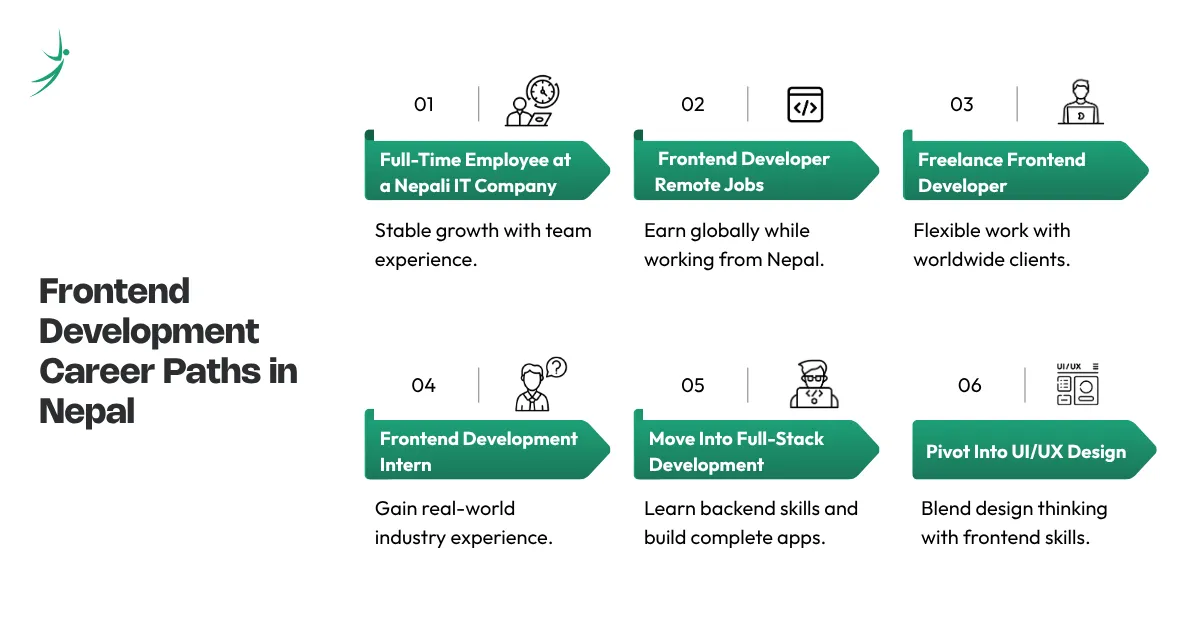
Full-Time Employee at a Nepali IT Company
Nepal's IT sector includes companies like Vrittechnologies, Cotiviti Nepal, Leapfrog Technology, Deerwalk Services, Cloudfactory, Innovate Tech, Webpoint, and hundreds of fast-growing startups. Front end entry level jobs at these companies offer structured mentorship, team learning, and clear growth paths.
Frontend Developer Remote Jobs
Frontend developer remote positions are accessible from anywhere in Nepal once you have demonstrable skills. Platforms like LinkedIn, We Work Remotely, Arc.dev, Toptal, and Remote OK connect qualified Nepali developers to international companies paying in USD. This is the highest-earning path for most frontend developers in Nepal.
Frontend Developer Freelance Jobs
Frontend developer freelance jobs are available on Upwork, Fiverr, Contra, and PeoplePerHour. Starting frontend developer part time while employed or studying, then scaling to full freelance once your income is stable, is the most risk-managed path.
Frontend Development Intern at a Nepali Company
A frontend development intern position is often the fastest entry point. It gives you real team experience, teaches professional workflows, and often converts to a full-time role. Frontend developer internship in Nepal postings appear regularly on Merojob, Kumarijob, and LinkedIn.
Move Into Full-Stack Development
After 1–2 years of solid frontend experience, many developers want to handle the complete application. Moving to full-stack by learning Node.js, Express, MongoDB or PostgreSQL is a natural progression. Adding backend skills to your frontend foundation increases your salary ceiling significantly and opens up the most flexible freelance opportunities.
Pivot Into UI/UX Design
Some frontend developers discover they are more drawn to the design and user research side. With your frontend knowledge, you already understand technical constraints making you a uniquely effective UI/UX designer. Understanding user experience principles from the ground up and combining that with your coding skills creates one of the most sought-after professional profiles in Nepal's product companies.
Frontend Developer Job Descriptions: What Employers Actually Want
Understanding the front end job description before you start applying saves you time and helps you prioritize your learning. Here is a composite of what real front end entry level jobs and frontend junior jobs in Nepal require in 2026:
Entry-Level / Frontend Junior Jobs (most common at NPR 20,000–50,000/month):
- Solid knowledge of HTML5, CSS3, JavaScript (ES6+)
- At least one React.js project (doesn't need to be large)
- Git/GitHub proficiency
- Ability to convert Figma designs to responsive HTML/CSS
- Basic understanding of REST APIs
- Comfortable reading and working inside an existing codebase
Mid-Level (NPR 50,000–100,000/month):
- React.js + TypeScript
- State management (Zustand/Redux Toolkit)
- Writing unit and integration tests
- Next.js or similar SSR framework
- Code review experience
Senior / Lead (NPR 100,000+):
- Architecture decisions
- Performance optimization
- Mentoring juniors
- Strong TypeScript
- GraphQL
- CI/CD pipeline understanding
Most common red flags in frontend trainee jobs interviews:
- Candidates who claim to know React but can't explain what state is
- No deployed projects (GitHub with 0 commits is a dealbreaker)
- Unable to explain what happens when you type a URL in a browser
- Copy-pasted code they cannot walk through
The front-end developer position listings on Merojob and LinkedIn Nepal consistently show React, TypeScript, and Git as the three most-demanded skills across all experience levels.
Tools Every Frontend Developer Needs in 2026
These are the standard tools in every professional frontend developer's toolkit in Nepal's IT companies:
Code editor:
- VS Code (Visual Studio Code): free, fast, with excellent extensions (Prettier, ESLint, GitLens, Live Server)
Must-have VS Code extensions:
- Prettier: automatic code formatting
- ESLint: catches JavaScript/TypeScript errors in real time
- GitLens: visual Git history and blame annotations
- ES7+ React/Redux Snippets: faster React component scaffolding
- Thunder Client: API testing inside VS Code
- Tailwind CSS IntelliSense: autocomplete for Tailwind classes
- Auto Rename Tag: renames HTML closing tags automatically
- Live Server: hot reload for HTML/CSS files during development
Design collaboration:
- Figma: Every IT company in Nepal uses Figma. Knowing how to inspect spacing, typography, and colors from a Figma file is a required skill.
Browser & debugging:
- Chrome DevTools, Firefox Developer Edition
API testing:
- Postman: test and inspect API responses before connecting to your frontend
Package manager:
- npm: comes with Node.js; understand package.json, node_modules, scripts
- pnpm: faster alternative to npm, increasingly preferred
CSS framework:
- Tailwind CSS: utility-first, widely adopted in 2025–2026 production environments
- Bootstrap: still used in older/legacy projects
Component library (UI):
- shadcn/ui: growing fast in 2026, works with Tailwind and React
- Material UI (MUI): established option for React projects
Deployment platforms:
- Vercel, Netlify, GitHub Pages
Version control hosting:
- GitHub: the professional standard. Also look at GitLab for enterprise projects.
Frontend Developer Projects: Ideas That Impress Nepali Employers
Standard tutorial project lists tell you to build a to-do app and call it a portfolio. That worked in 2019. In 2026, hiring managers in Nepal see hundreds of to-do apps. Here is what actually stands out:
Projects that work in Nepal's job market:
- Nepali Job Board UI (React + API): Build a job listing UI that fetches from a mock JSON API or an existing jobs API. Add filters by category, experience level, and salary range. This directly mirrors what most Nepali IT companies build for their clients. Deploy on Vercel.
- Bikri.com or Hamro Bazar Clone (Product listing UI): A product listing page with search, filter, sort, and a cart sidebar. Tests CSS Grid, state management, and responsive design simultaneously.
- Real-Time Currency Converter (NPR to USD/INR/EUR): Uses a live exchange rate API. Simple concept, teaches async JavaScript, loading/error state handling, and API key security.
- Nepal BS/AD Calendar with Event Functionality: An extremely valuable project for the local market. Bikram Sambat (BS) to Gregorian calendar conversion is a common feature requirement in Nepali enterprise applications. Building this from scratch demonstrates serious JavaScript skills.
- SaaS Dashboard with Charts (Next.js + TypeScript + Tailwind): A data analytics dashboard with line charts, bar charts, user stats, and a sidebar navigation. This is almost identical to what Cotiviti Nepal and other data-heavy IT companies build professionally.
- Authentication Flow App (Login, Register, Protected Routes): Shows React Router, JWT token handling, localStorage for session, and API integration. Almost every professional app has authentication showing you understand it is a strong signal.
Where to deploy: Vercel, Netlify, GitHub Pages. Every project needs a live URL. A GitHub link without a live demo is half as valuable.
Want to build projects under guidance with industry mentors? This is exactly what Skill Shikshya's hands-on training structure delivers real projects, real feedback, real deployment.
Certificates That Actually Help in Nepal's Job Market
Not all certificates are equal. Many cost money and do nothing for your job application. Here is what actually matters:
Certificates that Nepali employers recognize:
| Certificate | Provider | Cost | Value |
| JavaScript Algorithms & Data Structures | freeCodeCamp | Free | High — recognized globally |
| Front End Development Libraries | freeCodeCamp | Free | High — covers React |
| Responsive Web Design | freeCodeCamp | Free | Medium — good for entry level |
| React Certificate | Meta (via Coursera) | Paid | High — Meta brand recognition |
| TypeScript Certificate | Udemy (specific courses) | Paid (~$15 on sale) | Medium — shows initiative |
| Skill Shikshya Frontend Diploma | Skill Shikshya Nepal | Paid | High locally — Nepal employers recognize it |
What matters more than any certificate: A live deployed project. Companies care whether you can build things, not which website issued your certificate. Certificates signal that you studied something. Projects prove that you can actually do it.
If you earn a Skill Shikshya certificate, you can verify it at skillshikshya.com/verify-certificates and so can any employer in Nepal who wants to confirm authenticity.
The frontend developer free certificate from freeCodeCamp (specifically the JavaScript Algorithms & Data Structures and Front End Development Libraries certifications) is one of the most recognized free credentials in the global tech community.
Free Resources & Platforms for Frontend Learning
Frontend development course free options:
- freeCodeCamp: structured curriculum covering HTML, CSS, JavaScript, React. Free certifications.
- The Odin Project: project-based curriculum, one of the best free resources available
- MDN Web Docs: Mozilla's official documentation, the gold standard for web reference
- JavaScript.info: the most detailed free JavaScript resource
- CSS Tricks: all things CSS, from beginner to advanced
Frontend development platforms (paid, worth it):
- Scrimba: Interactive in-browser coding environment. Unique format where you can pause tutorials and edit the instructor's code directly.
- Udemy: Angela Yu's Web Development Bootcamp is the most popular beginner course and typically costs NPR 1,500–3,000 during sales.
- Frontend Masters: High-quality courses taught by engineers from Google, Netflix, and Microsoft. Best for intermediate-to-advanced topics.
Front end development books for beginners:
- HTML and CSS: Design and Build Websites by Jon Duckett visual, beginner-friendly
- Eloquent JavaScript by Marijn Haverbeke: free online, deep JavaScript coverage
- Learning React by Alex Banks & Eve Porcello: practical React for beginners
Best option for Nepal: Skill Shikshya's Frontend Software Engineering Course is the most Nepal-specific structured program available. Taught by industry professionals who understand what Nepali employers look for, it covers the complete front end developer full roadmap HTML through React, TypeScript, Git, and deployment. See the full curriculum and upcoming batch dates here.
Want to try a session before committing? Attend a live workshop first and experience the teaching style.
Frontend Developer Freelance in Nepal: How to Get Started
Frontend developer freelance jobs are one of the most exciting opportunities for developers in Nepal in 2026. Here is a practical starting plan:
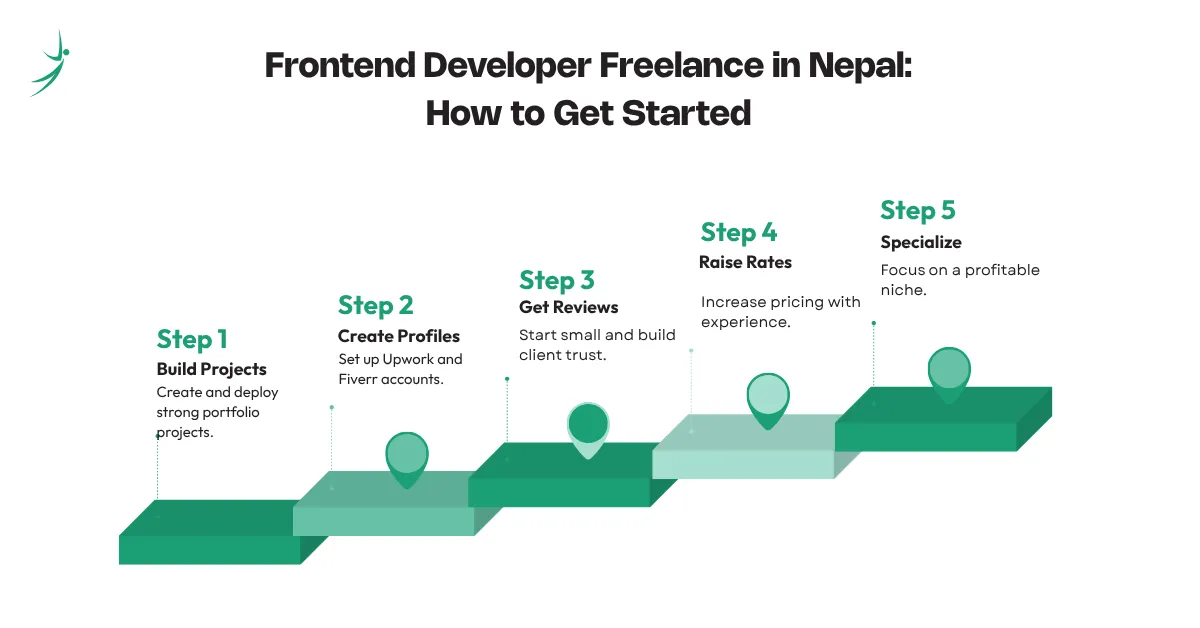
- Step 1: Build at least 3 strong portfolio projects and deploy them publicly.
- Step 2: Create profiles on Upwork and Fiverr. Write clear profile descriptions targeting specific services: "React.js developer for landing pages," "Responsive HTML/CSS conversion from Figma designs."
- Step 3: Start with small, well-scoped jobs to build reviews. One positive review on Upwork is worth more than a certification.
- Step 4: As you gain reviews, increase your rates. Many Nepali developers on Upwork charge $15–$35/hour after 6–12 months and scale to $50–$80/hour within 2–3 years.
- Step 5: Consider specializing. Developers who specialize in a specific niche (Shopify storefronts, React dashboards, WordPress custom themes) earn more than generalists at the junior level.
Frontend developer remote work from Nepal: The frontend developer remote path is now completely viable. Internet connectivity across Nepal has improved dramatically. Many developers in Pokhara, Biratnagar, Chitwan, and Butwal are working full-time for international clients without ever moving to Kathmandu.
AI Tools Reshaping Frontend Development in 2026
AI is changing how frontend developers write code. This does not mean frontend developers are being replaced it means skilled developers who use AI tools ship code significantly faster than those who don't.
AI tools every frontend developer should know in 2026:
- GitHub Copilot: AI code autocomplete integrated into VS Code. Suggests entire functions and component structures based on context. Paid ($10/month), but often free for students via GitHub Education Pack.
- Cursor: AI-first code editor built on VS Code. Lets you prompt your code editor in natural language: "refactor this component to use TypeScript" or "add error handling to this API call." Growing rapidly in professional teams.
- v0 by Vercel: Generate entire React component UIs by describing them in plain text. Type "build me a pricing table with three tiers and a toggle for monthly/annual" and get ready-to-use Tailwind+React code. Excellent for rapid prototyping.
- Bolt.new: Full-stack web app generation in the browser. Useful for spinning up project starters quickly.
- Claude and ChatGPT: Debugging complex errors, explaining concepts, reviewing code, writing boilerplate. Treat these as a senior developer you can ask anything but always read and understand the code they generate before using it.
The important caveat: AI tools make skilled developers faster they do not make unskilled developers employable. If you do not understand the code an AI generates, you cannot debug it when it breaks (and it will break). Learn the fundamentals first. Then use AI to accelerate.
Understanding how AI agents are transforming the way software gets built is becoming an increasingly valuable skill set alongside traditional frontend engineering.
How to Build Your Personal Brand as a Developer in Nepal
Getting a frontend developer job in Nepal is not just about skills it is about visibility. Here is a practical branding strategy for Nepali developers:
LinkedIn (most important for Nepal's job market):
- Headline: "Frontend Developer | React.js | JavaScript | Open to Work" be specific
- About section: 3–4 lines explaining what you build, what you are looking for, and one specific achievement
- Post regularly: project updates, things you learned, bugs you solved. 1–2 posts per week builds an audience.
- Connect with hiring managers at Leapfrog, Cotiviti, Deerwalk, and local startups — personally, not with automated messages
GitHub:
- Pin your best 6 projects
- Every project should have a README explaining: what it does, the tech stack, how to run it, and a live link
- Contribute to at least one open-source repository even small documentation fixes count
Twitter/X:
- Share short coding tips, project screenshots, what you are learning. Nepal's developer community is active here.
Dev.to or Hashnode:
- Write one technical article per month. Topics like "How I built X in React" or "5 CSS tricks I use every week" build search traffic and demonstrate expertise.
Community involvement:
- Attend Google Developer Groups (GDG) meetups in Kathmandu
- Join the Nepal JavaScript Community on Facebook
- Participate in Kathmandu Valley Hackathon or similar events
- Be active in Discord communities (Reactiflux, The Odin Project Discord, etc.)
Nepal IT Companies Hiring Frontend Developers {#companies}
These are companies actively hiring at various front end developer position levels in Nepal:
| Company | Location | Known For |
| Leapfrog Technology | Kathmandu | Product development, strong engineering culture |
| Cotiviti Nepal | Kathmandu | Healthcare IT, data-heavy applications |
| Deerwalk Services | Kathmandu | Healthcare technology |
| CloudFactory | Kathmandu | AI/ML data operations |
| Innovate Tech | Kathmandu | Custom software development |
| Webpoint Solution | Kathmandu | Web and mobile development |
| F1Soft Group | Kathmandu | Fintech (eSewa parent company) |
| Verisk Nepal | Kathmandu | Insurance/data analytics |
| Fusemachines | Kathmandu | AI-focused software development |
| Tootle | Kathmandu | Local tech startup |
For front end entry level jobs and frontend trainee jobs, Merojob.com, Kumarijob.com, and LinkedIn are the three most active job boards in Nepal.
Common Mistakes Nepali Students Make
Mistake 1: Jumping to React Without JavaScript Foundations
The most widespread mistake in Nepal's frontend learning community. Students see "learn React" trending and skip JavaScript fundamentals entirely. They can copy-paste React components but cannot debug a single broken one. Fix: Complete Phase 4 of this roadmap fully before touching any framework.
Mistake 2: Watching Tutorials Without Building
Tutorial hell is real. You can spend 6 months watching Udemy courses and know nothing useful. Fix: For every hour of video content, spend 2 hours writing code. Build something anything from what you just watched.
Mistake 3: No Portfolio, Just Certificates
Certificates are not proof of skill in Nepal's hiring market. A StackOverflow question you answered, a GitHub project someone starred, or a deployed app someone can use that is proof. Fix: Build and deploy at minimum 3 projects before applying for jobs.
Mistake 4: Applying Only on Merojob
Merojob has frontend jobs, but the most competitive packages come from LinkedIn direct applications, company career pages, and referrals. Fix: Apply on all three channels simultaneously.
Mistake 5: Not Practicing Communication in English
Many Nepali developers have strong technical skills but struggle with written and spoken English in technical interviews. This matters especially for remote work. Fix: Practice explaining your code in English — record yourself, review, improve.
Mistake 6: Giving Up After Rejections
Most developers who now work at Leapfrog or Cotiviti applied and got rejected 5–10 times before their first offer. Rejections are information, not verdicts. Fix: Ask for feedback after every rejection. Apply the feedback. Reapply.
Case Studies: Real Nepali Developers Who Made It
Case Study 1: From BCA Student to React Developer
A student at Tribhuvan University, mid-way through their BCA program, felt lost in the classroom curriculum and decided to build real skills in parallel. They spent 9 months learning HTML, CSS, JavaScript, and React — 3 hours a day, consistently. Built four deployed projects including a Nepali news aggregator and a real estate listing UI. Applied to 23 companies over 6 weeks. Got a frontend developer internship in Nepal at a Kathmandu-based B2B SaaS company. Converted to NPR 45,000/month employment after 3 months. Currently earning NPR 80,000/month at 18 months in.
Case Study 2: School Teacher Turned Remote Frontend Developer
A school teacher from Pokhara with no prior programming experience completed a structured frontend training program, then spent 10 months consistently building projects and improving. Started freelancing on Upwork with small landing page projects. Built up 12 reviews in 8 months. Currently earning $25/hour working for a US-based digital marketing agency from home in Pokhara. Monthly income: approximately NPR 250,000.
Case Study 3: +2 Graduate Who Skipped University
A student who completed +2 in science decided not to pursue a bachelor's degree and instead invested 8 months in focused frontend training. Secured a frontend developer trainee position at a startup in Boudha 2 months after completing the course. That startup was acquired 14 months later by a larger company. Now working as a mid-level frontend developer at age 21.
These are not rare stories they are the normal outcomes of consistent learning, real project building, and deliberate job searching.
Want to read more outcomes like these? See what students who trained at Skill Shikshya built and where they work now. Or hear directly from developers about what the training experience felt like.
Future Trends in Frontend Development
The frontend development career roadmap for 2026 and beyond is shaped by several forces that every frontend developer in Nepal should be aware of:
- React Server Components + Next.js App Router The boundary between frontend and backend is blurring. Next.js App Router with React Server Components allows frontend developers to handle data fetching, caching, and server-side rendering without a separate backend. This trend rewards developers who understand both sides even slightly.
- AI-Assisted Development as a Professional Standard: GitHub Copilot, Cursor, and v0 by Vercel are now considered standard productivity tools in progressive engineering teams. Developers who refuse to use AI tools will simply work slower than those who do.
- Web Accessibility as a Legal and Business Requirement: WCAG 2.2 compliance is increasingly becoming a contractual requirement in enterprise software projects, especially for government and healthcare clients. Accessibility knowledge is shifting from a "nice to have" to a required skill.
- Edge Computing and Serverless Functions Vercel Edge Functions: Cloudflare Workers, and Deno Deploy are pushing rendering logic to the network edge closer to the user. Understanding where your code runs is becoming part of the senior frontend developer's responsibilities.
- WebAssembly (Wasm) Maturing: Still early-stage for most roles, but applications like browser-based video editing, real-time image processing, and complex data computation are being unlocked by Wasm. Worth tracking if you want to stay ahead.
- Design Systems Becoming Team Infrastructure: Large companies are investing in internal component libraries and design systems. Experience building and maintaining component libraries — not just using them is increasingly valued at senior and staff engineer levels.
- What this means for Nepali developers: Start with the fundamentals. Then pick up Next.js, TypeScript, and accessibility. Learn to use AI tools in your workflow. The developers who combine solid core skills with adaptability to new tooling are the ones who grow fastest.
Self-Taught vs Structured Course vs University Degree in Nepal
| Path | Time to Job-Ready | Cost | Outcome Quality | Employer Recognition |
| Self-taught (free resources only) | 14–24 months | Nearly free | Variable — depends heavily on discipline | Portfolio matters more than path |
| Structured local course (Skill Shikshya) | 6–10 months | Moderate | High — guided project building, mentorship | Strong locally and for entry-level |
| Online international bootcamp | 6–9 months | High (often $5,000–$15,000) | High if project-based | Good globally |
| University degree (BIT/BCA/BSc CSIT) | 4 years | Moderate | Foundational but slow | Strong for large corporate entry |
The honest answer for Nepal in 2026: University degrees are still respected for government and corporate entry-level positions. But the fastest path to employment as a frontend developer is a structured short-to-medium program combined with a strong portfolio.
Self-taught developers succeed regularly in Nepal but the failure rate is also high because without structure, most people give up or spend months learning things in the wrong order.
A structured program like Skill Shikshya's builds the complete front end web developer roadmap in one place, with mentors who can answer questions in real time, regular project reviews, and career support after completion. Explore every skill-building track available in Nepal through Skill Shikshya.
If you are an SEE-appeared student who wants to get a head start before your board results, there are specific programs designed for that entry point. If you just finished your +2 and are deciding what to study, there is a clear path built for exactly that moment.
How to Choose the Right Frontend Course in Nepal
Not all courses are equal. Here is what to look for when evaluating a frontend developer training program in Nepal:
Check these before enrolling:
- Does the course cover HTML, CSS, JavaScript, AND a framework (React)?
- Are projects included, or is it purely theory?
- Does the instructor have real industry experience?
- Is the curriculum updated for 2025–2026 tools?
- Is there job placement support or career guidance?
- Does it cover Git, deployment, and the full professional workflow?
Skill Shikshya's Frontend Software Engineering Course checks all of these boxes. Built specifically for the Nepal context, it covers the complete front end developer full roadmap from HTML fundamentals to React.js, TypeScript, Git, project deployment, and career preparation for the Nepali and remote job market.
Enroll in our Frontend Software Enineering Course
Measuring Your Progress: How to Know You Are Ready
These are the milestones that signal you are genuinely job-ready as a frontend developer in Nepal:
Technical readiness checklist:
- [ ] You can build a fully responsive, multi-page website from a Figma design without referencing documentation for every step
- [ ] You have 3–5 deployed projects on Vercel or Netlify
- [ ] Your GitHub profile shows at least 3 months of consistent commit activity
- [ ] You can build and connect a React app to a public API and handle loading/error states
- [ ] You understand how Git branching and pull requests work
- [ ] You can explain what a React component is, what props and state do, and when to use useEffect
Career readiness checklist:
- [ ] Your portfolio website is live and mobile-responsive
- [ ] Your LinkedIn profile is complete with a clear headline: "Frontend Developer | React.js | JavaScript"[ ] Your GitHub README files explain your projects clearly
- [ ] You have applied to at least 20 frontend positions, internships, or trainee roles
- [ ] You have done at least one mock technical interview
Conclusion: Your Next Step Starts Today
The frontend developer career roadmap is not a shortcut. It is a structured plan that, if followed consistently for 6–12 months, turns any motivated student in Nepal into a job-ready professional.
Here is the summary of what to do, in order:
- Learn HTML and CSS deeply do not rush this
- Build JavaScript fundamentals before touching any framework
- Add Git and GitHub to your daily workflow early
- Learn React.js with TypeScript this combination opens most doors
- Build 3–5 real projects and deploy them
- Apply for internships, trainee roles, and junior positions
- Continue learning while working the best developers never stop
The frontend development career in Nepal in 2026 offers real salaries, real remote work, and real freedom. The only thing standing between you and your first developer job is time, consistency, and the quality of your projects.
Ready to start? Skill Shikshya's Frontend Software Engineering Course gives you the structure, mentorship, and career support to get there faster.
Frequently Asked Questions
What is the best programming language to start with for frontend development?
Can I become a frontend developer without a degree in Nepal?
What is the frontend developer salary for freshers in Nepal?
Is React necessary for frontend developer jobs in Nepal?
What does a frontend developer do on a typical day?
What are the best sites to find frontend developer jobs in Nepal?
Is the frontend developer career good for women in Nepal?
About Author: