Master Class · 2026 Cohort
Nepal Startup Mastery is a 12-day masterclass that teaches aspiring entrepreneurs to launch and run legally compliant businesses in Nepal, covering ideation, registration, funding, operations, growth, and risk management with practical guidance.


5+ Students have already registered

Trusted by 1,000+ Professionals, Companies & Institutions Across Nepal — Nepal's growing home for intermediate level professional courses Kathmandu and specialized training.
5,000+
Professionals Trained
4.9/5
Learner Rating (350+ Reviews)
2,000+
Masterclass Sessions Delivered
Nepal Startup Mastery: From Idea to Operation
Numbered by day because that's genuinely how the class runs: a step-by-step build, one skill layered on the next.
Understanding Entrepreneurship in Nepal
Current opportunities and key challenges in Nepal's economy
Success stories of Nepalese entrepreneurs
Identifying your entrepreneurial "why" and vision
Nepal Startup Ecosystem Overview
Key industries: Tourism, agriculture tech, fintech, e-commerce, education
Government initiatives and support programs
Startup hubs and incubators in Nepal
Common Mistakes & How to Avoid Them
Legal compliance failures, underestimating capital
Poor market research and ignoring feedback
Interactive Exercise: Idea brainstorming and validation discussion
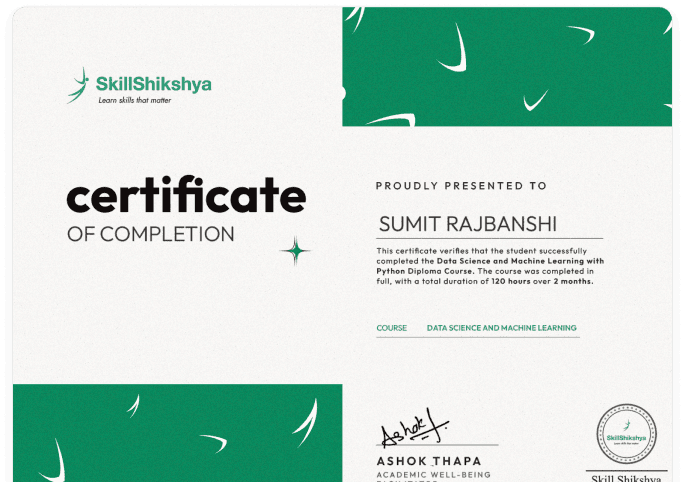
After completing the program, you will receive a certification from At Skill shikshya, the best online learning institute in Nepal. This certification helps demonstrate your professional skills when applying for jobs or freelance opportunities.

Our advisors will help you
Book a call today and start your journey into professional training.
John Doe
Digital Marketing Student
Connect with our team to design a training plan tailored to your organization's goals, challenges, and workforce needs.

50+
Corporate & Institutional Partners
Generating Scalable Business Ideas
Problem-solution fit framework for Nepal market
Leveraging skills, passion, and market opportunity
Service vs. product-based businesses
Market Research in Nepal
Primary and secondary research methods
Urban vs. rural market dynamics
Pricing strategies for Nepalese purchasing power
Validating Ideas with Customers
MVP mindset and pre-selling techniques
Feedback collection and iteration
When to pivot vs. persevere
Case Study: Successful Nepalese startups (eSewa, Foodmandu, Pathao, Khalti)
Types of Business Entities
Sole Proprietorship, Partnership, Private Limited, Public Limited
Comparison: Registration cost, compliance, liability, funding access
Step 1: OCR (Office of Company Registrar) Registration
Creating account on OCR portal (https://application.ocr.gov.np/)
Company name reservation (90-day validity)
Required documents: MOA, AOA, citizenship, agreements
Company Act 2063 compliance | Timeline: 7-15 days
Step 2: IRD - PAN Registration
Mandatory within 7 days of OCR registration
Documents: OCR certificate, citizenship, office documents
Biometric verification required | Timeline: 1-3 days
Step 3: IRD - VAT Registration (if applicable)
Mandatory if annual turnover exceeds NPR 5 million
Documents: PAN, OCR certificate, office lease
Timeline: 3-5 days
Step 4: Ward Office Registration
Mandatory for all businesses
Documents: OCR certificate, PAN, rental agreement, landlord's citizenship
Timeline: 1-3 days
Step 5: Department-Specific Registrations
Department of Industry (manufacturing/production - Industries Act)
Tourism Board (tourism businesses)
DFTQC (food businesses)
Nepal Rastra Bank (financial institutions)
Intellectual Property Protection
Trademark registration at Department of Industry
Copyright and patent application process
Labour Act 2074 (2017) Compliance
Written employment contracts mandatory
Working hours: 8 hours/day, 48 hours/week
SSF registration mandatory when hiring employees
Labour audit required for 10+ employees
Post-Registration Compliance (Within 3 Months)
✓ PAN registration (within 7 days)
✓ VAT registration if applicable (within 30 days)
✓ Ward office registration (within 15 days)
✓ SSF registration when hiring (within 15 days of hiring)
✓ Bank account and accounting system setup
Practical Activity: Document preparation checklist completion
Writing Practical Business Plans
Executive summary, market analysis, business model
Operations structure and financial projections
Defining Goals & Milestones
Short-term (3-6 months), medium-term (1-2 years), long-term (3-5 years)
SMART goal framework
Financial Planning Essentials
Startup capital estimation and budgeting
Cash flow projections and break-even analysis
Contingency planning (minimum 20% buffer)
Market Entry Strategies
Direct sales vs. distribution partnerships
Online vs. offline presence and pricing strategies
Exercise: Draft one-page strategic plan
Building Brand Identity
Brand essence: mission, vision, values
Visual identity and brand voice
Positioning in Nepalese market
Unique Value Proposition (UVP)
Differentiation from competitors
Clear communication of customer benefits
Digital Marketing Essentials
Social media strategy: Facebook, Instagram, TikTok
Content marketing, SEO, email marketing, WhatsApp Business
Cost-effective online advertising
Offline Marketing in Nepal
Traditional media, community events, word-of-mouth
Strategic partnerships and experiential marketing
Exercise: Create simple marketing plan with budget
Understanding Nepalese Consumer Behavior
Cultural factors and trust-building
Price sensitivity and family influence in buying
Building Sales Funnels
Awareness → Interest → Consideration → Purchase
Lead generation and conversion optimization
Customer Acquisition Strategies
Online: Social media, search engines, content
Offline: Personal selling, partnerships, events
B2B vs. B2C approaches
Handling Feedback
Feedback collection systems
Using feedback for improvement and building loyalty
Role-Play: Pitching to Nepalese customers
Understanding Financial Statements
Income statement, balance sheet, cash flow statement
Reading and interpreting reports
Funding Options in Nepal
Bootstrapping, friends & family, bank loans (Nabil, NIC Asia)
Microfinance, angel investors, government programs
International grants and development funding
Pitching to Investors
Crafting compelling pitch deck (10-15 slides)
Financial projections, valuation, handling questions
Budget Management
Zero-based budgeting and prioritization
Monthly financial review and cost control
Exercise: Prepare 3-year financial forecast
Designing Efficient Workflows
Business process mapping and SOPs
Quality control and productivity tools
Hiring the Right Team
Job descriptions and recruitment channels in Nepal
Employment contracts per Labour Act 2074
Interview techniques and onboarding
Leadership Skills for Founders
Communication, delegation, motivation
Performance management and feedback
Tools and Software
Accounting: Tally, QuickBooks
Project management: Trello, Asana
Communication: Slack, Teams
Exercise: Create organizational structure
Leveraging Technology
Automation and cloud-based collaboration
Digital payments: eSewa, Khalti, Fonepay, ConnectIPS
E-commerce platforms for Nepal
AI Tools for Business
ChatGPT for content and customer service
AI graphic design and video creation
Email automation and data analysis
Practical AI Applications
Chatbots, social media content, inventory management
Financial reporting, multilingual content (Nepali/English)
Cost-Effective Integration
Free and freemium tools
When to build vs. buy technology
Hands-on Demo: Live AI tools practice
Choosing the Right Location
Kathmandu Valley vs. other cities
Commercial areas, accessibility, visibility
Cost considerations: rent, utilities, maintenance
Negotiating Leases
Standard lease terms and negotiations
Documentation for OCR and ward registration
Exit clauses and renewal terms
Office Setup Options
Traditional office, co-working spaces (Karkhana, Paila Cowork)
Home-based business, virtual offices
Shared warehousing
Compliance Requirements
Municipal permits, fire safety, electrical certification
Health standards, environmental compliance
Case Study: Nepalese startup physical operations optimization
Scaling Your Startup
Identifying growth opportunities
When to scale vs. consolidate
Operational and financial requirements for scaling
Strategic Partnerships
Finding complementary businesses
Co-marketing and distribution partnerships
Negotiating win-win terms
Expanding Product/Service Lines
Market research for new offerings
Pricing and managing complexity
Branding for Scale
Maintaining consistency and reputation
Customer experience standardization
Exercise: Create 6-month growth roadmap with KPIs
Understanding Exit Strategies
Selling the business, merger, IPO (Nepal Stock Exchange)
Management buyout, liquidation
Timing and preparation
Comprehensive Risk Management
Financial: Cash flow, bad debt, currency fluctuations
Operational: Supply chain, quality control, technology failures
Legal: Tax penalties, labour disputes, IP infringement
Insurance and business continuity planning
Tracking Metrics & KPIs
Revenue growth, CAC, LTV, profit margins
Cash runway, burn rate, productivity metrics
Networking & Mentorship
Joining entrepreneur communities
Finding mentors and attending events
Building investor relationships
Continuous Learning
Industry forums, government updates
Legal and tax advisory consultations
Capstone Project: Final startup plan presentation
Business concept and validation
Legal compliance roadmap
Financial projections and funding strategy
Marketing, sales, operations plan
Growth roadmap with milestones
Certificate Presentation & Networking Session