Data Structures & Algorithms Course in Nepal
Build a future-ready software engineering career with Skill Shikshya's Data Structures & Algorithms course in Nepal. Learn how top tech companies evaluate, test, and hire software engineers using arrays, linked lists, trees, graphs, dynamic programming, sorting algorithms, and advanced algorithmic problem-solving the exact skills that power technical coding interviews at every leading technology company in Nepal and globally, including the AI-collaborative interview formats more companies are adopting in 2026. Whether you want to crack technical coding interviews at top tech companies, build an unshakeable programming foundation, grow as a competitive programmer, improve your problem-solving speed, or simply become a significantly better software engineer in Nepal, this DSA course in Kathmandu gives you the systematic algorithmic thinking, coding confidence, and interview preparation to make it happen. Whether you want to crack technical coding interviews at top tech companies, build an unshakeable programming foundation, grow as a competitive programmer, improve your problem-solving speed, or simply become a significantly better software engineer in Nepal this DSA course gives you the systematic algorithmic thinking, coding confidence, and interview preparation to make it happen.
Course Key Highlights

Hybrid Classes
Attend class physically or online from anywhere and learn practical, real-world skills with guidance from industry professionals.

Industry Practices
Learn essential strategies used by agencies, brands, and global marketing teams.

Flexible Schedule
Morning and evening batches designed for students and working professionals.

Beginner Friendly
No prior experience required to start learning and building your skills.
Learn Data Structures & Algorithms with Skill Shikshya
Skill Shikshya's Data Structures & Algorithms Course is a structured, comprehensive computer science fundamentals training program in Kathmandu designed for students, fresh graduates, junior developers, and working programmers who want to master the core concepts that separate average coders from exceptional software engineers. Whether you're a beginner who just learned programming or an experienced developer who struggles with technical coding interviews, this DSA course in Nepal takes you from fundamentals to solving complex algorithmic problems under real interview conditions.
Data structures and algorithms remain the bedrock of every strong software engineer's skill set but what a technical interview actually tests has shifted recently. AI coding assistants have made the old "does the code run" test far less meaningful, and a 2026 survey of FAANG and startup interviewers found that more than half have already retooled the types of algorithmic questions they ask. Some companies now run interviews where candidates use AI tools openly, evaluated on how well they break down problems, prompt effectively, and catch mistakes in AI-generated code not just whether they can recite an algorithm from memory. Strong DSA fundamentals are still what makes someone able to do all of that well.
Through this DSA diploma training, you will master all major data structures (arrays, strings, linked lists, stacks, queues, hash maps, heaps, tries, trees, and graphs), all essential algorithm families (sorting, searching, dynamic programming, greedy algorithms, backtracking, and graph traversal), Big O complexity analysis, and systematic problem-solving patterns. You'll practice on real LeetCode-style coding problems and mock interview sessions including practice with the AI-collaborative interview format more companies are adopting that build the speed, accuracy, and judgment needed to pass competitive coding interviews at any level.
What You Will Achieve:
- Master all essential data structures: arrays, linked lists, trees, graphs, heaps, hash maps, and tries
- Solve complex algorithm problems using dynamic programming, greedy algorithms, and graph traversal confidently
- Analyze time and space complexity using Big O notation and write optimized, production-quality code
- Build the systematic problem-solving speed and accuracy needed to pass technical coding interviews
- Get career-ready with dedicated coding interview preparation for software engineering roles in Nepal and globally
Who Is This Course For
Students and Graduates
Start your career with practical training and build job-ready, indusrty-relevant skills.
Entrepreneurs and Business Owners
Apply modern strategies to grow your business and reach more customers.
Aspiring Professionals
Build a strong foundation and transition into a professional career path.

Freelancers and Side Hustlers
Work independently, offer services globally, and build income-generating skills.
Skills You Will Learn
DSA Fundamentals & Big-O Analysis
Understand core data structures, algorithms, and time/space complexity analysis.
Arrays, Strings & Sliding Window
Master arrays, strings, and key patterns like sliding window and two pointers.
Linked Lists & Pointer Manipulation
Work with linked lists and solve problems using advanced pointer techniques.
Stacks, Queues & Monotonic Structures
Solve problems using stacks, queues, and monotonic data structures.
Trees & Traversal Algorithms
Master binary trees, BSTs, and core DFS/BFS traversal techniques.
Heaps & Hashing
Use heaps and hash maps for efficient searching, sorting, and frequency problems.
Graphs & Graph Algorithms
Learn BFS, DFS, shortest path, and advanced graph algorithms.
Sorting & Binary Search
Master sorting techniques and advanced binary search variations.
Dynamic Programming
Solve optimization problems using memoization and tabulation techniques.
Coding Interview Preparation
Prepare for interviews with structured practice, patterns, and mock tests.
AI-Collaborative Interview Skills
Practice the problem-decomposition, AI-assisted coding, and code-review format more companies now use in real technical interviews.
Platforms & Tools You'll Master
You will learn industry-standard tools used by agencies and companies.
 Python

AI-Integrated Learning: What You Do at Every Stage
This is the course where AI hasn't just changed how you practice it's changed what the interview itself looks like. A 2026 survey of 67 interviewers at FAANG and startup companies found that 58% have already retooled the types of algorithmic questions they ask, specifically because AI coding assistants made old-style "does the code run" assessments far less meaningful. Some companies, including a Meta pilot, now run interviews where candidates use AI tools openly. The skill being tested has shifted from "can you recite this algorithm" to "can you break down a problem, direct an AI tool well, and catch it when it's wrong" and strong DSA fundamentals are exactly what makes that possible. Every phase below includes free or free-tier AI tools, a real practice task, and a deliverable.
| Course Phase | What You Learn | AI Tools Used | Your Output |
| Phase 1: Foundations, Arrays & Math | Big O analysis, arrays, basic math-based problems | ChatGPT (for concept explanation) | Solved problem set + complexity analysis writeup |
| Phase 2: Recursion, Backtracking, Sorting & Hashing | Recursive thinking, backtracking, sorting algorithms, hash maps | ChatGPT, GitHub Copilot | Solved problem set with explained approach |
| Phase 3: Linked Lists, Stacks, Queues & Trees | Pointer manipulation, stack/queue patterns, tree traversal | ChatGPT, GitHub Copilot | Solved problem set + traversal implementation |
| Phase 4: Heaps, Graphs, DP & Advanced Topics | Heap operations, graph algorithms, dynamic programming | ChatGPT, GitHub Copilot | Solved problem set covering advanced patterns |
| Phase 5: Mock Interview & Final Review | Traditional mock interviews plus AI-collaborative interview practice: problem decomposition, AI-assisted coding, code review | ChatGPT, GitHub Copilot (used openly, interview-style) | A completed mock interview in both traditional and AI-collaborative formats |
How this changes the actual day-to-day work
Practicing a DSA problem used to mean reading the problem, writing the solution alone, and checking it against a known answer. AI tools can now explain a concept you're stuck on instantly, or generate a working solution in seconds which means practicing alone with AI available can either deepen your understanding fast, or let you skip the struggle that actually builds the skill, depending entirely on how you use it. This course is explicit about the difference: using AI to understand why an approach works, after genuinely attempting a problem yourself, builds real skill; asking AI to just solve it for you doesn't.
The bigger shift is in the interview itself. Some companies now structure technical interviews around three visible phases: breaking an ambiguous problem into smaller pieces, using an AI tool to help generate code while the interviewer watches how you prompt and iterate, and then reviewing and fixing the AI's output. That's a different skill from solving a problem silently on a whiteboard it rewards being able to explain your reasoning out loud, catch a subtly wrong AI suggestion, and know enough DSA fundamentals to recognize when a suggested approach has the wrong time complexity for the problem. This course's mock interview module practices both the traditional format and this newer AI-collaborative format, since you won't know in advance which one a given company will use.
Students always practice solving problems on their own first, before using AI to check or extend their understanding this course does not let "I can prompt an AI to solve it" substitute for actually knowing the underlying algorithm. The interviews that allow AI are explicitly testing whether you can catch the AI being wrong, and you can't catch that if you don't know the material yourself.
AI Prompts You'll Use in Class:
- Concept Check: "Explain why this approach to [problem type] has O(n log n) time complexity, in simple terms." Used only after attempting the problem yourself, to deepen understanding, not replace the attempt.
- Code Review: "Here's my solution to [problem]: [paste code]. Identify any edge cases I might have missed and suggest where the time complexity could be improved." You'll evaluate whether the AI's suggestions are actually correct before applying them.
- Mock AI-Collaborative Interview: "Act as an interviewer. Give me a problem similar to [topic], and as I work through it, ask me to explain my reasoning at each step." Practiced live in class with an instructor watching, mirroring the real interview format described above.
- Debugging Practice: "Here's a solution that's giving the wrong output for this edge case: [paste code + failing case]. Don't fix it just explain what's wrong." You'll fix it yourself, using the AI's explanation as a hint, not a solution.
DATA STRUCTURES & ALGORITHMS COURSE CURRICULUM
Skill Shikshya's Data Structures & Algorithms Course in Nepal is structured to take you from foundational programming knowledge to a confident, interview-ready software engineer. Every module includes algorithm implementation exercises, timed LeetCode-style coding problems, Big O analysis practice, and progressive difficulty problem sets building both theoretical understanding and real problem-solving speed under pressure.
The curriculum covers the complete DSA landscape: Big O complexity analysis, arrays and strings with sliding window, linked lists and pointer manipulation, stacks and queues, binary trees and BSTs, heaps and hash maps, graph algorithms (BFS, DFS, Dijkstra, topological sort, Union-Find), sorting and binary search variants, dynamic programming, greedy algorithms, backtracking, tries, and a comprehensive coding interview preparation module the full algorithmic skill set that software companies, tech startups, and product companies in Nepal and globally test in every technical hiring process.
Below is the complete digital marketing roadmap covered in the course:
Accordian Title

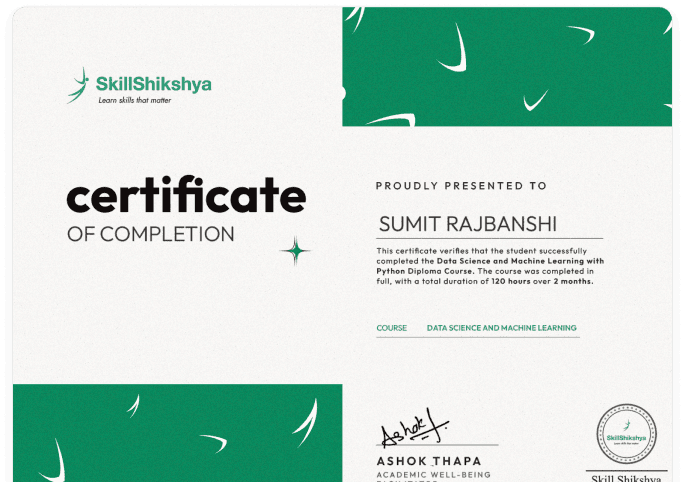
Earn a Certification & Advance Your Career
After completing the program, you will receive a certification from At Skill shikshya, the best online learning institute in Nepal. This certification helps demonstrate your professional skills when applying for jobs or freelance opportunities.
How We Make Learning Different
Thinking of enrolling? Here's what makes our courses different.

Beginner Friendly
Start from the basics and gradually progress to advanced concepts.

Expert Led Training
Learn from professionals with real-world industry experience.

Hands-On Projects
Work on practical projects and build a strong, portfolio-ready skillset.

Lifetime Learning Resources
Access learning materials, updates, and resources even after completing the program.

Career Support
Get guidance for job applications, internships, and career growth opportunities.

Industry Certification
Earn a recognized certification that validates your skills and knowledge.

Batch Repeating Options
Repeat sessions if needed to strengthen your understanding.

Free Workshops
Access additional workshops covering tools, trends, and evolving practices.
HR & CV Sessions
Resume building, interview preparation, and career counseling support.
Career Support
Our structured system helps you go from learning to applying it in real-world scenarios with confidence and direction.
Build real experience, present your skills professionally, and confidently step into jobs, internships, or freelance opportunities.
Join the Data Structures & Algorithms(AI Integrated) Course in Nepal Today
Build a strong foundation in problem-solving, arrays, trees, graphs, recursion, and algorithm design to become interview-ready for top tech companies.
Enroll Now
Frequently Asked Questions
Everything you need to know about our Professional Courses in Nepal
What is a Data Structures & Algorithms Course?
Who can enroll in this DSA course in Nepal?
What programming language is used in this DSA course?
Will this DSA course help me crack technical coding interviews?
Will I get a certificate after completing this DSA course?
Is there placement support after the DSA course?
Can I join this DSA course online?
How long will it take to see results from this DSA course?
Do I get lifetime access to DSA course materials?