NEPSE & Share Market Guide for Beginners: How to Start Investing in Nepal (2026)
Every year, thousands of Nepalis open their first Demat account chasing IPO screenshots and "NEPSE up today" messages on social media and just as many lose money in their first six months because nobody explained how the market actually works. That gap is measurable now, not just anecdotal: CDSC data reported by Kantipur shows Demat accounts crossing 8.13 million as of early August 2026, with roughly 4,200 new accounts opening every single day yet trading and MeroShare activity has grown far slower than account openings, which tells you a large share of new entrants are signing up without ever placing an informed trade.
This guide walks through exactly what the share market is, how NEPSE actually functions, and the step-by-step process to start investing the right way backed by current NEPSE, SEBON, and CDSC data rather than guesswork. If you want structured, hands-on training instead of piecing this together from YouTube comments, Skill Shikshya runs an in-person, 15-day beginner-to-advanced trading program in Baneshwor, Kathmandu, built to take complete beginners, including people with zero finance background to confident, independent investors.
This guide is for educational purposes only and does not constitute financial advice. Always do your own research or consult a licensed investment advisor before making investment decisions.
What Is the Share Market? (NEPSE Explained)
The share market, also called the stock market, is where ordinary people can buy small ownership pieces called shares or stocks in publicly listed companies. In Nepal, this all happens through one exchange: NEPSE, the Nepal Stock Exchange. NEPSE traces its roots to the Securities Exchange Center, established in 1976 under the Companies Act; it was converted into Nepal Stock Exchange Ltd. under the Securities Exchange Act, 1983, and its trading floor opened on 13 January 1994, according to NEPSE's own recorded history. NEPSE is headquartered at Singha Durbar Plaza, Kathmandu, and is itself partly government-owned the Government of Nepal, Nepal Rastra Bank, and the Employees Provident Fund together hold roughly 78% of NEPSE, with the remainder held by other shareholders.
When you own a share, you own a small slice of that company. If the company grows and becomes more valuable, your share generally becomes worth more too. If it earns a profit, you may also receive a portion of it as a dividend.
Understanding the share market meaning in the Nepali context matters because NEPSE works a bit differently from what you might see in Hollywood movies about Wall Street. Nepal's market is smaller, dominated by banking, insurance, and hydropower stocks, and moves in ways that are heavily influenced by local liquidity, interest rates, and investor sentiment, sometimes more than by company performance alone. That's exactly why structured learning matters more here than copying what you read on a random Facebook trading group.
NEPSE by the Numbers: The Share Market of Nepal Today
Before the how-to steps, it helps to see the actual scale of what you're entering. Here's where the share market of Nepal stood in official and media-reported data through mid-August 2026, drawn from Kathmandu Post market reporting, CDSC's own account figures, and ShareSansar's valuation coverage treat this as a snapshot, not a live feed, since figures for "NEPSE live" and "share market Nepal today" change every trading minute and should always be checked against NEPSE's own site or a licensed data terminal for real-time numbers.
| Metric | Figure | As of |
|---|---|---|
| NEPSE index (benchmark) | ~2,641–2,650 points | Aug 8–17, 2026 |
| Total market capitalisation | ~Rs 4.55 trillion | Aug 8, 2026 |
| Listed companies | ~284–286 | Early–mid 2026 |
| Total Demat (beneficiary) accounts | 8,130,358 | Aug 4, 2026 |
| Active MeroShare users | ~5.15 million | Jul 2026 |
| New Demat accounts opened daily | ~4,200 | Aug 2026 |
| Registered brokers | 92 | Sept 2024 (last widely reported count) |
| NEPSE overall P/E ratio | 38.32 | Late Oct 2025 |
| NEPSE's historical average P/E | 31.25 | — |
| All-time high NEPSE index | 3,198.28 | Mid-2021 |
A few things stand out in this data. First, participation has genuinely exploded. Demat accounts now represent roughly a quarter of Nepal's population, according to CDSC's own account breakdown reported by Kantipur (4.64 million held by men, 3.45 million by women, and about 9,600 by institutions). Second, the market has been through a real correction: after peaking near 3,198 in 2021, NEPSE ended 2025 around 2,634 and has traded in the 2,600s through most of 2026, per Merokalam's tracking of NEPSE closing data. Third, valuations look stretched by historical standards; a P/E ratio of 38.32 sits well above NEPSE's own 31.25 historical average and far above the 15–20 range that global analysts, including the CFA Institute, generally treat as a "healthy" long-term P/E band, according to ShareSansar's analysis. None of this tells you what to buy; it tells you why understanding valuation matters before you do.
How Does NEPSE Work? Key Players & Structure
Before you invest a single rupee, it helps to understand who does what in the Nepali capital market ecosystem:
- SEBON (Securities Board of Nepal): The regulator that oversees the entire capital market, protects investors, and enforces the Securities Act, 2007.
- NEPSE (Nepal Stock Exchange): The exchange itself, where shares of listed companies are actually bought and sold electronically through the Online Trading System (TMS). NEPSE replaced its open-outcry floor with an automated trading system in 2007.
- CDSC (Central Depository System and Clearing Limited): NEPSE's subsidiary that holds your shares electronically in your Demat account, similar to how a bank holds your money. CDSC was established in 2010, and dematerialisation of physical shares expanded from 2015 onward.
- Licensed Brokers: The companies you place your buy and sell orders through you cannot trade directly on NEPSE without going through one of its roughly 92 registered brokers, a list SEBON itself publishes.
- MeroShare: The online portal, run by CDSC, where you apply for IPOs, view your share holdings, and manage your Demat account. MeroShare does not itself let you place secondary-market trades that's what the broker's TMS is for.
Share Market Opening Time in Nepal And Why It's Sometimes Closed
NEPSE's regular trading runs Sunday through Thursday, following Nepal's working week, with Friday and Saturday as standing market holidays a detail that trips up plenty of first-time investors expecting a Monday-to-Friday schedule. On top of the weekly close, NEPSE also observes a published list of public and festival holidays each year, so "why is the share market closed today in Nepal" is almost always answered by either a Friday/Saturday or a gazetted holiday on NEPSE's official calendar the calendar itself is the only reliable source, since dates shift yearly with the Nepali calendar.
Within a trading day, the current session structure is:
- Pre-open session: 10:30 AM – 10:45 AM
- Regular trading: 11:00 AM – 3:00 PM
In April 2026, SEBON approved a further change allowing brokers to accept after-market orders between 6 PM and 6 AM, priced within roughly 2% of the day's last traded price, specifically to make it easier for Nepali investors living abroad to place orders outside NEPSE's core hours though execution still only happens once the regular market reopens, and the feature depended on NEPSE issuing its operational rollout directive. If you're asking "will the share market open tomorrow," the honest answer is: check NEPSE's holiday calendar for that specific date rather than assuming a standard Sunday–Thursday week, since exchange-wide closures for elections, strikes, or system upgrades do happen periodically.
Why Invest in the Nepal Stock Market?
- Building long-term wealth: Historically, investing in strong, well-managed companies over years rather than chasing daily price swings has been one of the more accessible ways for ordinary Nepalis to grow their savings beyond what a fixed deposit offers.
- Low entry barrier: Unlike real estate or starting a business, you can begin investing in NEPSE with a relatively small amount of money the minimum IPO application is typically just 10 units of shares, and secondary-market purchases can be smaller still making it one of the more accessible investment options in Nepal for students, young professionals, and first-time savers.
- IPO opportunities: Applying for Initial Public Offerings (IPOs) through MeroShare gives everyday investors a chance to buy shares at their original listing price before they start trading on the open market. IPO issuers must reserve at least 10% of shares for Nepalis working abroad, 10% for project-affected locals (where relevant), and 2–5% for company employees, with the remainder going to general public applicants usually through a lottery when the issue is oversubscribed, which is common.
- Growing financial literacy: More Nepalis than ever are opening Demat accounts, which means better access to information, more community discussion, and more structured share market classes to actually learn the fundamentals instead of guessing, including a track built specifically for students just finishing +2 who want a head start on budgeting, investing, and career planning before university.
How Share Prices Move (And Why the Market Halts Sometimes)
Understanding how the share market works day to day starts with one basic mechanism: price is set by the interaction of buy and sell orders in NEPSE's electronic order book, matched automatically through the TMS. More buyers than sellers at a given price pushes it up; more sellers than buyers pushes it down. This is also why questions like "why is the share market up/down today" rarely have one clean answer sentiment, banking-sector liquidity, interest rate movements, dividend and earnings announcements, and political news all feed into that order book simultaneously.
To stop single-day panic from spiralling, NEPSE and SEBON use a circuit breaker system, which was substantially revised in April 2026 after investors criticised the older, stricter rules for triggering repeated halts. Under the current two-tier structure:
- If the NEPSE index moves 5% (up or down) within the first two hours of trading, the market halts for 15 minutes.
- If, after reopening, the index moves a further 8%, trading is suspended for the rest of the day.
This replaced an older three-tier system that used to freeze trading after just a 4–6% move, which SEBON found was closing the market too often on ordinary volatile days a shift also covered in Kathmandu Post's reporting on the wider rule overhaul. Individual stocks also have their own daily price bands separate from the index-wide circuit breaker.
Every trade also settles on a T+2 cycle meaning the shares and cash from a trade you place today actually move into your Demat account and bank account two trading days later, handled automatically by CDSC. First-time investors who check their portfolio the next morning expecting to see a completed trade are usually just running into this settlement gap, not an error.
How to Start Investing in NEPSE: A Step-by-Step Roadmap
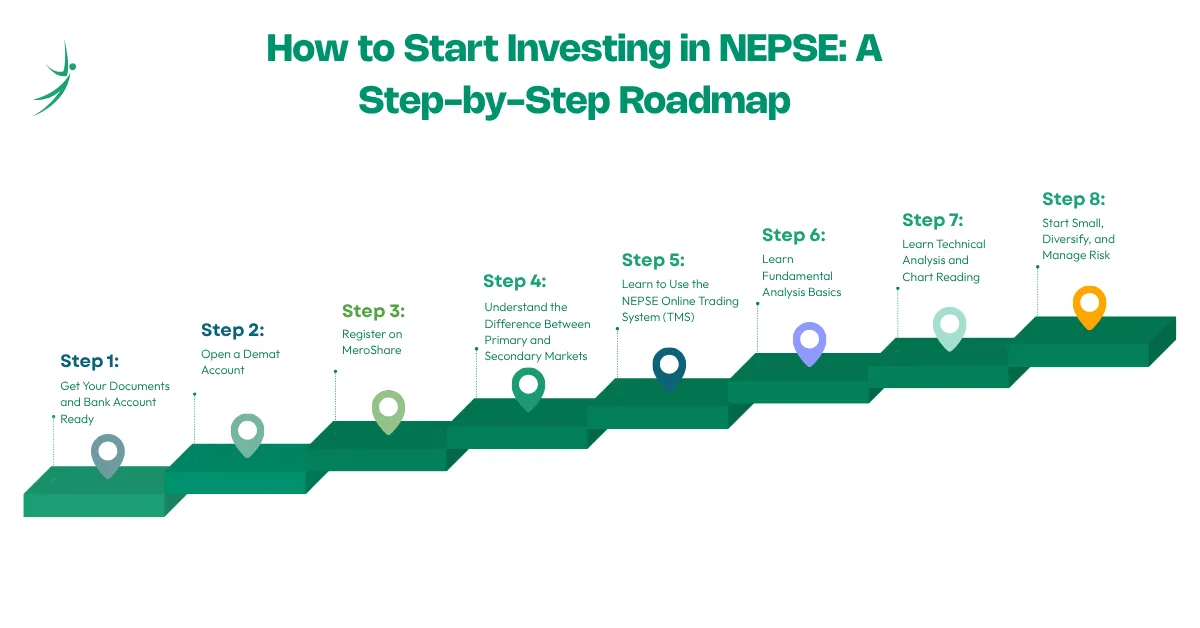
1. Get Your Documents and Bank Account Ready
You'll need Nepali citizenship documentation and an active bank account with a bank that offers Demat services, since your Demat account and bank account need to be linked for share transactions.
2. Open a Demat Account
A Demat account holds your shares electronically instead of as physical paper certificates. You can open one through any of Nepal's licensed depository participants — mostly banks and finance companies and it comes with a unique 16-digit BOID (Beneficiary Owner ID) issued by CDSC. Annual maintenance typically runs around Rs 100–200, and many banks now let you open the account fully online.
3. Register on MeroShare
Once your Demat account is active, register on the MeroShare portal. This is where you'll apply for IPOs, track your holdings, and manage most of your day-to-day account activity. Registration typically costs around Rs 50 one-time plus a small annual renewal fee.
4. Understand the Difference Between Primary and Secondary Markets
The primary market is where you apply for new shares through an IPO on MeroShare. The secondary market is NEPSE itself, where existing shares are traded between investors after they've already listed.
5. Learn to Use the NEPSE Online Trading System (TMS)
Once you're ready to buy or sell shares in the secondary market, you'll place orders through your broker's Trading Management System (TMS) — understanding order types, market depth (the live stack of buy and sell orders at each price level), and collateral requirements here is where most self-taught beginners get lost. Expect a flat DP charge of roughly Rs 25 per scrip per transaction, deducted automatically at settlement, plus your broker's commission.
6. Learn Fundamental Analysis Basics
Fundamental analysis means evaluating a company's actual financial health its earnings, debt levels, sector outlook, and management before deciding whether it's worth owning, using tools like EPS, P/E ratio, ROE, and book value.
7. Learn Technical Analysis and Chart Reading
Technical analysis is the study of price movement and trading volume through charts, candlestick patterns, and indicators like moving averages, RSI, and MACD to understand market sentiment and timing.
8. Start Small, Diversify, and Manage Risk
Never invest money you'll need in the next few months, and avoid putting your entire capital into a single stock or sector, no matter how confident a tip sounds remember that banking, financial institutions, and insurance alone make up roughly 52% of NEPSE's total market capitalisation, with hydropower a distant second at around 16%, so even a "diversified" portfolio can be more concentrated than it feels.
Trader vs Investor: Which Path Fits You?
One of the first concepts every beginner needs to untangle is the difference between a trader and an investor. An investor typically buys shares in fundamentally strong companies and holds them for years, focusing on long-term growth and dividends. A trader, on the other hand, buys and sells more frequently sometimes within days or even hours trying to profit from short-term price movements using technical analysis. Neither approach is inherently better; they simply require different skills, different time commitments, and different risk tolerances. Most successful long-term participants in NEPSE actually blend both: using fundamental analysis to choose what to buy, and technical analysis to help decide when.
Tax treatment differs by holding period too: for individual investors, capital gains on listed shares are taxed at 5% if held more than 365 days and 7.5% if held for a year or less, while institutional investors pay 10% withheld automatically by CDSC at settlement based on your holding period. That gap alone is a concrete, numbers-based reason long-term investing is structurally rewarded in Nepal's market.
Fundamental Analysis vs Technical Analysis: What's the Difference?
| Aspect | Fundamental Analysis | Technical Analysis |
|---|---|---|
| Focus | Company financials, earnings, sector health | Price charts, volume, market psychology |
| Time Horizon | Long-term investing | Short-to-medium term trading |
| Key Question | "Is this a good company to own?" | "Is this a good time to buy or sell?" |
| Tools Used | Financial statements, ratios, sector reports | Candlestick charts, RSI, MACD, moving averages |
| Best For | Long-term investors | Active traders |
Beginners often ask which one to learn first. In practice, a basic grounding in fundamental analysis helps you avoid buying weak companies, while technical analysis helps you time your entries and exits more effectively which is why most structured stock market courses in Nepal, including Skill Shikshya's, teach both together rather than picking one side.
Essential Tools Every NEPSE Investor Should Know
| Tool | Category | Primary Use Case |
|---|---|---|
| MeroShare | IPO & Account Management | Applying for IPOs, viewing your Demat holdings |
| NEPSE TMS (via your broker) | Trading Platform | Placing buy and sell orders, viewing market depth |
| NEPSE official site | Regulator/Exchange Data | Official index, holiday calendar, circulars |
| ShareSansar | Market News & Data | Live prices, floorsheet, IPO news, company announcements |
| NepseAlpha | Charting & Analysis | Technical indicators and fundamental data tools |
| CDSC Portal | Depository Records | Verifying your electronic share holdings |
| Excel / Google Sheets | Portfolio Tracking | Tracking your cost basis, dividends, and overall returns the same spreadsheet skills Skill Shikshya's Excel-to-Power BI track builds on for more advanced dashboards |
"Which share market app is best?" doesn't really have one universal answer it depends on what you're doing. For placing actual trades, you're limited to your specific broker's TMS app. For live charts, technical indicators, and daily NEPSE news, most investors layer on a data platform like ShareSansar or NepseAlpha alongside their broker's app rather than relying on one tool for everything.
Common Mistakes Beginner Investors Make in Nepal
- Following rumors instead of research: Buying a stock because "everyone" is talking about it on social media, without checking the company's actual fundamentals.
- No diversification: Putting most or all of your capital into one or two stocks, often in the same sector easy to do given how banking-and-hydropower-heavy NEPSE's overall weighting is.
- Panic selling: Selling in a hurry the moment prices dip, instead of sticking to a plan often triggered by the very circuit-breaker halts designed to give investors a cooling-off period.
- Ignoring the IPO lock-in period: Not understanding that some IPO allotments come with restrictions before you can sell.
- Trading on borrowed money: Using loans or margin facilities before understanding the risks involved.
- Skipping the learning phase entirely: Jumping straight into trading without understanding NEPSE's structure, order types, or basic chart reading first a real risk given that account openings (8.1 million-plus) are growing far faster than genuinely active, informed trading behavior.
Risk Management: How to Protect Your Capital
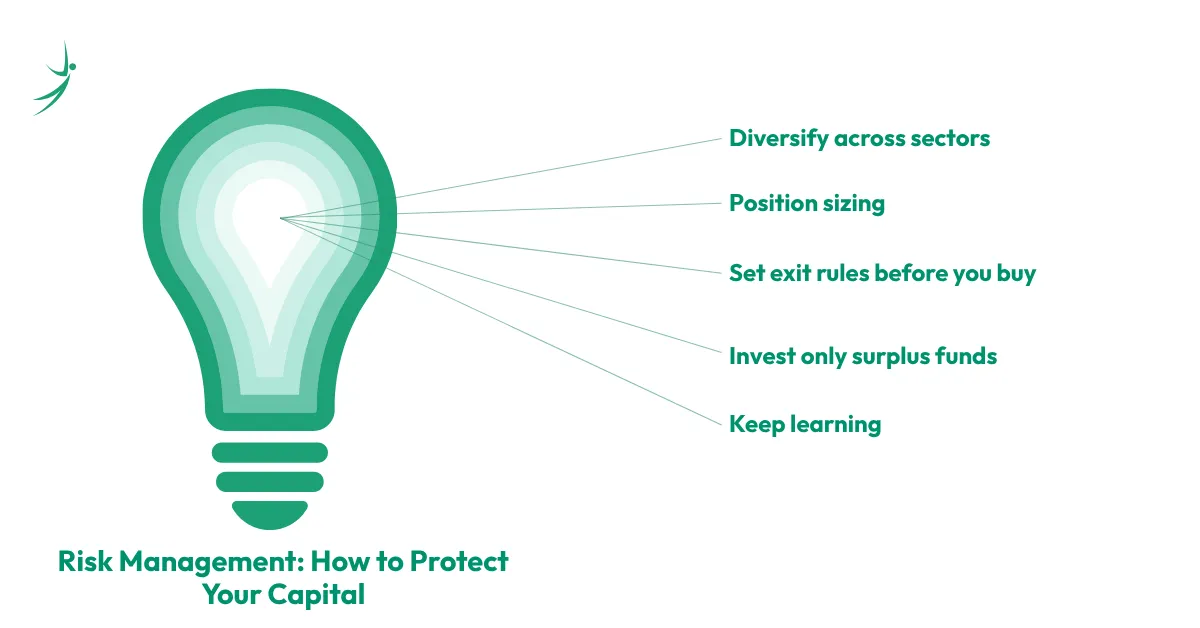
- Diversify across sectors: Spread your investments across banking, hydropower, insurance, and other sectors rather than concentrating in one.
- Position sizing: Decide in advance how much of your total capital you're willing to put into any single stock.
- Set exit rules before you buy: Decide your target profit and acceptable loss level before entering a position, not after.
- Invest only surplus funds: Never invest money you might need for rent, tuition, or emergencies within the next year.
- Keep learning: Markets evolve. NEPSE itself rewrote its circuit-breaker and settlement-adjacent rules as recently as April 2026, so information that was accurate a year ago may already be outdated.
NEPSE in a Global Context
A handful of searches around this topic "share market world," "stock market Pakistan," "share market India today" reflect genuine curiosity about how NEPSE compares. The short, factual answer: it's a much smaller, single-instrument market. NEPSE is Nepal's only stock exchange, trading roughly 284–286 companies purely as equities, with no derivatives, options, or short-selling a structural gap flagged by Nepal Investors Forum figures even as account numbers pass eight million, per Kathmandu Post's July 2026 reporting. India's NSE and BSE together list thousands of companies and offer a much wider range of instruments, while Pakistan consolidated its three regional bourses into a single Pakistan Stock Exchange (PSX) in 2016, whose benchmark KSE-100 index stood around 178,000 points in mid-August 2026, having risen roughly 19% over the preceding year according to PSX's own market data. Direct retail access to foreign markets from Nepal is limited by capital-control rules, so for practical purposes, "which share market is best" for a Nepali investor usually comes down to NEPSE by default rather than a genuine multi-market choice.
What's Next After Learning the Basics?
Once you're comfortable with the fundamentals, a few different paths tend to open up depending on your interests:
- Long-Term Value Investor: Focuses on building a diversified portfolio of fundamentally strong companies held for years.
- Active Trader: Uses technical analysis and chart patterns to trade more frequently around short-term price movements.
- IPO-Focused Investor: Specializes in applying for and managing primary market opportunities through MeroShare.
- Equity Research or Brokerage Career: For those who want to go further, understanding NEPSE deeply can open doors to roles at brokerage houses, merchant banks, or financial media though advising others professionally requires proper SEBON licensing, not just personal investing experience.
Learn Stock Market Investing with Skill Shikshya
If you've read this far and still feel like NEPSE is a maze of acronyms and jargon, that's exactly the gap Skill Shikshya's Stock Market & NEPSE Trading Masterclass is built to close. It's a 15-day, in-person program in Baneshwor, Kathmandu that starts from the absolute basics including a dedicated focus on simplifying numbers for people with zero finance background before moving into NEPSE structure, SEBON regulations, the TMS trading platform, candlestick patterns, trendline strategies, and technical indicators.
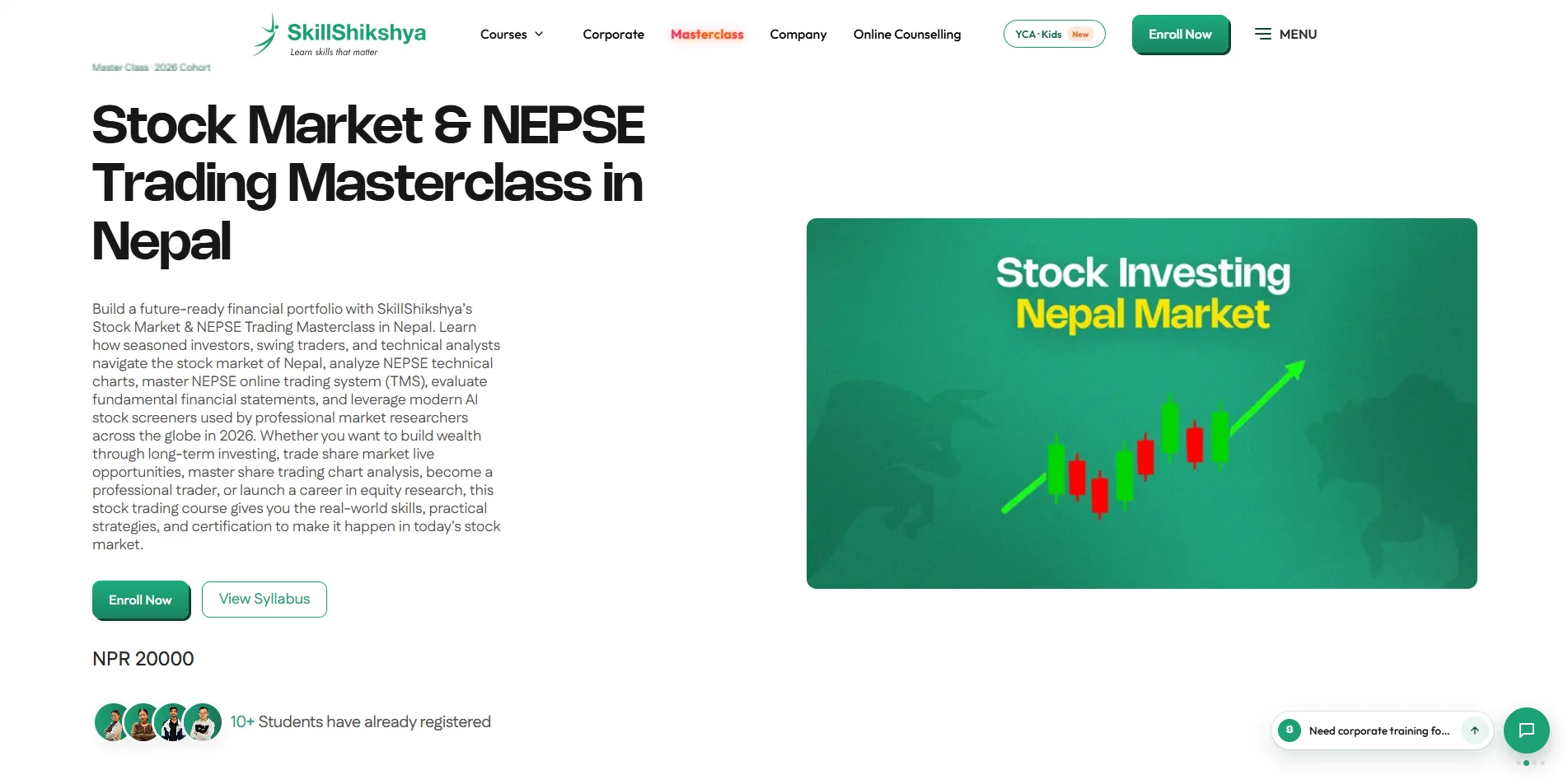
Rather than leaving you to piece together fundamental and technical analysis from scattered YouTube videos and Telegram groups, the masterclass teaches both side by side, so you leave understanding not just what to buy, but when. You'll also walk away with a completion certification you can point to when discussing your financial literacy and analytical skills, whether that's for your own investing confidence or for roles that value strong numerical and analytical thinking.
Not sure this is the right fit, or want to see what else is on offer? Browse Skill Shikshya's full lineup of expert-led finance, data, and career workshops, or book a free course consultation and one of our advisors will help you pick a track that matches where you're actually starting from.
Frequently Asked Questions
What is NEPSE?
How do I start investing in the Nepal stock market?
How many sectors does NEPSE track?
When does the share market open in Nepal, and why is it sometimes closed?
Is stock market investing safe in Nepal?
How much money do I need to start investing in NEPSE?
What is the difference between a Demat account and MeroShare?
Can I make stock trading a full-time career in Nepal?
Is a stock market course worth it for beginners?
How long does it take to learn technical analysis?
Which share market app is best?
About Author: