IT Course After Plus 2 in Nepal: 10 Reasons to Choose Skill Shikshya
So you just finished +2. Take a moment, that was genuinely hard work.
Now comes the part nobody really prepares you for. Everyone around you has a strong opinion about what you should do next. College applications. Entrance exams. Gap year. And somewhere in the middle of all that noise, someone probably mentioned an IT course.
Here is the honest truth: an IT course after Plus 2 can be one of the best decisions you make but only if you choose the right place to learn it.
There are plenty of IT training institutes in Nepal. Most of them look the same on the surface. Same posters. Same promises. Same "100% placement guarantee" written in big letters outside the door.
Skill Shikshya is different. This blog will show you exactly why, not with marketing words, but with specifics.
Not sure if IT is the right path for you? Book a free 30-minute counselling session with a Skill Shikshya mentor. No sales pitch. No pressure. Just honest guidance tailored to you.
What Makes Skill Shikshya Different From Other IT Training Institutes in Nepal?
Walk into almost any IT training institute in Kathmandu and ask what makes them different. You will hear the same three things everywhere: "We are practical," "Our teachers have industry experience," "We support your placement."
When every institute says the same thing, none of those words mean anything.
Skill Shikshya does not compete on slogans. It competes on outcomes. Nepal's IT sector crossed $1 billion in exports in 2025, growing at an estimated 18% annually. Real opportunities exist but only for students who graduate with real, demonstrable skills, not just a certificate.
That is the gap Skill Shikshya is built to close.
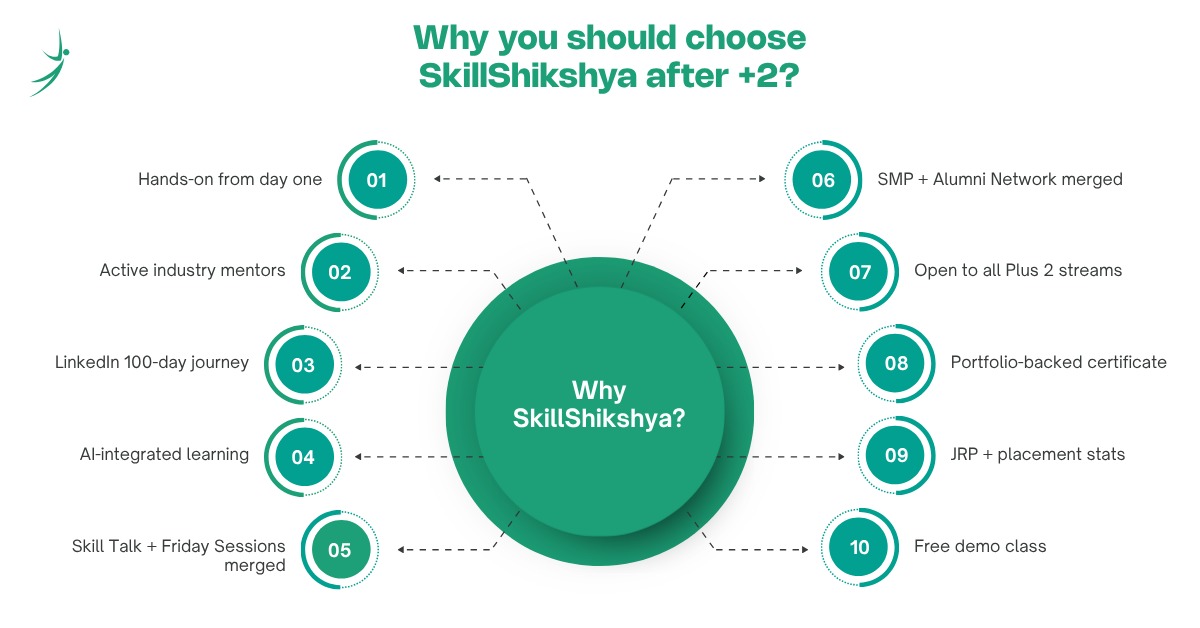
Here is where Skill Shikshya stands apart; backed by verifiable outcomes, not marketing language.
| Factor | Skill Shikshya | Typical Nepal IT Institute |
|---|---|---|
| When real work begins | Day 1; build immediately | After weeks of theory |
| Instructor background | Active industry professionals | Career teachers |
| Career building | During training (100-Day LinkedIn Model) | After graduation |
| AI integration | Built into every course | Limited or absent |
| Placement rate | 91% within 3 months | Certificate + best wishes |
| Proof of outcomes | Verified LinkedIn portfolios | Generic website testimonials |
| Pre-enrollment trial | Free demo class always available | Rarely available |
| Counselling | Personalised, free, zero pressure | Often a sales pitch |
1. Build on Day 1, Not Month 4
Most IT institutes follow the same pattern. You sit through weeks of theory. You watch slides. You take notes. Somewhere around month three or four, you finally get to touch a real project.
At Skill Shikshya, your very first session begins with one question from your mentor: "What do you want to build?"
Then you start building it together, from that day.
- Day 1: You are not watching a lecture. You are doing the actual work.
- Day 3: Concepts that felt abstract start connecting into a small, working project.
- Day 7: You have something real you built yourself; something you can open, show anyone, and talk about confidently.
This matters because skills do not develop through watching. They develop through doing. And when you build something real in your first week, your confidence shifts in a way that no lecture can create.
2. Mentors Who Work in IT, Not Just Teach It
There is a big difference between someone who teaches IT and someone who works in IT.
A career teacher knows the textbook. An active professional knows what Nepal's companies are actually hiring for this month because they are living it.
Every Skill Shikshya mentor is currently working in Nepal's IT field. They are building real products, working with real clients, and solving real problems every day. When they sit down to teach you, they are not reading from a syllabus written five years ago. They are sharing what works right now.
This means you learn tools, workflows, and skills that are immediately relevant, not outdated techniques that companies have already moved on from.
3. Your Career Starts Day 1
Here is something no other IT training institute in Nepal does.
From your very first day at Skill Shikshya, you publicly document your learning journey on LinkedIn for 100 consecutive days under #100DaysLearningSkill Shikshya.
By the time you graduate, you already have:
- A visible LinkedIn profile that recruiters in Nepal and abroad can find
- 100 days of public proof that you are consistent, serious, and capable
- A growing professional network built while you were still studying
- In many cases, hiring managers already reaching out before you have applied anywhere
Most institutes treat career building as something that happens after your course ends. Skill Shikshya builds your career during your course so that by graduation day, you are not starting your job search from scratch. You are already known.
4. Learn With AI, Not About It
In 2026, AI is not a trend. It is how Nepal's best developers, designers, and marketers do their work every single day.
The Stack Overflow Developer Survey 2025 found that 84% of developers now use or plan to use AI tools in their daily workflow. Companies are not looking for people who have heard of AI, they are looking for people who can actually use it.
At Skill Shikshya, AI tools are integrated into your learning from Day 1. You do not study AI as a separate topic. You use it as part of how you build, create, and solve problems throughout your entire training.
You graduate already working the way real companies work in 2026.
5. Weekly Industry Sessions That Close the Gap Between Class and Career
Textbooks tell you how things are supposed to work. Industry professionals tell you how things actually work. Skill Shikshya gives you both, every single week.
Skill Talk Sessions bring domain experts and working IT professionals into your learning journey on a regular basis. These are not motivational talks. They are practical, honest conversations about what is happening in Nepal's tech industry right now, the tools companies are adopting, the skills that are getting people hired, and what early-career professionals most commonly get wrong.
Every Friday, the focus shifts to the professional side of your development. Communication, confidence, interview readiness, workplace navigation, industry trends; the skills that separate a good developer from a complete professional. Most IT institutes ignore this entirely. Skill Shikshya treats it as non-negotiable.
Because the market does not just hire people who can code. It hires people who can communicate, collaborate, and show up ready.
6. A Support System That Stays With You; During and After Your Course
At most institutes, support ends the day your course does. At Skill Shikshya, it is just getting started.
During your training, the Student Mentorship Program (SMP) connects you directly with an industry-active IT professional invested in your personal growth. Your mentor brings current, real-world experience to every session; the tools, the hiring realities, the career decisions and helps you develop the specific, job-ready skills that align with where the market is heading. This is not a helpline you call when you are stuck. It is a structured relationship built to accelerate your career.
After you graduate, Skill Shikshya's Alumni Support Network keeps the doors open. Job referrals, networking opportunities, insider industry insights, and a community of working professionals who were once exactly where you are now. In Nepal's IT sector, who you know matters as much as what you know and the Skill Shikshya alumni network means you start building those connections from Day 1.
7. Any Background. Any Stream.
This is one of the most common worries students carry into their first counselling session: "I studied management. I studied humanities. Is IT still possible for me?"
The answer is yes, completely.
Skill Shikshya has students from every +2 background: science, management, arts, humanities. Many of the institute's most successful graduates did not come from technical streams at all.
What matters is not what you studied before. What matters is your willingness to show up, stay curious, and keep building.
Your free counselling session will match you to the right starting point based on your actual strengths and goals not your school subjects.
8. Authorized Certifications Backed by Real Work
A certificate means nothing if the company interviewing you has never heard of the institute that issued it.
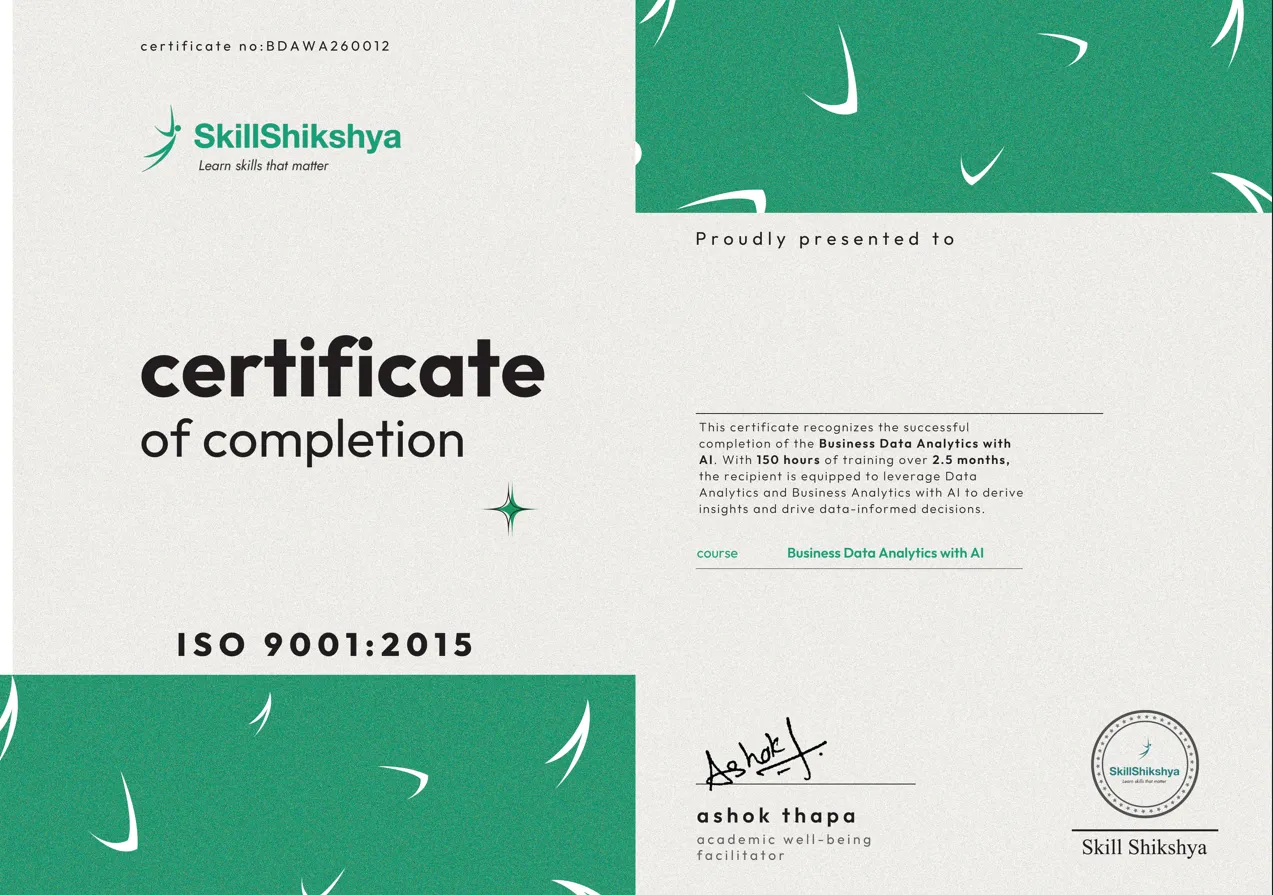
When you complete an IT course at Skill Shikshya, the certification you earn is backed by real, verifiable outcomes, not just a stamp at the end of a course. Skill Shikshya is an ISO 9001:2015 certified institution, which means the training standards, processes, and quality benchmarks you learn under are internationally recognized. On top of that, Skill Shikshya's certificates carry weight because they are tied to a public portfolio, 100 days of documented work, and skills that hiring managers in Nepal's IT sector can test on the spot.
That combination certificate plus portfolio plus LinkedIn presence is what separates a Skill Shikshya graduate from someone who simply attended classes and collected a piece of paper.
By the time you finish, you will not just have a certificate to show. You will have the work to back it up.
9. 91% Placed in 3 Months
"Placement support" is a phrase every institute uses. Very few define what it actually means.
At Skill Shikshya, placement support means:
- Portfolio reviews before you start applying
- Mock interview preparation so you walk into any interview confident
- Direct referrals to hiring companies through Skill Shikshya's network
- The Job Ready Program (JRP), which guarantees a job or internship upon successful completion
The result: 91% of Skill Shikshya graduates are placed within 3 months of completing their course.
That number exists because support starts from Day 1, not as an afterthought on the last day of class. By the time you graduate, you already have a portfolio, a LinkedIn presence, and a network. You are not starting from zero.
10. Try Before You Pay
Before you enroll, you can attend a free demo class. No payment. No commitment. No pressure.
You get to see the teaching style, meet the mentors, understand what Day 1 actually looks like, and decide from experience not from a brochure.
An institute that is confident in what it offers invites you to experience it first. That is what Skill Shikshya does.
Real Students Who Chose an IT Course After Plus 2 at Skill Shikshya
Testimonials on a website prove nothing. Skill Shikshya's results are publicly searchable.
Open LinkedIn and search #100DaysLearningSkill Shikshya, you will find real students, real projects, and real career journeys you can verify yourself.
Aryan: From Zero Coding Background to Flutter Developer
Aryan passed SEE from Gautam School in 2023 with no coding experience at all. By Day 45 at Skill Shikshya, his first Flutter app was running on a real phone. By Day 100, it was live on the Play Store with the entire journey documented publicly on LinkedIn.
A hiring manager at a Kathmandu startup had been following the posts for weeks and reached out before Aryan had applied anywhere. Today, Aryan works as a junior Flutter developer earning a competitive salary.
Monika: Management Background to International Freelancing Client in 3 Months
Monika completed +2 in Management and worried that a non-science background would make IT too difficult. During her free counselling session, a Skill Shikshya mentor recommended a track that matched her communication strengths without requiring heavy programming.
Within three months, she landed her first international client on Upwork.
Is an IT Course After Plus 2 at Skill Shikshya Right for You?
Skill Shikshya is built for students who:
- See training as an investment, not a cost: A real job, real freelancing income, a real career, those outcomes make the investment worthwhile.
- Want to build real things, not just collect a certificate: Every Skill Shikshya graduate finishes with real, portfolio-worthy projects.
- Are ready to show up consistently: You do not need to be the most talented person in the room. You need to show up, stay curious, and keep building.
Not sure if you are ready? That is completely normal and exactly why the free counselling session exists.
Your Next Step Starts Here
You now have a clear, honest picture of IT courses in Nepal after Plus 2: what to look for, which skills are in demand in 2026, and how to avoid wasting time and money on the wrong institute.
The next step is simple.
- Step 1 - Book your free counselling session: 30 minutes with a Skill Shikshya mentor. Honest, personalized guidance based on your background and goals.
- Step 2 - Attend a free demo class: Experience the teaching before you pay a single rupee.
- Step 3 - Enroll and start building from Day 1: Your first project. Your first LinkedIn post. Your first step toward a real IT career in Nepal.
Frequently Asked Questions About IT Course after +2
Can I join Skill Shikshya without any prior IT knowledge?
Can I attend a class before paying anything?
I studied Management or Humanities in Plus 2. Can I still do IT?
Does Skill Shikshya guarantee a job after the course?
How are classes conducted at Skill Shikshya?
What happens if I miss a class?
How long does an IT course after +2 take at Skill Shikshya?
About Author: