How to Build an IT Career in Australia, USA, Canada & UK as a Nepali Student
Every year, thousands of Nepali students venture overseas for higher education, with technology and software engineering ranking among the most sought-after fields. Building a successful IT career abroad requires more than just enrolling in a degree program. Simply completing university coursework rarely guarantees employment in competitive global tech hubs. Global employers prioritize demonstrable technical skills, real-world projects, verified problem-solving capabilities, and market readiness over degree certificates alone.
Choosing the right technology path depends on evaluating your personal strengths, building practical project portfolios, and understanding the distinct recruitment requirements of target countries. Australia, the USA, Canada, and the UK each present unique study pathways, work rights, visa frameworks, and local tech market structures. Preparing early by taking industry-aligned career-focused IT courses helps international students build the practical capabilities needed to transition from academic study to professional employment.
What Do You Need to Build an IT Career Abroad?
Key Steps to Build Your IT Career Abroad
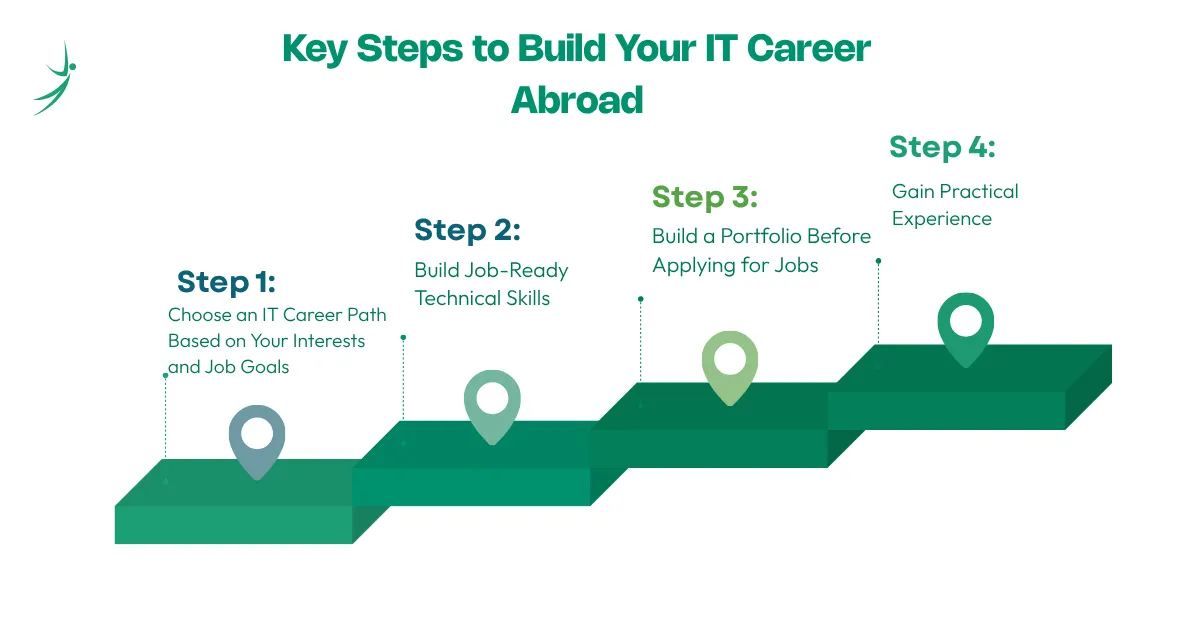
1. Choose an IT Career Path Based on Your Interests and Job Goals
Selecting an IT field aligned with your aptitudes and local job market demands is the essential first step. Core technology specializations include:
- Software and Web Development: Focuses on front-end, back-end, and full-stack engineering using modern programming languages and frameworks.
- Data Science and AI: Centers on machine learning models, statistical analysis, predictive modeling, and data pipelines.
- Cybersecurity: Specializes in network security, threat intelligence, cloud security, and risk assessment.
- Cloud and DevOps: Focuses on infrastructure management, continuous integration/continuous deployment (CI/CD), and public cloud platforms.
- Data Analytics: Blends business intelligence, data visualization, and database query optimization.
- UI/UX Design: Combines user experience research, wireframing, and interactive design interfaces.
2. Build Job-Ready Technical Skills
Employers assess entry-level tech talent based on execution capability. Core competencies to master include:
- Programming Foundations: Proficiency in languages such as Python, JavaScript, Java, C++, or Go.
- Databases and Data Management: Relational databases (SQL Server, PostgreSQL) and non-relational systems (MongoDB).
- Cloud Architecture: Basic operation in AWS, Azure, or Google Cloud Platform.
- Security Fundamentals: System authentication, identity management, and secure coding practices.
- Data & AI Tools: Data analysis frameworks (Pandas, NumPy) and generative development tools.
3. Build a Portfolio Before Applying for Jobs
Theoretical knowledge alone will not pass modern tech interviews. Nepali students must establish public proof of their capabilities:
- Maintain an active GitHub repository with clear commit histories.
- Deploy functional, end-to-end web or mobile applications to public cloud servers.
- Write detailed technical case studies documenting project architecture and software decisions.
- Host a personal portfolio website presenting your projects, technical skills, and background.
4. Gain Practical Experience
Work experience acquired during study provides a major competitive edge during post-graduation job searches:
- Secure local or remote internships during academic breaks.
- Participate in part-time technical support or developer assistant roles.
- Deliver freelance client work or complete verified volunteer projects.
- Contribute code fixes and documentation to open-source software projects.
How to Build an IT Career in Australia as a Nepali Student
1. Understand Australia's IT Career and Study Pathways
Australia remains a major destination for international education due to clear post-study work avenues. Success in the Australian job market requires understanding local hiring expectations early, adhering strictly to student visa work conditions, and matching university studies with industry skill requirements.
2. Choose the Right IT Courses and Skills
Evaluating IT courses in Australia requires matching academic study with high-growth technical domains. Key demand areas across Sydney, Melbourne, and Brisbane include software engineering, data management, and network defense.
For international students researching IT courses in Australia for international students, practical coursework combined with practical skill acquisition yields the highest return. Evaluating specialized programs such as a Data Science course in Australia allows learners to develop production-ready data skills alongside formal degree studies. Students exploring ITtraining in Australia should prioritize structured modules in software engineering, data science, and cloud operations.
3. How to Become Job-Ready for Australia's IT Market
Understand Australia's IT Career and Study Pathways
Australia remains a major destination for international education due to clear post-study work avenues. Success in the Australian job market requires understanding local hiring expectations early, adhering strictly to student visa work conditions, and matching university studies with industry skill requirements.
Choose the Right IT Courses and Skills
Evaluating IT courses in Australia requires matching academic study with high-growth technical domains. Key demand areas across Sydney, Melbourne, and Brisbane include software engineering, data management, and network defense.
For international students researching IT courses in Australia for international students, practical coursework combined with practical skill acquisition yields the highest return. Evaluating specialized programs such as a Data Science course in Australia allows learners to develop production-ready data skills alongside formal degree studies. Students exploring ITtraining in Australia should prioritize structured modules in software engineering, data science, and cloud operations.
How to Become Job-Ready for Australia's IT Market
Securing employment in the Australian market requires a deliberate step-by-step approach:
IT Courses in Australia: What Should International Students Consider?
When comparing options, evaluate key delivery metrics:
- Curriculum Currency: Ensures instruction includes modern tech stacks and contemporary engineering workflows.
- Project-Based Learning: Evaluates whether students build live applications or complete theoretical exams only.
- Financial Investment: Reviewing IT course in Australia fees relative to practical career support and mentorship included.
- Schedule Flexibility: Programs structured to complement academic university schedules.
How to Build an IT Career in the USA as a Nepali Student
1. Understand the US IT Job Market Before Choosing a Career Path
The United States represents the world's largest software market, offering high earning potential alongside intense candidate competition. US recruiters place heavy weight on specialized skill sets, demonstrably complex technical projects, structured internships, and direct networking via technical events and online platforms.
2. Which IT Courses and Skills Can Help You Prepare?
Preparing for US roles involves focusing on specialized areas. Studying IT courses in the US or exploring the best IT courses in the USA requires targeted focus in software engineering, distributed systems, machine learning, or cybersecurity.
- Software Engineering: Object-oriented design, microservices, and system architecture.
- Data Science & AI: Deep learning architectures, statistical model building, and data engineering.
- Cybersecurity: System hardening, penetration testing, and enterprise security architecture.
International students targeting IT training in US should combine theoretical coursework with specialized external modules to stand out in technical evaluations.
3. Build a Strong Technical Portfolio for US Opportunities
To capture the attention of US tech recruiters, international applicants should compile evidence of high-level technical capability:
- Participate in national hackathons and open-source coding challenges.
- Maintain clean GitHub repositories featuring technical documentation and unit test coverage.
- Write technical blog posts breaking down complex software architecture decisions.
- Leverage LinkedIn to connect directly with software engineering managers and recruiters.
4. How International Students Can Continue Building Skills While Studying
Academic degree schedules can be demanding, making flexible learning channels essential. Enrolling in IT courses online with certificates allows students to master specialized tools without disrupting formal university attendance. Learners pursuing a data science course online can acquire core statistical modeling and Python capabilities at their own pace.
How to Build an IT Career in Canada as a Nepali Student
1. Understand Canada's IT Career Requirements and Local Job Market
Canada offers steady growth across major tech hubs like Toronto, Vancouver, Montreal, and Calgary. Succeeding in the Canadian tech landscape requires understanding local employer preferences, adapting application materials to Canadian hiring standards, and targeting regional industry specializations.
2. IT Courses and Training Options for Students Preparing for Canadian Tech Careers
Evaluating IT courses in Canada involves selecting training environments that emphasize practical application over memorization. Canadian tech employers value candidates who can contribute code to team repositories on their first day.
3. Focus on In-Demand Technical Skills
Major Canadian industry sectors seek candidates proficient across key core technical paths:
- Cloud Infrastructure: Terraform, Docker, Kubernetes, AWS, and Azure management.
- Cybersecurity: Identity management, network auditing, and compliance management.
- Data Engineering & Analytics: Enterprise database administration, ETL pipeline development, and data visualization.
4. Build Canadian Job-Search Readiness
- Tailor CVs to standard Canadian formats, focusing on measurable technical contributions.
- Engage actively with local tech meetups and campus technology societies.
- Seek co-op terms and technical internships early in academic programs.
- Build direct connections with technical recruiters on professional networks.
How to Build an IT Career in the UK as a Nepali Student
1. Understand the UK Technology Job Market
The United Kingdom features a rapidly evolving tech sector, centered in London and expanding across regional hubs such as Manchester, Birmingham, and Edinburgh. UK employers evaluate candidates based on targeted skills, practical experience, and alignment with specific role requirements.
2. Which IT Courses Are In Demand in the UK?
Students asking which courses are in demand in the UK or evaluating which course is best for a job in the UK should recognize that no single title guarantees success. Employability depends on mastering technical skills matching live job postings.
3. The primary options targeting IT courses in UK include:
- Software Engineering: JavaScript/TypeScript, React, Node.js, and Java backend development.
- Data Science & AI: Machine learning frameworks, predictive analytics, and enterprise reporting. Learners targeting regional hubs can review specialized tracks such as a Data Science course in the UK.
- Cybersecurity: Security operations center (SOC) analysis, network defense, and vulnerability management.
Students evaluating IT short courses in UK or IT training in the UK often utilize modular programs to gain rapid proficiency in focused skill areas.
4. Build Practical Experience Alongside Your Studies
- Participate in university tech societies, hackathons, and developer communities.
- Contribute to open-source software projects to build verifiable public commits.
- Target student internships, spring insight weeks, and placement terms.
Short IT Courses vs Degree-Level Study: What Should Students Consider?
While university degrees fulfill formal academic requirements, short specialized IT courses provide flexible, targeted instruction focused on current industry frameworks. Combining formal academic study with focused practical modules ensures students develop both theoretical foundation and production-ready implementation skills.
Which IT Career Path Is Right for You?
Selecting a technology track requires matching personal interests with technical demands and international market opportunities.
| Career Path | Best For | Core Skills to Build | Sample Portfolio Project |
|---|---|---|---|
| Software Development | Students who enjoy building user applications and complex systems | JavaScript/React, Python, Java, SQL, Git | Full-stack e-commerce web platform |
| Data Science & AI | Students interested in advanced mathematics, data, and machine learning | Python, SQL, Pandas, Scikit-Learn, TensorFlow | Predictive customer churn machine learning model |
| Cybersecurity | Students focused on network protection, systems, and defense | Networking, Linux, Python, penetration testing, security frameworks | Isolated vulnerability assessment lab |
| Cloud & DevOps | Students interested in infrastructure automation and deployment | Linux, AWS/Azure, Docker, Kubernetes, CI/CD pipelines | Automated cloud deployment infrastructure setup |
| Data Analytics | Students interested in business data insight and analytics reporting | SQL, Excel, Power BI/Tableau, Python | Interactive business performance dashboard |
Country-specific demand varies across regions. High-growth sectors like cybersecurity in us, Australia, and the UK show steady hiring. Similarly, specialized roles in data science in us, Australia, UK, and tech hubs driving data science in London actively seek individuals with strong analytical portfolios.
How to Choose IT Courses That Support Your International Career Goals
Look Beyond the Certificate
A completion certificate verifies attendance, but a portfolio proves capability. Select courses that incorporate project builds, live code reviews, and practical assignments over theoretical lectures.
Choose Training Based on Your Target Role
Align your skill development directly with target job requirements:
- Targeting Data Roles: Master SQL, Python, data modeling, and data pipelines.
- Targeting Cybersecurity Roles: Develop expertise in Linux administration, network architecture, and security protocols.
- Targeting Developer Roles: Build production-ready web or mobile applications with clean architecture and automated test suites.
Consider Flexible and Career-Focused Learning Options
Selecting modular, flexible skill programs allows international students to gain industry-aligned competencies alongside their degree studies. Exploring specialized external IT training programs helps bridge the gap between academic theory and practical enterprise recruitment expectations.
A Step-by-Step IT Career Roadmap for Nepali Students
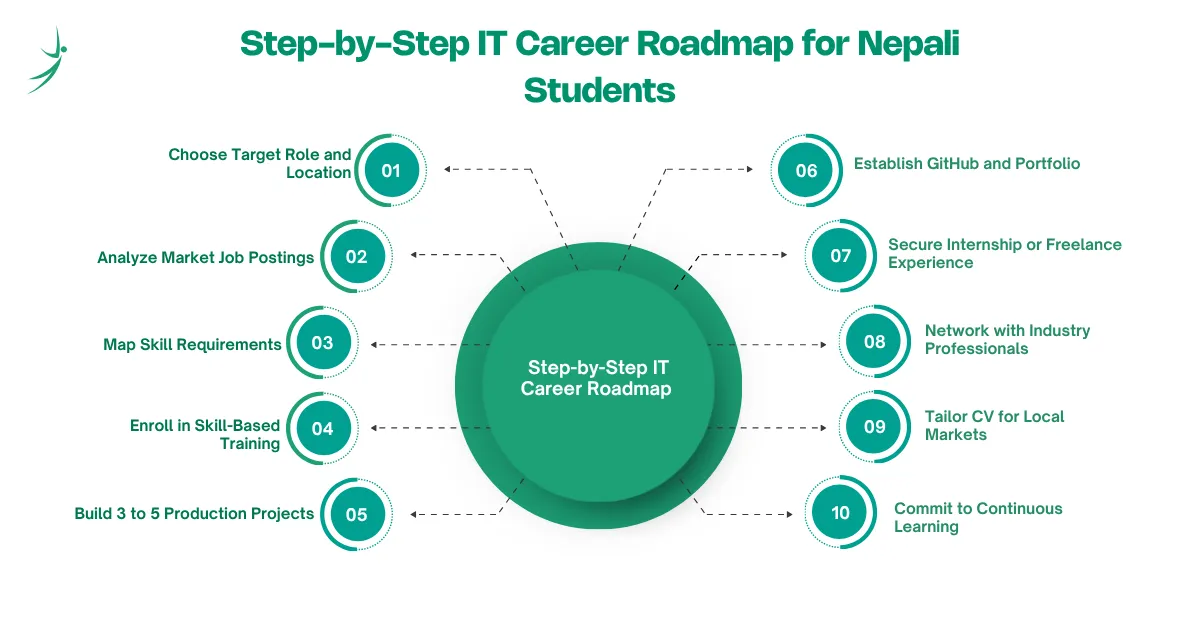
- Choose Target Role and Location: Identify your preferred tech domain and study destination early.
- Analyze Market Job Postings: Review current entry-level job descriptions in your destination market to identify required tools.
- Map Skill Requirements: List technical competencies mandatory for your chosen specialization.
- Enroll in Skill-Based Training: Complete practical courses to acquire missing technical competencies.
- Build 3 to 5 Production Projects: Develop functional, deployed applications solving real-world challenges.
- Establish GitHub and Portfolio: Publish source code with comprehensive setup guides and clean documentation.
- Secure Internship or Freelance Experience: Acquire practical work history during academic studies.
- Network with Industry Professionals: Build connections with engineers, alumni, and tech recruiters.
- Tailor CV for Local Markets: Customize your resume to match the regional formatting standards of your target country.
- Commit to Continuous Learning: Keep pace with evolving frameworks, cloud platforms, and generative AI tools.
Common Mistakes Nepali Students Should Avoid When Preparing for an IT Career Abroad
- Relying Solely on Academic Degrees: Expecting a university diploma alone to guarantee immediate tech job offers without personal project proof.
- Prioritizing Certifications over Projects: Collecting course certificates while lacking functional code repositories or deployed applications.
- Neglecting GitHub Documentation: Uploading unstructured code without clear README files, setup instructions, or architectural explanations.
- Ignoring Local Job Market Demands: Studying outdated tech stacks without reviewing active job postings in target cities.
- Using Generic CVs Across All Applications: Submitting identical application materials without tailoring skills to specific job descriptions.
- Delaying Job Preparation Until Graduation: Waiting until degree completion to begin portfolio building and professional networking.
- Assuming Guaranteed Visa or Employment Outcomes: Failing to check official government resources for accurate, current work visa regulations.
Start Building Your IT Career Before You Need to Apply
Choosing an international destination is only one piece of building a global tech career. Degree credentials can open academic doors, but practical execution skills, demonstrable project portfolios, relevant internship experience, and awareness of employer expectations are what help candidates compete for professional roles.
Begin preparing early by evaluating your career goals, identifying the technical skills required for your target role, and developing those skills through practical, project-based IT training before building a public portfolio and submitting your first job application.
Frequently Asked Questions
Can a Nepali student get an IT job in Australia?
Can international students work in IT in Canada?
Which IT field is best for jobs in the UK?
Which IT skills should I learn for jobs in the USA?
Do I need a computer science degree to start an IT career?
What should I check before choosing an IT course for an international career?
About Author: