Graphic Design Career Roadmap Nepal 2026: Skills, Tools, Salary & How to Get Hired
A logo project lands in your inbox. A restaurant needs a new menu, a startup needs a full brand identity, a clothing brand needs Instagram creatives for the next six months. Somewhere between "I like making things look nice" and actually getting paid for it sits a graphic design career and most people never get a straight answer about what that path actually looks like.
This guide is that answer. It covers what a graphic designer actually does day to day, whether graphic design is still a good career in 2026, every realistic career path the field branches into, the skills and tools that get you hired, what you can expect to earn in Nepal and worldwide, and a practical roadmap for getting there whether you're a student, a career switcher, or someone quietly wondering if this is a real profession or just a hobby with a Behance account.
Why a Graphic Design Career Matters in 2026
Visual content isn't optional for businesses anymore it's the default language of marketing, product, and social media. Every Instagram post, every app icon, every product package, every pitch deck someone half-pays-attention-to in a meeting was designed by someone. That "someone" is increasingly in demand.
A few numbers make the case better than opinion does:
- The global graphic design market was valued at roughly $45.8 billion in 2026 and is projected to reach $78.3 billion by 2032, according to Fortune Business Insights meaning the field is expanding, not shrinking, despite constant "is design dead" headlines.
- The U.S. Bureau of Labor Statistics places the median annual wage for graphic designers at $61,300 as of its most recent data, with the occupation remaining a stable, widely available career path across nearly every industry.
- 75% of designers now use AI tools in their workflow, up from just 35% in 2023 and designers fluent in AI-assisted tools report earning roughly 12% more than peers who aren't, according to Design Industry Association research. AI hasn't replaced the profession; it's changed which skills inside it are worth more.
- Remote design roles grew 150% between 2020 and 2025, and an estimated 90% of graphic designers worldwide do at least some freelance work a genuinely strong signal for anyone in Nepal thinking about international clients without relocating.
For Nepal specifically, the growth in digital marketing agencies, e-commerce brands, and startup branding needs has pushed graphic design from a "nice skill to have" into a standard line item most small businesses now budget for.
Is Graphic Design a Good Career in 2026?
Is graphic design a good career? For most people who genuinely enjoy visual problem-solving, yes with a caveat. It's a good career for people willing to specialize and keep building a portfolio, not for people expecting a static skill set to carry them for a decade.
Is graphic design good career in the AI era specifically? The honest answer is that graphic design as a career is shifting rather than shrinking. Purely repetitive execution work (basic resizing, template filling) is exactly what AI tools now handle in seconds. What's growing in value is strategic thinking brand storytelling, understanding a client's actual problem, and directing AI tools rather than being replaced by them.
Graphic design as a career also offers something few technical fields do: a genuinely low barrier to entry. You don't need a computer science degree or years of theory before you can start earning a strong portfolio and consistent client work matter more than credentials in most hiring conversations, in Nepal and internationally alike.
What Does a Graphic Designer Actually Do?
This is one of the most commonly searched questions about the field, and it deserves a direct answer rather than a vague one.
What is a graphic designer?
A graphic designer is a visual communicator someone who uses typography, imagery, color, and layout to convey a message, promote a product, or build a brand identity. Put simply, what's a graphic designer if not a professional translator between a business idea and the image that represents it. If a marketer decides what needs to be said, a graphic designer decides how it looks saying it.
What do you do as a graphic designer, and what does that path toward becoming one look like?
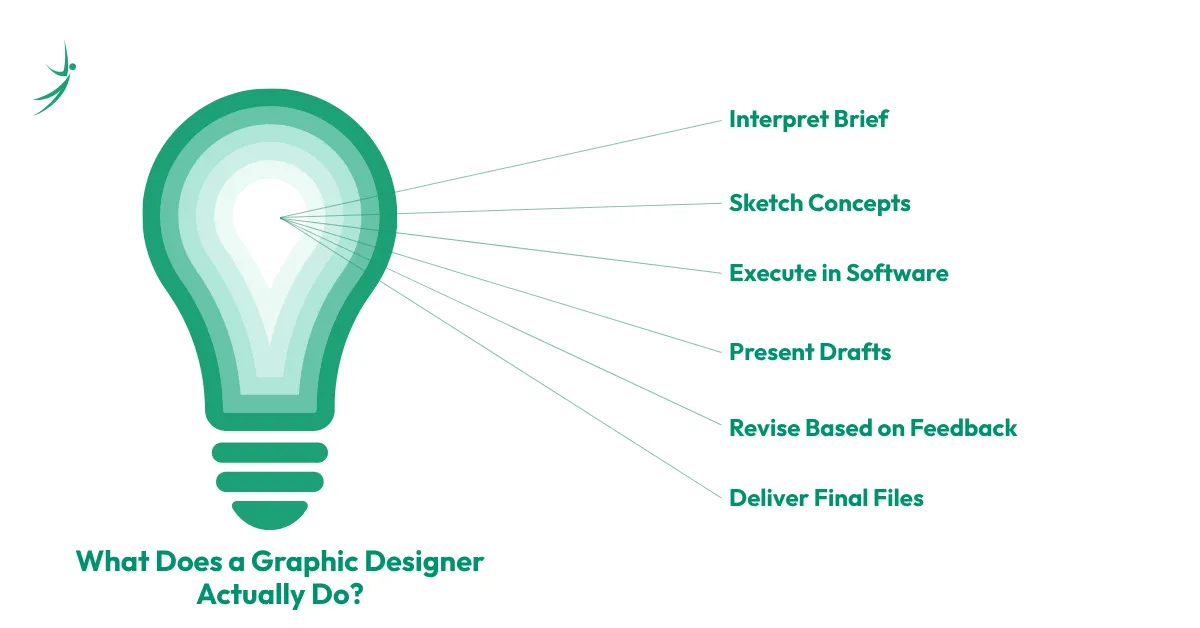
Someone who wants to become graphic designer status usually starts by asking exactly this. What do graphic designers do, practically, is best described as a repeatable process rather than a single task: interpret a brief, sketch concepts, execute in software, present drafts, revise based on feedback, and deliver final files. A junior graphic designer career looks different day-to-day than a senior one, but the core loop stays the same at every level.
What can a graphic designer do beyond logos and posters?
Far more than most people assume. What graphic designers do spans branding and identity systems, packaging design, social media creative, editorial and magazine layouts, motion graphics and animation, UI/UX design crossover work, presentation design, and even game and environmental design.
What do graphic artists do differently from graphic designers?
In practice, the terms overlap heavily. "Graphic artist" leans slightly more toward illustration and original artwork, while "graphic designer" leans toward structured, brief-driven visual communication but most job postings use the terms interchangeably. Day-to-day, what does a graphic designer do that a pure illustrator doesn't: manage client briefs, work within brand guidelines, and prepare production-ready files, not just original artwork.
What is a graphic designer's job actually measured by?
Not just "does it look good," but whether the design solves the stated problem: does the logo actually feel right for the brand, does the ad creative drive clicks, does the packaging stand out on a crowded shelf. Client and stakeholder feedback loops are a constant, unavoidable part of the graphic design job.
Graphic Design Career Paths: The Complete List
One of the most search-common questions in this space is simply "what jobs can you get from graphic design" and the honest answer is that it branches far wider than most beginners expect. Whether you frame it as career paths for graphic designers, graphic designer careers, or the broader graphic design career path a specific person ends up on, the underlying list of destinations is the same. Here's a breakdown of the real graphic design careers list, organized by how the field typically progresses.
The Standard Career Ladder
Most graphic design career paths follow a recognizable progression, whether you're in-house or at an agency:
- Junior Graphic Designer Handles smaller, supervised tasks: layout adjustments, logo variations, color corrections, and template work, while learning from senior designers.
- Graphic Designer Owns full projects from concept to final file, works more directly with clients, and has meaningfully more creative control.
- Senior Graphic Designer Leads larger campaigns, mentors junior designers, and often manages client relationships directly.
- Art Director / Creative Director Shifts focus from hands-on design toward overall creative direction, team leadership, and aligning design output with business and marketing strategy.
Specialized Careers Involving Graphic Design
Beyond the standard ladder, these are the specific careers related to graphic design worth knowing about, since many pay noticeably more than generalist roles:
- Brand Identity Designer Focused specifically on logos, brand guidelines, and visual identity systems.
- UI/UX Designer Careers with graphic design degree holders frequently pivot here, applying visual design skill to digital product interfaces; this is consistently one of the highest-paying careers that use graphic design skill.
- Motion Graphics Designer / Animator Combines design with animation for video, social content, and advertising a fast-growing branch of the graphic and design careers, especially with the rise of short-form video content.
- Packaging Designer Specializes in product packaging, a niche with strong demand from FMCG and e-commerce brands.
- Web Designer Focuses on the visual layer of websites, often working alongside developers.
- Illustrator A more artistic branch, producing original artwork for books, editorial content, or brands.
- Production Artist / Prepress Specialist A technical specialization preparing final files for print production less creative, but consistently in demand.
- Freelance / Independent Designer Not a job title so much as a business model; many designers eventually run their own client base rather than staying employed full-time.
For anyone asking what jobs can you get from graphic design beyond "designer" itself art teacher, design educator, print production manager, and creative studio manager are all realistic destinations once you have a few years of experience behind you.
Different Careers in Graphic Design, By Whatever Name You Search For Them
Different careers in graphic design tend to get searched under slightly different phrasing depending on who's asking. A student might search graphic design major careers or graphic design profession while researching a degree; a career switcher might search careers with a graphic design degree or careers with graphic design degree while weighing a pivot; a recruiter might post a listing under graphic design job roles or simply what is graphic designer job. All of these point at the same underlying career graphic a visual communication role, whatever the exact wording. Careers in graphic design, careers in graphics, and career graphics are really the same search intent typed three different ways, and career in graphic (without the "s") shows up just as often from people typing quickly on mobile.
For a full graphic design career description in one sentence: it's a visual-communication role, at any of the levels or specializations above, judged on whether the work solves the client's actual problem not just whether it looks polished. (If you searched this topic under a slightly different spelling "graphic desginer" is a common typo that still lands people on this exact page you're in the right place.)
A quick note on phrasing: whether you think of it as graphic design as career, graphic design as a career, or simply a graphic designer career path, and whether you're mapping out what a graphic designer do across ten years or just the next two, the roadmap below covers the same ground either way.
How to Become a Graphic Designer: A Step-by-Step Roadmap
If you're wondering how to get a job in graphic design starting from zero, here's the sequence that actually works, rather than a scattered list of software tutorials.
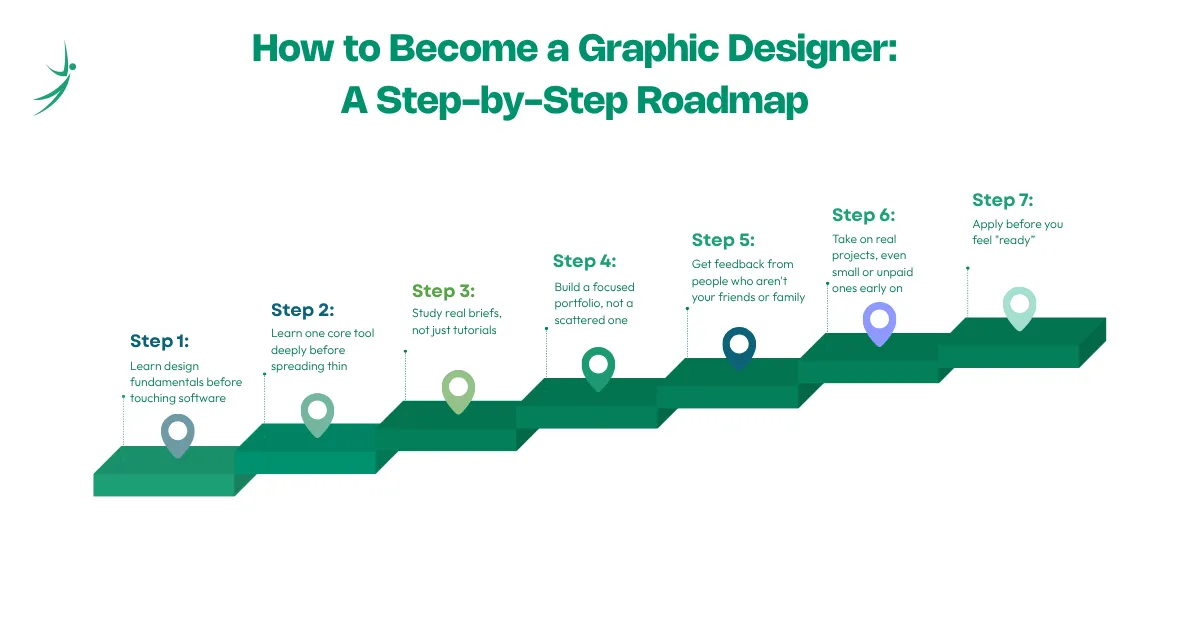
- Learn design fundamentals before touching software. Color theory, typography, composition, and visual hierarchy are the actual skill software is just the tool that expresses it. Skipping this stage is the single biggest reason self-taught beginners plateau early.
- Learn one core tool deeply before spreading thin. Most beginners try to learn Photoshop, Illustrator, InDesign, and Figma simultaneously and end up mediocre at all four. Pick one usually Illustrator for branding-focused work and get genuinely comfortable before adding the next.
- Study real briefs, not just tutorials. Recreate an existing brand's rebrand, respond to a fictional client brief, or redesign a local business's poor Facebook graphics. This builds problem-solving skill that copying a YouTube tutorial never does.
- Build a focused portfolio, not a scattered one. Five to eight strong, varied pieces (a logo project, a poster series, a social media campaign, one packaging concept) beat twenty half-finished experiments. Employers and clients decide fast usually within seconds of opening a portfolio.
- Get feedback from people who aren't your friends or family. Design communities, mentors, or a structured graphic design course expose you to the kind of blunt, useful critique that actually improves your work.
- Take on real projects, even small or unpaid ones early on. A logo for a friend's small business or a poster for a local event is worth more to your portfolio than another practice exercise, because it comes with real constraints and real feedback.
- Apply before you feel "ready." Nobody feels fully ready. Junior roles and internships exist specifically to develop skills further waiting for total confidence just delays the timeline unnecessarily.
Skills You Need for a Graphic Design Career
Core Design Skills
- Typography choosing and pairing fonts that communicate the right tone
- Color theory understanding how color choices affect perception and brand feeling
- Layout and composition visual hierarchy, balance, and grid systems
- Branding fundamentals building consistent visual identity systems, not just one-off graphics
Industry-Standard Tools
- Adobe Photoshop image editing and manipulation
- Adobe Illustrator vector graphics, logos, and illustration
- Adobe InDesign multi-page layouts: brochures, magazines, reports
- Figma increasingly essential, especially for designers crossing into UI/UX work; Figma now appears in the majority of design job listings globally, a sharp rise from just a few years ago
- Canva widely used for fast social media and marketing content, especially at agencies and small businesses working on tight timelines
Increasingly Expected Skills
- Basic AI tool fluency tools like Adobe Firefly and Midjourney are now used for rapid ideation and mockup generation, not as full replacements for skilled design work
- Motion and video basics even a working knowledge of After Effects or CapCut-level animation increasingly separates candidates in a crowded junior market
- Client communication explaining design decisions clearly and handling feedback professionally is a skill employers rate as highly as technical ability
Challenges in a Graphic Design Career and How to Handle Them
- Constant subjective feedback and rejection. Design work gets criticized more openly than most professions, often by people without design training. Fix: separate feedback on the work from feedback on you personally, and build a habit of asking "what problem is this solving for the client" before reacting emotionally to critique.
- A crowded junior market. Because entry barriers are low, junior graphic design roles get flooded with applicants. Fix: specialize early a portfolio focused on branding or packaging stands out far more than another generalist logo-and-poster collection.
- AI tools shifting what "valuable work" means. Purely executional tasks are increasingly automated. Fix: lean into the parts AI can't replicate original concept development, brand strategy, and taste rather than competing directly with AI on speed.
- Inconsistent freelance income. Freelancers often experience feast-or-famine cycles early on. Fix: build 2–3 retainer-style clients for stable income before chasing purely project-based freelance work.
- Burnout from constant revisions. Endless client revision cycles are one of the most common reasons designers leave the field. Fix: set clear revision limits in your process (e.g., two rounds included, additional rounds billed separately) from the very first client conversation.
Real Career Paths: How Designers Actually Build Careers
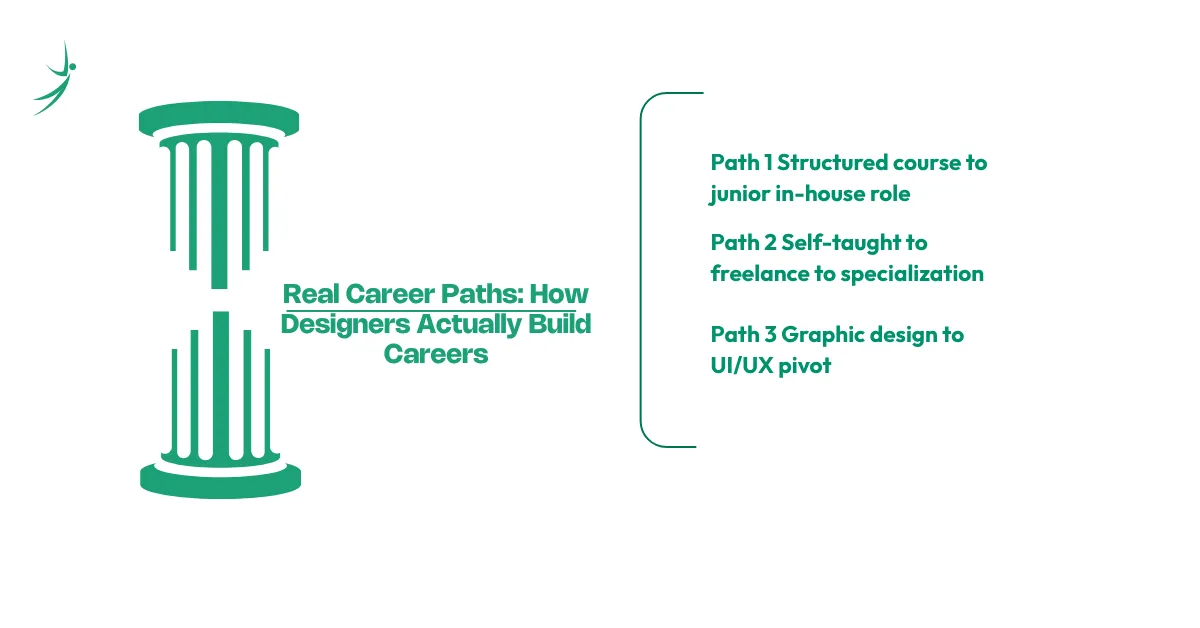
- Path 1 Structured course to junior in-house role. A student with no prior design background completes a project-based graphic design course, builds a portfolio around 6–8 real client-style projects, and lands a junior designer role at a local agency or marketing team within a few months of finishing.
- Path 2 Self-taught to freelance to specialization. A self-taught designer starts with small freelance logo and social media work on platforms like Fiverr, builds a reputation and repeat clients over a year or two, and gradually specializes in one high-value niche packaging or branding where rates are meaningfully higher than generalist work.
- Path 3 Graphic design to UI/UX pivot. A designer with a strong foundation in typography, layout, and visual hierarchy moves into UI/UX design, since the two fields share core visual principles even though UI/UX adds user research and interaction design on top. This is consistently one of the more lucrative careers with a graphic design degree or background, given how much UI/UX salaries tend to exceed pure graphic design roles.
Future Trends in Graphic Design (2026 and Beyond)
- AI is a collaborator, not a replacement. The data consistently shows AI tools speeding up ideation and repetitive execution while human designers remain essential for original concepts, brand storytelling, and final creative judgment.
- Motion and video content keep growing. Short-form video across Instagram, TikTok, and YouTube Shorts is pulling static graphic design skill toward motion graphics, making animation literacy increasingly valuable rather than optional.
- UI/UX crossover skills pay a premium. As more companies blend product and marketing design teams, designers who can move between static branding work and digital product interfaces are consistently the highest earners in the field.
- Remote and international freelance work keeps expanding. With design output being fully digital, geography matters less every year a genuinely strong opportunity for Nepali designers building international client bases without relocating.
- Sustainability and accessibility are becoming real design considerations, not niche concerns inclusive design (color contrast, readable typography, accessible layouts) is increasingly a client and legal expectation, especially for international brands.
How to Choose the Right Graphic Design Course
Not every graphic design course delivers the same outcome. When evaluating options, check for:
- A project-based curriculum, not just software tutorials you should be working on realistic client-style briefs, not just following along with instructional videos.
- Coverage of the full toolkit: Photoshop, Illustrator, InDesign, and increasingly Figma, rather than just one program in isolation.
- A portfolio outcome you should graduate with several strong, varied pieces you can actually show a client or employer, not just a certificate.
- Mentors with real industry experience, ideally people who've worked on actual client or brand projects, not only taught from a fixed curriculum.
- Internship or placement support, since converting design skill into paid work is usually the hardest step for beginners, not the learning itself.
If you're comparing options in Kathmandu, Skill Shikshya's Graphic Design training program is built around exactly this design fundamentals, Adobe Photoshop, Illustrator, and InDesign, plus AI-assisted design tools, with real client-style projects instead of a software-only lecture series. If you're still deciding between design paths entirely, this comparison of graphic design and UI/UX as career options is worth reading before you commit to either.
For anyone earlier in the decision figuring out whether design fits alongside other beginner-friendly options after school this broader roundup of IT courses worth considering after SEE covers where graphic design fits next to Python, UI/UX, and digital marketing.
Graphic Designer Salary in Nepal (2026)
Salary bands vary by specialization, company type, and portfolio strength. These figures reflect a composite of current Nepal job market data from multiple sources a planning range, not a guarantee.
| Experience Level | Typical Monthly Salary (NPR) | Notes |
| Entry-level / Junior (0–2 yrs) | 15,000 – 30,000 | Portfolio strength matters more than credentials here |
| Mid-level (2–5 yrs) | 30,000 – 50,000 | Specialization (branding, UI/UX crossover) pushes toward the top |
| Senior (5+ yrs) | 50,000 – 100,000+ | Art direction, team leadership, or strong agency reputation |
| Freelance / international clients | 100,000 – 300,000+ | Highly variable, based on niche and client base |
A few things consistently move designers toward the top of each band:
- A specialization branding, packaging, or UI/UX crossover pays noticeably more than generalist "does everything" design work.
- AI tool fluency increasingly separates candidates, since employers now expect designers to work faster using AI-assisted ideation without sacrificing quality.
- International or remote clients pay in their own market's rate, which is why freelance income potential in Nepal significantly exceeds most local full-time salaries once a designer has 2+ years of experience and a reliable client base.
Graphic Designer Salary Worldwide (2026)
Nepal's numbers are only part of the picture, especially for designers considering remote work or eventual relocation. Here's how graphic designer pay compares internationally.
| Country | Average Annual Salary | Typical Range | Source |
| United States | $61,300 (median) | $50,000 – $90,000+ | U.S. Bureau of Labor Statistics |
| United Kingdom | £30,453 | £25,000 – £50,000 | Indeed UK, 2026 |
| India | ₹3,90,000 (~$4,700) | ₹1,10,000 – ₹7,00,000 | Composite of current Indian salary-comparison data |
| Canada | ~CAD 65,000 | CAD 50,000 – CAD 80,000 | Composite of current Canadian salary-comparison data |
| Australia | ~A$77,500 | A$55,000 – A$100,000+ | AND Academy global design salary research, 2026 |
| Nepal (for comparison) | ~$1,800 – $9,000 | NPR 15,000 – 100,000+/month, per the table above | Composite of current Nepal job market data |
A few honest caveats:
- The India, Canada, and Australia figures are drawn from broader salary-comparison research, not a single government labor bureau, so treat them as directional benchmarks rather than exact figures the way the U.S. BLS data can be treated.
- The gap between Nepal and higher-paying markets is exactly why remote and freelance work matters so much in this roadmap. A Nepali designer picking up even a handful of international clients through platforms like Upwork or Fiverr can meaningfully close that gap without leaving Kathmandu.
- UI/UX crossover consistently pays more than pure graphic design across nearly every country in this table, which is part of why so many graphic designers eventually specialize in that direction as their career matures.
Measuring Your Progress: Career Milestones
Rather than vaguely "getting better," track concrete markers so you can tell if you're actually progressing:
- Month 1–2: You understand core design principles (typography, color theory, composition) well enough to critique your own work, not just follow tutorials.
- Month 3–4: You've completed several full projects from brief to final file, not just isolated design exercises.
- Month 4–6: You have a focused portfolio of 5–8 strong pieces, and you can explain the reasoning behind your design decisions clearly to someone who isn't a designer.
- Post-training: You've either landed a junior role, an internship, or your first few paid freelance clients proof the portfolio is actually converting into opportunity.
- First year on the job: You're beginning to specialize in a specific direction branding, packaging, motion, or UI/UX rather than staying a pure generalist indefinitely.
These aren't formal certification benchmarks they're a practical way to notice if you're stalling before it becomes a longer pattern.
Conclusion and Action Steps
A graphic design career in 2026 is still a genuinely viable, in-demand path the data backs that up clearly but it rewards people who specialize and keep building, not people who stop learning after their first course. Whether you're drawn toward branding, motion graphics, UI/UX crossover work, or straightforward freelance client work, the underlying sequence is the same: learn the fundamentals properly, master one tool deeply before spreading thin, build a portfolio around real problems instead of practice exercises, and get feedback from people who'll actually be honest with you.
If you're starting today: learn design fundamentals before software, pick one core tool and get genuinely good at it, build a portfolio around 5–8 strong projects instead of twenty half-finished ones, and apply or take on real client work before you feel completely ready. The demand locally in Nepal and internationally is real for designers who treat this as a craft worth building, not a shortcut.
Frequently Asked Questions
Is graphic design a good career in 2026?
What does a graphic designer do?
What jobs can you get from graphic design?
Where do graphic designers work?
How do I become a graphic designer with no prior experience?
Do I need a degree for a career in graphic design?
What's the difference between graphic design and UI/UX design as a career?
About Author:

Mr. Nijal Tamrakar, Graphic Design mentor at SkillShikshya, specializes in creating impactful visual identities and modern branding solutions. With expertise in typography, social media creatives, and visual storytelling, he guides learners through practical design techniques and real-world creative strategies to build industry-ready skills.