GEO (Generative Engine Optimization) Explained: How AI Search Is Changing Digital Marketing in Nepal (2026)
What Is GEO in Digital Marketing?
Search used to mean typing a phrase into Google and scanning ten blue links. In 2026, a growing share of that behavior happens inside ChatGPT, Gemini, Perplexity, and Google's own AI Overviews, tools that read the web and hand back a written answer instead of a list of pages to click through. This is exactly why GEO in digital marketing has moved from a niche term into a core skill for Nepali marketers, IT training institutes, and small businesses that depend on being found online.
GEO stands for Generative Engine Optimization, not to be confused with geo-targeting or location marketing. It is the practice of shaping your content and online presence so AI systems can find it, trust it, and use it when they write an answer for someone else. Where SEO earns you a spot on a results page, GEO earns you a mention inside the answer itself, sometimes with a link back to your site and sometimes without one.
You will also see two close cousins of the term: AEO (Answer Engine Optimization) and LLMO (Large Language Model Optimization). As of mid-2026, there is no single agreed-upon line between them, and most practitioners use the terms loosely. A rough, working distinction that most of the guides reviewed for this article use looks like this:
| SEO | AEO | GEO | |
|---|---|---|---|
| Goal | Rank in the list of results | Get picked for a short, direct answer | Get cited or summarized inside an AI-written answer |
| Where it shows up | Google/Bing organic listings | Featured snippets, People Also Ask, voice answers | ChatGPT, Gemini, Perplexity, Copilot, Google AI Overviews |
| What earns a place | Keywords, backlinks, page authority | A precise answer placed near the top of the page | Clear structure, specific facts, named sources, consistent brand signals |
| How you track it | Rankings, organic clicks | Snippet ownership | Citation frequency, brand mentions inside AI answers |
Why GEO in Digital Marketing Matters for Nepal in 2026
The shift toward AI-generated answers is no longer a prediction; the usage numbers back it up.
- ChatGPT reported around 900 million weekly active users by early 2026, and its app crossed 1 billion monthly active users by June 2026, according to Sensor Tower data reported by Reuters, making it one of the fastest-growing consumer apps in history.
- A McKinsey survey from October 2025 found that roughly half of US consumers now use AI-powered search on purpose, with 44% calling it their "primary and preferred" source of information, ahead of the 31% who still favor traditional search. McKinsey projects $750 billion in US consumer spending will pass through AI-powered search by 2028.
- The same McKinsey research found that only about 16% of brands currently track how they appear in AI search, which means most businesses, in Nepal and elsewhere, have no idea whether AI tools even mention them.
- By mid-2026, independent trackers such as Similarweb and BrightEdge put the share of Google searches that trigger an AI Overview anywhere from roughly two-fifths to about half, depending on the market and the type of query. Similarweb measured 43% in July 2026, up from 15% twelve months earlier.
- Research from SparkToro puts the share of all searches that end without a single click, often called zero-click searches, at around 58%. People are getting their answer without ever reaching a website.
For Nepal specifically, this arrives at a moment when the underlying audience is already large and growing. DataReportal's Digital 2026 Nepal report counted 16.6 million internet users in the country by the end of 2025, a 56.0% penetration rate, alongside 14.8 million active social media identities. Next door, OpenAI reported that ChatGPT's weekly active users in India alone passed 100 million, a strong signal that AI chat apps are becoming a default habit across South Asia, including among the students and professionals who make up much of Nepal's IT training and digital services audience.
One Gartner prediction from February 2024 is worth a fair mention here, because it circulates constantly in GEO content: Gartner said traditional search engine volume would drop 25% by 2026 due to AI chatbots and virtual agents. A mid-2026 check of that prediction shows a more mixed picture. Total Google search volume has not collapsed; Google still processes billions of searches a day and holds roughly 89 to 90% of global search market share. But specific slices of that traffic have genuinely shrunk: US organic search traffic fell around 2.5% year over year by January 2026, and traffic from Google to publishers dropped by close to a third in the year to November 2025, according to Chartbeat data. The prediction was not fully accurate as a single number, but the direction it pointed to was correct.
For a Kathmandu-based training institute, retailer, clinic, or service business, the practical takeaway is the same either way: a growing number of people researching your industry are asking an AI system before, or instead of, opening Google. GEO digital marketing in Nepal is still young enough that very few competitors are doing it well, which is itself an advantage for anyone who starts now.
Key Benefits of GEO in Digital Marketing
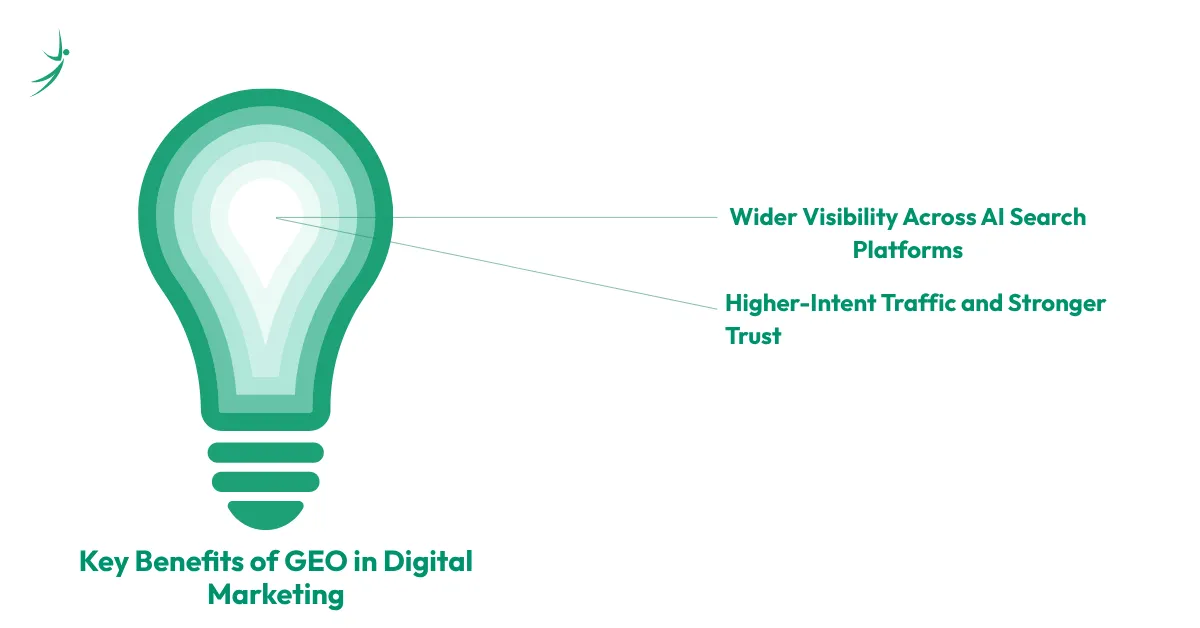
Wider Visibility Across AI Search Platforms
Ranking on Google is one placement on one platform. GEO in digital marketing works across ChatGPT, Gemini, Perplexity, Copilot, and Google AI Overviews at once, since all of them draw on similar signals: clear structure, specific facts, and a trustworthy source.
A widely cited 2023–2024 study by researchers from Princeton, Georgia Tech, IIT Delhi, and the Allen Institute for AI, presented at the ACM KDD 2024 conference, tested close to 10,000 search queries and found that adding statistics, quotations, and cited sources to a page boosted its visibility inside AI-generated answers by roughly 30 to 40%. The same research found something particularly useful for smaller or newer sites: pages that ranked lower in traditional Google results, around position five, saw a much larger relative gain from these changes than pages that already ranked first. For a Nepali institute or business competing against bigger, more established names, that is a real opening.
Higher-Intent Traffic and Stronger Trust
Being named inside an AI answer functions like a quiet third-party endorsement. The user did not find your name through your own advertisement; an independent system chose to mention you while answering someone else's question. Several 2026 industry analyses report that brands cited inside AI Overviews see noticeably more of both organic and paid clicks than brands the AI leaves out, and that visitors who arrive after reading an AI summary tend to already understand what you offer, since the AI pre-qualified their intent before they ever reached your site.
For education and training providers, this matters even more than usual. A prospective student who reads an AI-written comparison of Nepal's IT training options before ever visiting a website arrives with fewer basic questions and a shorter path to enrollment.
GEO Use Cases: How Nepali Businesses Are Applying AI Search Marketing
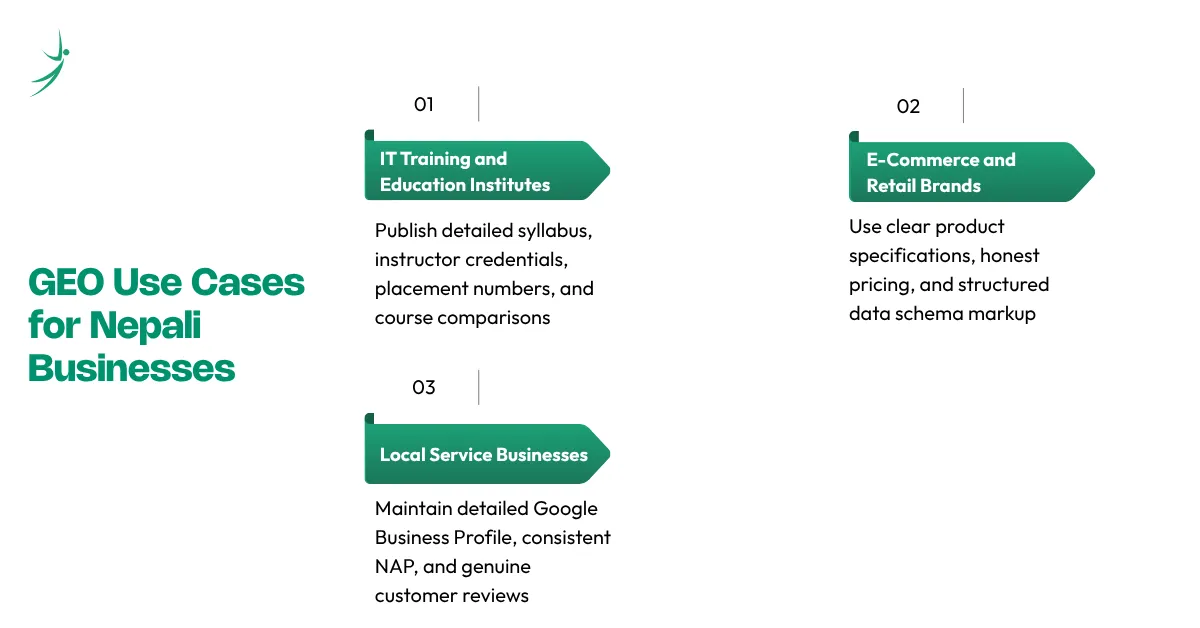
IT Training and Education Institutes
Students increasingly ask AI tools questions like "which institute teaches data analytics in Kathmandu" or "is a digital marketing course worth it in Nepal" before they ever search Google by name. Institutes that publish detailed syllabus pages, instructor credentials, verifiable placement numbers, and course comparison content give an AI system real, specific facts to quote. Vague claims such as "we are the best institute in Nepal" are exactly the kind of unsupported statement that both the Princeton research and common sense say AI systems tend to skip.
E-Commerce and Retail Brands
Nepali shoppers researching a purchase increasingly ask AI tools to compare products or recommend a store, whether through ChatGPT, Perplexity, or Google's shopping-related AI features. Product pages with clear specifications, honest pricing, and structured data (schema markup) are far easier for an AI system to summarize accurately than a page built around a slogan and a photo gallery. This applies whether a business sells through its own site or through a marketplace such as Daraz.
Local Service Businesses
Clinics, law offices, real estate agents, and restaurants are increasingly discovered through questions like "best dentist near Baneshwor" asked directly to an AI assistant rather than typed into Google. For these businesses, GEO overlaps heavily with local SEO: a claimed and detailed Google Business Profile, consistent name, address, and phone number (NAP) across directories, and genuine customer reviews all feed the same signals AI systems use to decide who to recommend.
Best Practices for GEO in Digital Marketing
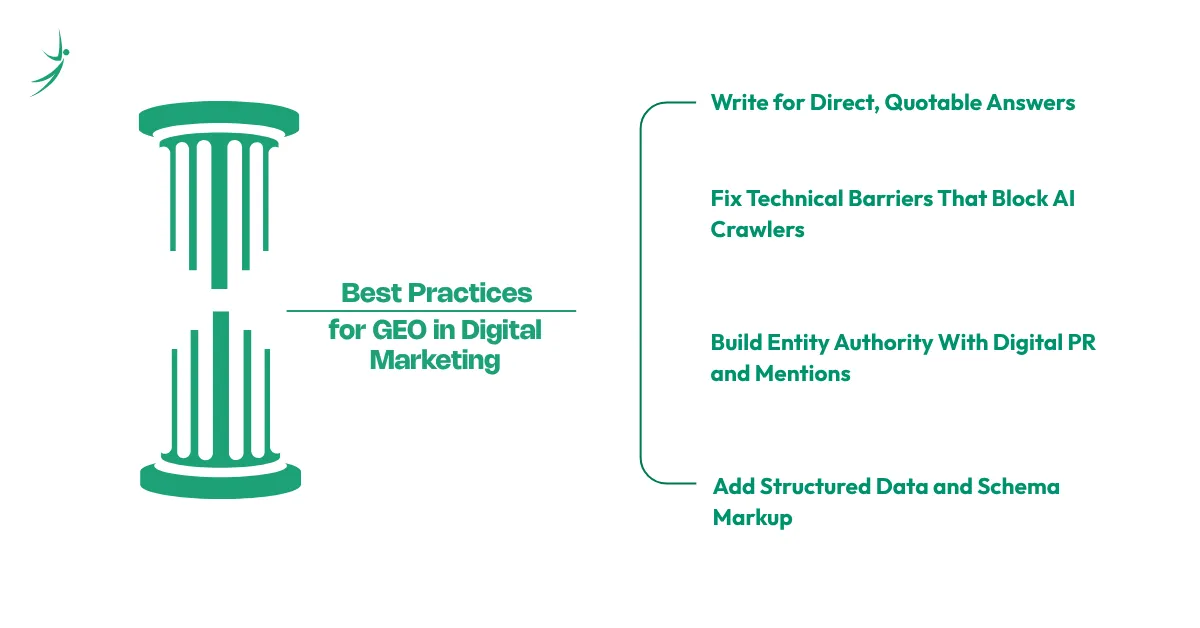
Write for Direct, Quotable Answers
Open each page, or each major section, with a short, factual answer in the first sentence or two, then explain further underneath. "GEO is the practice of shaping content so AI systems can find, trust, and cite it" is far easier for a model to lift and quote than three paragraphs of scene-setting before the actual definition arrives. Write subheadings the way a person would actually type or speak a question to an AI tool, not as vague labels. "What does an SEO course in Nepal cost?" performs better than "Pricing Details."
Fix Technical Barriers That Block AI Crawlers
This is the step most guides skip, and it is often the difference between being cited and being invisible. AI crawlers such as GPTBot, ClaudeBot, PerplexityBot, and Google-Extended do not always render JavaScript the way a browser does. If your FAQ answers, pricing tables, or key definitions only appear after a script runs on the page, several of these crawlers may see a blank or incomplete page even though a human visitor sees everything perfectly. Check what a crawler actually sees using "view page source" rather than a browser's inspect-element panel, and consider serving key answer content as plain HTML rather than loading it client-side. A well-designed FAQ section is wasted if the answers themselves are invisible to the systems you are trying to reach.
Build Entity Authority With Digital PR and Mentions
AI systems weigh a brand's presence across the wider web, not just its own site. Reviews on independent platforms, mentions in local news or industry publications, guest posts, directory listings, and, where relevant, a Wikipedia or Wikidata entry all add up. One industry report found that brands with consistent profiles on review platforms were roughly three times more likely to be cited by AI systems than brands without them. Keep your business name, description, and contact details identical across every platform; inconsistency reads as ambiguity to a system trying to confirm who you are.
Add Structured Data and Schema Markup
Schema markup (structured data added to your site's code) tells AI systems exactly what a page contains rather than leaving them to guess. At minimum, most sites benefit from Organization, FAQPage, Article, and, where relevant, Course or LocalBusiness schema from schema.org. This is one of the fastest technical wins available, since it usually takes days rather than months to put in place and directly supports the same E-E-A-T (Experience, Expertise, Authoritativeness, Trustworthiness) signals Google already rewards.
Common GEO Challenges (and How to Solve Them)
- Measurement is still immature: There is no single dashboard yet that shows AI citations the way Google Search Console shows rankings, though Search Console has started surfacing some AI Overview data and dedicated tools are catching up quickly. Solve this by combining free manual checks with one paid tool once budget allows, rather than waiting for a perfect system.
- Citations are not always accurate: Independent research published in 2025 found that a large share of the citations inside AI-generated answers do not fully support the claim being attached to them. Being mentioned is not the same as being represented correctly. The best defense is keeping claims specific, sourced, and easy to verify, so there is less room for an AI system to misread them.
- Not every tactic that gets marketed as "GEO" is proven: A 2025 review of conversational SEO tactics found that many popular tricks made little or no difference, while plain, relevant, well-sourced content kept working. Be cautious of anyone promising guaranteed AI rankings; focus spending on the fundamentals covered in this guide rather than unproven shortcuts.
- Nepal-specific resources are thin: Most published GEO research and case studies come from the US, Europe, and the Gulf. As one industry voice put it, roughly 80% of good GEO is simply good, fundamental SEO; that fundamental work, which Nepali marketers already understand well, still carries most of the weight.
GEO Success Patterns and Real-World Examples
Public, verified GEO case studies specific to Nepal are still rare simply because the discipline is new here; most documented examples so far come from larger markets. Even so, the underlying research points to clear, repeatable patterns rather than guesswork.
The Princeton-led study referenced earlier found that adding sourced statistics and direct quotations to a page produced some of the largest single gains in the entire test, and that the "cite your sources" tactic alone produced a visibility increase of well over 100% for pages that started outside the top few Google positions. In practice, this means a smaller Nepali site with accurate data and clear sourcing can out-perform a larger competitor that relies on generic, unsupported claims.
As an illustrative example of applying these tactics: a Kathmandu-based training institute that rewrites a vague "why choose us" page into a specific, sourced comparison of course length, fees, and placement outcomes, and makes sure that content loads without depending on JavaScript, is applying every major factor the research points to at once, clear structure, specific facts, and technical accessibility. Institutes that have made similar changes to their most competitive pages typically report an increase in how often they show up when someone asks an AI tool to compare training options, alongside the usual SEO gains from writing more specific, useful content.
Future Trends in GEO and AI Search Marketing
- Multimodal AI search: Google, OpenAI, and others are folding image, video, and voice input into search, which means alt text, video transcripts, and image schema will carry more weight than before.
- Agentic AI: Assistants are moving from answering questions to taking actions on a user's behalf, such as comparing options and starting a booking or purchase. Businesses that are already the trusted, cited answer are best placed to be chosen when agents start acting.
- Continued growth, not a straight line: AI Overview coverage has already risen and briefly pulled back more than once as Google recalibrates the feature, so expect further adjustment rather than a single permanent number.
- PR and SEO merging further: Earned mentions in real publications, industry directories, and review platforms are becoming as important to AI visibility as anything published on a company's own site.
- Better measurement tools: The AI-visibility tracking market raised well over $300 million in funding between mid-2025 and early 2026, and official platforms such as Google Search Console are beginning to add AI Overview reporting, which should make GEO results easier to prove over time.
How to Choose the Right GEO Strategy for Your Business
There is no single correct starting point; the right approach depends on a few honest questions.
- Is your core SEO already solid? If your site is slow, poorly structured, or thin on content, fix that first. GEO builds on SEO rather than skipping it.
- What is your budget and team size? A one-person marketing team can realistically fix schema markup, rewrite FAQ pages, and check technical crawlability without outside help. Larger organizations may want a dedicated tool or agency support for ongoing tracking.
- Which industry are you in? Categories such as education, healthcare, and B2B services see AI Overviews more often than categories like fast-moving retail, so the urgency differs by sector.
- Do you want to build the skill in-house or bring in outside support? Both are reasonable. Many of the technical and content changes described in this guide can be learned through structured training rather than requiring a specialist hire, particularly for institutes and small teams already comfortable with SEO fundamentals.
Measuring GEO ROI: The Metrics That Matter
Clicks alone no longer tell the full story, since a well-cited page can build trust and drive a later, direct visit without registering as a referral at all. Track these alongside your usual analytics:
- AI citation frequency: how often your brand or content is mentioned across ChatGPT, Gemini, Perplexity, and AI Overviews for your core topics.
- Share of voice: how often you appear compared with named competitors for the same set of questions.
- Branded search growth: an increase in people searching for your business by name is a common downstream sign that AI mentions are working, even when the AI conversation itself is not tracked.
- Lead quality: whether contacts that arrive after an AI-assisted search convert at a higher rate, which a CRM can usually show even when the original AI conversation cannot be traced.
For tools, start free: manually run your ten or twenty most important questions through ChatGPT, Perplexity, and Gemini on a regular schedule and log what comes back. When budget allows, entry-level trackers such as Otterly.AI start at around $25 to $30 a month, mid-market platforms such as Peec AI sit a step up from that, and Profound serves larger organizations that need enterprise-level reporting. Teams already paying for Semrush or Ahrefs should also check their AI Toolkit and Brand Radar add-ons before buying a separate tool.
Conclusion: Your Next Steps With GEO in Digital Marketing in Nepal
AI-generated answers are already handling a meaningful share of the questions your future students, customers, and clients are asking, and that share is still growing. GEO in digital marketing is not a separate discipline that replaces the SEO work Nepali marketers already know; it is an extension of it, built around the same values of accuracy, clarity, and trust that good SEO has always rewarded.
A realistic starting point looks like this:
- Pick your five most important pages and rewrite the opening lines to answer the core question directly.
- Check whether your FAQ content and key definitions are visible in your page's raw HTML, not only after JavaScript runs.
- Add or fix Organization, FAQPage, and Article schema across your main pages.
- Make sure your business name, description, and contact details match exactly across your site, directories, and review platforms.
- Start a simple log of what ChatGPT, Perplexity, and Gemini say when you ask your own most important questions, and repeat it monthly.
None of these require a large budget or a specialist team. They require the same close, patient attention to content quality that has always separated strong SEO work from weak SEO work, applied to a new set of platforms. For marketers and institutes building this skill for the first time, treating GEO as a standard part of SEO training, rather than a separate add-on, is the most realistic way to keep pace with how search is changing in Nepal and everywhere else.
Frequently Asked Questions
What is GEO in digital marketing?
Is GEO the same as AEO?
Does GEO replace SEO?
How long does GEO take to show results?
Can a small business or institute in Nepal do GEO without a big budget?
About Author:

Meet Mr. Prakash Bhandari, a Digital Marketer at Skill Shikshya. He brings real-world marketing experience to learners, guiding them through campaigns, strategies, and hands-on projects to build practical, career-ready skills.