Accounting Career Roadmap 2026: Paths, Salary, and How to Become an Accountant
If you're weighing an accounting career right now, the timing is unusual in a good way. The U.S. Bureau of Labor Statistics reports a median annual wage of $83,680 for accountants and auditors as of May 2025, with about 115,300 openings projected each year through 2035 and the number of new accounting graduates hasn't kept pace with that demand. At the same time, the rules for one of the field's biggest licenses, the CPA, changed in 2025 and 2026 in ways most existing guides haven't caught up with yet. This article covers what a career in accounting actually looks like today: the real paths, the real numbers, the real requirements, and the real steps to get in.
Why an Accounting Career Matters Right Now?
Every organization that handles money a five-person startup, a hospital, a city government, a multinational bank needs someone qualified to record it, report it, and answer for it when regulators ask. That single fact has kept the accounting career field remarkably stable through recessions, automation waves, and now the early years of generative AI.
What's changed is the supply side. According to AICPA Trends data, roughly 55,000 accounting degrees were awarded in the 2023–24 academic year, down about 30% from the field's peak and its lowest point in two decades. Meanwhile, BLS projects far more openings than that each year, once you account for retirements and people leaving the field for other work. Add in CPA exam pass rates that run between 42% and 63% depending on the section, and you have a profession where qualified people are, for the moment, in short supply. Encouragingly, four-year college accounting enrollment rose for a third straight year in early 2026 but those students won't be job-ready for another three to five years, which means the current opening is real and immediate for anyone starting now.
Key Benefits of a Career in Accounting
Job Security in a Field With More Openings Than Graduates
An accounting career path options list usually leads with stability, and the current numbers back that up. Beyond the raw opening count, accountants and auditors work across every industry and every size of organization, so a downturn in one sector rarely means a shortage of accounting work overall. Robert Half's 2026 Salary Guide also points to above-average pay growth for public accounting roles in tax, audit, and assurance, a sign that employers are competing harder for talent rather than the reverse.
A Clear, Well-Paid Ladder From Entry-Level to the C-Suite
Few career fields lay out their progression as clearly as accounting does. A typical accounting career path runs from Accounting Clerk or Bookkeeper, into Staff Accountant (roughly years zero to three), Senior Accountant (three to six years), Accounting Manager (six to ten years), Director of Accounting, Controller, and eventually CFO or VP of Finance for those who want it. Robert Half's 2026 data puts entry-level clerk pay around $49,000 and CFO compensation above $270,000, with a senior accountant's national midpoint at $94,750. That's a documented, well-traveled ladder not a vague promise.
Accounting Career Options: The Main Paths You Can Take
One thing that surprises people newly researching careers in accounting is how many distinct jobs in the accounting field actually exist under one label. Broadly, the career field of accounting splits into four groups.
Public Accounting
Public accountants work for firms that serve multiple outside clients rather than one employer the "Big Four" (Deloitte, EY, KPMG, and PwC) are the best-known examples, alongside thousands of regional and local firms. Public accounting covers audit, tax, and advisory work, moves fast, and generally requires a CPA license to advance past entry-level roles. It's demanding expect long hours during tax season and audit crunches but it also tends to build skills and open doors faster than almost any other accounting career path.
Private and Corporate Accounting
Also called industry or corporate accounting, this path means working inside a single company's finance department: financial reporting, internal audit, cost accounting, payroll oversight, and compliance. Hours are steadier, travel is rare, and a CPA is often optional rather than required, though it still helps for management-track roles. This is frequently the better fit for people who want depth in one industry over breadth across many clients.
Government and Nonprofit Accounting
Government accountants manage public funds at the federal, state, or local level and make sure agencies follow the regulations tied to that spending. Nonprofit accounting is similar in spirit fund accounting, grant compliance, and donor reporting instead of shareholder reporting. Both paths tend to offer more predictable schedules and strong benefits, and a CPA credential is a real advantage for anyone who wants to sign off on audited financial statements for a public body.
Specialized Paths Tax, Forensic, and Management Accounting
Beyond the four broad categories, accountants increasingly specialize:
- Tax accountants prepare returns, plan tax strategy, and represent clients before tax authorities. Many pursue the Enrolled Agent (EA) credential the only accounting-adjacent credential the IRS itself administers, and one that doesn't require a college degree at all, just passing its three-part exam.
- Forensic accountants investigate fraud and financial disputes, often pursuing the Certified Fraud Examiner (CFE) credential on top of a CPA.
- Management accountants focus on internal decision-making budgeting, forecasting, cost control and often hold the Certified Management Accountant (CMA) credential from the Institute of Management Accountants.
What Does an Accountant Do, Exactly?
Ask ten people what an accountant does and you'll get ten partial answers usually "taxes" or "bookkeeping." In reality, accountants examine financial statements for accuracy, make sure records conform to applicable law and accounting standards, and turn raw transactions into reports that owners, boards, investors, and regulators actually use to make decisions. AICPA & CIMA's own breakdown of the role covers everything from auditing and tax to advisory and technology-focused work the job has expanded well past data entry and toward interpreting what the numbers mean.
Day to day, that can include preparing and reviewing financial statements, reconciling accounts, managing payroll or tax filings, building forecasts and budgets, and increasingly in 2026 reviewing the output of automated systems rather than producing every number by hand.
How to Become an Accountant: A Step-by-Step Guide
There's no single answer to how to become an accountant, because the field genuinely branches early. But the steps below cover what's needed to become an accountant no matter which specific path you eventually choose.
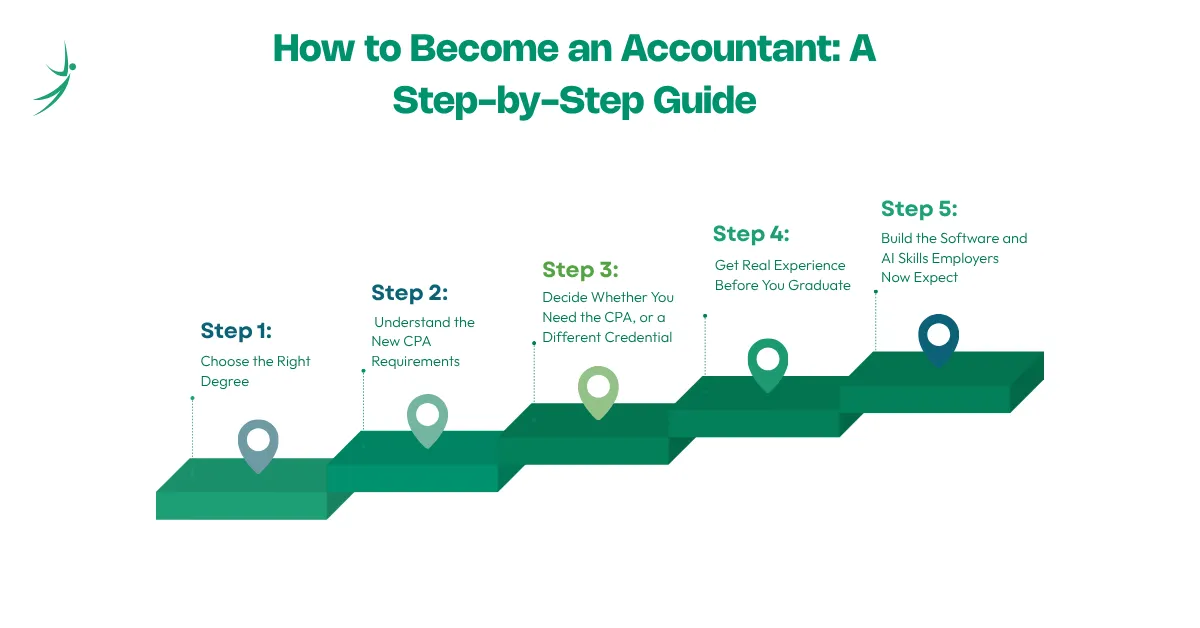
Step 1: Choose the Right Degree
For nearly every accounting career, the starting requirement is a bachelor's degree in accounting or a closely related field such as finance or business administration this is the baseline education needed to become an accountant according to BLS. If you already know you want a CPA license eventually, it's worth checking your target state's exact credit-hour rules before you finalize your course plan, since those rules are in the middle of changing (more on that below).
Step 2: Understand the New CPA Requirements (2026 Update)
This is the single most important, most recently changed fact in the entire field, and it's the reason so much older content about becoming an accountant is now out of date. For decades, CPA licensure required 150 semester hours of college credit 30 more than a standard bachelor's degree plus one year of supervised experience and passing the Uniform CPA Exam.
In May 2025, the AICPA and the National Association of State Boards of Accountancy (NASBA) approved a new model law creating an additional pathway: a standard bachelor's degree (120 semester hours) plus two years of professional experience, in place of the extra 30 credit hours. States are adopting this on their own timelines Ohio was first, effective January 1, 2026, with Virginia, Tennessee, Alabama, Arizona, and California among the states that have since codified some version of the new pathway. NASBA has also shifted CPA mobility to an individual basis, meaning a licensed CPA's ability to practice across state lines now depends on their own qualifications rather than which state issued the license.
If you're currently planning your education around the old 150-hour assumption, it's worth checking your specific state board's current rules before committing to an extra year of school you may no longer need.
Step 3: Decide Whether You Need the CPA or a Different Credential
Not every accounting career requires the CPA, and picking the right credential up front saves years. Here's how the four most common accounting certifications actually compare:
| Credential | Issued By | Typical Requirements | Best Fit For |
| CPA | State Boards of Accountancy (via AICPA/NASBA standards) | Bachelor's degree (120 or 150 credit hours, depending on state), 1–2 years of experience, four-part Uniform CPA Exam | Public accounting, audit, signing off on official financial statements |
| CMA | Institute of Management Accountants (IMA) | Bachelor's degree, 2 years of relevant experience (can be completed within 7 years of passing the exam), 2-part exam | Corporate/management accounting, budgeting, financial planning and analysis |
| CIA | Institute of Internal Auditors (IIA) | Education plus internal-audit-related experience (varies by degree level), exam, ethics agreement | Internal audit careers specifically |
| EA | Internal Revenue Service | No degree required pass a three-part Special Enrollment Examination | Tax preparation and representing clients before the IRS |
The EA is worth calling out specifically: it's the most accessible entry point into the accounting career field for someone who wants to work in tax without first completing a four-year degree.
Step 4: Get Real Experience Before You Graduate
Almost every credential above requires supervised or verified work experience, and firms overwhelmingly hire from their own internship pools. An internship at a public accounting firm, a corporate finance department, or even a smaller local firm gives you the practical reference points that a transcript alone can't.
Step 5: Build the Software and AI Skills Employers Now Expect
A 2026 Gartner survey of CFOs found that 78% are actively investing in AI and automation tools, but only 47% believe their teams are actually equipped to use them well that gap is where new accountants can stand out immediately. Beyond the standard expectations (advanced Excel, and familiarity with an ERP system such as SAP, Oracle, or NetSuite, or QuickBooks and Xero at smaller organizations), employers are increasingly looking for comfort with AI tools like Microsoft Copilot, ChatGPT, or Claude for drafting reports and reviewing large datasets, plus
Challenges in an Accounting Career, and How to Get Past Them
No honest accounting career guide skips the real friction points:
- The CPA exam itself is difficult. Pass rates on individual sections run 42–63%, and most successful candidates budget several hundred study hours per section. Structured review courses and realistic timelines matter more than raw study hours.
- Public accounting hours can be long, particularly during tax season and year-end audits. Many accountants deliberately move from public to private accounting mid-career specifically to trade some pay growth for a steadier schedule.
- AI is changing entry-level work. Systems now handle a large share of routine reconciliation, data entry, and basic documentation one industry estimate suggests as much as 77% of purely routine accounting tasks could be automated by 2026. The response isn't to avoid the field; it's to build the reviewing, judgment, and client-communication skills that sit on top of automated output, which is exactly where employers say they're short-staffed.
- The 150-hour CPA rule has historically discouraged entrants by adding a costly fifth year of school. The 2026 pathway changes described above directly address this, and it's worth revisiting your assumptions if you ruled out the CPA for cost reasons even a year or two ago.
Accounting Career Paths in Practice: Three Illustrative Examples
These composite examples reflect common, documented patterns in the field rather than specific real individuals.
- The public-to-private mover. A new graduate joins a mid-size public accounting firm as a staff auditor, earns the CPA within two years using the firm's exam-support program, and after four years of audit experience across multiple industries moves into a corporate controller-track role at a manufacturing company trading travel and tax-season hours for a fixed schedule and equity compensation.
- The tax specialist who skipped the four-year detour. Someone already working in bookkeeping decides to specialize in tax rather than pursue a full accounting degree, studies for and passes the IRS Special Enrollment Examination to become an Enrolled Agent, and builds an independent tax practice representing individual and small-business clients reaching solid income without ever sitting the CPA exam.
- The management accountant who leans into analytics. An in-house accountant at a retail company pursues the CMA rather than the CPA because the role is entirely internal-facing, pairs the credential with self-taught Power BI and basic AI-tool fluency, and becomes the team's go-to person for forecasting a route that increasingly leads to FP&A leadership and eventually CFO tracks even without public accounting experience.
Future Trends Shaping Accounting Careers Beyond 2026
- AI shifts accountants from producing numbers to reviewing them. Every recent industry survey points the same direction: automation is absorbing routine work, and the accountants who benefit are the ones who can question, validate, and explain AI-generated output rather than the ones who can produce it fastest by hand.
- CPA licensure keeps getting more flexible. Expect more states to adopt some version of the 120-hour-plus-experience pathway through 2026 and 2027, alongside the shift toward individual-based interstate mobility.
- The talent shortage keeps compensation growing, particularly for senior accountants, audit and assurance managers, and compliance roles Robert Half's 2026 data shows meaningfully higher pay at every level above entry.
- ESG and sustainability reporting are a growing, if still smaller, specialty, as more firms build out advisory services around environmental and governance disclosure requirements.
How to Choose the Right Accounting Career Path for You
There's no universally "best" path only the one that fits your priorities. A short framework:
- Want the fastest skill growth and don't mind demanding hours for a few years? Public accounting, working toward the CPA, is the well-worn route into management and eventually a Big Four partnership or a corporate finance leadership seat.
- Want work-life balance and a single-industry focus? Corporate or private accounting, with the CPA as optional rather than required, fits better.
- Want to work in tax specifically, without a four-year detour? The Enrolled Agent path is the fastest legitimate credential in the entire accounting career field.
- Want to stay entirely internal-facing and analytical? The CMA, paired with strong Excel and data-visualization skills, tracks directly toward FP&A and CFO roles.
- Drawn to investigation and litigation-adjacent work? Forensic accounting, built on top of a CPA plus the CFE credential, is a distinct and growing specialty.
Measuring Success: Salary Benchmarks and Career Milestones by Level
| Career Stage | Typical Experience | Approx. Salary (2026 data) |
| Accounting Clerk / Bookkeeper | Entry | ~$49,000 |
| Staff Accountant | 0–3 years | Entry to low $60,000s |
| Senior Accountant | 3–6 years | National midpoint ~$94,750 |
| Accounting Manager | 6–10 years | Mid-to-high $100,000s |
| Audit & Assurance Manager | Varies (public accounting track) | ~$113,500 |
| Controller | 12–18 years | High $100,000s to low $200,000s |
| Compliance Director | Senior specialist track | ~$164,750 |
| CFO / VP Finance | 15+ years | $270,000+ |
(Salary figures drawn from BLS OEWS May 2025 data and Robert Half's 2026 Salary Guide; actual figures vary by region, industry, and company size.)
Beyond raw salary, useful milestones to track include: time to first promotion (typically 2–4 years at each step below manager level), whether a target credential is completed within its required timeframe (CMA experience must be finished within seven years of passing the exam, for example), and whether your skill set includes at least one AI or data-analytics tool beyond spreadsheets, since that increasingly separates candidates at the manager level and above.
Conclusion and Next Steps
An accounting career in 2026 offers something increasingly rare: real, BLS-documented demand, a well-mapped path from entry-level to the C-suite, and licensure rules that are actually getting easier to meet rather than harder, thanks to the 2025–2026 CPA pathway changes. The field is genuinely changing under the pressure of AI and automation, but the response that consistently pays off is building judgment and technical skill on top of the tools, not competing against them.
If you're ready to start, the next concrete steps are: confirm your target state's current CPA credit-hour requirement (don't assume it's still 150), decide early which of the CPA, CMA, CIA, or EA credentials actually matches the specific accounting career path you want, and look for an internship or entry-level role that gives you supervised experience while you study.
Frequently Asked Questions
What is an accounting career, and is accounting a good career?
What are accounting jobs, exactly, and what does an accountant do day to day?
How do you become an accountant?
What education is needed to become an accountant?
What degree is required to be an accountant, and can I become an accountant without one?
How to get into accounting if you're switching careers?
What is the difference between a CPA, CMA, CIA, and EA?
About Author: