Academic Writing Tips for IT Students: A Complete Guide to Assignments, Reports & Research Papers
The digital landscape is constantly evolving, and so are the expectations from the IT students. While they also need to submit their work in the form of reports, assignments and research papers, their writing varies from other learners because of the complexity of this specific niche.
The core issue with IT students is that they need to deal with a significantly higher workload during their academic journey. On one side they are busy juggling with coding projects, system designs and technical problem-solving, they also need to do work on academic writing tasks on the other side.
Academic writing is important because it allows them to excel in academia and achieve professional credibility later. Hence, they need to ensure clarity and logical structure in their writing whether they are drafting an assignment, compiling a project report or publishing a research paper.
This guide explores all the practical strategies IT students should follow to master academic writing and tailor it to the unique requirements of the technological landscape.
Discover more by reading this guide thoroughly.
Effective Tips to Draft IT-Specific Academic Write-ups
IT students can ensure meaningful academic writing by strategically blending clear logic with technical precision. They must master the fundamental structure, back claims with credible sources and cite code or specifications properly. Applying the same rigorous logic, which is used in programming, to documentation and research papers is the key.
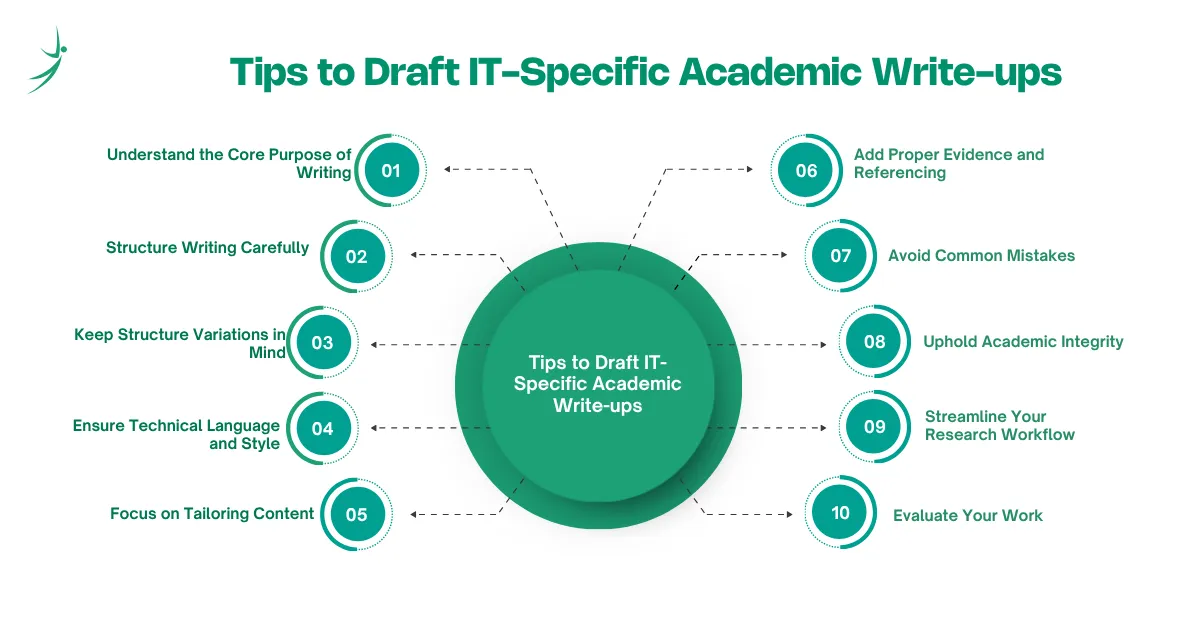
Given below are some tips to make it possible:
1. Understand the Core Purpose of Writing
The process of drafting meaningful IT-specific writing in an academic context starts with the realization of the core purpose behind it. You can’t just meet the word count requirements and call it a day. Focus on communicating technical ideas effectively and write according to the nature of the task.
- Assignments evaluate your skill of solving practical problems by using theoretical concepts, such as sharing SQL-based examples that are usable for database normalization.
- Project Reports reflect process, methodology and results. For instance, documentation of detailed development of a smartphone app along with architecture diagrams.
- Research Papers lead to new revelations, like a proposal related to an AI-driven system meant to detect possible invasions.
Each task comes with its own requirements. You have to address them while ensuring clarity, precision and evidence-based arguments, as these elements are the cornerstones of impactful IT-specific academic writing.
2. Structure Writing Carefully
Your writing should offer clear context, explain solutions to problems meaningfully, integrate code snippets or relate to case studies. It is only possible when you ensure a clear structure that is easily understandable to professors and capable of demonstrating your technical knowledge and communication skills alike. So, ensure the structure of your writing includes:
- Introduction that defines a particular problem, introduces a strong thesis or adds a research question that clearly defines the scope of your writing. For instance, “How are sorting algorithms related to large datasets?”
- Body capable of presenting solutions step by step, focusing on one idea or system component per paragraph. You can also leverage subheadings named like “Evaluation of Algorithm”, “Implementation” and “Outcomes”.
- Code with proper explanations, giving a clear idea about the purpose and relevance of each function.
- Proof or evidence with clearly crafted code snippets, tables or graphs. For instance, you can compare the efficiency or specifications of two distinct tools usable for the same purpose.
- Conclusion should summarize all the findings, reflect on limitations and suggest possible modifications in your own wording (if applicable).
Keep in mind that the core purpose behind IT writing is to help the target audience understand your problem-solving, shared ideas or outcomes of a process. It should be segmented into obvious sections that demonstrate organization.
3. Keep Structure Variations in Mind
You should understand that the prerequisites of every type of writing, be it an assignment, project report or research paper, differ significantly. The structure explained in the previous section is specific to assignments. Project reports and research papers vary in terms of structure.
A research paper is segmented into:
- Specific Title, such as “Role of IoT Devices in Smart Workplaces”.
- Abstract, summarizing objectives, methods and findings in 250 words at most.
- Introduction, defining the research gap, like “While IoT devices have been around for a significant time, their use in workplaces is still underexplored”.
- Methodology, focusing on detailed algorithms, datasets or simulations.
- Results, featuring charts, confusion matrices or performance benchmarks.
- Discussion, reflecting on interpretation of results while emphasizing the ability of your findings to outperform existing ones.
- Conclusion, shedding light on contributions and recommending the path for future research.
Since research papers require thoroughness, you should not simply consider them extended reports. Focus on reflecting originality and contributing something productive to the IT landscape. Similarly, project reports require an entirely different structure.
Here is a breakdown of their key sections:
- Abstract offers a concise overview of the project.
- Introduction reflects objectives, like “Developing a holistic online search solution capable of driving and displaying results from multiple repositories”.
- Literature Review summarizes existing solutions and justifies your strategy.
- Methodology explains tools, frameworks and process, such as Agile methodology and a cloud-based system employed for version control.
- System Design leverages diagrams or topologies to provide a visual explanation regarding the system architecture because wise use of visuals communicates more than hundreds of words.
- Testing and Results section presents test cases, screenshots or performance metrics to demonstrate system efficiency.
- Conclusion and Future Work segment focuses on suggesting improvements, like scalability for enterprise use.
IT courses often require students to formulate project reports. Such submissions, which demand a balance of technical detail and readability, are quite specific for software engineering and networking projects.
4. Ensure Technical Language and Style
IT-specific academic writing should demonstrate a perfect blend of readability and accuracy. So, ensure that you:
- Avoid jargon overload. For instance, add “various types of distributed systems” instead of “diverse distributed computing paradigms”.
- Stay consistent while using terminology, such as switching between AI and machine learning, until or unless you have properly explained distinctions.
- Ensure precision by stating exact figures like “the system processed 10,000 requests per second”
- Prefer active voice throughout the writing. For example, “We used heterogeneous methods to drive outcomes” is clearer than “Heterogeneous methods were employed for driving outcomes”.
- Clearly define specialized terms by explaining niche acronyms or custom frameworks when you use them for the first time, such as API (Application Programming Interface).
- Sidestep slang and contractions by writing “do not” instead of “don’t” and replacing “messy” with “poorly organized”.
5. Focus on Tailoring Content for Writing Based on its Topic
Ensure that you have tailored content according to the topic you have addressed in any type of academic writing. For instance:
- Networking assignments feature packet flow diagrams and screenshots of the packet analyzer instead of generic explanations.
- Database reports present SQL queries with execution plans.
- AI research papers come with dataset details, preprocessing steps and metrics for model analysis.
- Cybersecurity projects document penetration testing results with screenshots and logs.
6. Add Proper Evidence and Referencing
Like any other piece of academic writing, you also need to reference credible sources and properly cite them to prevent others from raising questions regarding the credibility of your work. You can do it by:
- Citing authoritative sources, such as backing up claims with official documentation.
- Ensure attributions are cited in recommended referencing style, such as APA or IEEE.
- Reference source codes borrowed from third-party libraries, APIs or software versions correctly.
Doing so will reflect your honesty and attention to detail.
7. Avoid Common Mistakes
Students sometimes become so indulged in the technical work that they fail to focus on the readability of their content. Resultantly, their writing fails to communicate information properly.
A few common mistakes you should avoid are:
- Copying and pasting code without explanation because educators require analysis instead of mere execution. So, elaborate on the purpose and functionality of each piece of code.
- Writing weak introductions that fail to offer proper context and jump straight into technical details, because they confuse readers. So, offer proper context before getting into technical details.
- Citing sources poorly, such as adding answers from 3rd party platforms without proper attribution, can undermine your credibility. So, acknowledge every source.
- Using an overly casual tone, such as writing: “buggy code” instead of “error-prone code”
- Submitting content without checking for grammar, spelling and punctuation mistakes. Always employ a credible grammar checker to find such mistakes and get AI-driven rectification suggestions.
8. Uphold Academic Integrity
When workload pressure stacks up, IT students, like academics from any other field, also feel the temptation of copying code, repurposing project templates or adding existing information to their work. However, you must honor academic integrity and focus on ensuring originality in your work.
Here is a breakdown to make it possible:
- Avoid copy-and-paste practice. Follow proper quotation rules by citing verbatim quotes picked from elsewhere and enclosing them in quotation marks.
- Prevent plagiarism from sneaking into your work by copying diagrams or visuals from elsewhere or reusing imagery without credit. Redraw system architecture on your own.
- Stay away from scraping textbook definitions. Rephrase them with proper examples while keeping the original meaning intact. Use an AI-powered paraphrase tool to do it accurately if you struggle with it.
- While technical sections are exclusive to you, chances of overlaps in theoretical explanations still exist. Use a free plagiarism checker to run automated scans and accurately pinpoint such instances, so that you can eradicate them beforehand.
9. Use Advanced Technology to Streamline Your Research Workflow
Gone are the days when you had to do everything ranging from managing references to documenting code on your own. Now advanced AI-driven resources are available to help you for this purpose.
So, use them to:
- Manage references
- Draw system architecture designs
- Format research papers with equations, algorithms and references
- Combine code and explanation for proper documentation
10. Evaluate Your Work Against Final Checklist Before Submission
You can’t rule out the likelihood of mistakes because of rushed work, lack of attention, a close deadline or work overload. Hence, you should map your work against a final checklist before submitting it or publishing it so that you can present it confidently.
Here is the final checklist:
- Is the structure clear (intro, body, conclusion)?
- Are technical terms explained?
- Are diagrams and code annotated?
- Are references properly cited?
- Is the writing concise and free of filler?
- Have you proofread for grammar and formatting?
- Have you checked your work for possible plagiarism and rectified identified flaws?
Conclusion
IT students should consider academic writing more than just a formality. It is a professional skill that guarantees success in the long term. Meaningful writing allows you to demonstrate your technical expertise and communication skills. Follow structured approaches, use precise language and uphold academic integrity to transform complex technical information into clear, impactful and easily understandable writing. We wish you luck with your upcoming academic writing tasks!
For IT students looking to complement their academic learning with practical technical skills, exploring IT courses at Skill Shikshya can be a useful next step.
About Author:

Meet Mr. Bibek Subedi, CTO at Vrit Technologies and Project Management mentor at SkillShikshya. He shares his leadership experience and guides learners through real projects, practical strategies, and career-ready skills.